-
-
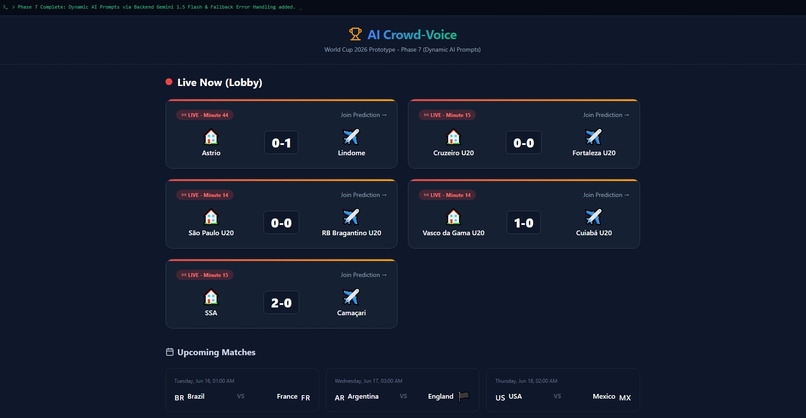
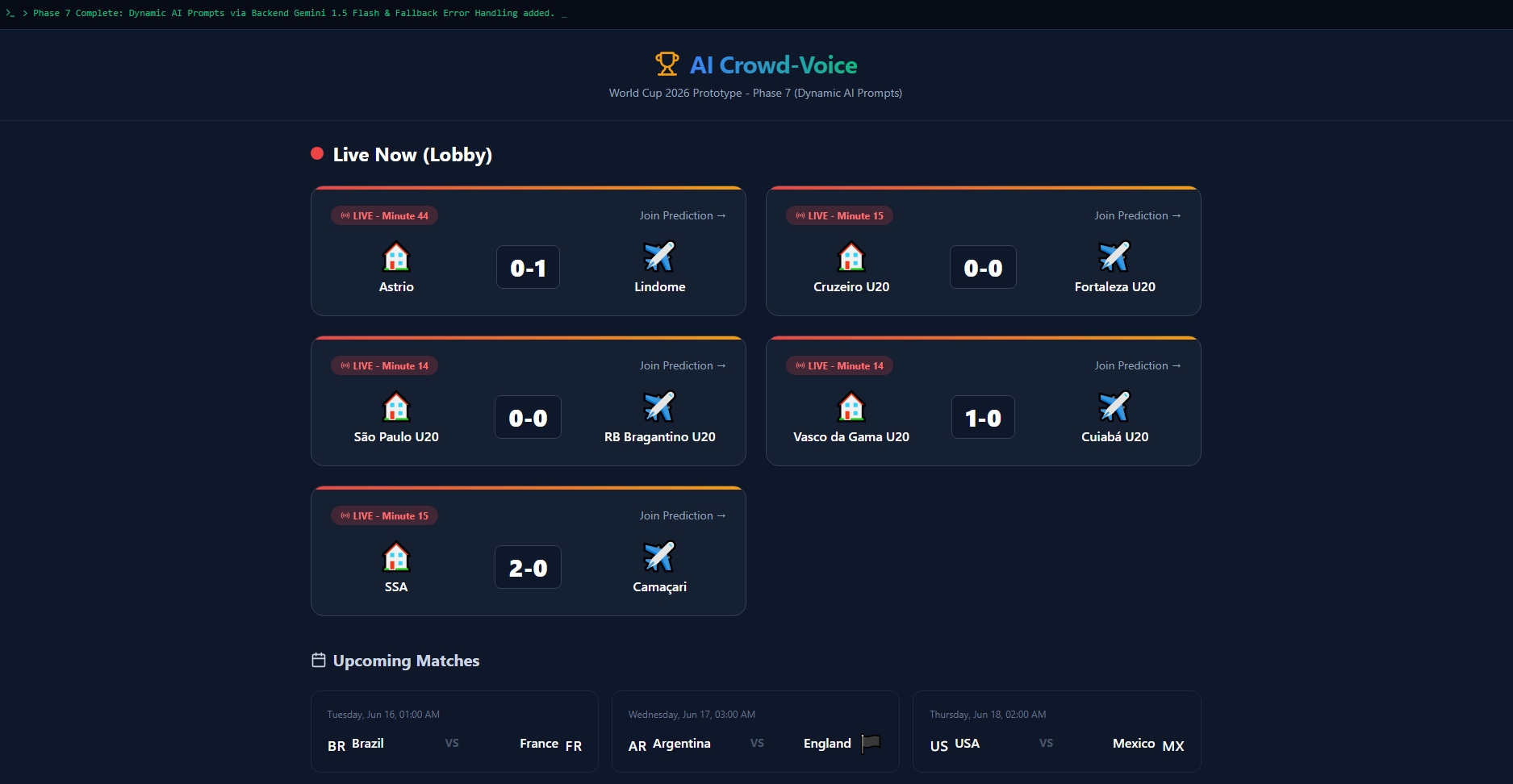
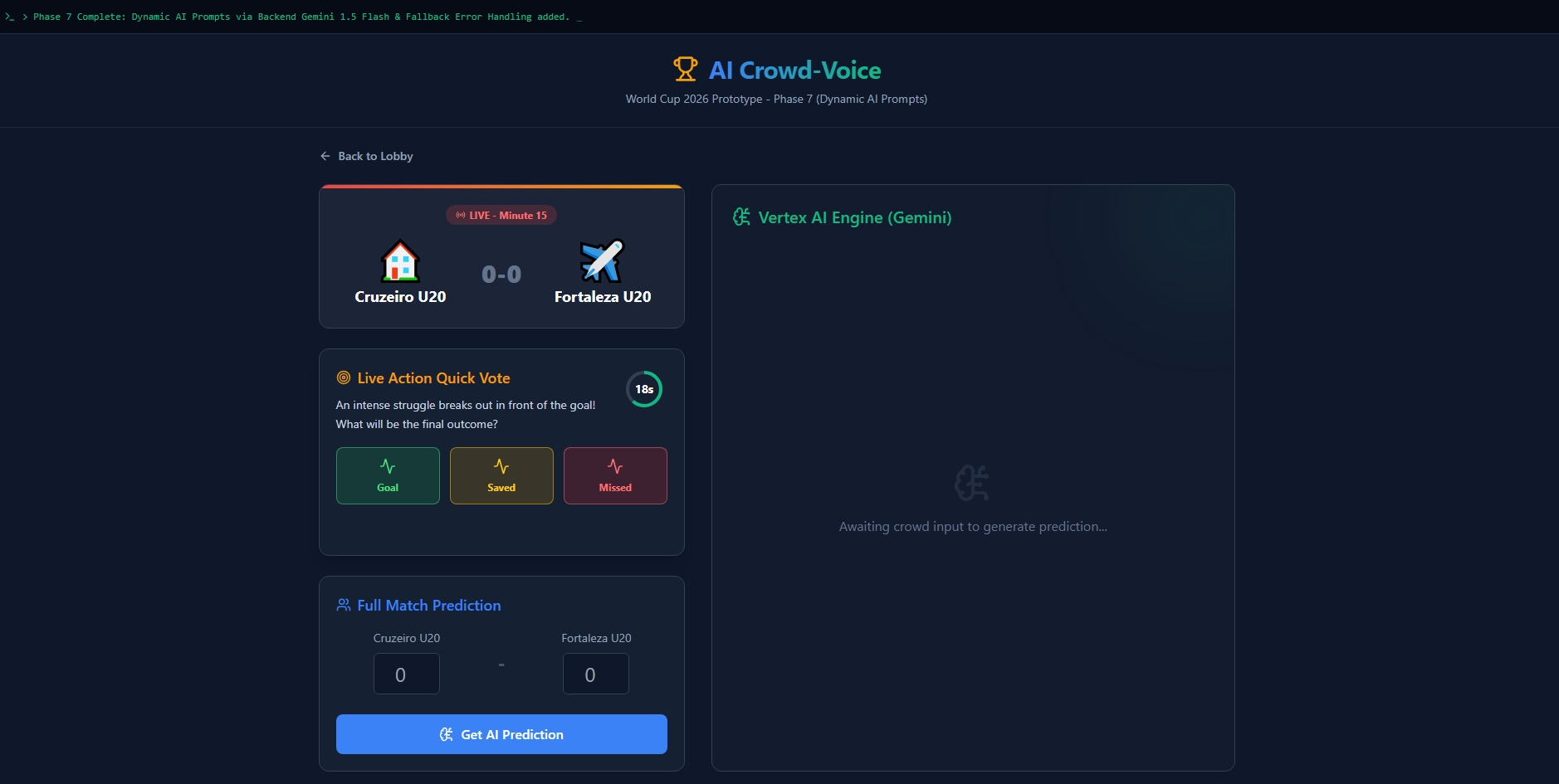
Landing Page
-
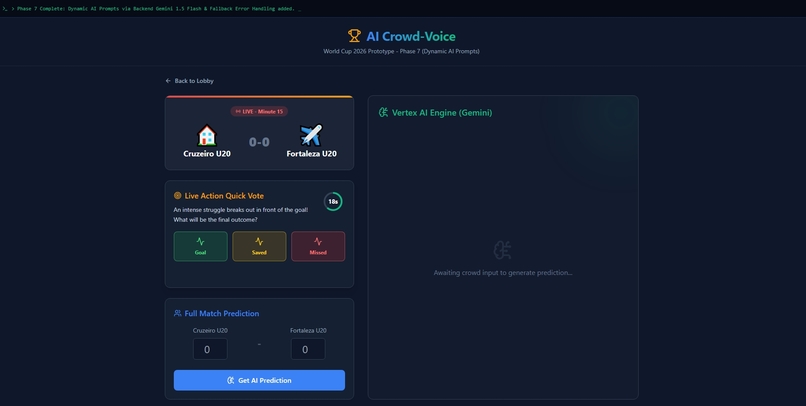
Prediction Page
-
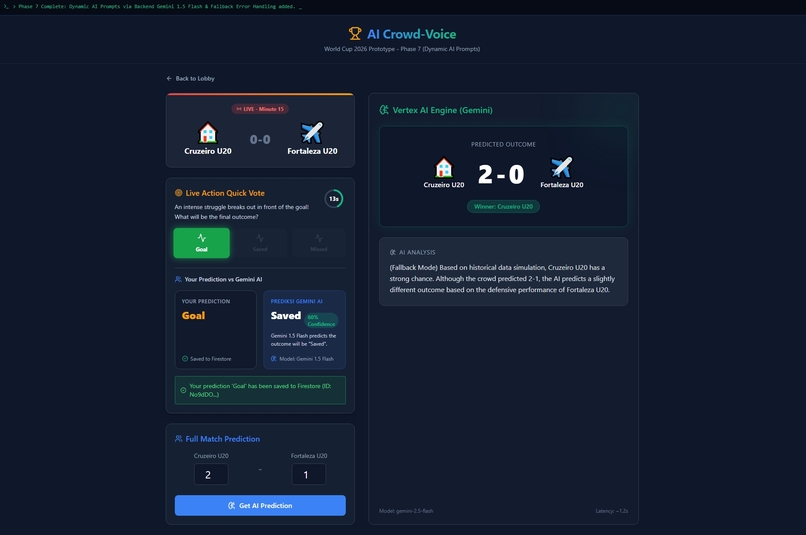
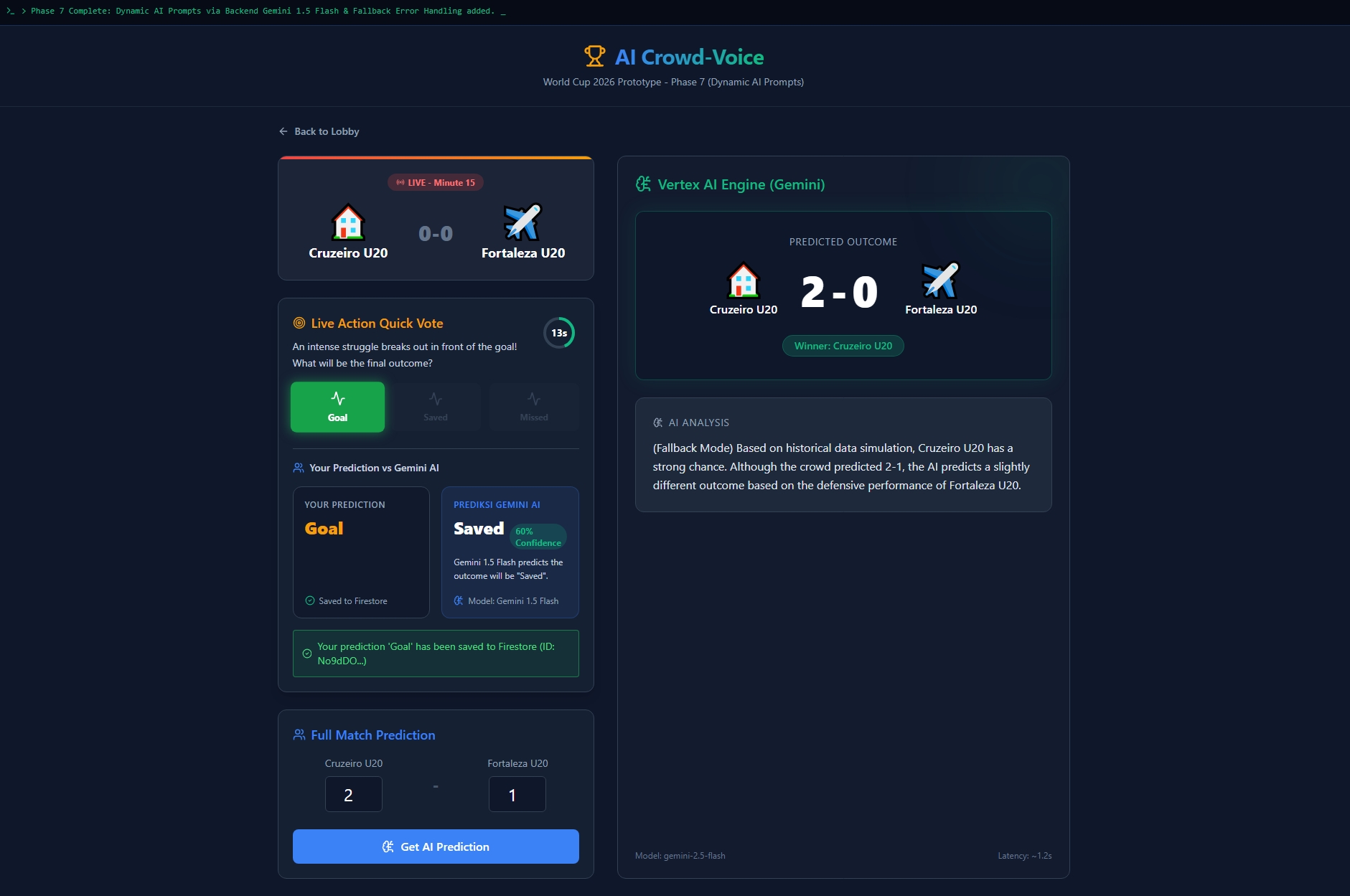
Prediction Result
Inspiration
The 2026 World Cup will be the largest ever, spanning three countries and reaching billions of screens. However, the fan experience is still largely passive: you sit, you watch, you tweet. We wanted to bridge the gap between the stadium and the living room by turning passive viewers into active, real-time participants.
We also looked at the technical side of massive global events: third-party sports APIs frequently crash or lag under the weight of millions of requests. We were inspired to build a highly interactive app that not only engages fans but is also completely resilient and self-healing, proving that enterprise-grade observability can save the user experience during a global sports phenomenon.
What it does
AI Crowd Voice is a real-time, second-screen interactive arena for football fans.
When a critical moment happens during a live match (e.g., a dangerous free kick in the 80th minute), the app triggers a 30-second live voting window. Fans worldwide vote on the outcome (Goal, Saved, or Missed).
Simultaneously, the app feeds live match telemetry (weather, player stats, match context) into Gemini AI, which acts as an expert analyst to generate its own calculated prediction. After the timer ends, the app pits "Crowd Intuition" against "AI Logic" on a real-time leaderboard. Behind the scenes, the app tracks every single interaction not just as a database entry, but as a live Business Event to monitor the "pulse" of the crowd.
How we built it
We built AI Crowd Voice with a focus on serverless scalability and enterprise observability:
- Backend & Cloud: We used Python (FastAPI) deployed on Google Cloud Run. This allows our backend to auto-scale from zero to thousands of instances instantly when a goal is scored.
- Database: Google Cloud Firestore processes the massive influx of concurrent fan votes with sub-second latency.
- AI Engine: We utilized Google Vertex AI (Gemini 1.5 Flash) for its blazing-fast inference speed. We prompt-engineered Gemini to ingest live match variables and return strictly formatted JSON predictions.
- Live Data & Self-Healing Architecture: We integrated API-Football (RapidAPI) for live match data. To protect our app from API crashes, we built a Hybrid Fallback System.
- Observability: We integrated Dynatrace. Instead of just monitoring CPU and RAM, we used the Dynatrace API to ingest Business Events. Every vote cast by a fan is sent to Dynatrace, allowing us to build a real-time Grail dashboard showing fan sentiment spikes. Furthermore, Dynatrace monitors our third-party API latency; if it detects a delay over 2000ms, it automatically triggers our app to switch to a "Simulated Demo Mode", ensuring zero downtime for the fans.
Challenges we ran into
- AI Latency vs. Live Action: Getting an LLM to respond fast enough for a live sports environment was tricky. We solved this by using Gemini 1.5 Flash and enforcing a strict
application/jsonresponse type to eliminate token-heavy markdown generation. - The "Demo Day" Curse: Relying on live sports data means if no matches are playing during the hackathon judging, the app looks empty. Building the "Toggle Mode" (Live vs. Demo Scenario) required complex asynchronous routing in FastAPI to seamlessly swap data sources without breaking the frontend.
- Integrating Telemetry without Blocking Users: Sending data to Dynatrace synchronously slowed down the voting process. We overcame this by utilizing FastAPI's
BackgroundTasksandhttpxto send Business Events to Dynatrace asynchronously.
Accomplishments that we're proud of
- Zero-Downtime Resilience: We successfully built a "Design for Failure" architecture. Seeing the app automatically fall back to simulated data when we intentionally throttled the live API was a massive win.
- Redefining Observability: We are incredibly proud of how we utilized Dynatrace. We moved beyond traditional IT metrics and proved that Dynatrace can track the actual emotional engagement of sports fans in real-time.
- Fully Functional on Free Tiers: We architected an enterprise-level system using only trial accounts and serverless technologies, proving that smart architecture trumps expensive server costs.
What we learned
- Business Observability is a Game Changer: Monitoring infrastructure is good, but monitoring user actions (votes, clicks, engagement spikes) as telemetry data completely changes how you understand your application's success.
- Prompt Engineering is Software Engineering: Structuring the context window for Gemini so it understands football nuances (like why a rainy pitch affects a free-kick prediction) requires rigorous testing and iteration.
- Always have a Fallback: Relying on external APIs without a backup plan is a recipe for disaster. The Hybrid Demo mode saved our development process multiple times.
What's next for AI Crowd Voice
For the 2026 World Cup, we plan to take this to the next level:
- Massive Multiplayer Leaderboards: Introducing a global ranking system where the most accurate fans win digital merchandise.
- Generative Audio Commentary: Using Gemini Multimodal and Google Cloud Text-to-Speech to generate custom audio commentary based on whether the crowd beat the AI or vice versa.
- Local Business Integration: Providing a B2B Dynatrace dashboard for local sports bars, allowing them to see real-time fan sentiment in their specific area to optimize their digital signage and drink promotions during the match!

Log in or sign up for Devpost to join the conversation.