-
-
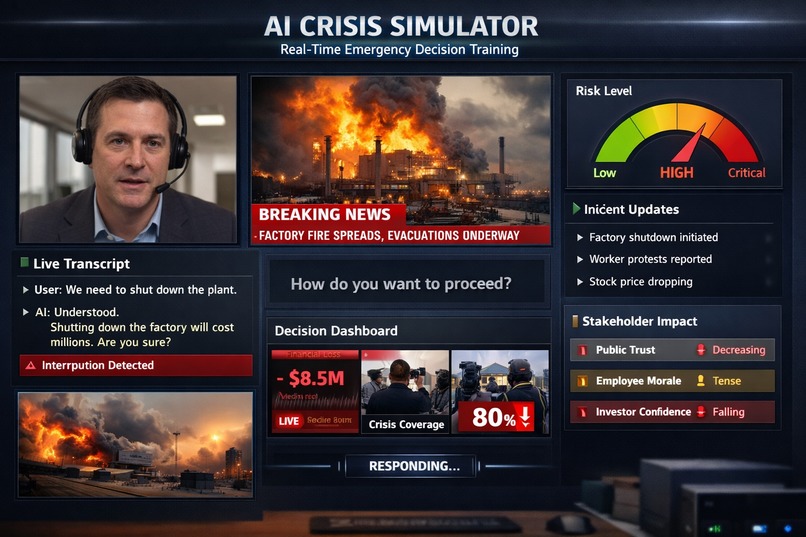
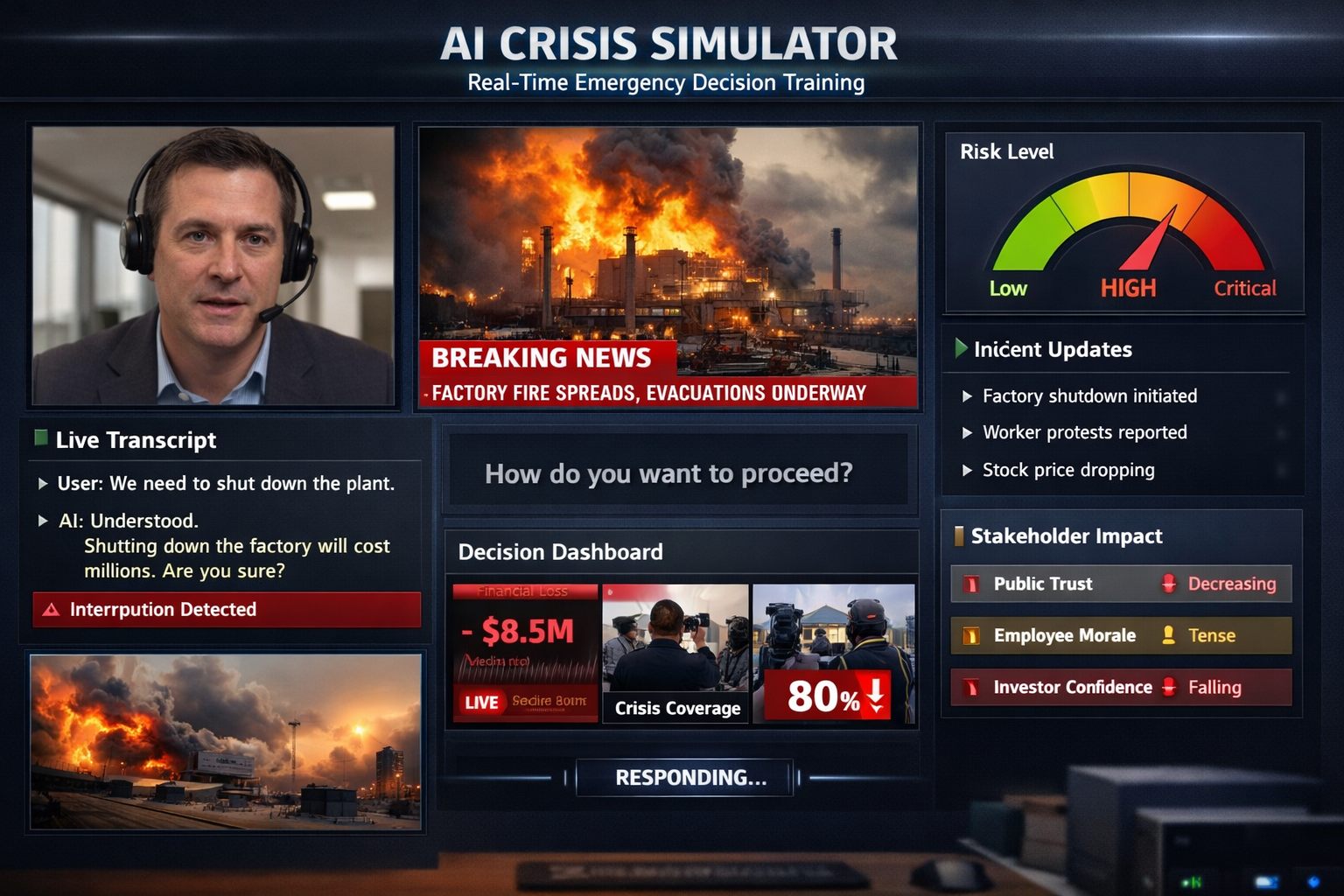
AI Crisis Simulator interface with live voice interaction, scenario escalation, interruption handling, and impact analytics.
Inspiration
High-stakes decisions are rarely practiced under realistic pressure. Traditional crisis training relies on static case studies, tabletop exercises, or expensive live simulations that lack scalability and real-time adaptability. Organizations need a dynamic, intelligent system that can simulate evolving emergencies and respond to human decisions instantly. The project was inspired by the gap between theoretical crisis training and real-world volatility.
What it does
AI Crisis Simulator is a real-time, multimodal emergency decision-training agent. Users assume roles such as CEO, Incident Commander, or PR Lead. The agent: Generates evolving crisis scenarios (industrial accident, cyberattack, PR disaster, etc.) Communicates via real-time voice interaction Accepts interruptions naturally Adapts scenario outcomes based on user decisions Produces multimodal outputs (voice briefings, visual dashboards, simulated news visuals) Tracks risk level, stakeholder trust, financial impact, and operational stability Each session dynamically branches depending on user choices, creating a non-linear simulation environment.
How we built it
Core stack: Gemini Live API for real-time multimodal reasoning and interruption handling Google GenAI SDK for agent orchestration Vertex AI for model deployment Cloud Run for backend hosting Firestore for session state management Cloud Storage for generated visual assets Architecture flow: User audio and camera feed stream from frontend (WebRTC). Backend (Cloud Run) forwards input to Gemini Live API. Gemini processes multimodal context and outputs: Streaming voice responses Structured scenario updates Image/video generation prompts Simulation engine updates state in Firestore. Frontend renders updated dashboards and generated visuals in real time. The system functions as a stateful simulation engine rather than a simple chatbot.
Challenges we ran into
Latency management Real-time streaming required optimization to keep response time within conversational thresholds. State consistency Maintaining a coherent crisis progression across multiple user interruptions required structured memory management. Balancing realism and control The agent needed to simulate realistic escalation without becoming chaotic or unpredictable. Multimodal synchronization Ensuring that generated visuals aligned precisely with spoken updates required event-driven orchestration.
Accomplishments that we're proud of
Built a fully stateful live AI simulation agent rather than a stateless chatbot Achieved real-time interruption handling Integrated voice, vision, structured state tracking, and dynamic media generation Created a branching decision system that meaningfully changes scenario outcomes Deployed fully on Google Cloud infrastructure
What we learned
Multimodal agents require explicit state modeling; implicit context is insufficient for complex simulations. Real-time systems must prioritize response streaming over batch generation. Clear role definition significantly improves agent reasoning consistency. Designing for latency is as important as model intelligence in live applications.
What's next for AI Crisis Simulator – Real-Time Emergency Decision Agent
Add scenario libraries for specific industries (cybersecurity, healthcare, aviation). Introduce multi-user collaborative crisis simulations. Implement performance scoring dashboards powered by BigQuery analytics. Add automated deployment using Infrastructure-as-Code for scalable enterprise rollout. Expand to VR/AR immersive crisis environments.
Built With
- ai
- api
- cloud
- genai
- model
- multimodal
- python
- typescript
- vertex
- websockets


Log in or sign up for Devpost to join the conversation.