-
-
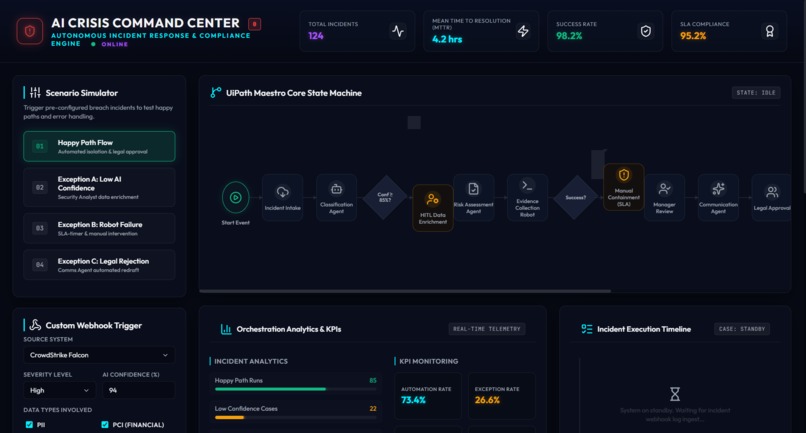
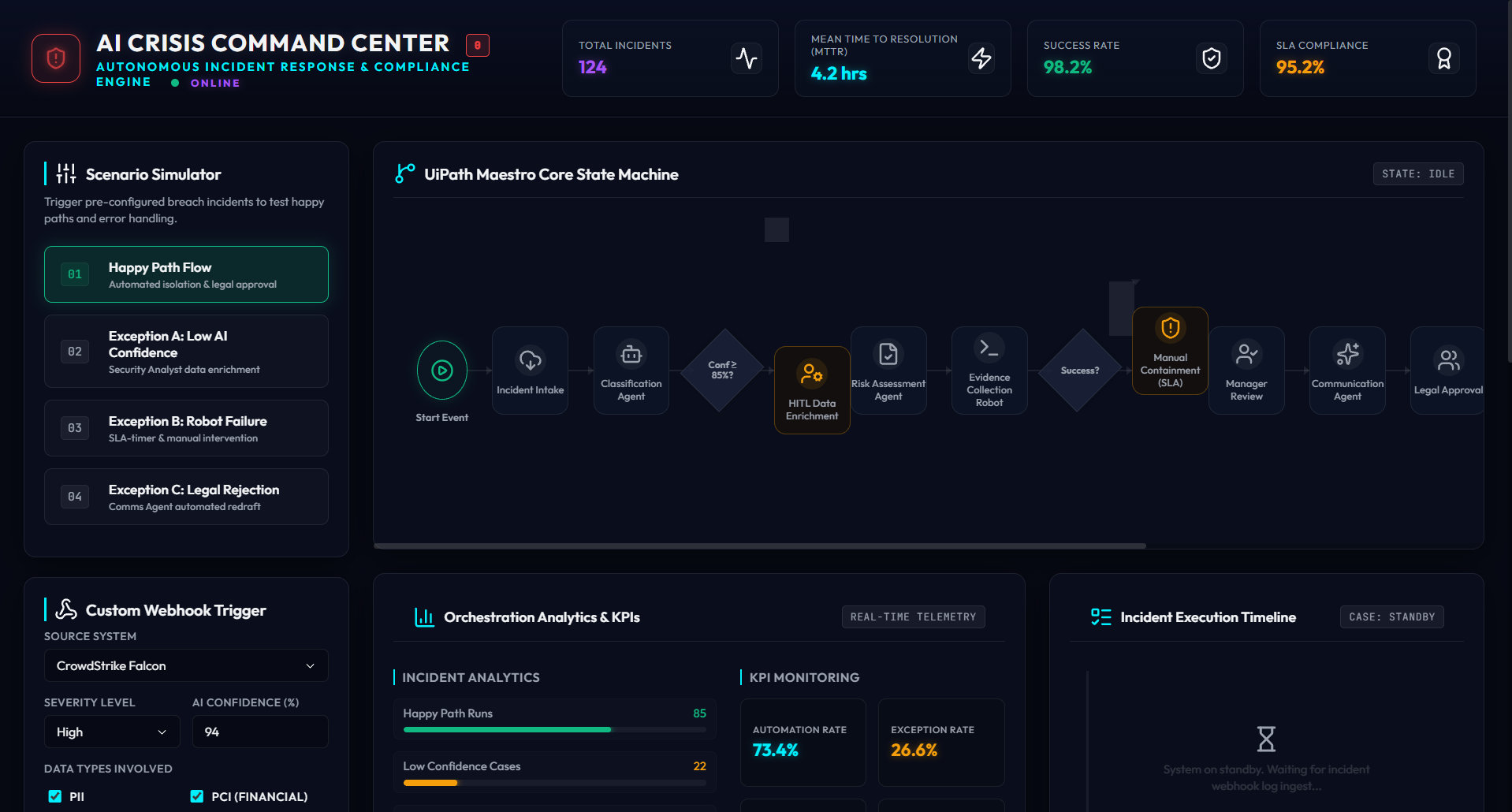
AI Crisis Command Centre-Main dashboard
-
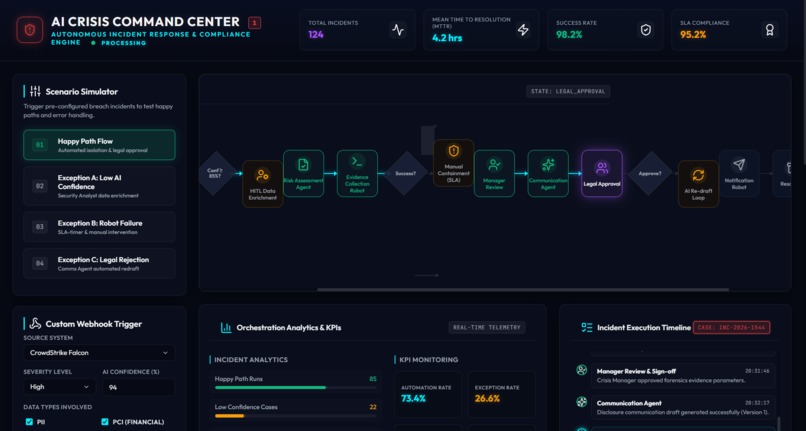
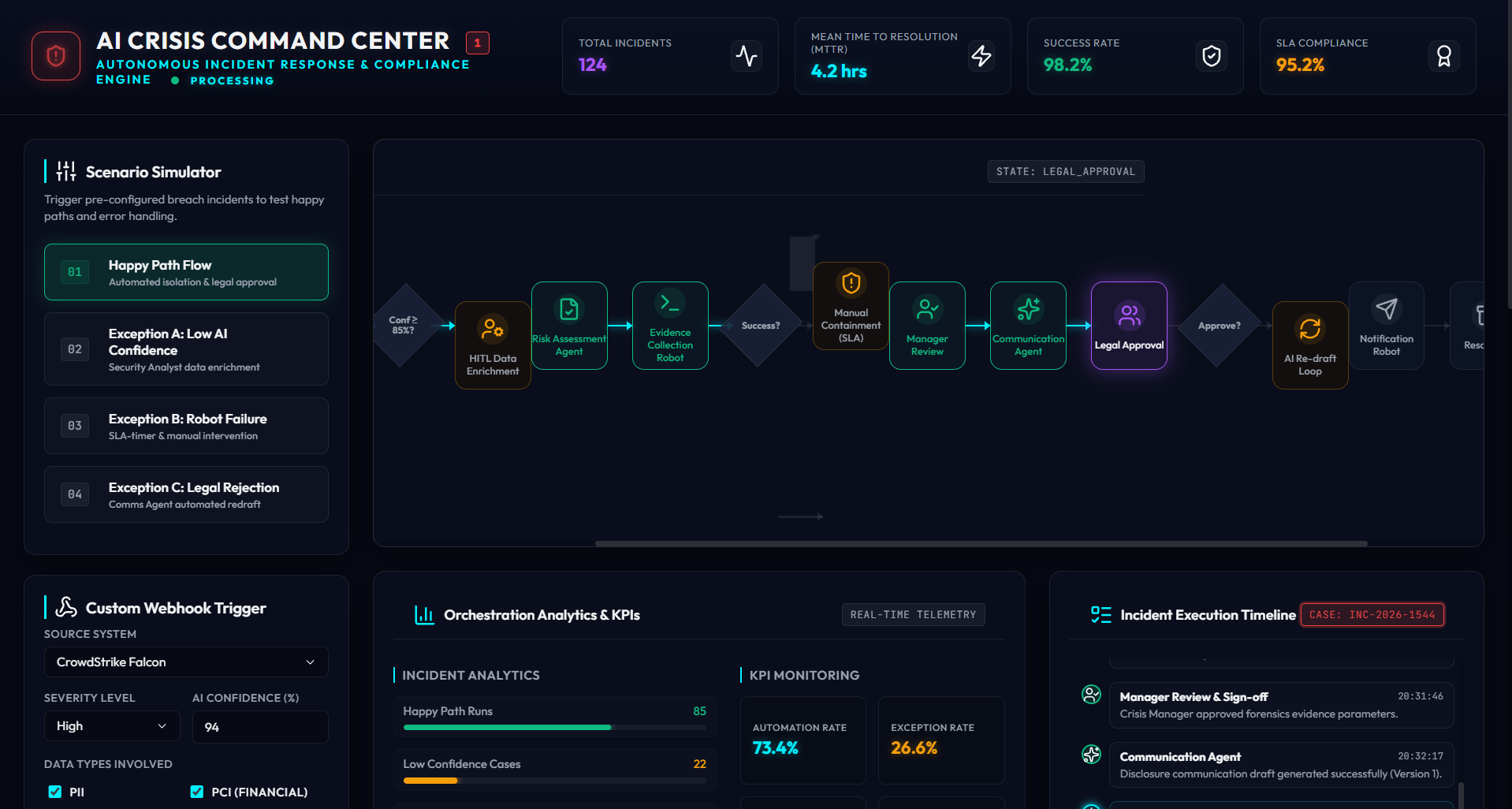
Workflow Processing
-
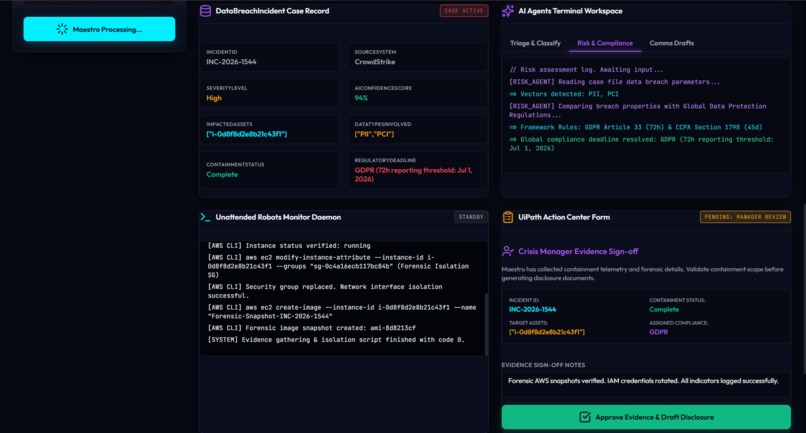
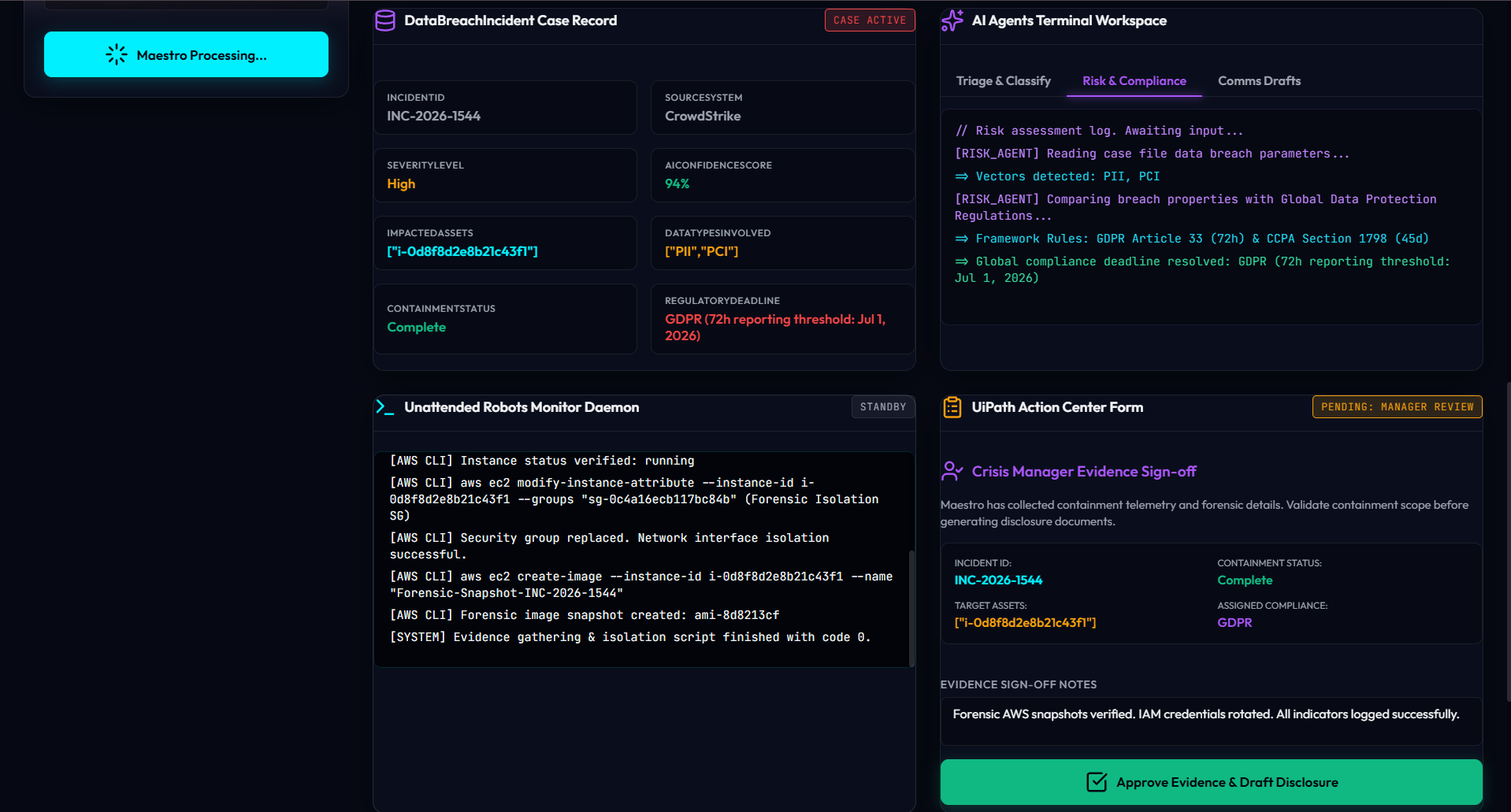
Robots and UiPath Action Centre - Approval
-
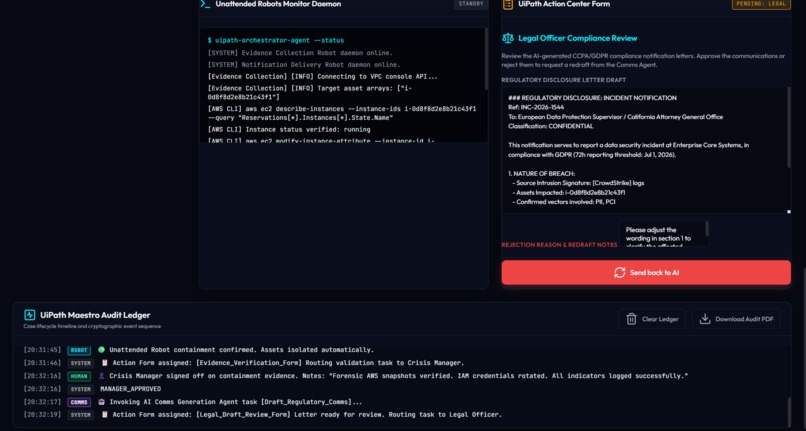
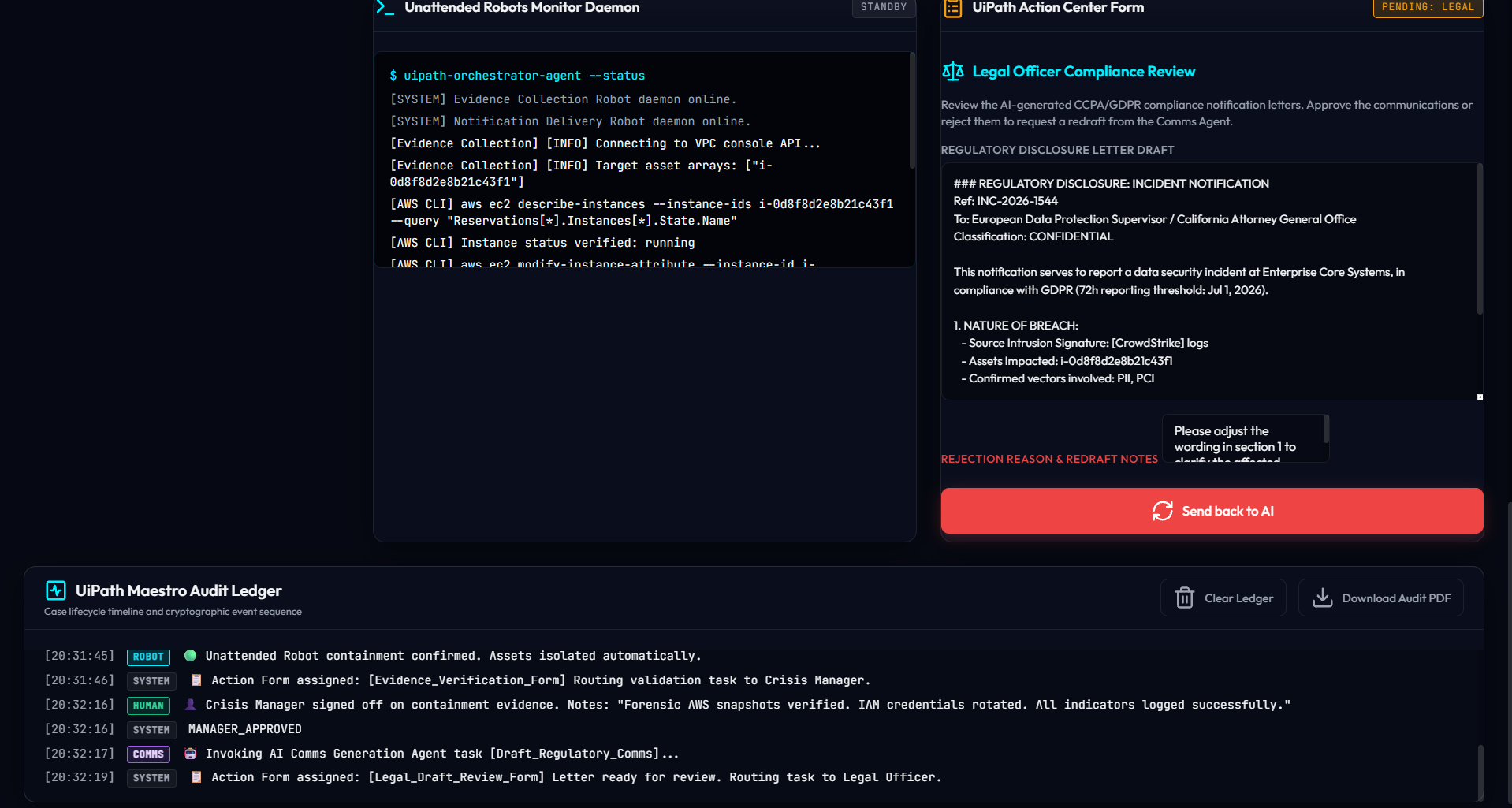
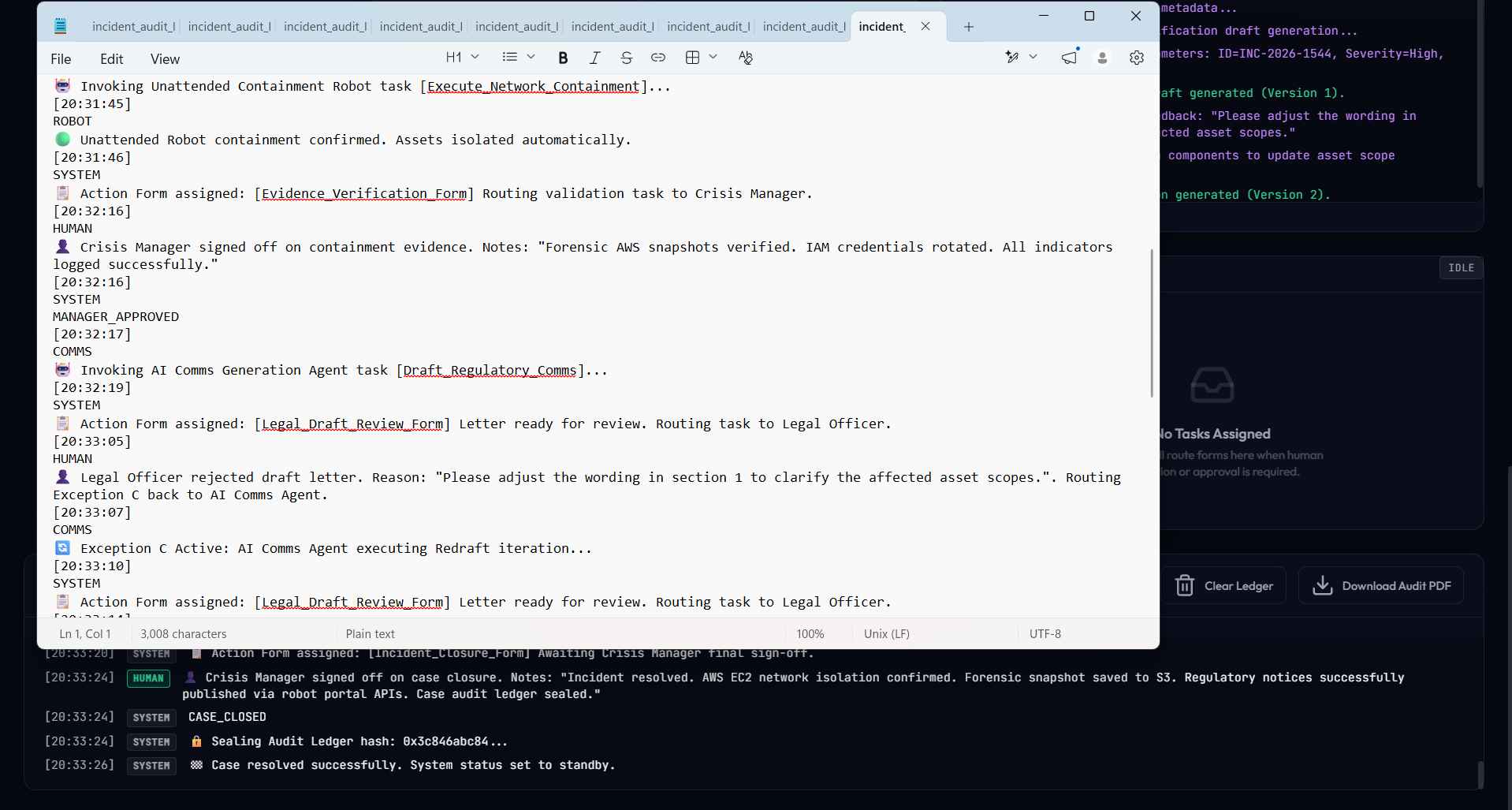
Sending back to AI-After rejection
-
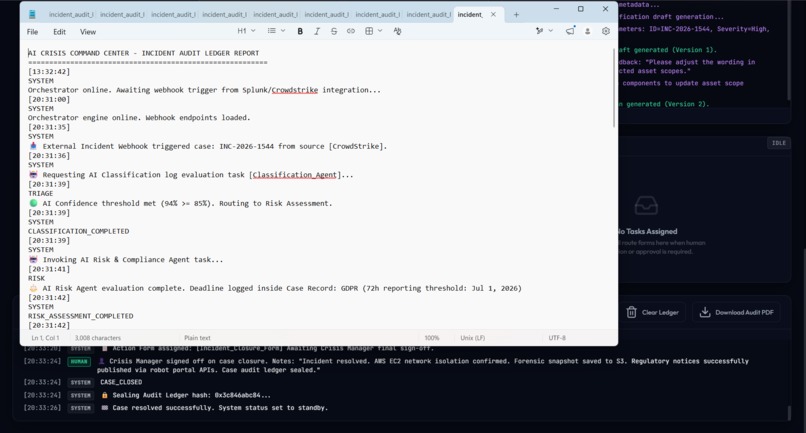
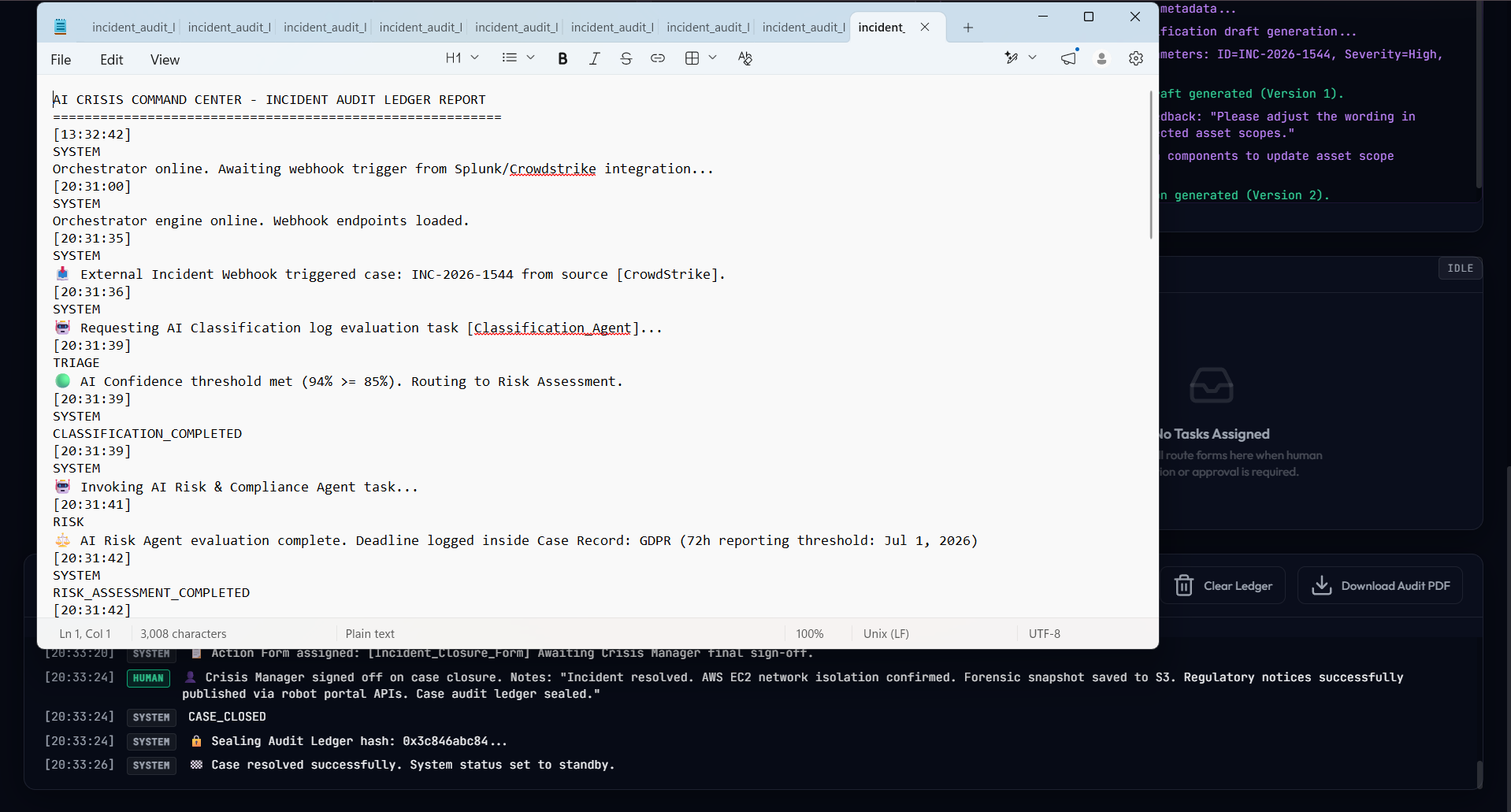
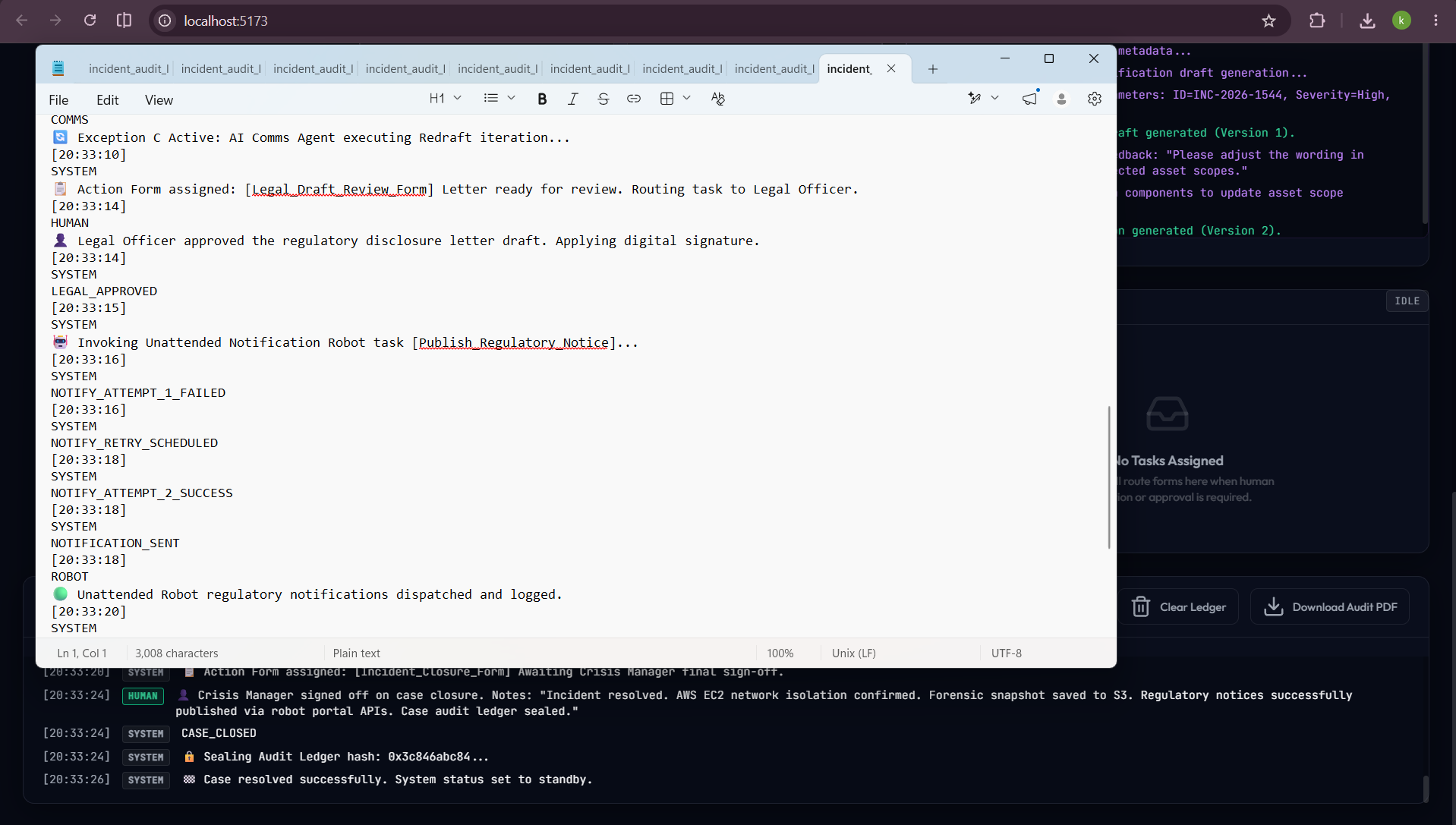
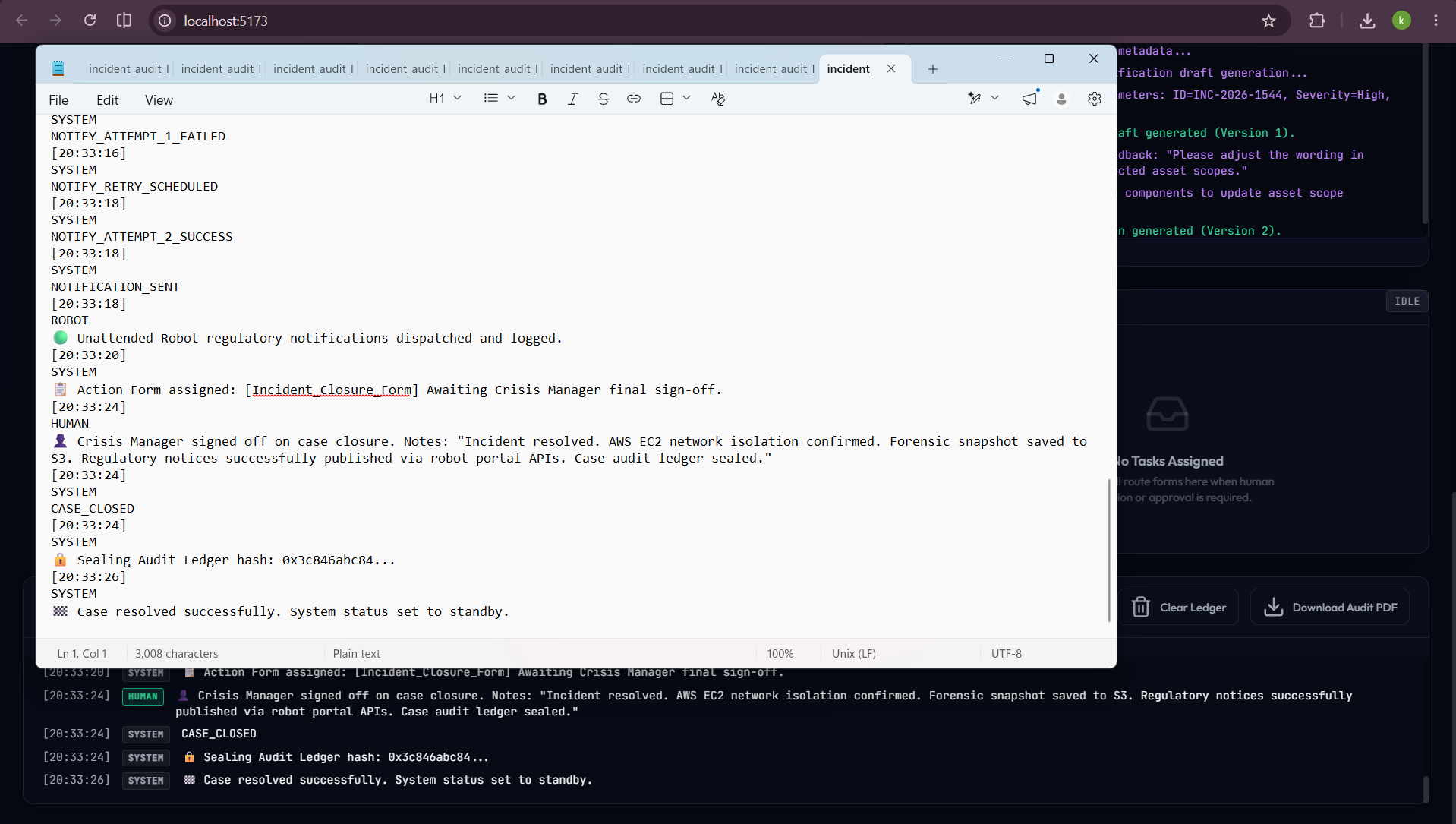
Downloaded Audit Ledger
-
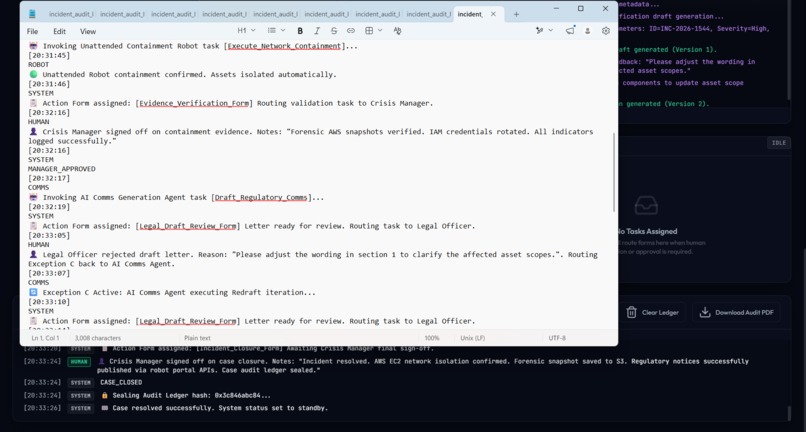
Complete details
-
-
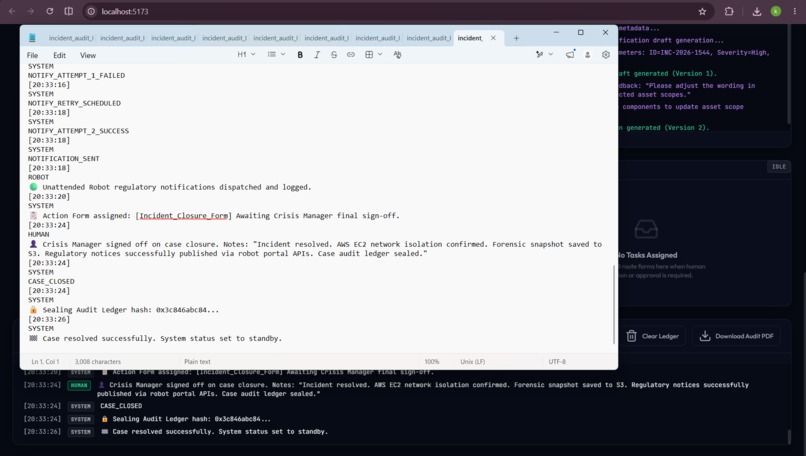
Case Resolved at the End
Inspiration
Cybersecurity incidents require organizations to respond within strict regulatory deadlines while coordinating multiple teams. In many organizations, this process is still manual, resulting in delayed responses, inconsistent decisions, and compliance risks. We wanted to demonstrate how UiPath Maestro can orchestrate an end-to-end incident response workflow where AI agents, unattended robots, and human approvals work together seamlessly. Our goal was to build a realistic enterprise solution that automates repetitive work while ensuring humans remain in control for critical decisions.
What it does
Our project, AI Crisis Command Center, automates the complete lifecycle of a cybersecurity incident. The workflow begins when a security alert is received through a webhook. Maestro creates an incident case and orchestrates multiple AI agents and robots throughout the response process.
The Classification Agent analyzes the incident and calculates an AI confidence score. If the confidence is high, the workflow continues automatically. If the confidence is low, the system intelligently pauses and requests a security analyst to enrich the missing information before continuing.
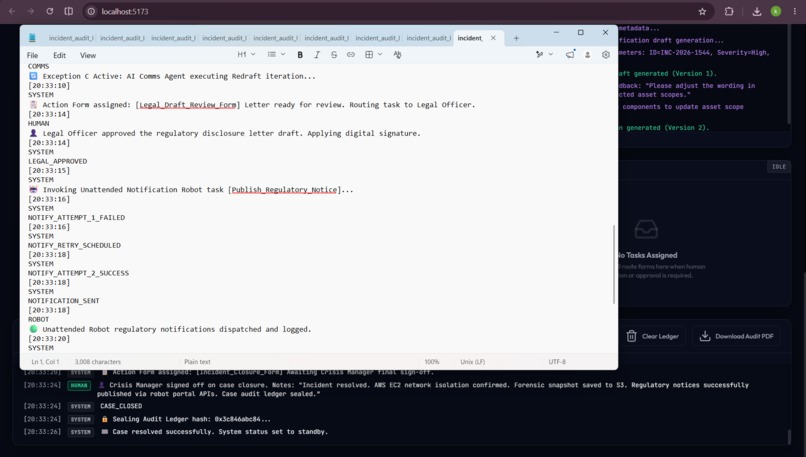
The Risk Assessment Agent determines applicable compliance regulations such as GDPR, HIPAA, or CCPA and calculates reporting deadlines. An Unattended Robot performs evidence collection and containment. If automation fails, Maestro automatically routes the case to a human analyst while triggering SLA monitoring and escalation. After containment, a manager verifies the evidence. An AI Communication Agent prepares regulatory disclosure letters, which are reviewed by Legal. If Legal rejects the draft, Maestro loops back to AI for redrafting until approval is obtained. Finally, another unattended robot publishes the approved notifications, the manager closes the incident, and the complete audit trail is stored. Our biggest innovation is AI confidence-based human approval, where AI decides whether automation is trustworthy enough to continue or whether human expertise is required. This creates an intelligent balance between automation and governance.
How we built it
We designed the solution around UiPath Maestro's orchestration model, representing the complete incident response lifecycle using BPMN-inspired workflow stages. The frontend was built using HTML, CSS, and JavaScript, providing a real-time command center dashboard with workflow visualization, AI workspaces, audit logs, execution timeline, KPI dashboards, and human approval forms. The application simulates multiple AI agents, including Classification, Risk Assessment, and Communication agents, while unattended robots perform evidence collection and regulatory notification tasks. We also implemented multiple execution scenarios, including Happy Path, Low AI Confidence, Robot Failure, and Legal Rejection, to demonstrate Maestro's ability to manage complex enterprise workflows with exception handling and human-in-the-loop approvals.
Challenges we ran into
One of our biggest challenges was designing a workflow that accurately represents real enterprise incident response instead of a simple linear automation. We also had to implement realistic exception handling, human approval loops, SLA monitoring, legal review cycles, robot failures, and dynamic workflow routing while keeping the user experience intuitive. Another challenge was synchronizing multiple workflow stages, dashboards, execution logs, and BPMN visualization so every action remained consistent throughout the demonstration.
Accomplishments that we're proud of
We successfully built a complete end-to-end cybersecurity incident response platform demonstrating how UiPath Maestro can orchestrate AI agents, robots, and humans within a single workflow. Some highlights include: AI confidence-driven decision making Human-in-the-loop approvals Dynamic workflow routing Automated evidence collection SLA monitoring and escalation Legal review with AI redrafting loop Complete audit trail and execution timeline Interactive real-time dashboard simulating enterprise operations We believe this closely represents how modern enterprises can operationalize AI safely and responsibly.
What we learned
This project gave us hands-on experience with orchestration-first automation using UiPath Maestro. We learned that successful enterprise AI is not just about making AI smarter--it is about coordinating AI, humans, and automation in a governed workflow. We also gained a deeper understanding of exception handling, compliance-driven automation, workflow orchestration, human approval systems, and enterprise-scale process design. Most importantly, we learned how intelligent orchestration can make AI systems more trustworthy, transparent, and production-ready.
What's next for AI Crisis Command Centre
Our current project demonstrates the orchestration of an end-to-end cybersecurity incident response workflow using UiPath Maestro. Moving forward, we plan to evolve it into a production-ready enterprise platform.
Our future roadmap includes: Real-time integrations with security platforms such as Microsoft Sentinel, CrowdStrike, Splunk, AWS Security Hub, and ServiceNow. Deployment of actual AI Agents using UiPath Agent Builder and enterprise LLMs instead of simulated agents. Predictive risk analysis to identify high-risk incidents before they escalate using historical security data.
Multi-channel automated notifications through Microsoft Teams, Slack, Email, and SMS. Advanced analytics dashboards with incident trends, compliance metrics, SLA forecasting, and executive reporting.
Multi-tenant support so multiple organizations can securely manage incidents from a single platform. Cloud-native deployment with UiPath Automation Cloud for scalable, enterprise-grade orchestration. Continuous learning AI, where agent decisions improve over time using feedback from analysts and legal reviewers.
Our long-term vision is to build an intelligent, AI-driven Security Operations Command Center where humans, AI agents, and automation work together to deliver faster, more accurate, and fully compliant incident response at enterprise scale.


Log in or sign up for Devpost to join the conversation.