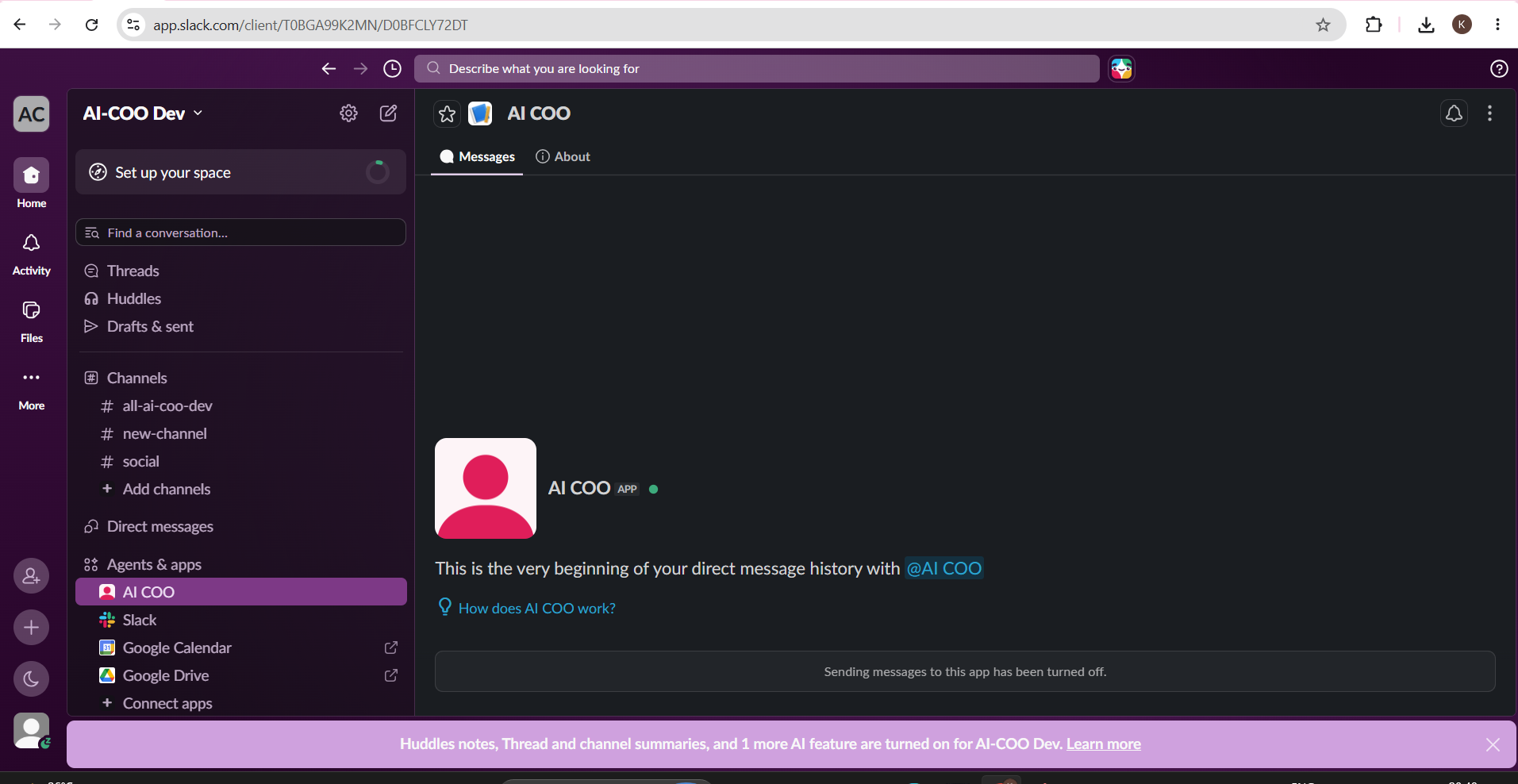
Here is a complete, ready-to-copy draft for your Devpost/Hackathon submission based on everything we've built together. Feel free to tweak the tone or add any personal touches!
Inspiration In fast-paced enterprise environments, cross-functional teams constantly lose time tracking down context. A customer support agent asks about a bug in Slack, an engineer checks GitHub for a PR, and a product manager hunts through Jira for the roadmap. We realized that what teams actually need isn't another dashboard—it's an autonomous executive assistant living right where they communicate. We built AI-COO (Artificial Intelligence Chief Operating Officer) to eliminate context switching, instantly bridging the gap between conversations in Slack and the source of truth in Jira, GitHub, and Notion.
What it does AI-COO is an Enterprise Slack Agent that acts as an autonomous operations pipeline. When a user mentions the agent in a Slack thread (e.g., "ACME hasn't heard back, what's the status?"), the AI-COO immediately goes to work:
Intent Routing: It identifies the core request and extracts key entities (like "ACME"). Context Gathering: It securely queries your company's Jira boards, GitHub repositories, and Notion documentation to fetch real-time updates. Decision Making: The built-in Decision Engine evaluates the data against company policies (for example, flagging if a Jira ticket hasn't been updated in 48 hours, breaching an SLA). Executive Briefing: It replies directly in the Slack thread using rich Block Kit UI elements, providing a clear summary, actionable next steps, and instantly alerting managers if SLAs are breached. How we built it We architected AI-COO as a modular monorepo containing three core microservices:
The Frontend (slack-app): Built with TypeScript and the @slack/bolt framework, hosted on Vercel to handle real-time Slack webhooks and UI rendering. The Brain (backend): A Node.js and Express orchestrator powered by Google Gemini. We utilized Gemini to drive the Intent Router, LLM Planner, and Action Generator. The Data Layer (integrations): We heavily leveraged the brand new Model Context Protocol (MCP). Using the @modelcontextprotocol/sdk, we built secure proxy servers that seamlessly interface natively with GitHub, Jira, and Notion APIs. The Database: We integrated Supabase for persistent entity memory and context caching to ensure high-speed query resolution. Deployment: The backend and all MCP servers are deployed uniformly in a single container on Render using a custom unified startup script. Challenges we ran into One of our biggest hurdles was orchestrating multiple local MCP servers (GitHub, Jira, Notion) alongside the primary backend API in a production environment. During our initial deployment to Render, the isolated container architecture caused connection refusals (ECONNREFUSED) when the backend tried to ping the local MCP proxies. We solved this by engineering a unified start.js script that leverages native Node child_process spawning. This allowed us to spin up the Express Orchestrator and all MCP proxies concurrently within the exact same container, sharing the same network ports and environment variables flawlessly.
Accomplishments that we're proud of We are incredibly proud of successfully implementing the Model Context Protocol (MCP). Instead of hardcoding fragile API wrappers for every service, we built a scalable, standardized data layer. We are also proud of the Decision Engine—rather than just blindly dumping data into a chat, the AI-COO actually evaluates the data it finds to make deterministic business decisions (like identifying SLA breaches) before replying.
What we learned We learned a massive amount about the intricacies of Slack's Event API and Block Kit framework. More importantly, we learned how to structure autonomous agent architectures. By splitting the AI's responsibilities into a "Planner," a "Decision Engine," and an "Action Generator," we dramatically reduced hallucinations and improved response latency compared to using a single, monolithic LLM prompt.
What's next for AI-COO Currently, AI-COO is an incredible investigator and reporter. The next logical step is giving it write-access. We plan to expand the MCP toolset so that AI-COO can autonomously transition Jira tickets, approve simple GitHub PRs based on test statuses, and automatically draft email follow-ups to customers directly from Slack commands. We also plan to build out a persistent analytics dashboard using our Supabase integration to track SLA trends over time.
Built With
- express.js
- genai
- githubapi
- googlegemini
- javascript
- jiraintegration
- llm
- mcp
- modelcontextprotocol
- node.js
- notionapi
- postgresql
- slackapi
- slackapp
- slackbolt
- supabase
- typescript
- vercel

Log in or sign up for Devpost to join the conversation.