Inspiration
Contracts often contain important terms buried in dense, lengthy documents. A quick AI summary can be convenient, but it is hard to trust if you cannot see where its claims came from—or tell what it missed.
ai-contract-review is designed around a simple idea: make contract review easier to verify, not just easier to generate. The goal is to help people find and check key information while keeping uncertainty visible and leaving legal decisions to qualified professionals.
What it does
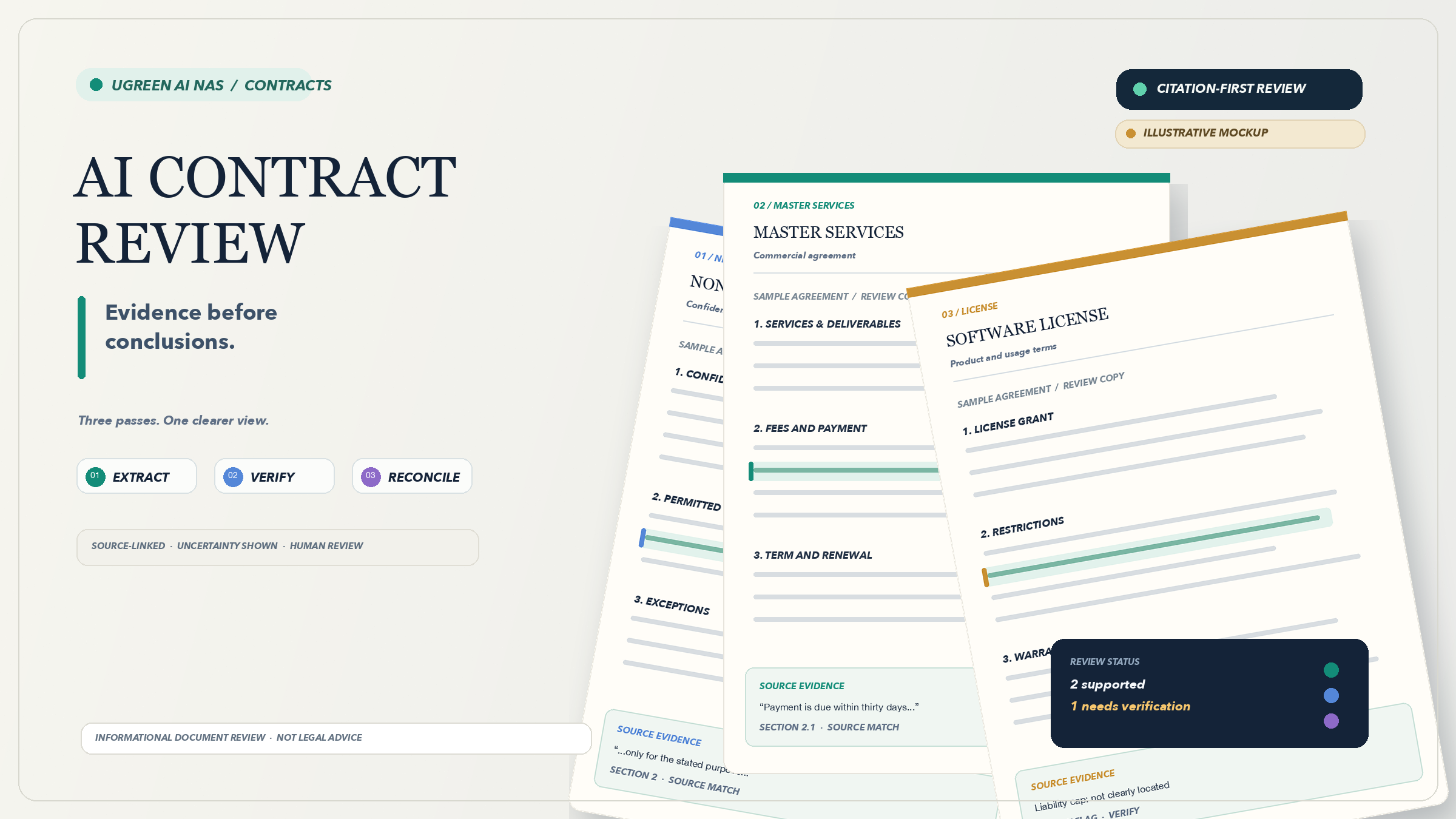
The Skill reviews a user-selected contract stored on a UGREEN AI NAS. It extracts key terms, checks those claims against evidence from the source, and reconciles the results into a readable report.
The report is designed to include key findings, source citations where available, confidence in the evidence, clearly labeled inferences, and items the workflow could not verify. If there are conflicting clauses or missing information, the Skill should flag them rather than fill in the gaps. It is an informational review aid—not legal advice.
How we built it
We created an orchestration Skill around capabilities listed in UGREEN’s NAS capability catalog:
ug-filesystem findcan locate candidate contracts in a user-selected folder.ug-document extractextracts terms using the contract schema.ug-knowledge collect-evidenceperforms a separate evidence-collection pass.ug-document reconcilecompares the results and identifies corrections or unresolved discrepancies.
The workflow is read-only and uses registered NAS experts; it does not write back to the NAS or send documents externally. The catalog maps extraction and reconciliation to the same document-agent, so the workflow uses distinct review passes, but does not claim three independent AI models.
Challenges we ran into
The hardest challenge was balancing a useful review with honest limits. A confident-sounding answer is not useful if its citation is missing, its source is ambiguous, or the document was only partially processed.
The available capability catalog also does not specify whether every result includes precise page or clause locators, which models run behind the experts, or exactly how runtime data is handled. The Skill therefore requires the report to preserve those gaps instead of promising capabilities we have not verified.
Accomplishments that we're proud of
We turned the idea into a structured Skill with a clear workflow, required inputs, registered capability mappings, and explicit handling for missing files, access issues, incomplete coverage, conflicting evidence, and user cancellation.
We also created a reader-focused output guide that emphasizes source-backed claims, confidence in evidence, plain language, and a clear separation between document facts and inferences.
What we learned
Trustworthy AI document review is about more than extracting fields. The workflow needs to make it easy to check claims, show what remains uncertain, and avoid presenting an informational summary as legal judgment.
We also learned to distinguish what the capability catalog documents from what still needs to be tested on a NAS. Static validation confirms the Skill’s package and format—not the quality of contract analysis at runtime.
What's next for ai-contract-review
If selected as a finalist, we will test the workflow on a UGREEN AI NAS using readable sample contracts. We will verify that cited terms match the source, that absent fields are reported as not found, and that conflicting clauses or inaccessible documents are flagged without invented citations.
We also want to evaluate how readable the final report is for non-lawyers and gather feedback from contract reviewers. Any future feature that saves or exports a report to the NAS would need its own clear user confirmation and validation.
