-
-
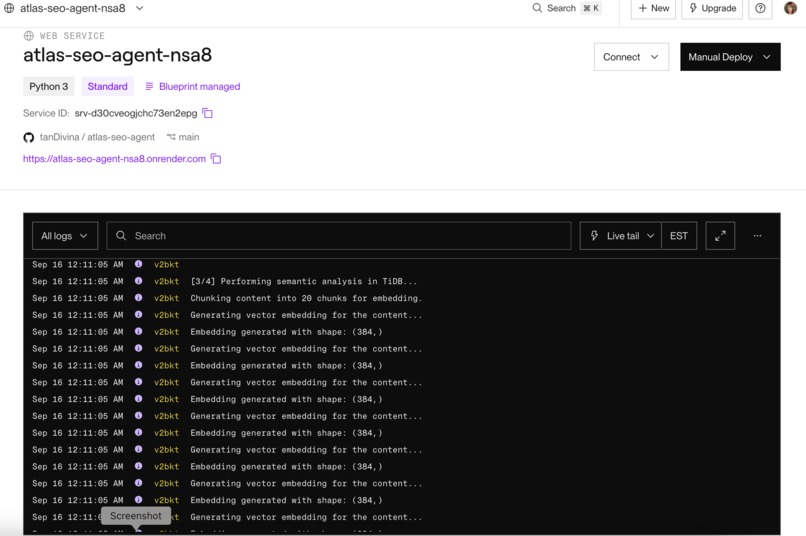
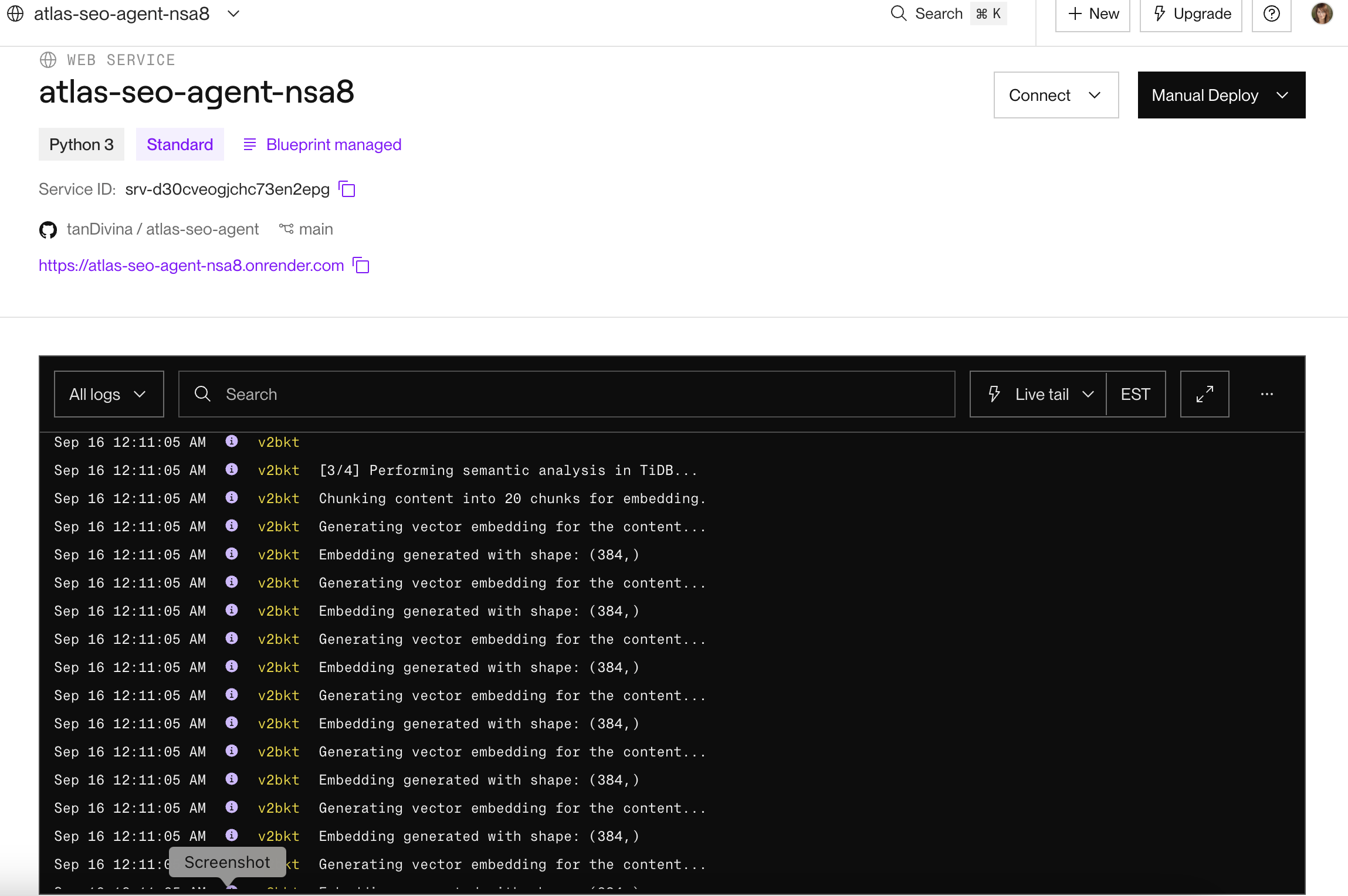
vectors in TiDB
-
Inspiration
The Atlas SEO Agent was inspired by the need for automated, intelligent competitor analysis in the SEO space. Traditional SEO tools often require manual input and don't leverage modern AI capabilities for semantic understanding of content. We wanted to create a tool that could automatically discover competitors, analyze their content using vector similarity, and generate actionable strategies using advanced language models.
What it does
Atlas SEO Agent automates the entire SEO strategy generation process:
- Competitor Discovery: Uses SERP scraping to find top-ranking URLs for any keyword.
- Content Extraction: Robustly scrapes and cleans content from competitor pages.
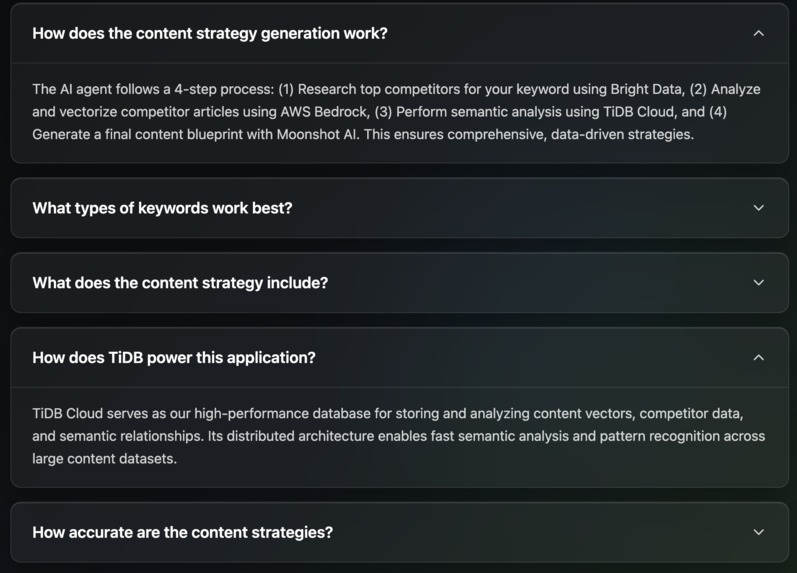
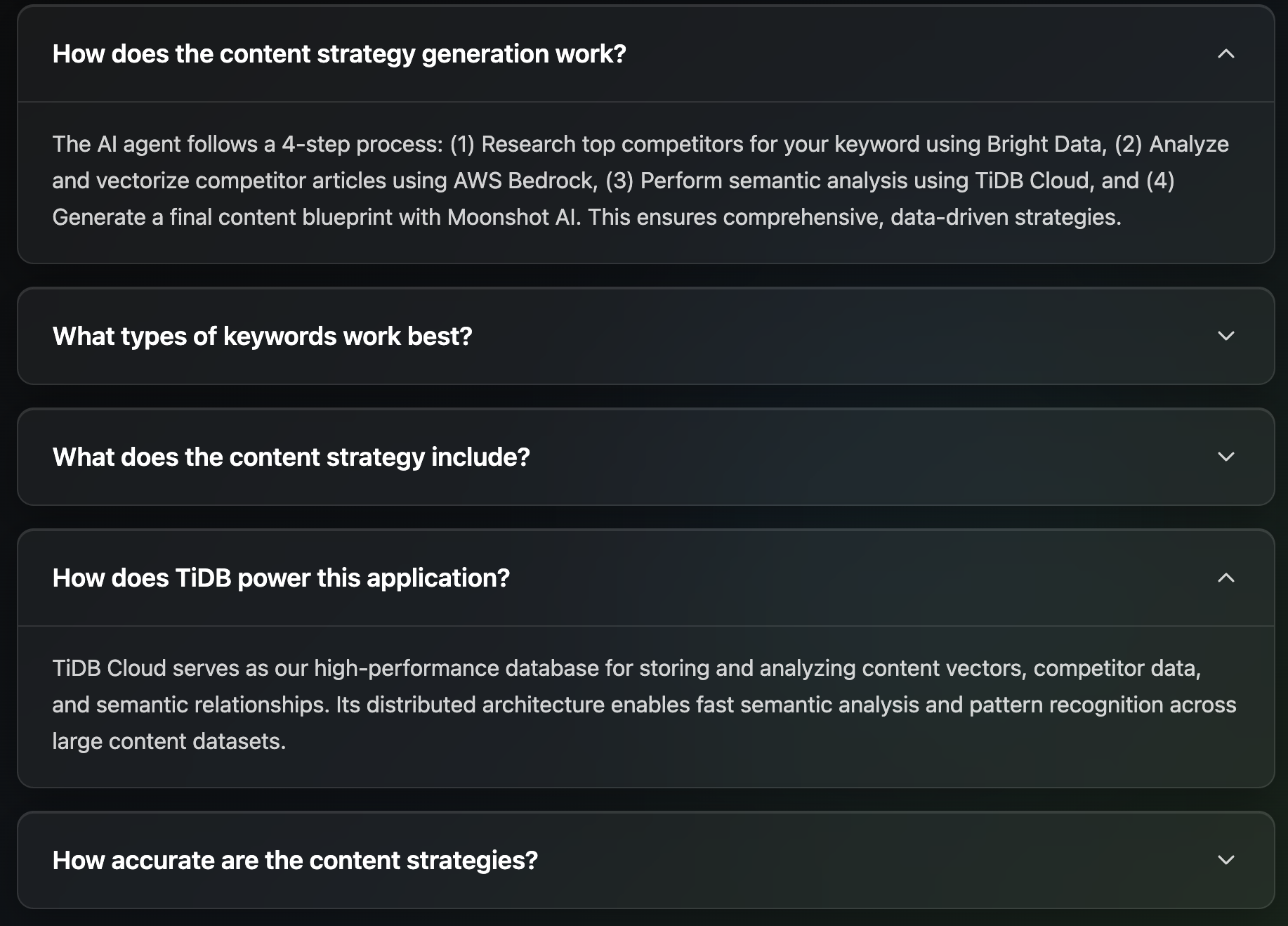
- Semantic Analysis: Stores embeddings in TiDB and performs vector similarity searches to find the most relevant competitor content.
- AI Strategy Generation: Uses Kimi AI (Moonshot) to analyze competitors and produce a comprehensive content blueprint with themes, keywords, structure, and optimization tips.
- Suggested Resources: Provides a top suggested article from the database for reference.
The result is a ready-to-use SEO strategy that helps users outrank their competitors.
How we built it
We built Atlas SEO Agent using a modern Python stack:
- Backend: FastAPI for the API server, providing high-performance endpoints.
- Database: TiDB for scalable storage with native vector search capabilities, allowing efficient similarity queries.
- Scraping: BeautifulSoup and requests for robust web scraping with error handling.
- Embeddings: SentenceTransformers for generating content embeddings, with chunking to handle long texts.
- AI Integration: OpenAI client for Kimi AI to generate strategies based on competitor analysis.
- Deployment: Render for hosting, with optimizations for memory usage.
The workflow integrates these components seamlessly through a modular structure in src/.
Challenges we ran into
- Memory Management: Handling large scraped content and embedding generation caused out-of-memory errors on free-tier hosting. We solved this with content truncation, chunked embedding processing, and worker optimization.
- Vector Search Integration: TiDB's vector functions required binary BLOB storage and precise SQL queries, with fallbacks for text search when vector support was unavailable.
- Scraping Robustness: Dealing with varying website structures and anti-bot measures required deduplication, domain filtering, and timeout handling.
- Deployment Issues: ModuleNotFoundError for OpenAI was fixed by updating requirements.txt. Git push conflicts were resolved with merges and force pushes.
Accomplishments that we're proud of
- Successfully integrated TiDB vector search for semantic competitor analysis, enabling intelligent content recommendations.
- Implemented robust fallback mechanisms (vector to text search) for reliability across different environments.
- Optimized the app for low-memory deployment while maintaining functionality, including chunked processing for embeddings.
- Created a complete end-to-end workflow from keyword input to AI-generated strategy, with suggested articles for practical use.
- Deployed on Render with API endpoints ready for frontend integration.
What we learned
- The importance of memory-efficient processing in AI applications, especially with embeddings and large texts.
- How to leverage database-native vector search (TiDB) for scalable similarity matching without external services.
- Best practices for web scraping: handling errors gracefully, deduplicating results, and respecting rate limits.
- AI prompting techniques for generating actionable SEO strategies from competitor data.
- Deployment challenges on platforms like Render, including environment variables, requirements management, and instance upgrades.
What's next for AI Content Strategy Generator
- Multi-Language Support: Extend scraping and analysis to non-English content.
- Real-Time Monitoring: Add cron jobs for periodic competitor tracking and alerts.
- Advanced Analytics: Integrate Google Analytics and Search Console APIs for performance metrics.
- Visual Dashboard: Build a React frontend for interactive strategy visualization.
- More AI Features: Incorporate image analysis for visual SEO and predictive ranking models.
- Collaboration Tools: Allow team sharing of strategies and collaborative editing.
TiDB Cloud account email: [email protected]
Built With
- bright-data-api
- fastapi
- gunicorn/uvicorn
- numpy
- openai/moonshot-kimi
- python-3.11
- python-dotenv
- render
- requests/beautifulsoup4
- sentence-transformers
- struct.
- tidb/sqlalchemy
- vector-search-functions

Log in or sign up for Devpost to join the conversation.