-
-
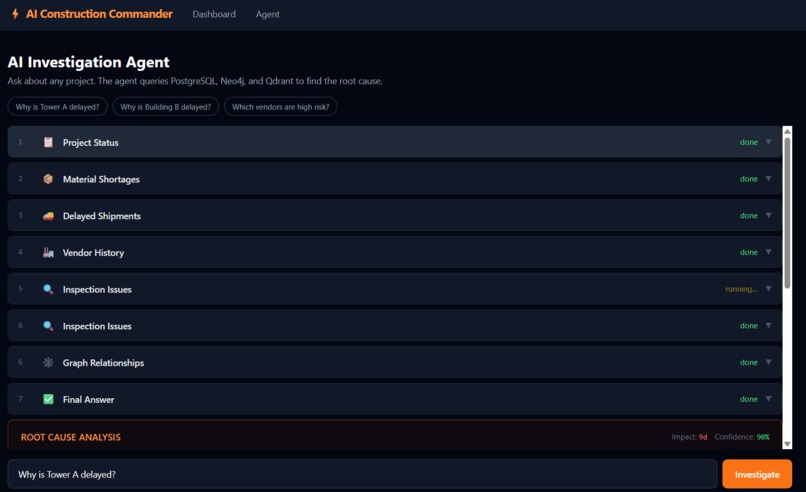
AI agent
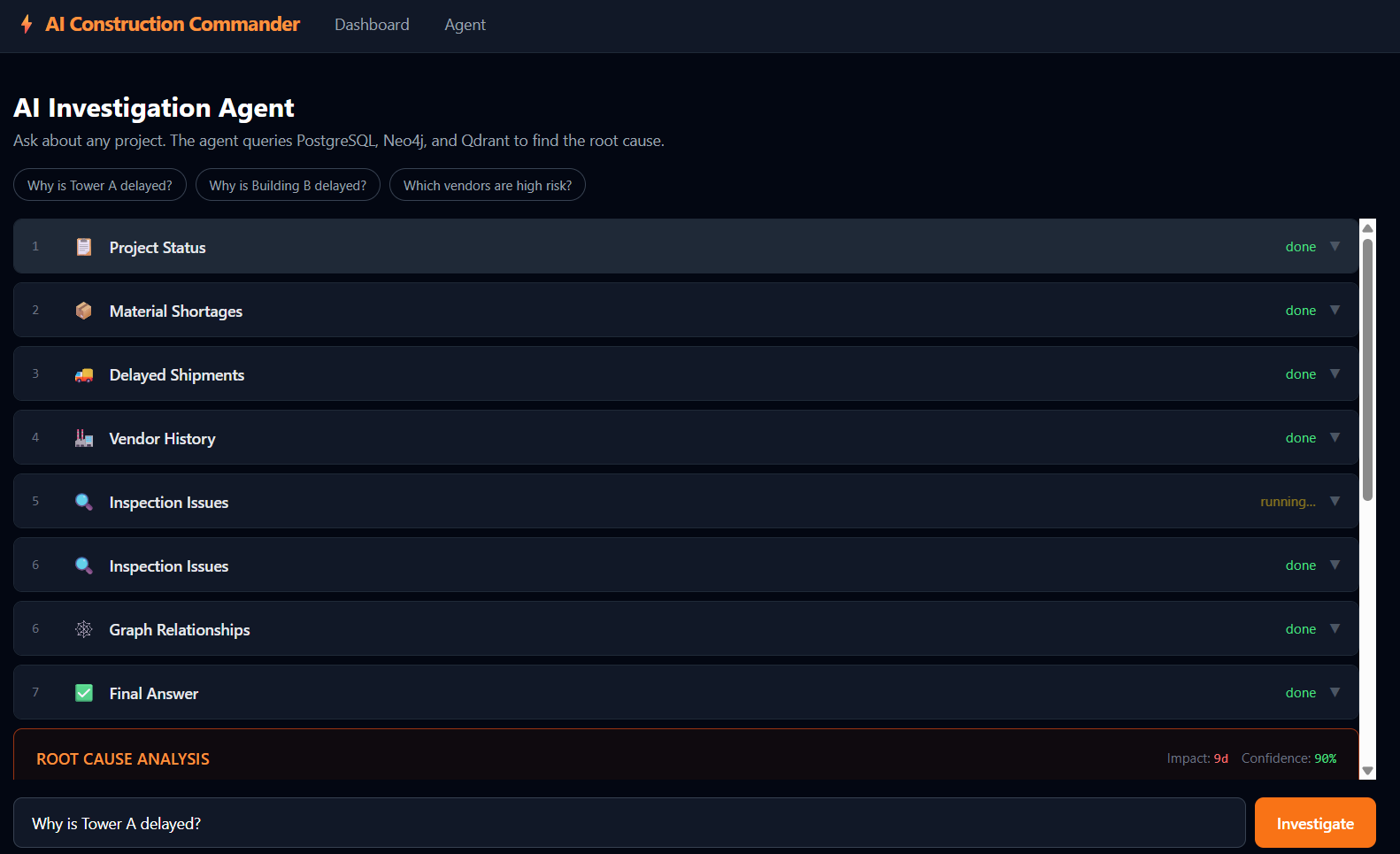
AI Construction Commander
Inspiration
Construction is one of the world's largest industries, yet critical project decisions are still made by manually piecing together information from spreadsheets, emails, purchase orders, shipment trackers, contracts, and inspection reports.
When a project gets delayed, teams often spend hours investigating questions such as:
- What caused the delay?
- Which vendor is responsible?
- What materials are affected?
- What is the financial impact?
- What should we do next?
The data already exists, but it is fragmented across multiple systems. We were inspired by a simple idea:
What if construction projects had an AI command center capable of investigating problems like an experienced project manager, tracing evidence across systems, and explaining exactly why something happened?
This led us to build AI Construction Commander — an AI-powered investigation engine for construction supply chains and procurement operations.
What It Does
AI Construction Commander transforms construction data into actionable intelligence.
Instead of providing another dashboard, the platform answers high-value operational questions such as:
- Why is Tower A delayed?
- Which vendors are creating the highest risk?
- Which shipments are affecting project schedules?
- What procurement bottlenecks need immediate attention?
- What actions should project managers take next?
The system performs evidence-based investigations by combining structured project data, supply chain relationships, and construction documents.
Every answer includes a traceable reasoning path and supporting evidence.
How We Built It
Our architecture combines three specialized data systems, each optimized for a different type of reasoning.
PostgreSQL
Stores structured operational data:
- Projects
- Materials
- Vendors
- Purchase Orders
- Shipments
- AI Analysis Results
This serves as the source of truth for schedules, quantities, delivery dates, and procurement status.
Neo4j Knowledge Graph
Construction projects are highly interconnected.
A delayed shipment can affect materials, which affect project activities, which affect completion dates.
Neo4j models these relationships:
Project
  ↓
Material
  ↓
Shipment
  ↓
Vendor
This allows the system to trace dependencies and uncover hidden risk paths across the supply chain.
Qdrant Vector Database
Many critical insights live inside unstructured documents.
We process:
- Inspection Reports
- Contracts
- RFIs
- Procurement Documents
Documents are embedded and stored in Qdrant, enabling semantic search and evidence retrieval beyond traditional keyword matching.
Agentic Investigation System
We built a LangGraph-based investigation workflow that performs step-by-step reasoning.
Instead of generating answers immediately, the agent:
- Examines project status
- Identifies material shortages
- Investigates delayed shipments
- Evaluates vendor performance
- Searches inspection reports
- Traverses graph relationships
- Generates an evidence-backed conclusion
The process is streamed live so users can observe every tool invocation and reasoning step.
Example Investigation
When asked:
Why is Tower A delayed?
The system discovers:
- Tower A is behind schedule.
- Rebar inventory is below planned levels.
- Shipment S-102 is delayed by 9 days.
- Vendor ABC Steel has a poor delivery history.
- An inspection report reveals the shipment failed quality testing.
- Neo4j confirms the dependency chain between the project, material, shipment, and vendor.
The final answer identifies the root cause, estimates project impact, and recommends corrective actions.
Every statement is linked to real project data.
Challenges We Faced
Building Trustworthy AI
One of our biggest challenges was preventing hallucinations.
Many AI systems generate convincing answers without evidence.
To address this, we established a strict rule:
Every sentence generated by the agent must be traceable to a database record or document.
This required designing a complete evidence traceability framework before building the agent itself.
Combining Multiple Data Systems
Integrating PostgreSQL, Neo4j, and Qdrant into a unified reasoning workflow was another major challenge.
Each database solves a different problem:
- PostgreSQL handles facts.
- Neo4j handles relationships.
- Qdrant handles meaning.
Creating a seamless investigation experience across all three required careful orchestration.
Designing Realistic Failure Scenarios
We wanted the system to demonstrate genuine reasoning rather than follow a scripted path.
To achieve this, we created multiple projects with completely different root causes.
For example:
- Tower A fails because of a supplier quality issue.
- Building B fails because of a procurement approval bottleneck.
The same agent reaches different conclusions because the underlying evidence is different.
What We Learned
This project taught us that successful AI systems are not built around prompts alone.
The quality of reasoning depends on:
- Data modeling
- Evidence traceability
- Retrieval quality
- Tool reliability
- System architecture
We learned that building trustworthy AI requires designing the evidence chain first and the agent second.
Most importantly, we learned that construction projects don't need another dashboard.
They need systems that can explain what is happening, why it is happening, and what should happen next.
Impact
AI Construction Commander acts as an intelligent operational layer for construction projects.
By combining structured data, document intelligence, knowledge graphs, and agentic reasoning, it helps teams identify risks earlier, reduce investigation time, and make faster, evidence-backed decisions.
Our vision is simple:
Transform construction project management from reactive problem-solving into proactive intelligence.
Built With
- agentic-ai
- alembic
- docker
- docker-compose
- fastapi
- knowledge-graphs
- langgraph
- neo4j
- next-js
- openai-api
- postgresql
- pydantic
- python
- qdrant
- react
- rest-api
- retrieval-augmented-generation
- semantic-search
- server-sent-events
- shadcn-ui
- sqlalchemy
- tailwind-css
- typescript
- vector-embeddings

Log in or sign up for Devpost to join the conversation.