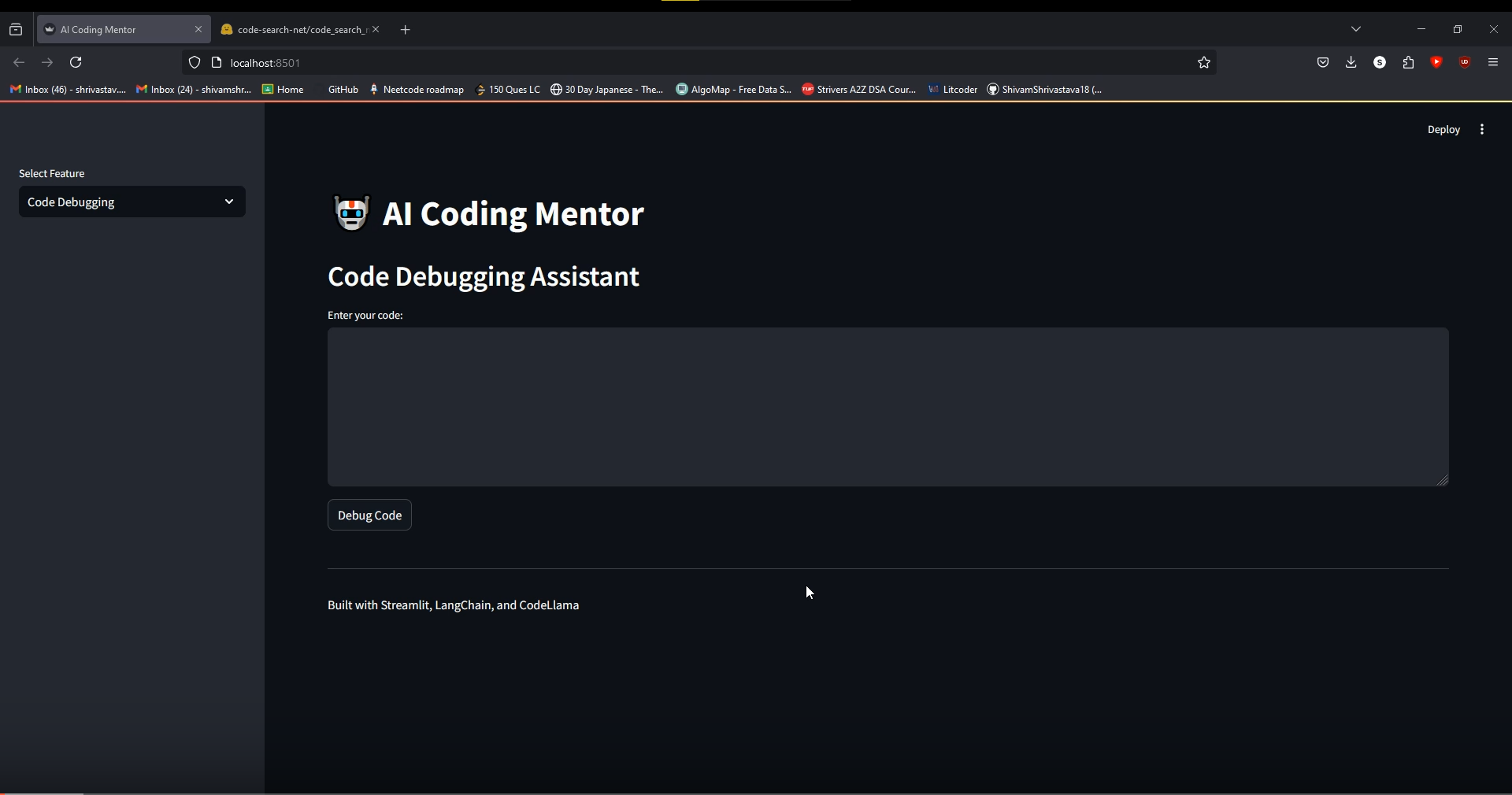
AI Coding Mentor
Overview
The AI Coding Mentor is a full-stack application designed to provide coding assistance, including debugging, complexity analysis, and code explanation. It integrates with a fine-tuned CodeLlama-7b model, optimized using 4-bit quantization and Low-Rank Adaptation (LoRA) to enhance efficiency and accuracy.
Inspiration
The idea for AI Coding Mentor came from my own struggles as a developer. I often found myself searching for explanations, debugging help, and best practices, hopping between Stack Overflow, documentation, and AI chatbots. While these tools were helpful, they often lacked context awareness and a structured way to guide users through problem-solving. I wanted to create an AI-powered tool that acted more like a mentor than a simple assistant—one that could analyze, explain, and even optimize code effectively.
What I Learned
Building this project gave me deep insights into multiple aspects of AI and software development. I learned how to fine-tune large language models like CodeLlama-7b, apply 4-bit quantization to optimize performance, and use LoRA for efficient tuning. Additionally, I gained experience in integrating Hugging Face Transformers with a practical application and deploying an AI model in a real-world coding scenario. On the frontend, I explored the power of Streamlit for interactive UI development, ensuring users could easily interact with the AI.
How I Built It
Developing AI Coding Mentor required a combination of backend AI processing and frontend UI implementation.
Backend Development
I built the backend using Flask, which acted as an API layer to communicate with the fine-tuned CodeLlama-7b model. The AI was optimized using LoRA and 4-bit quantization, making it efficient without sacrificing accuracy. I used Hugging Face Transformers to fine-tune the model, while LangChain helped enhance the prompt structuring for better responses.
Frontend Development
For the frontend, I chose Streamlit, as it provides an interactive UI that allows developers to input their code and receive instant AI-powered feedback. The design focused on ease of use, featuring real-time debugging, code conversion, and complexity analysis in an intuitive interface.
Model Optimization
To ensure fast response times and cost-efficient deployment, I applied 4-bit quantization, which significantly reduced the model's size while maintaining its effectiveness. Additionally, LoRA helped fine-tune the model without requiring extensive computational resources, making training more manageable.
Challenges I Faced
Optimizing Model Performance
Fine-tuning a large model like CodeLlama-7b required balancing accuracy and efficiency. Using LoRA and 4-bit quantization allowed me to reduce computational overhead while maintaining performance. However, tuning hyperparameters for the best tradeoff between speed and quality was a complex process.
Ensuring High-Quality Debugging & Explanations
One of the biggest challenges was ensuring the AI-generated debugging suggestions and explanations were accurate and relevant. I had to refine prompts, experiment with different training datasets, and implement filtering mechanisms to prevent misleading outputs.
Frontend Integration & User Experience
While Streamlit made UI development straightforward, integrating it seamlessly with the backend API required careful handling of asynchronous requests and response times. I optimized API calls to reduce latency and ensure a smooth, responsive user experience.
Features
Coding Mentor
- Debugging: Automatically detects errors in code and suggests fixes.
- Code Conversion: Translates code between programming languages (e.g., Python ↔ Java).
- Complexity Analysis: Evaluates time and space complexity, offering optimization tips.
- Code Explanation: Breaks down and explains code functionality line-by-line.
Model Training Script
- Fine-tunes the CodeLlama-7b model using Hugging Face Transformers.
- Implements 4-bit quantization for efficient training.
- Uses LoRA for parameter-efficient tuning, targeting key layers.
Tech Stack
- Backend: Python, Hugging Face, LangChain, Flask
- Frontend: Streamlit
The Future of AI Coding Mentor
Some of the future improvements I plan to work on include:
- Expanding debugging capabilities with more precise error analysis.
- Improving code conversion to support additional languages and frameworks.
- Enhancing model training with larger datasets and fine-tuning strategies.
- Deploying a cloud-based version for broader accessibility.
Built With
- hugging-face
- langchain
- llama
- python
- streamlit

Log in or sign up for Devpost to join the conversation.