-
-
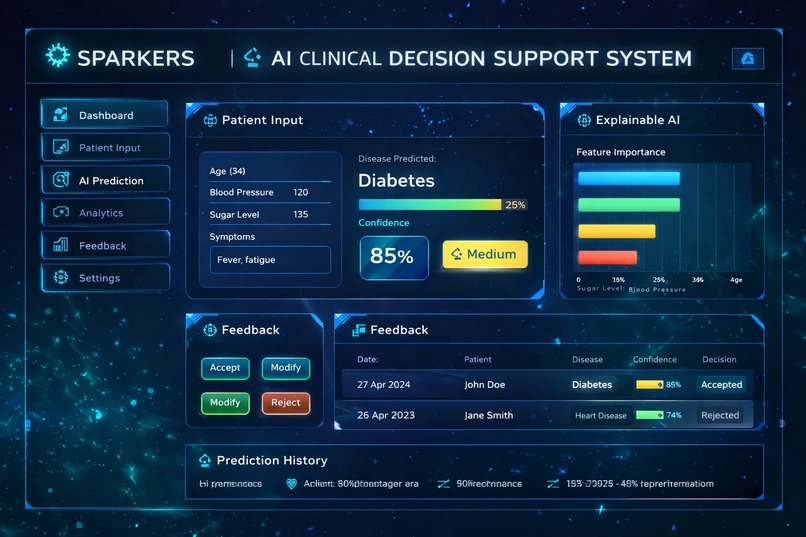
AI-powered dashboard enabling real-time clinical decision support with intelligent predictions and doctor feedback integration
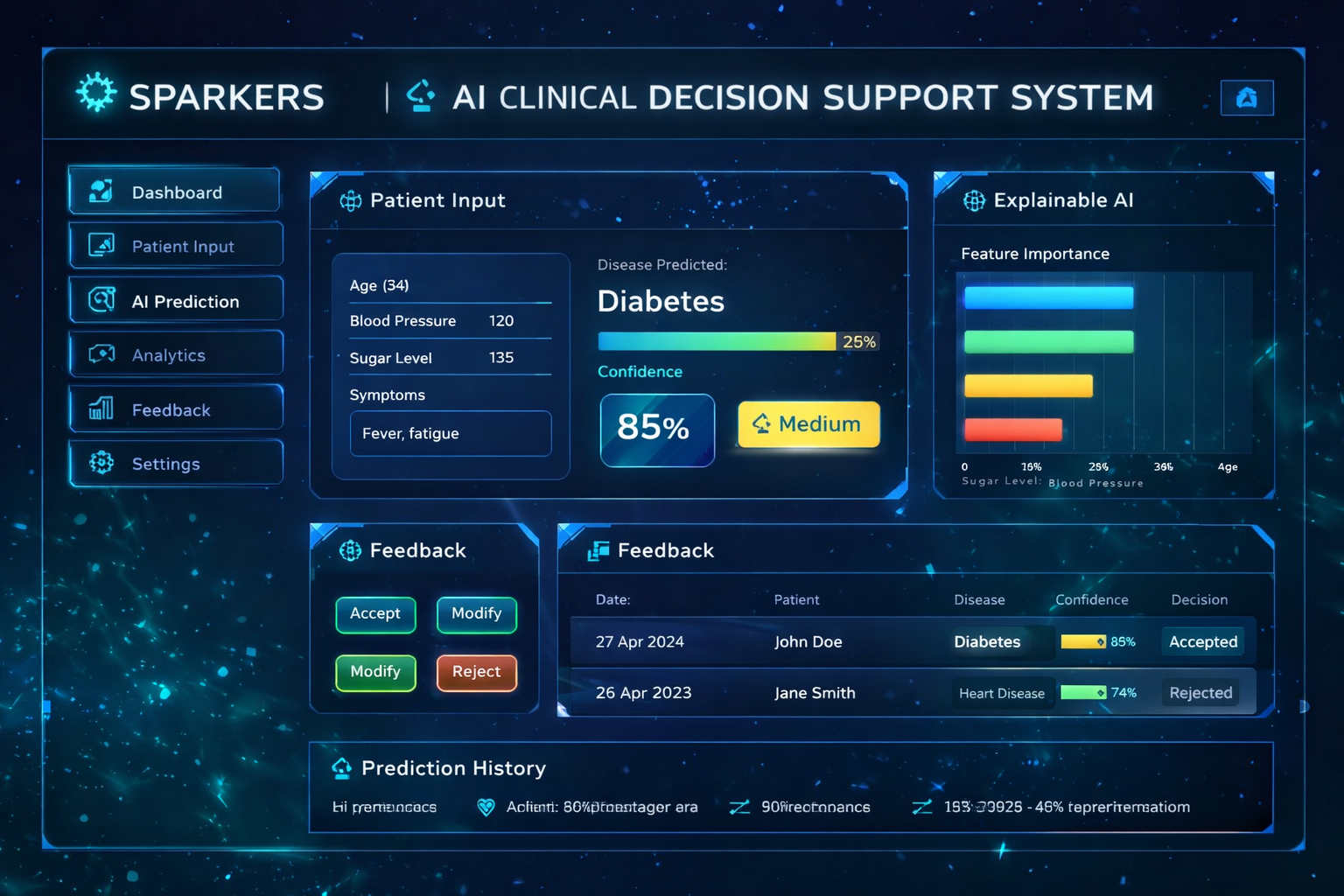
AI-Assisted Clinical Decision Support System
Inspiration
Manual diagnosis in healthcare is still highly dependent on human observation and experience. In busy hospitals, factors like fatigue, workload, and time pressure can lead to medical errors, delayed treatment, or misdiagnosis.
We were inspired by the idea that AI should not replace doctors, but assist them — acting as a second layer of intelligence to reduce errors and improve patient safety.
Our goal was simple:
Build a system where AI supports doctors in making faster, safer, and more accurate decisions.
What We Learned
During this project, we explored both technical and real-world healthcare challenges:
- How machine learning models can predict diseases from patient data
- The importance of Explainable AI in critical domains like healthcare
- Why human-in-the-loop systems are essential for trust and safety
- How reinforcement learning can improve systems over time
- Building a full-stack AI product using Python (Streamlit + FastAPI)
We also learned that accuracy alone is not enough — trust, transparency, and usability matter equally.
How We Built the Project
Step 1: Data Collection
We used medical datasets (e.g., heart disease / diabetes) from Kaggle and preprocessed them:
- Removed missing values
- Normalized features
- Encoded categorical data
Step 2: AI Model Development
We trained machine learning models like:
- Logistic Regression
- Random Forest
The model predicts disease probability:
$$ P(disease \mid features) $$
and outputs a confidence score along with prediction.
Step 3: Reinforcement Learning (Feedback Loop)
We designed a simple feedback mechanism:
$$ Reward = \begin{cases} +1 & \text{if doctor accepts prediction} \ 0 & \text{if modified} \ -1 & \text{if rejected} \end{cases} $$
This helps the system learn from doctor decisions over time.
Step 4: Backend System
- Built using FastAPI
- Handles predictions, feedback, and data flow
Step 5: Frontend Dashboard
- Built using Streamlit
Features:
- Patient data input
- AI prediction display
- Confidence & risk indicator
- Doctor feedback buttons
Step 6: Full Workflow
Patient Data → AI Prediction → Doctor Decision → Feedback → AI Improvement
⚡ Challenges We Faced
Data Quality Issues
Medical datasets often had missing or inconsistent values, requiring careful preprocessing.
Trust in AI Decisions
In healthcare, even small mistakes are critical. So we focused on:
- Explainable predictions
- Confidence scores
Designing Human-AI Collaboration
We ensured:
- AI assists, not replaces
- Doctor always has final control
Time Constraints (Hackathon)
Building:
- AI model
- Backend
- Frontend within limited time was challenging, so we prioritized a modular and scalable approach.
Impact
Our system aims to:
- Reduce medical errors
- Improve diagnosis speed
- Support doctors under heavy workload
- Enhance patient safety
Future Scope
*Emotion-aware patient analysis *Integration with hospital systems *Real-time IoT health data *Multi-disease prediction models


Log in or sign up for Devpost to join the conversation.