Inspiration
AI can already talk about your symptoms. But when it needs a structured screening tool, the experience breaks.
You leave the conversation, search for a test, complete it on another website, then bring the result back.
We wanted to remove that gap.
What if a health website wasn't just readable by an AI — but actually usable by it?
What it does
Medtests makes structured health screening tools available to AI agents through WebMCP.
An agent can discover available screenings, retrieve the questions, guide the user through them, score the answers, and return the structured result.
For example, instead of only answering:
"Could these symptoms be ADHD?"
an AI can use Medtests to start a relevant screening flow and guide the user through it.
The user doesn't have to figure out which page to open or copy information between an AI and a website.
How we built it
We turned Medtests from a traditional website into an agent-accessible website using WebMCP.
The browser exposes five tools:
list_screeningsget_screeningscore_screeningget_crisis_resourcesget_chat_analysis_protocol
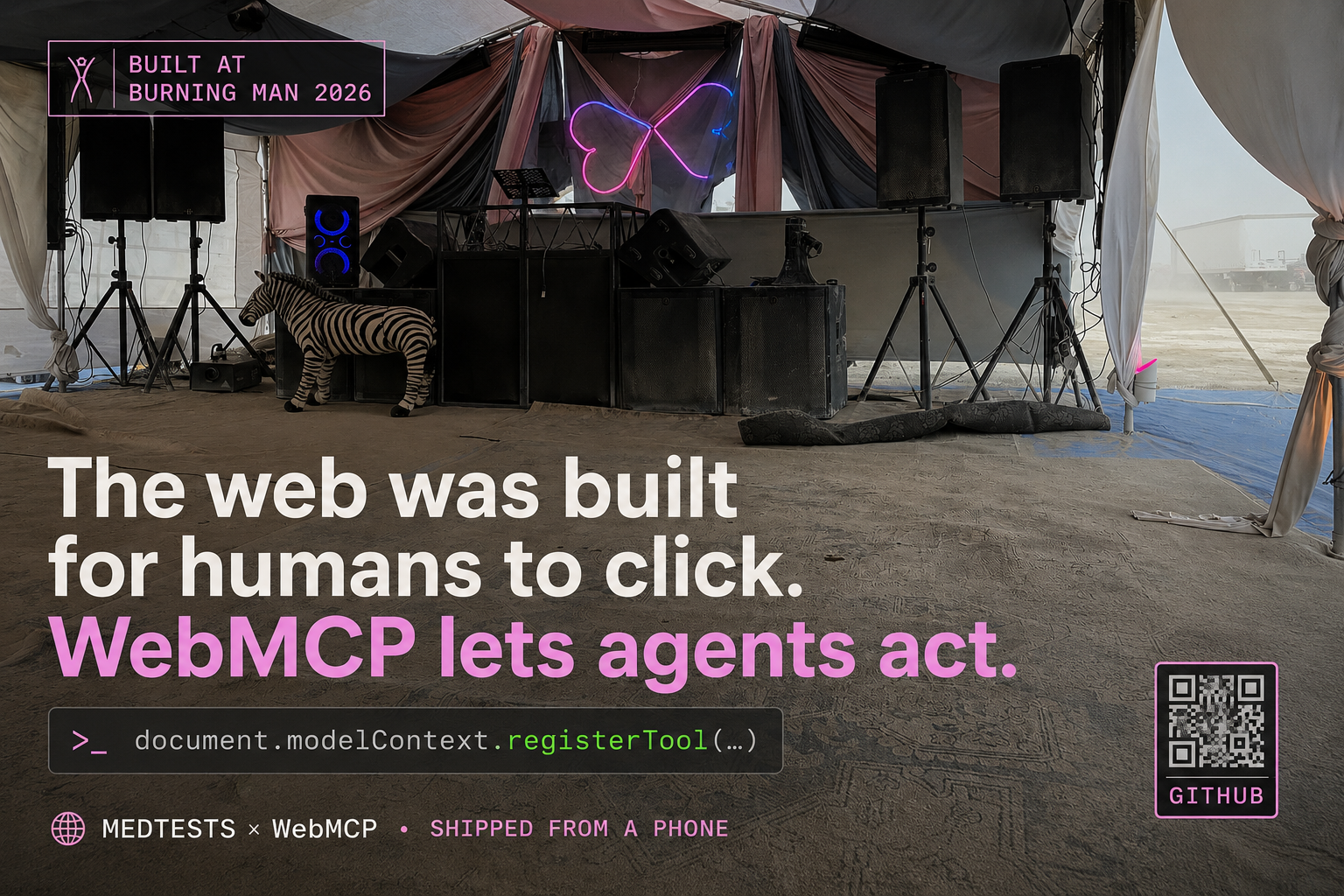
The tools are registered through the browser's WebMCP interface using document.modelContext.registerTool(...).
The application is written in JavaScript and deployed on Cloudflare Workers with Wrangler, with deployment through GitHub.
The important architectural decision was simple:
Instead of building another chatbot, we made the website itself callable by AI agents.
Challenges we ran into
Health screening is a good example of why agent interfaces need structure.
An agent shouldn't have to scrape a webpage and guess what a button, question, or score means.
We had to turn human-facing interactions into explicit tools with predictable inputs and outputs, while keeping the existing website useful for humans.
We also had to separate screening from diagnosis. Medtests provides structured screening tools and results — not medical diagnoses.
Accomplishments that we're proud of
We built a working WebMCP layer on top of a real health website.
The same resource can now serve two users:
Humans can use the website. Agents can use the tools.
No separate AI product is required.
That is the part we're most excited about.
What we learned
WebMCP changes what a website can be.
For the last 30 years, websites have primarily exposed interfaces for humans: pages, forms and buttons.
Agents need something different: capabilities with names, schemas and structured results.
Once those capabilities exist, the website stops being something an AI merely reads.
It becomes something the AI can use.
What's next
Medtests is the first use case.
The bigger idea is to make useful parts of the web agent-native — so an AI can move from explaining what someone could do to actually helping them do it.
The web was built for humans to click. WebMCP lets agents act.
Built With
- cloudflare
- github
- javascript
- mcp
- webmcp
- wrangler

Log in or sign up for Devpost to join the conversation.