Inspiration
Financial markets rarely react in isolation. A single geopolitical event, natural disaster, or policy decision can ripple through suppliers, industries, commodities, ETFs, and eventually investor portfolios. While researching past market disruptions, I realized that most financial tools explain what moved but not why it moved or how the impact spread. I built FinRipple to visualize these chain reactions and make financial contagion understandable.
What it does
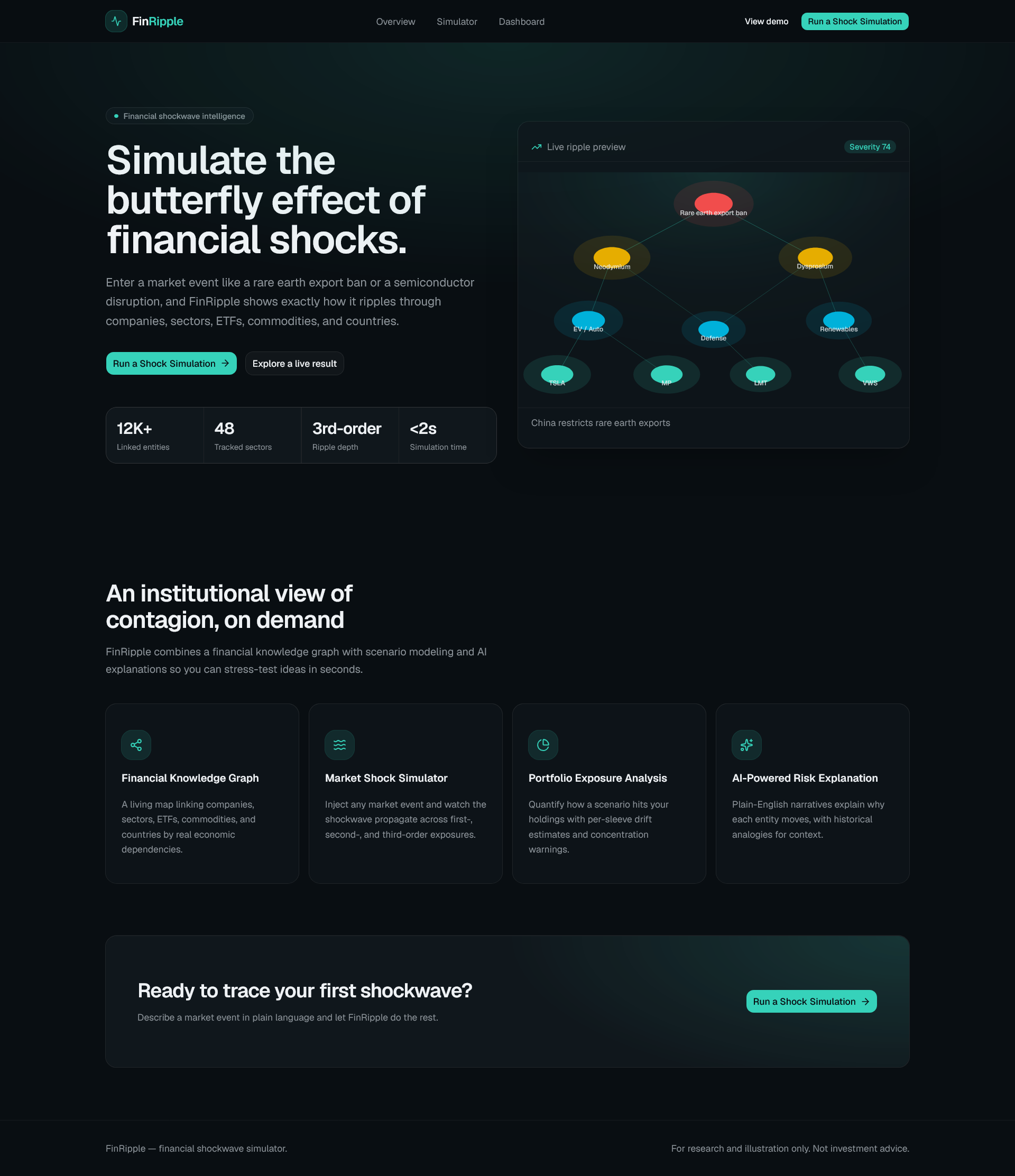
FinRipple is an AI-powered financial shock simulator that models the ripple effects of real-world events.
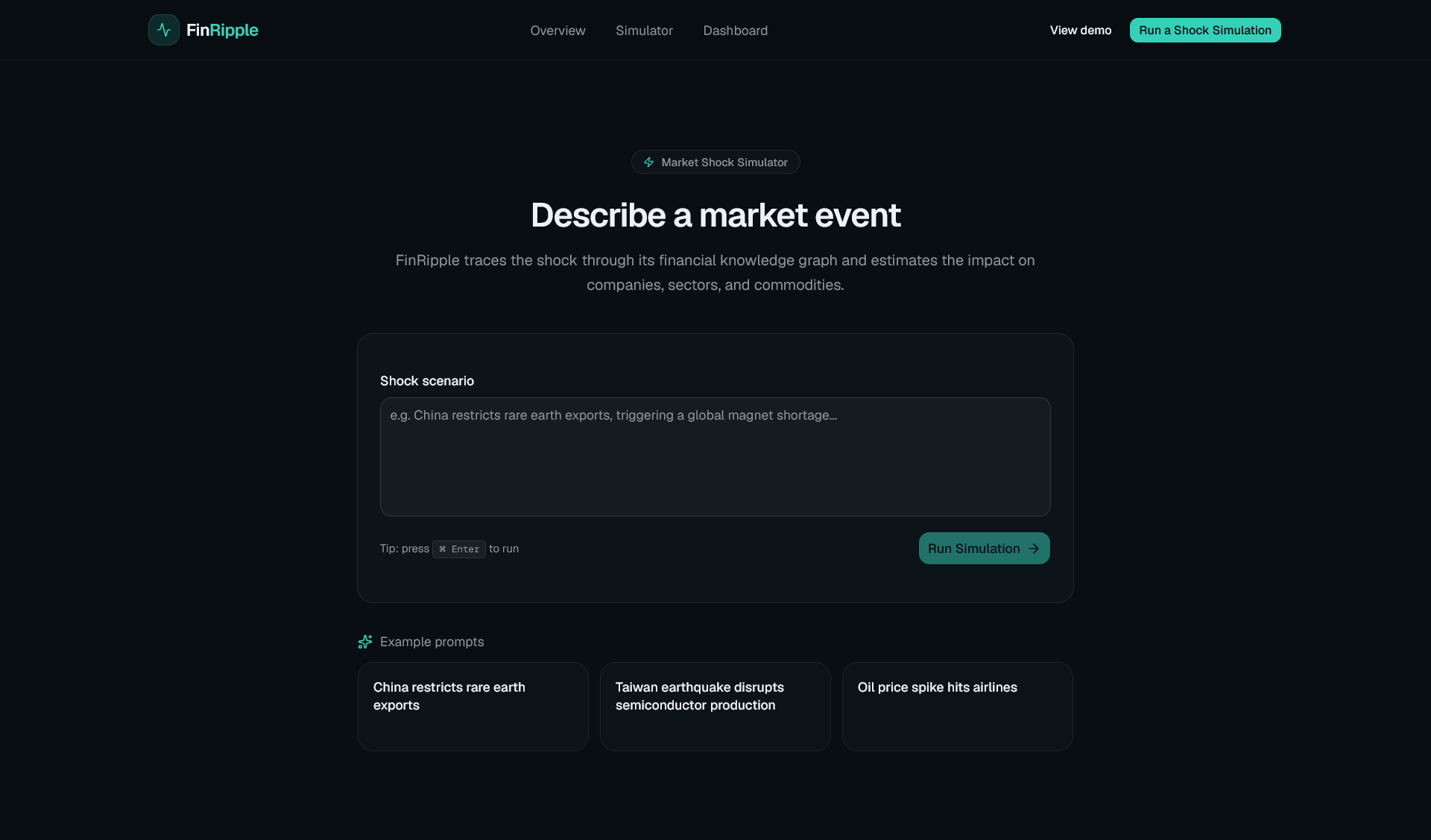
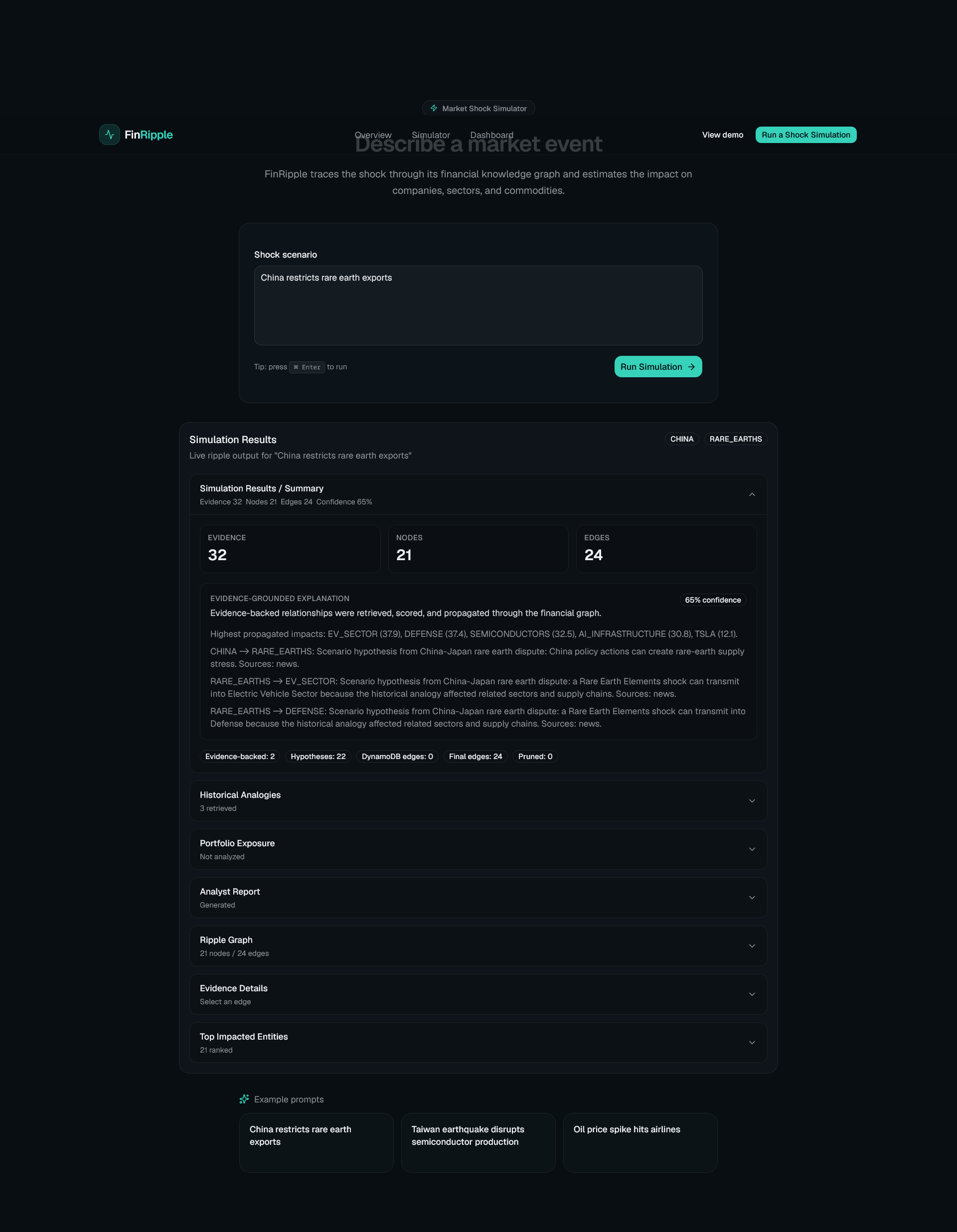
Users describe a market event in plain English—for example, "China restricts rare earth exports" or "Taiwan earthquake disrupts semiconductor production." FinRipple extracts the relevant entities, retrieves supporting evidence, traverses a financial knowledge graph, and estimates how the shock propagates across companies, sectors, commodities, ETFs, and supply chains.
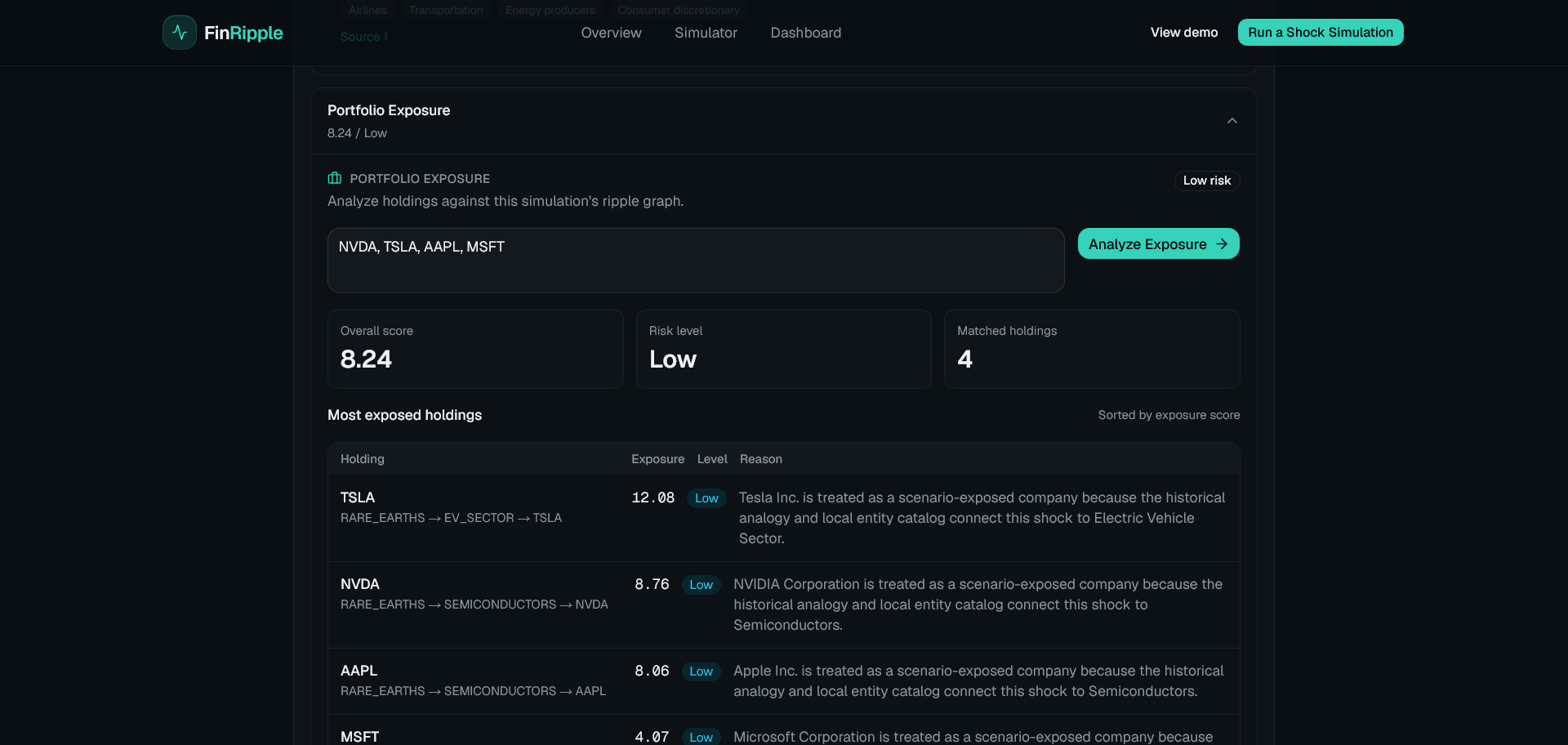
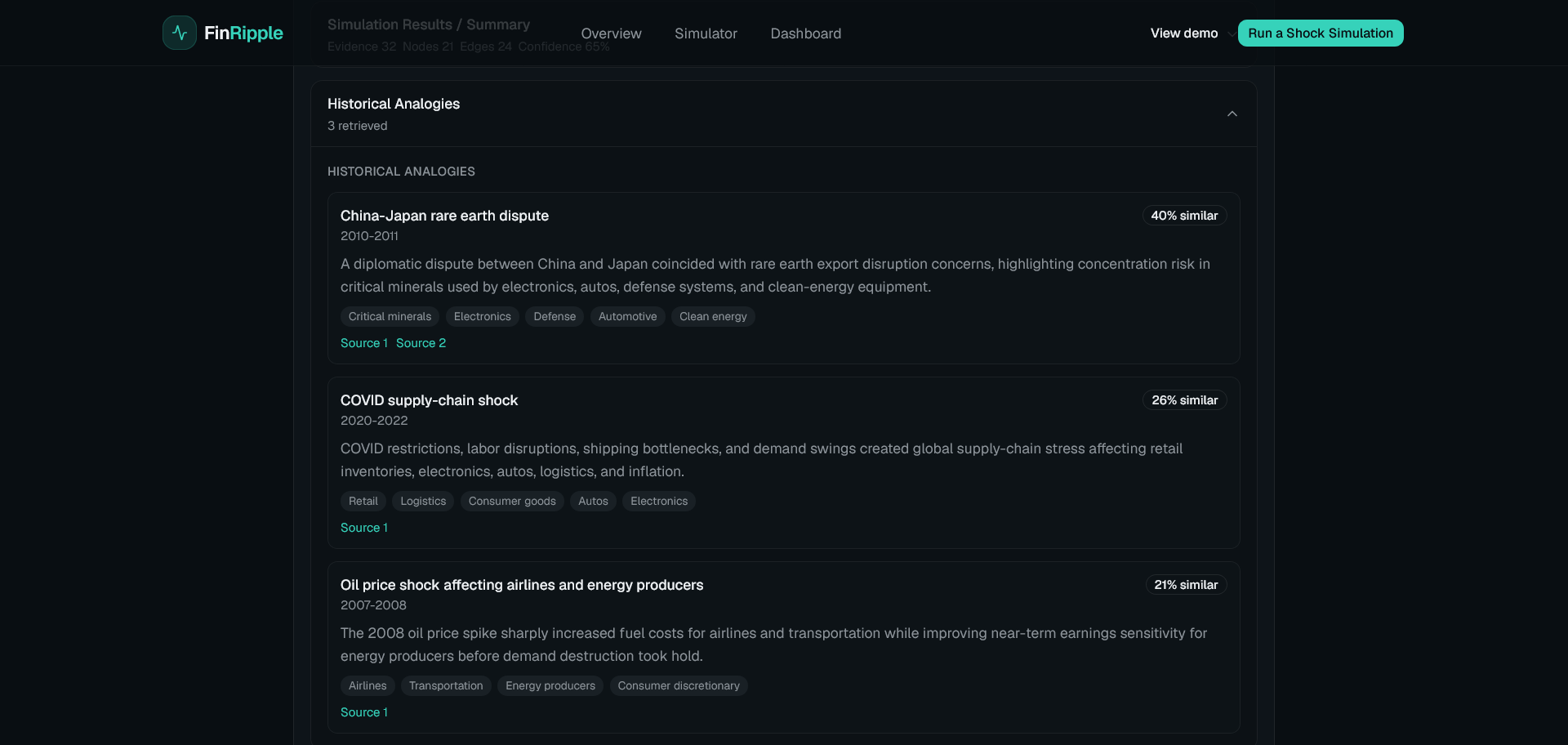
The platform then identifies historical analogies, analyzes portfolio exposure, and generates an analyst-style report explaining the reasoning behind every major impact. Evidence-backed relationships are distinguished from scenario-generated hypotheses, making the system transparent rather than a black box.
How I built it
I built FinRipple using Next.js, React, Tailwind CSS, shadcn/ui, and React Flow for the frontend, deploying the application on Vercel.
The backend is powered by Amazon DynamoDB, which stores the financial entities and persistent relationships that form the application's knowledge graph.
To populate the graph, I developed an evidence-ingestion pipeline that collects and processes SEC filings and financial datasets, extracting relationships supported by real-world evidence. During runtime, FinRipple combines these verified relationships with scenario-specific hypotheses to simulate how shocks propagate through the financial ecosystem.
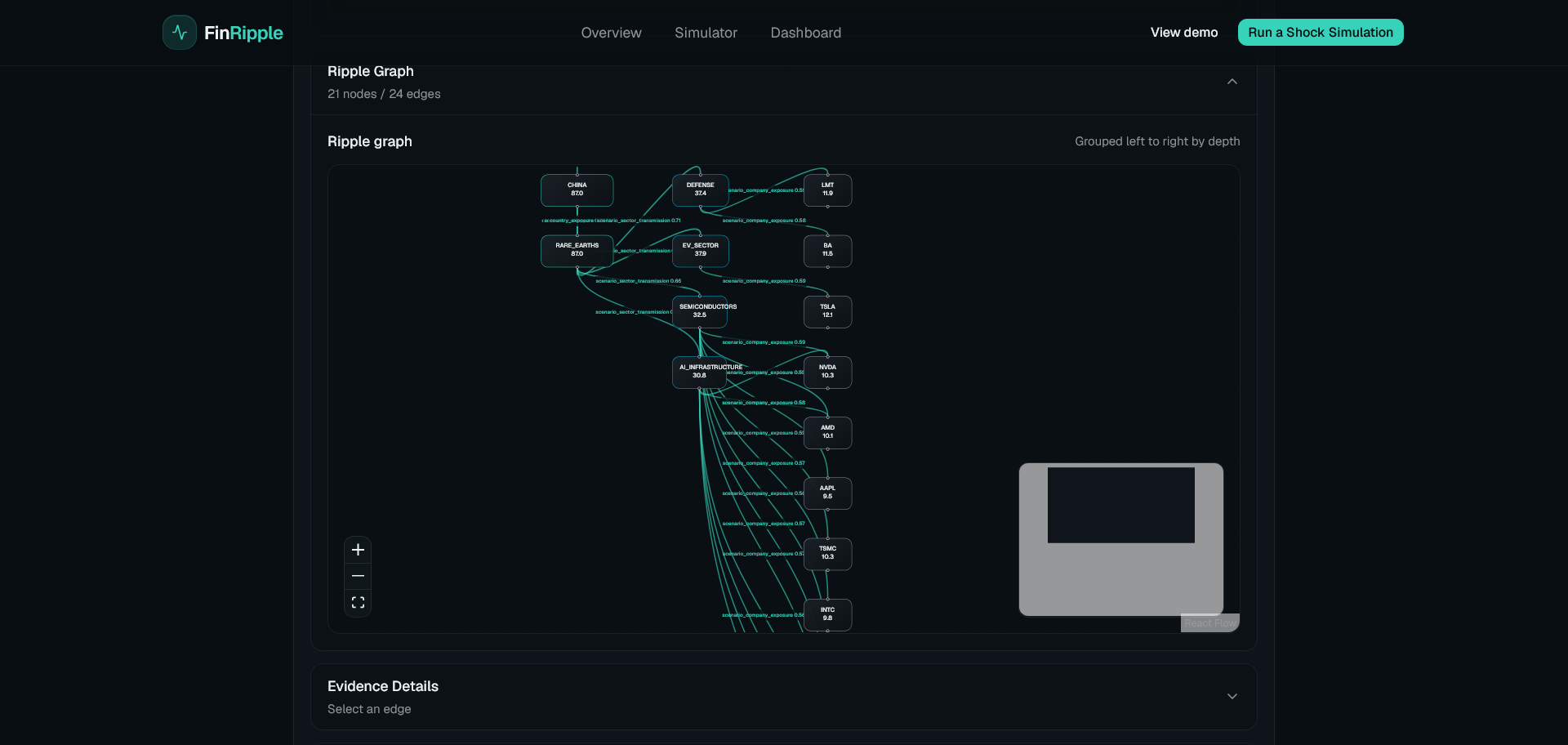
The application also includes an interactive ripple graph, evidence explorer, historical analogies, portfolio exposure analysis, and an AI-generated analyst report that explains the simulation results.
Challenges I ran into
The biggest challenge was balancing realism with explainability.
A graph built only from verified evidence was too sparse to simulate complex financial shocks, while a graph generated entirely by AI produced results that were difficult to trust. I addressed this by separating relationships into multiple confidence levels: evidence-backed relationships, scenario-generated hypotheses, and clearly labeled inferred connections.
Another challenge was visualizing large financial graphs without overwhelming users. I redesigned the graph layout and propagation engine several times before arriving at a structure that remains readable while preserving complex multi-hop relationships.
Accomplishments that I'm proud of
- Built an interactive financial knowledge graph from scratch.
- Integrated Amazon DynamoDB as the primary backend for graph storage.
- Developed an explainable multi-hop financial ripple propagation engine.
- Combined evidence retrieval, historical analogies, portfolio analysis, and AI-generated reports into a single workflow.
- Designed a professional interface that resembles institutional financial research tools rather than a traditional dashboard.
What I learned
This project reinforced that explainability is just as important as prediction.
I learned that users trust AI systems far more when every conclusion is supported by transparent evidence and clearly documented reasoning. Building FinRipple also deepened my understanding of financial dependency networks, graph-based reasoning, evidence retrieval, and combining structured financial data with AI to create interpretable decision-support systems.
What's next for FinRipple
My vision is to evolve FinRipple into a real-time financial intelligence platform.
Future work includes live market and news ingestion, continuously updating the knowledge graph with new SEC filings and economic events, portfolio optimization and hedging recommendations, probabilistic scenario forecasting, personalized watchlists, and AI agents that monitor global events and proactively alert investors before ripple effects fully materialize.
Ultimately, I envision FinRipple becoming a platform that helps investors, analysts, and enterprises understand not only what is happening in the market, but what is likely to happen next—and why.
Built With
- alalysis
- amazon-dynamodb
- aws-sdk-for-javascript
- exposure
- knowledge-graph-scoring
- local-embeddings/vector-search
- next.js
- node.js
- portfolio
- react
- react-flow
- sec-edgar-data-collection
- shadcn/ui
- tailwind-css
- typescript
- vercel
- yahoo-finance-market-data-collection


Log in or sign up for Devpost to join the conversation.