-
-
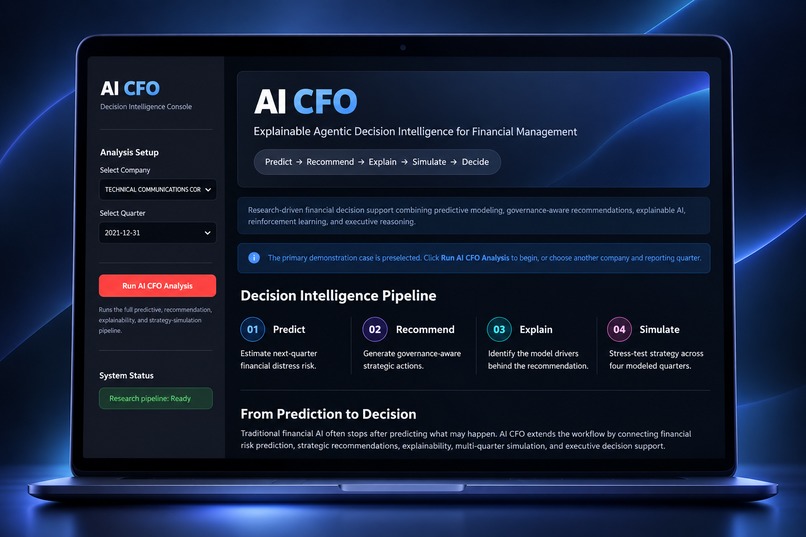
AI CFO: financial distress prediction, recommendations, SHAP explainability, PPO simulation, and Nemotron reasoning via Nebius
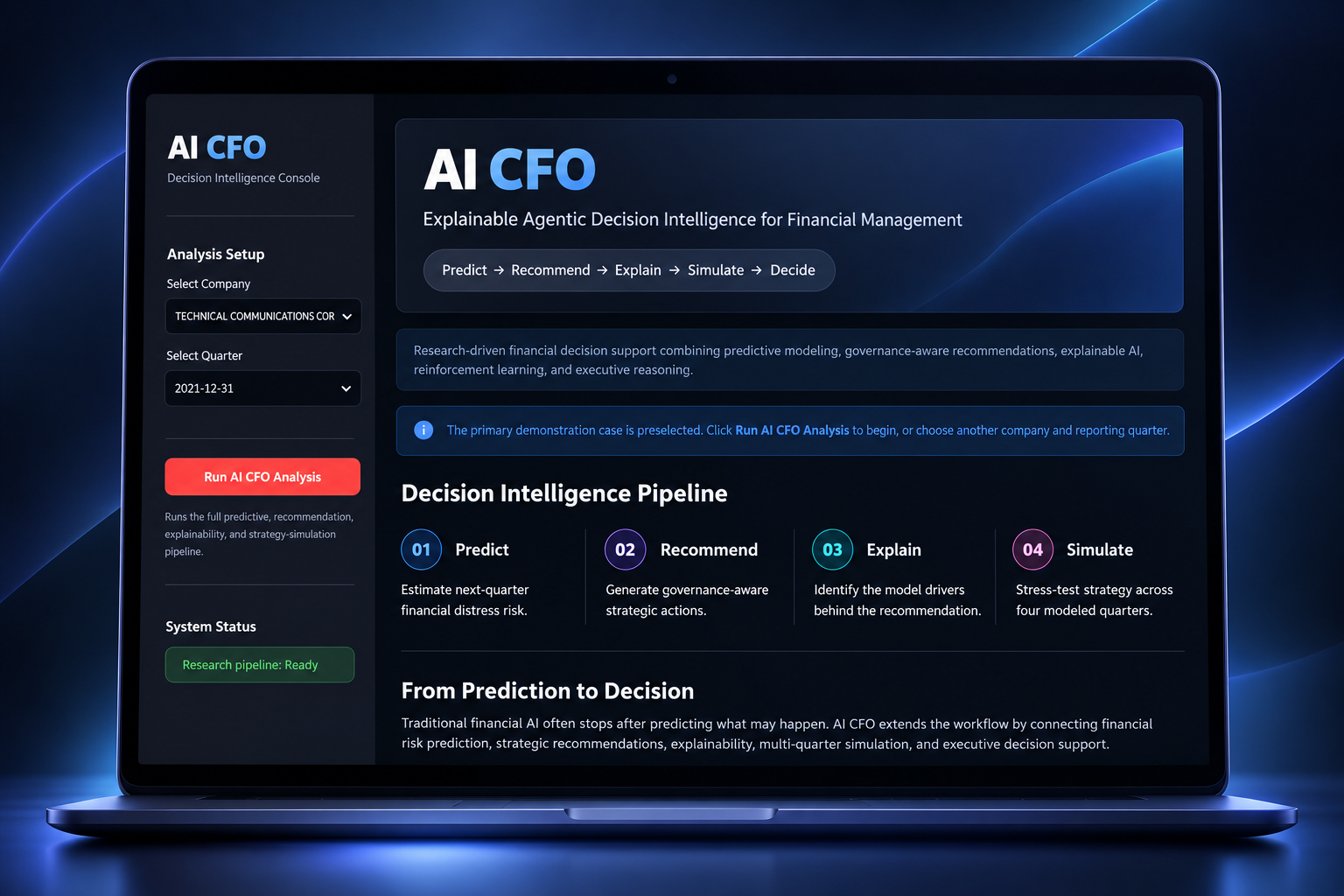
Inspiration
AI CFO grew out of a question I kept returning to through both my professional and academic work: how can artificial intelligence help financial leaders move beyond reporting what happened and support better decisions about what to do next? My professional background includes accounting, government financial oversight, audit, risk analysis, and executive decision support, while my doctoral research focuses on artificial intelligence, machine learning, predictive analytics, explainability, reinforcement learning, and decision intelligence. That combination led me to develop AI CFO as a financial decision-intelligence system rather than simply another financial chatbot. The goal is to help a decision-maker move through a complete reasoning process: financial data → prediction → recommendation → explanation → simulation → executive decision support What interested me most was not building one more model that produces a prediction. It was connecting several different forms of analytical intelligence while remaining transparent about evidence, uncertainty, assumptions, and the role of human judgment. For the hackathon, I wanted to take that research foundation and turn it into something closer to a real product: an application where specialized models perform the quantitative work and NVIDIA Nemotron, running through Nebius Token Factory, acts as the final executive reasoning layer.
What it does
AI CFO is an explainable, agentic financial decision-intelligence application that connects several analytical layers into one end-to-end workflow. The system can:
- predict next-quarter financial distress risk,
- assess overall financial health,
- classify the company into a strategic regime,
- generate next-quarter financial forecasts,
- rank governance-aware executive recommendations,
- explain the strongest model drivers behind the top recommendation using SHAP-based surrogate models,
- simulate a four-quarter strategy path using a PPO reinforcement-learning policy,
- and synthesize those outputs into an executive decision brief using NVIDIA Nemotron-3-Super-120B-A12B through Nebius Token Factory. The core workflow is: Predict → Recommend → Explain → Simulate → Decide Each layer answers a different question. The prediction layer estimates financial risk. The recommendation layer identifies possible management actions. The explainability layer shows which model factors influenced the recommendation. The simulation layer explores how a strategy may evolve over multiple modeled quarters. Finally, Nemotron receives the structured outputs from those components through Nebius Token Factory and converts them into an executive-level decision brief that highlights risk, recommendations, tradeoffs, conflicting signals, and model limitations. The language-model layer is intentionally not responsible for performing the underlying financial calculations. Its role is synthesis and interpretation. The public application provides three complementary workflows:
- Historical Dashboard — demonstrates the full decision pipeline on historical company-quarter examples.
- Forward Validation — evaluates the frozen financial-distress model on later, out-of-time financial states.
- New Company Analysis — allows a user to enter recognizable financial information and automatically constructs the model-ready state required by the analytical pipeline. The public deployment now uses live NVIDIA Nemotron inference through Nebius Token Factory for the executive reasoning layer.
How we built it
The analytical foundation of AI CFO was developed in Python as part of my doctoral research. For the hackathon, I transformed those research components into a deployment-ready, agentic application connecting four specialized analytical layers with a fifth executive-reasoning layer.
1. Prediction
An XGBoost model estimates next-quarter financial distress probability using firm-level financial variables together with macroeconomic and market conditions. The deployed model uses an 88-feature financial state covering accounting information, derived ratios, macroeconomic conditions, market indicators, and industry information. The New Company Analysis workflow automatically constructs those model-ready features from a much smaller set of recognizable financial inputs.
2. Forecasting and Recommendation
The system calculates a Financial Health Score across:
- liquidity,
- leverage,
- profitability,
- growth,
- and efficiency. It then classifies the company into one of three strategic regimes:
- Growth
- Balanced
- Defensive The recommendation engine ranks candidate actions such as:
- Improve Working Capital Efficiency
- Increase Revenue Growth Investment
- Reduce Operating Expenses
- Increase Cash Reserves
- Delay Capital Expenditures
- Reduce Debt Exposure
- Refinance Debt
- Hold Strategy The system also produces next-quarter forecasts for revenue, operating cash flow, and EBITDA.
3. Explainability
Action-specific Random Forest surrogate models provide recommendation-level explainability. Each surrogate uses:
- Financial Health Score
- Distress Probability
- Growth regime
- Balanced regime
- Defensive regime SHAP is then used to show the direction and relative contribution of those factors to the selected recommendation. These SHAP values are treated as predictive contributions, not causal effects.
4. Simulation
A PPO reinforcement-learning policy built with Stable-Baselines3 and Gymnasium evaluates a four-quarter strategy path inside a custom financial environment. The Chapter 6 environment uses a 24-variable company state covering:
- financial condition,
- distress risk,
- macroeconomic conditions,
- industry,
- and economic regime. The action space contains combinations across:
- cost control,
- pricing,
- hiring,
- debt policy,
- and investment strategy. The simulation produces a sequential scenario showing how the modeled financial state evolves over four quarters. These outputs are treated as scenario-based decision support, not guaranteed forecasts.
5. Executive Reasoning with NVIDIA Nemotron on Nebius
The final layer uses NVIDIA Nemotron-3-Super-120B-A12B through Nebius Token Factory. The application packages the outputs from prediction, recommendation, SHAP explainability, and PPO simulation into a structured evidence package and sends it to Nemotron through Nebius's OpenAI-compatible inference API. Nemotron is instructed to:
- use only evidence generated by the analytical pipeline,
- avoid inventing unsupported financial values,
- distinguish predictions from simulations,
- avoid treating SHAP explanations as causal evidence,
- identify mixed or conflicting outcomes,
- preserve uncertainty,
- and communicate the evidence as executive decision support rather than guaranteed financial advice. The public app displays the active model and provider directly: NVIDIA Nemotron-3-Super-120B-A12B via Nebius Token Factory A direct NVIDIA API integration is retained as a secondary fallback, while Nebius Token Factory is the preferred live provider.
Hackathon-specific development
The underlying predictive, recommendation, explainability, and reinforcement-learning models originated in my doctoral research. The hackathon work focused on converting those research components into an integrated, usable product. Major additions built for the hackathon include:
- Streamlit deployment,
- a new orchestration layer,
- a public historical decision dashboard,
- live NVIDIA Nemotron integration through Nebius Token Factory,
- an executive decision-reasoning workflow,
- an out-of-time forward-validation workflow,
- a five-quarter walk-forward validation case study,
- a New Company Analysis workflow,
- automatic financial feature construction,
- SIC-code mapping into the trained model representation,
- Chapter 5 explainability integration,
- Chapter 6 custom-state construction,
- PPO strategy simulation for user-entered companies,
- a verified SEC-based Axogen example,
- comparison of AI CFO forecasts against subsequently reported SEC results,
- deployment-ready model and data artifacts,
- and governance safeguards throughout the user interface.
Challenges we ran into
One of the biggest challenges was integrating several different forms of AI without allowing one layer to blur the meaning of another. AI CFO combines predictive modeling, financial forecasting, recommendation logic, explainability, reinforcement learning, and large-language-model reasoning. Each produces a different type of evidence. For example:
- a financial-distress probability is a predictive estimate,
- a recommendation score represents relative decision priority,
- a SHAP value explains model contribution rather than causation,
- and a reinforcement-learning trajectory represents a modeled scenario rather than a guaranteed business outcome. The executive-reasoning layer therefore had to synthesize these outputs without flattening those distinctions. Another major challenge was turning technically complex research workflows into something a business user could actually use. The original research pipeline expected engineered features. A CFO or analyst should not have to manually calculate dozens of ratios, encode industries, or assemble macroeconomic and market variables. For the hackathon, I built a New Company Analysis workflow that accepts familiar financial information and automatically constructs the model-ready state. Deployment created another challenge. The original research environment depended on dissertation notebooks, large datasets, local files, and saved model artifacts. I refactored the project into a self-contained deployment bundle with reusable services, reduced deployment datasets, model artifacts, normalization statistics, and a cloud-ready Streamlit application. Forward validation also required careful design. I reconstructed later financial states using the same feature definitions expected by the frozen model while avoiding claims beyond what the illustrative sample supports. Another important challenge was financial-data quality. While building a real SEC example, I found that processed research panels can contain a mixture of quarterly and cumulative SEC facts that are useful for modeling but not always appropriate to display directly as financial statements. Rather than hiding that issue, I reconstructed the Axogen example from official SEC filings and used those values in the public application. Finally, Nebius onboarding itself was a learning experience. I received promotional Token Factory credit through the AI Builder Program, but standard onboarding still required billing verification before API-key creation. Once the account was activated, the actual Token Factory integration was straightforward because of the OpenAI-compatible API.
Accomplishments that we're proud of
One of the accomplishments I am most proud of is transforming a set of research models into a working, publicly deployed decision-intelligence system. AI CFO now connects: financial data → prediction → forecasting → recommendation → explanation → simulation → Nemotron reasoning → executive decision support in one application. The deployed system can take a company and reporting quarter, estimate distress risk, assess financial health, identify a strategic regime, forecast selected financial outcomes, rank management actions, explain recommendation drivers, simulate a four-quarter strategy path, and synthesize the entire evidence package through NVIDIA Nemotron running on Nebius Token Factory. For the hackathon, I also built an out-of-time forward-validation workflow using Technical Communications Corporation. Starting from the company's March 31, 2022 financial, macroeconomic, and market state, the frozen distress model estimated a 94.39% probability of next-quarter financial distress. The subsequently observed June 30, 2022 state met the predefined distress criteria, resulting in a correct forward classification. Across five consecutive next-quarter observations in this illustrative company-level walk-forward case study, the frozen classifier correctly classified 4 of 5 outcomes. I present that result as targeted forward evidence rather than as a claim of overall model accuracy. Another major accomplishment was building the New Company Analysis workflow. A user can now enter familiar business information and run the integrated analytical pipeline without needing access to the original research notebooks or manually engineered model features. To demonstrate this with real-world data, I added a one-click Axogen 2022 Q3 SEC example reconstructed from official SEC filings. For that case, AI CFO produces:
- Distress probability: 0.58%
- Financial Health Score: 0.392
- Strategic Regime: Growth
- Top recommendation: Improve Working Capital Efficiency
- Chapter 5 surrogate probability: 96.66%
- Chapter 6 simulated distress: approximately 0.58% → 0.61% The application then compares selected next-quarter forecasts with Axogen's subsequently reported Q4 results. For example:
- AI CFO revenue forecast: approximately $56.95M
- Actual Q4 revenue: approximately $36.16M
- AI CFO operating cash flow forecast: approximately -$1.33M
- Actual Q4 operating cash flow: approximately +$1.36M Those forecast misses are deliberately shown rather than hidden. The purpose of the Axogen example is not to claim strong forecast accuracy. It demonstrates a complete business workflow using verified SEC inputs and shows how model outputs can be evaluated transparently against later reported outcomes. I am also proud of the governance safeguards built into the system. AI CFO deliberately distinguishes:
- prediction from recommendation,
- recommendation from probability of success,
- explanation from causality,
- simulation from forecast,
- and model evidence from executive interpretation.
What we learned
The biggest lesson from building AI CFO is that decision intelligence should not rely on one model or one type of AI. Different tools answer different questions. A predictive model estimates what may happen. A forecasting model estimates selected future financial outcomes. A recommendation layer identifies possible actions. SHAP helps explain what is influencing a model recommendation. Reinforcement learning explores how a strategy may evolve inside a modeled environment. Nemotron then synthesizes those outputs into a form that is easier for a human decision-maker to interpret. A second major lesson was that the boundaries between these analytical methods matter. A predictive explanation is not a causal explanation. A recommendation score is not the probability that an action will succeed. A simulated strategy path is not a guaranteed future outcome. Those distinctions became central design principles of the project. I also learned that explainability and governance cannot be treated as optional add-ons in high-stakes AI applications. Users need to understand:
- where a recommendation came from,
- what assumptions were used,
- what evidence supports it,
- what uncertainty remains,
- and where human judgment is still required. The forward-validation work reinforced another important lesson: model evaluation becomes more meaningful when predictions are compared with later financial states rather than only development samples. At the same time, one company and five observations are not enough to establish general performance, so the result is presented transparently as an illustrative case study. The Axogen SEC example reinforced how important data engineering is. Machine-learning datasets can contain transformations and reporting conventions appropriate for modeling but not necessarily appropriate for user-facing financial statements. Finally, the hackathon taught me the difference between a research model and a deployable AI product. Turning AI CFO into a working application required:
- refactoring model and data dependencies,
- creating reusable services,
- building an orchestration layer,
- deploying the system publicly,
- integrating cloud-hosted LLM inference,
- designing a business-friendly interface,
- implementing secrets and provider management,
- and thinking about the user experience rather than only the research experiment.
What's next for AI CFO
The next stage is to expand AI CFO from a historical research prototype into a broader decision-intelligence platform. I plan to expand forward validation across more companies and reporting periods so the system can be evaluated more systematically on later financial states. I also plan to extend New Company Analysis beyond the currently packaged 2021–2022 macroeconomic and market periods by connecting live macroeconomic, SEC, and market-data sources. Additional areas for development include:
- automated SEC financial-data ingestion,
- live macroeconomic and market intelligence,
- broader scenario analysis,
- additional executive decision tools,
- stronger model monitoring and governance controls,
- expanded out-of-time validation,
- structured Nemotron tool calling,
- richer natural-language financial questions,
- and additional evaluation of agentic AI in high-stakes decision environments. Longer term, the goal is to develop AI CFO into a transparent decision-intelligence platform that helps users move from: financial data → prediction → forecasting → recommendation → explanation → simulation → executive reasoning → decision support while keeping the human decision-maker in control.
Built With
- gymnasium
- joblib
- jupyter
- lightgbm
- nebius
- nemotron
- numpy
- pandas
- python
- pytorch
- scikit-learn
- shap
- stable-baselines3
- streamlit
- xgboost

