-
-
-
-
-
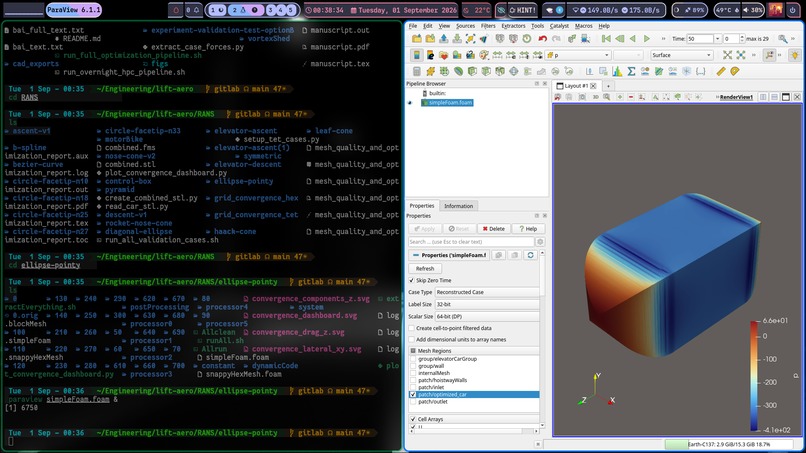
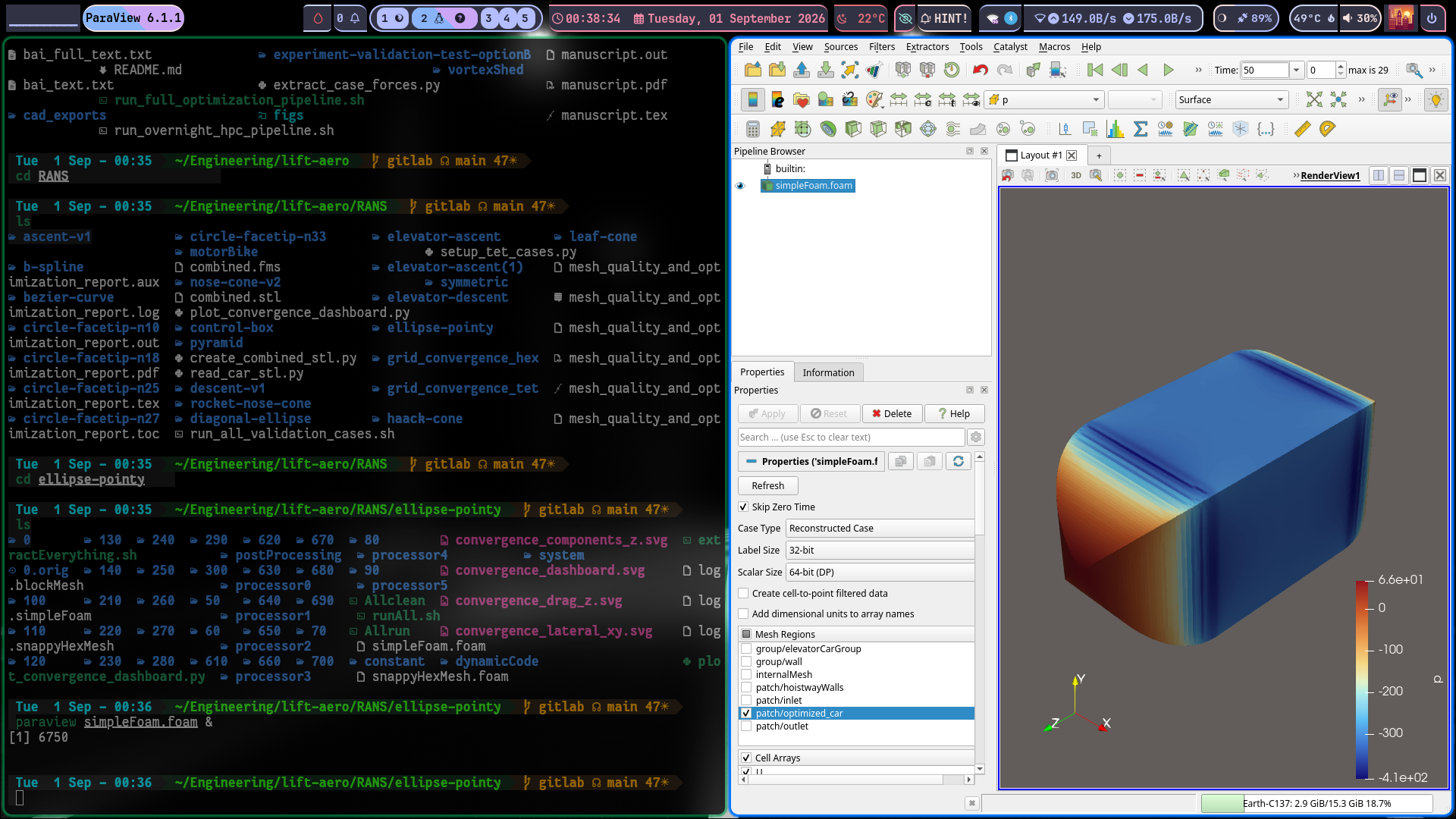
Pressure field visualized around elliptic fairing car at 10 m/s.
-
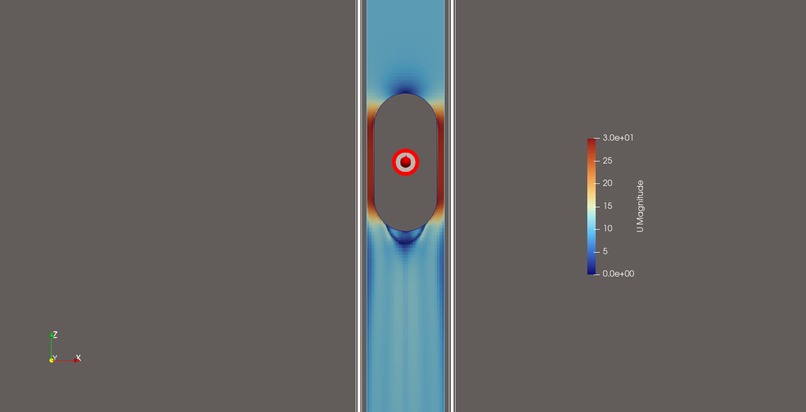
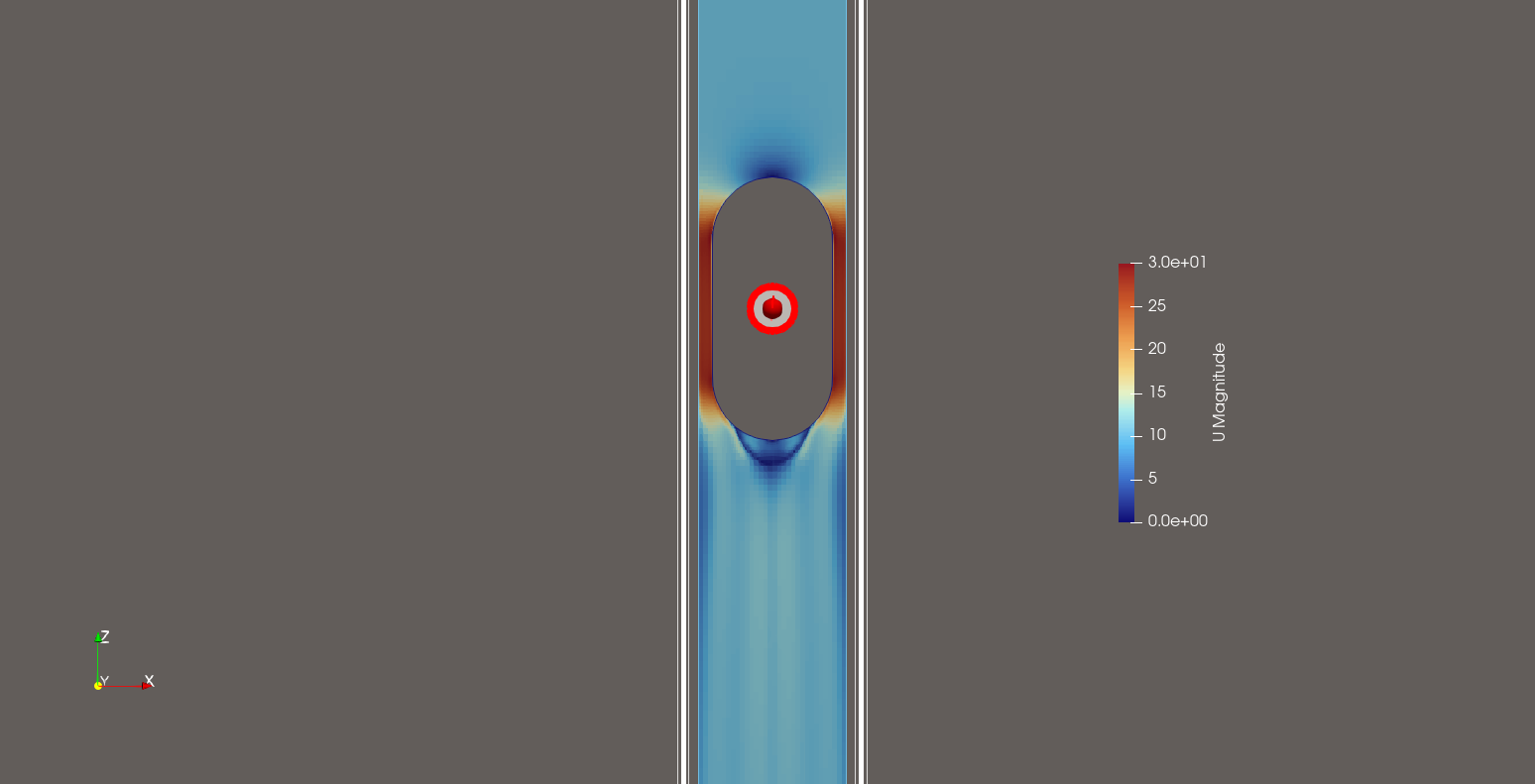
Velocity Magnitude field visualization along a section view normal to y of an elliptical fairing attached elevator car at 10 m/s
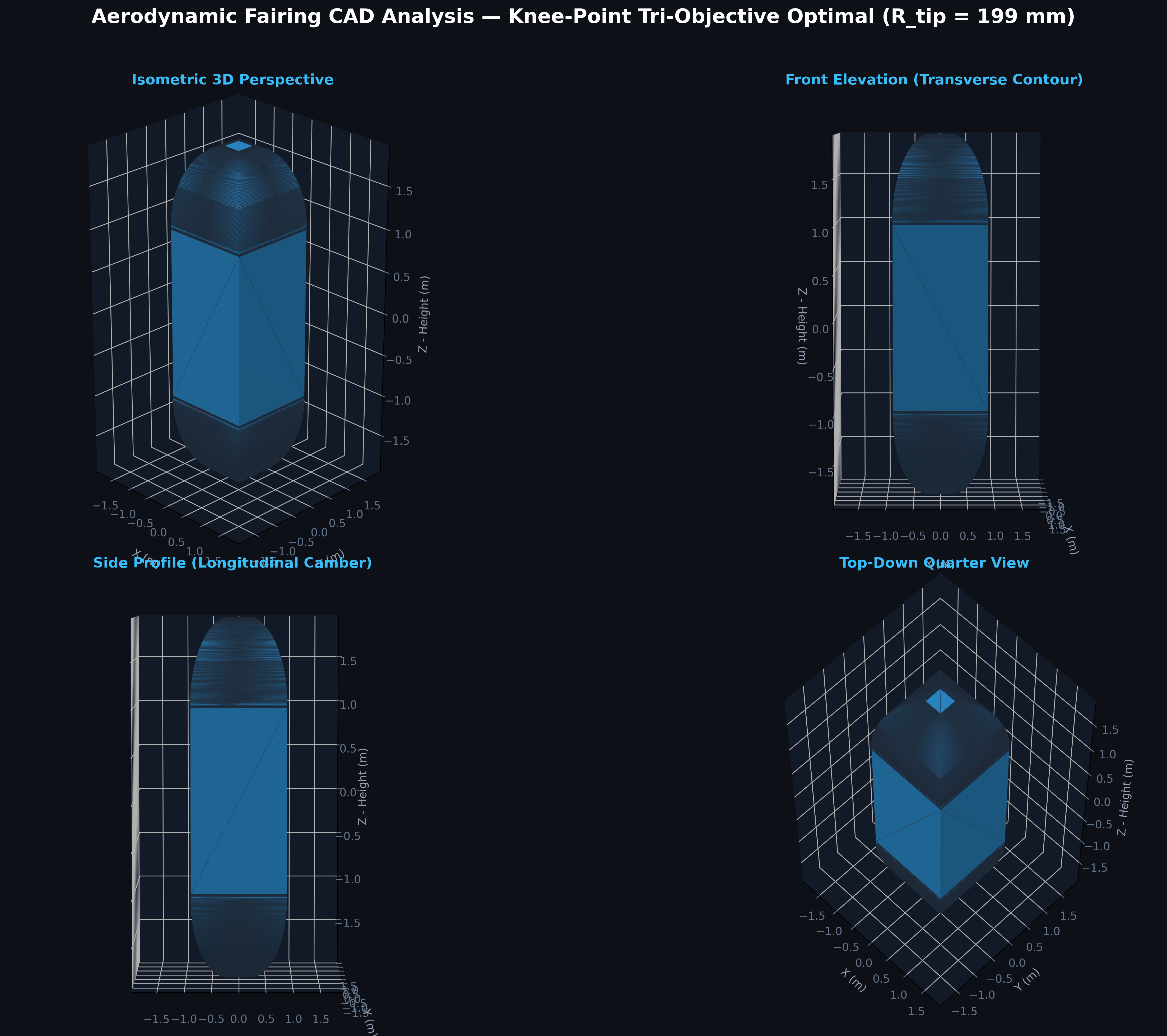
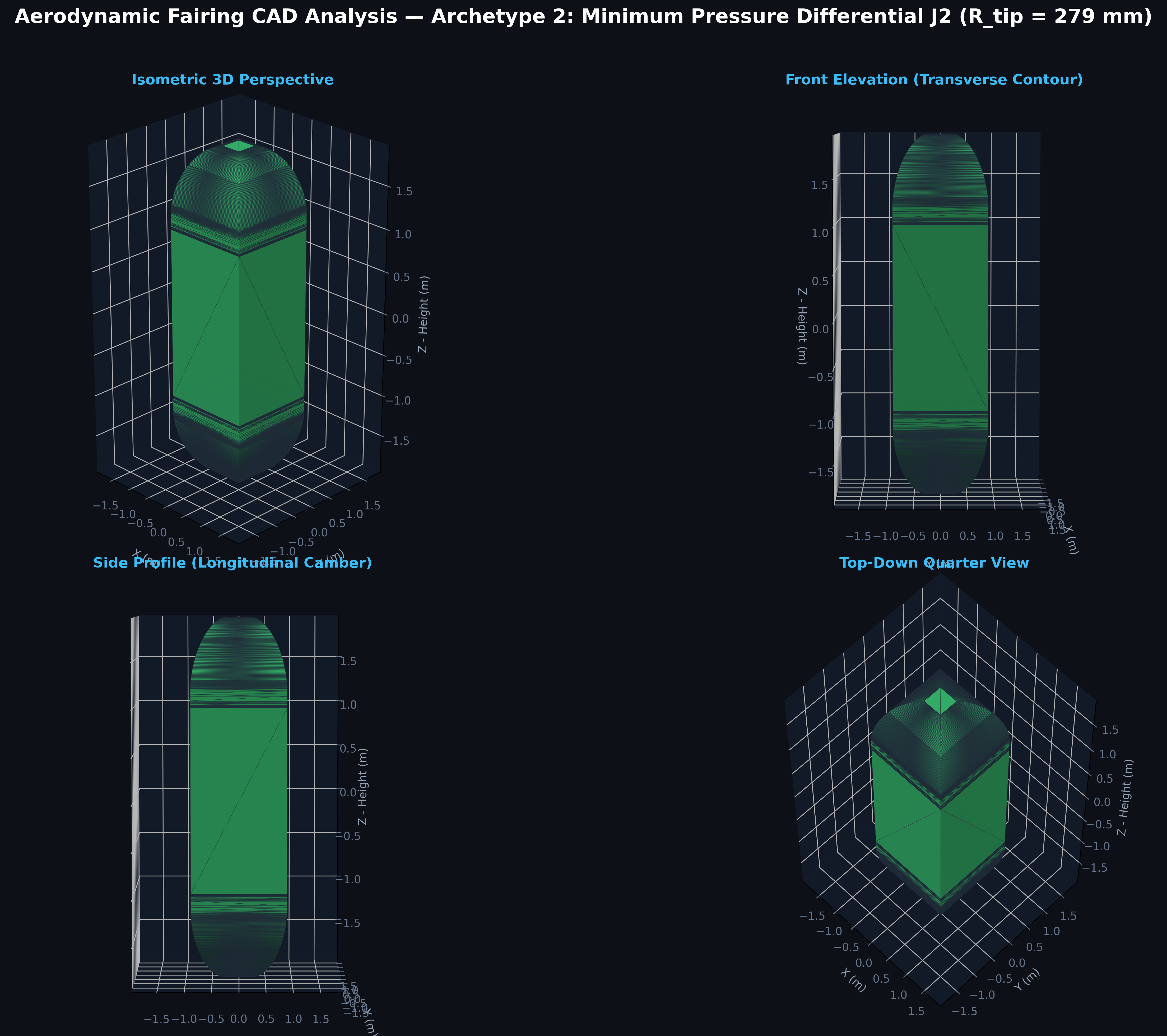
Lift-Aero-ML: AI-Driven 3D Aerodynamic Shape Optimization for Ultra-High-Speed Elevators
Inspiration
As modern architecture surges toward megatall skyscrapers exceeding 500–1000 meters, vertical transportation reaches speeds of \( 15 \text{ to } 20+\text{ m/s} \) (\( 54–72\text{ km/h} \)). However, when a high-speed car ascends inside a narrow hoistway with a high blockage ratio (\( \beta = A_{\text{car}} / A_{\text{shaft}} \approx 0.5–0.6 \)), it operates essentially like a high-speed piston inside an engine cylinder.
This confined aerodynamics creates three severe engineering bottlenecks:
- Excessive Aerodynamic Drag (\( J_1: F_d \)): Skyrockets motor energy consumption and thermal load.
- The "Piston Effect" Pressure Differential (\( J_2: \Delta P \)): Generates severe pressure transients that cause painful passenger ear discomfort and acoustic booming.
- Turbulent Flow Separation & Buffeting (\( J_3: F_{xy,\text{rms}} \)): Unsteady vortex shedding excites horizontal cabin sway, inducing motion sickness and wearing guide rails.
Traditional Computational Fluid Dynamics (CFD) optimization requires weeks of high-performance computing and manual CAD adjustments per iteration. We were inspired to ask: Can we combine continuous parametric geometry, Machine Learning surrogates, and evolutionary genetic algorithms to compress months of aerodynamics engineering into seconds of automated AI discovery?
How We Built It
We designed and implemented an end-to-end, hardware-agnostic 3D optimization and CAD generation framework:
[7D NURBS Parameterization]
            │
            ▼
[Latin Hypercube Sampling (LHS) DoE] ──► [CFD Database (OpenFOAM / Analytical)]
                                                       │
                                                       ▼
[Automated FreeCAD B-Rep Engine] ◄── [4-Island MIGA] ◄── [Kriging / GPR Surrogates]
   (STEP / STL Solids)                (10k Pareto Evals)   (R² > 0.95 with Matérn 5/2)
1. Continuous 7D NURBS Spine Parameterization
Instead of relying on rigid, discrete geometric primitives, we parameterized the fairing's longitudinal contour using a 7-dimensional continuous NURBS curve defined by: $$\mathbf{x} = \left[ R_{\text{tip}}, z_7, z_6, z_5, z_4, z_3, z_2 \right]^T$$ where \( R_{\text{tip}} \in [5\text{ mm}, 350\text{ mm}] \) sets the nose tip radius on a \( 1\text{ mm} \) manufacturing grid, and \( z_2 \dots z_7 \) govern vertical inflection heights controlling nose deceleration, flanks, and transition fillets.
2. High-Accuracy Kriging Gaussian Process Surrogates
To emulate expensive CFD evaluations, we trained Gaussian Process Regression (GPR) models for each objective using a generalized Matérn covariance kernel (\( \nu = 2.5 \)) combined with constant scaling and noise regularization: $$k(\mathbf{x}, \mathbf{x}') = \sigma_f^2 \left( 1 + \sqrt{5} d + \frac{5}{3} d^2 \right) \exp\left(-\sqrt{5} d\right) + \sigma_n^2 \delta(\mathbf{x}, \mathbf{x}')$$ where \( d = \sqrt{\sum_{i=1}^7 \frac{(x_i - x_i')^2}{\ell_i^2}} \).
Under rigorous Leave-One-Out Cross-Validation (LOOCV), our surrogates achieved:
- Drag Force (\( F_d \)): \( R^2 = 0.9805 \quad (\text{RMSE} = 0.4655\text{ N}) \)
- Pressure Differential (\( \Delta P \)): \( R^2 = 0.9667 \quad (\text{RMSE} = 1.4329\text{ Pa}) \)
- Lateral RMS Force (\( F_{xy,\text{rms}} \)): \( R^2 = 0.9540 \quad (\text{RMSE} = 0.0363\text{ N}) \)
3. 4-Island Multi-Island Genetic Algorithm (MIGA)
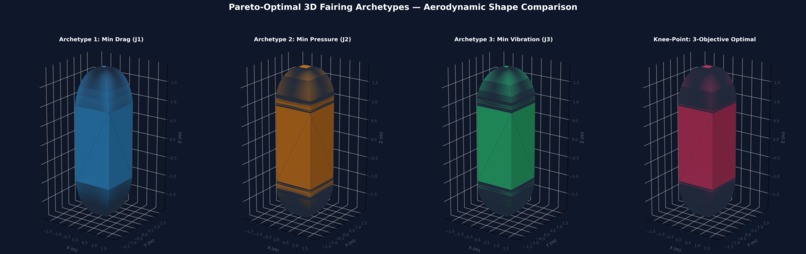
To avoid local entrapment across non-convex trade-off surfaces, we structured the search space into \( N_{\text{islands}} = 4 \) sub-populations running 50 generations with periodic ring migration: $$\min_{\mathbf{x} \in \Omega} \mathbf{J}(\mathbf{x}) = \left[ F_d(\mathbf{x}),\, \Delta P(\mathbf{x}),\, F_{xy,\text{rms}}(\mathbf{x}) \right]$$ In under \( 10\text{ seconds} \), MIGA executed \( 10,000 \) evaluations and mapped a 28-point non-dominated 3D Pareto frontier.
4. Automated B-Rep CAD Synthesis (FreeCAD Engine)
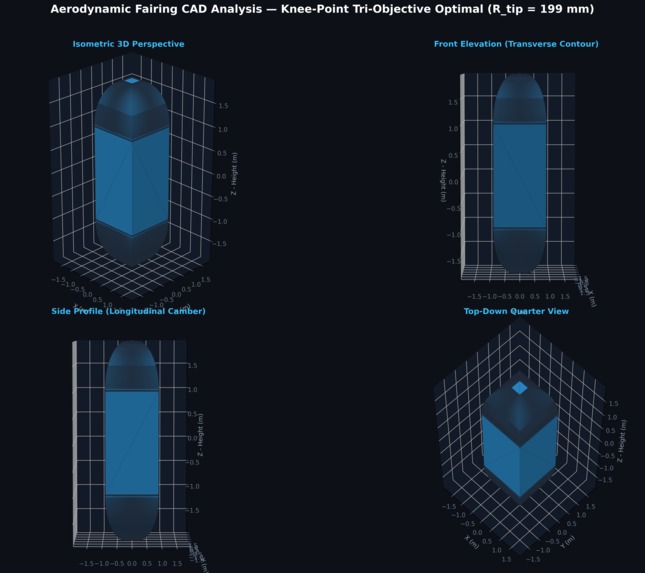
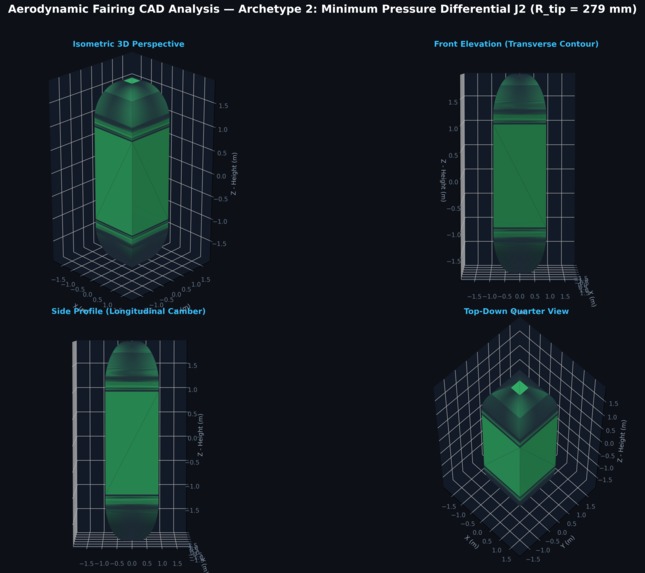
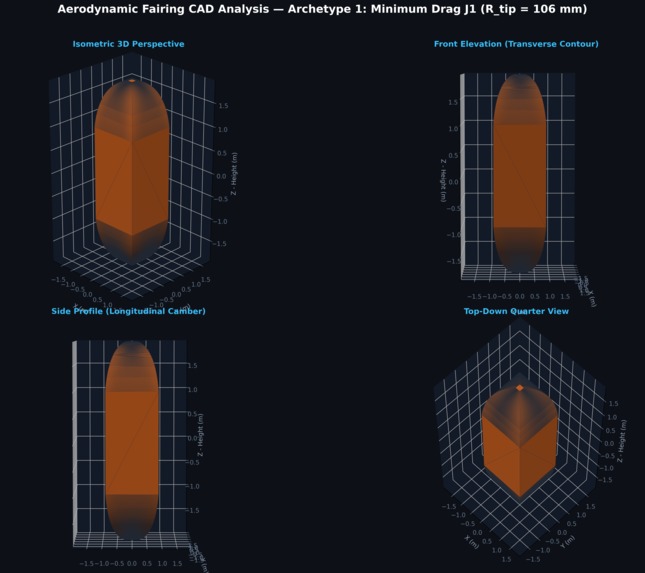
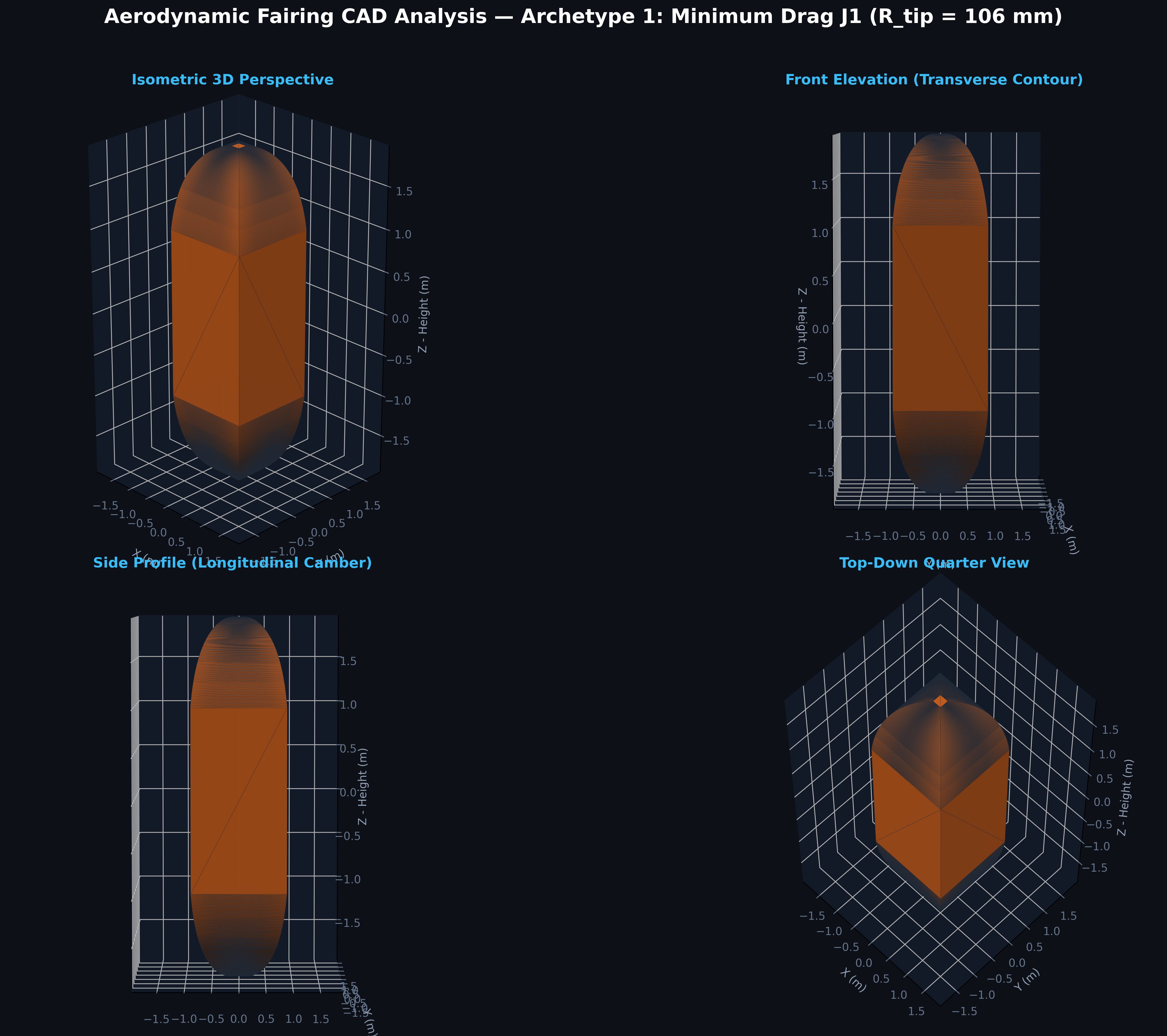
To bridge the gap between AI mathematical coordinates and the factory floor, we integrated a headless FreeCAD B-Rep engine. The engine lofts cross-sectional slices according to the optimal NURBS spine and exports watertight, 3D-printable .stl and precision CNC-machinable .step solid geometries.
Challenges We Faced
- The Tri-Objective Trade-off Conflict: Aerodynamic objectives directly oppose one another. A sharp, needle-like nose minimizes drag (\( F_d \)) but concentrates stagnation pressure gradients (\( \Delta P \)) and triggers asymmetric cross-flow detachment (\( F_{xy} \)). Balancing these required a Pareto multi-objective approach rather than a single weighted sum.
- Bridging Discrete Optimization to Continuous B-Rep CAD: Early optimizer outputs generated discrete point coordinates that traditional CAD kernels failed to loft smoothly, creating self-intersecting meshes. We solved this by developing a dedicated NURBS interpolation and lofting pipeline that translates 7D vector states directly into watertight B-Rep solids.
- Cross-Platform HPC & Colab Portability: CFD runs on high-performance Linux clusters with OpenFOAM, while optimization and visualization occur on cloud environments (Google Colab) and developer workstations. We engineered environment-agnostic wrappers that auto-detect Python runtimes, FreeCAD shared libraries, and Git LFS binary assets.
Accomplishments We're Proud Of
- Extreme Acceleration: Reduced the time required to discover optimal aerodynamic fairings from weeks of manual CFD iterations down to under 10 seconds.
- High Predictive Fidelity: Surpassed \( R^2 > 0.95 \) across all three turbulent objectives via localized Matérn length-scale optimization.
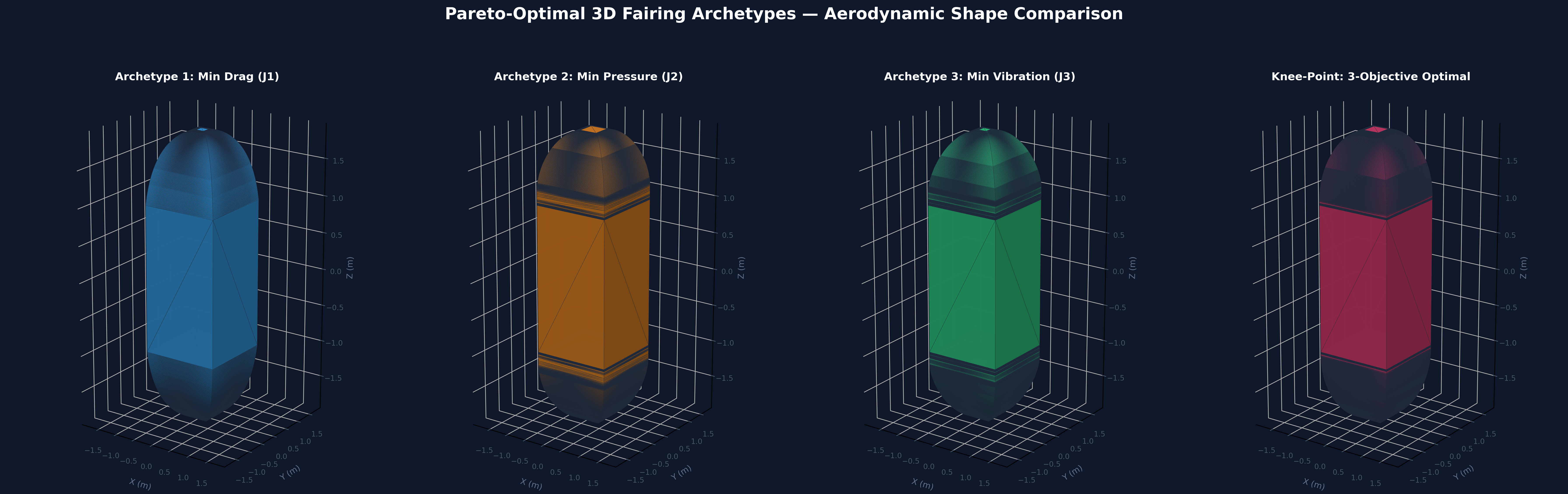
- Direct-to-Manufacturing: Successfully generated clean, airtight CAD solids (STEP/STL) of the optimal Knee-Point design ready for physical wind-tunnel scale-model 3D printing.
What We Learned
- Confined Aerodynamics Nuances: How high blockage ratios in enclosed shafts fundamentally alter boundary-layer separation compared to free-stream vehicle aerodynamics.
- Surrogate Modeling Robustness: How proper kernel selection (Matérn 5/2 vs. Radial Basis Functions) drastically enhances generalization when predicting non-linear fluid wake dynamics.
- MIGA Island Dynamics: The power of island migration topologies in maintaining genetic diversity and preventing premature convergence on complex Pareto manifolds.
What's Next for Lift-Aero-ML
- Full-Scale Wind Tunnel & IDDES Validation: Performing Scale-Resolving Simulations (IDDES) and physical 3D-printed wind-tunnel testing on the discovered Knee-Point geometry.
- Active Flow Control Integration: Extending the 7D parameter space to include micro-vortex generators and active boundary-layer suction slots.
- Interactive Web-Based 3D Visualizer: Deploying a web-based parametric digital twin allowing building designers and elevator manufacturers to customize shaft dimensions and inspect optimal fairing geometries in real time.
Built With
- aerodynamics
- cad
- cfd
- freecad
- genetic-algorithm
- git-lfs
- google-colab
- machine-learning
- matplotlib
- numpy
- openfoam
- pandas
- python
- scikit-learn
- scipy


Log in or sign up for Devpost to join the conversation.