Inspiration
Traditional business intelligence tools are excellent at showing companies what is happening, but they often stop there: dashboards, charts, alerts, and reports. We wanted to explore a different question: What if business intelligence could actually help a company decide what to do next—and, with human approval, execute it? That idea led to AI CEO. We imagined a system that continuously understands business signals, identifies risks and opportunities, brings multiple business perspectives into a decision, explains its reasoning, asks a human for approval, executes the approved action, and then measures the outcome. The goal wasn't to build another chatbot or dashboard. It was to build an auditable, human-supervised AI decision and execution layer for businesses.
What it does
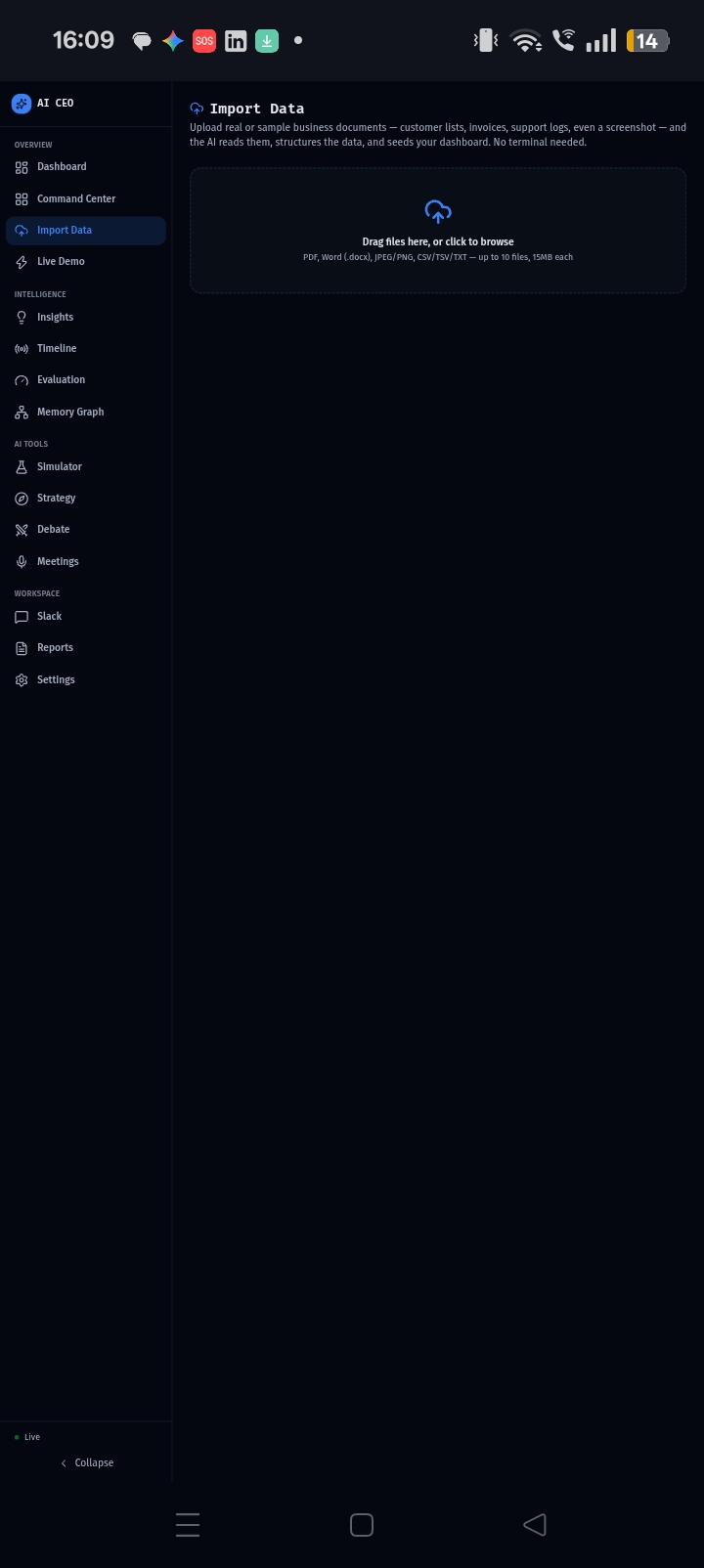
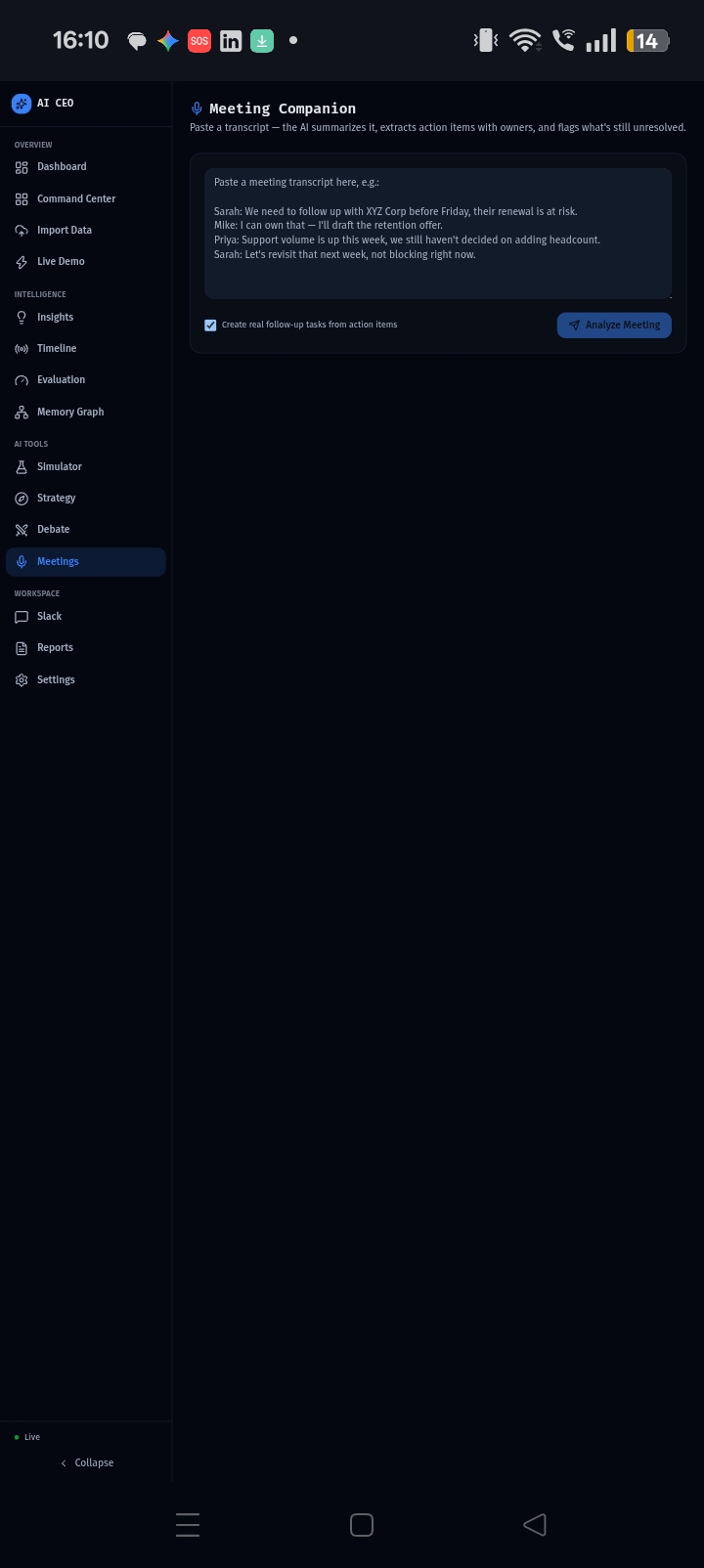
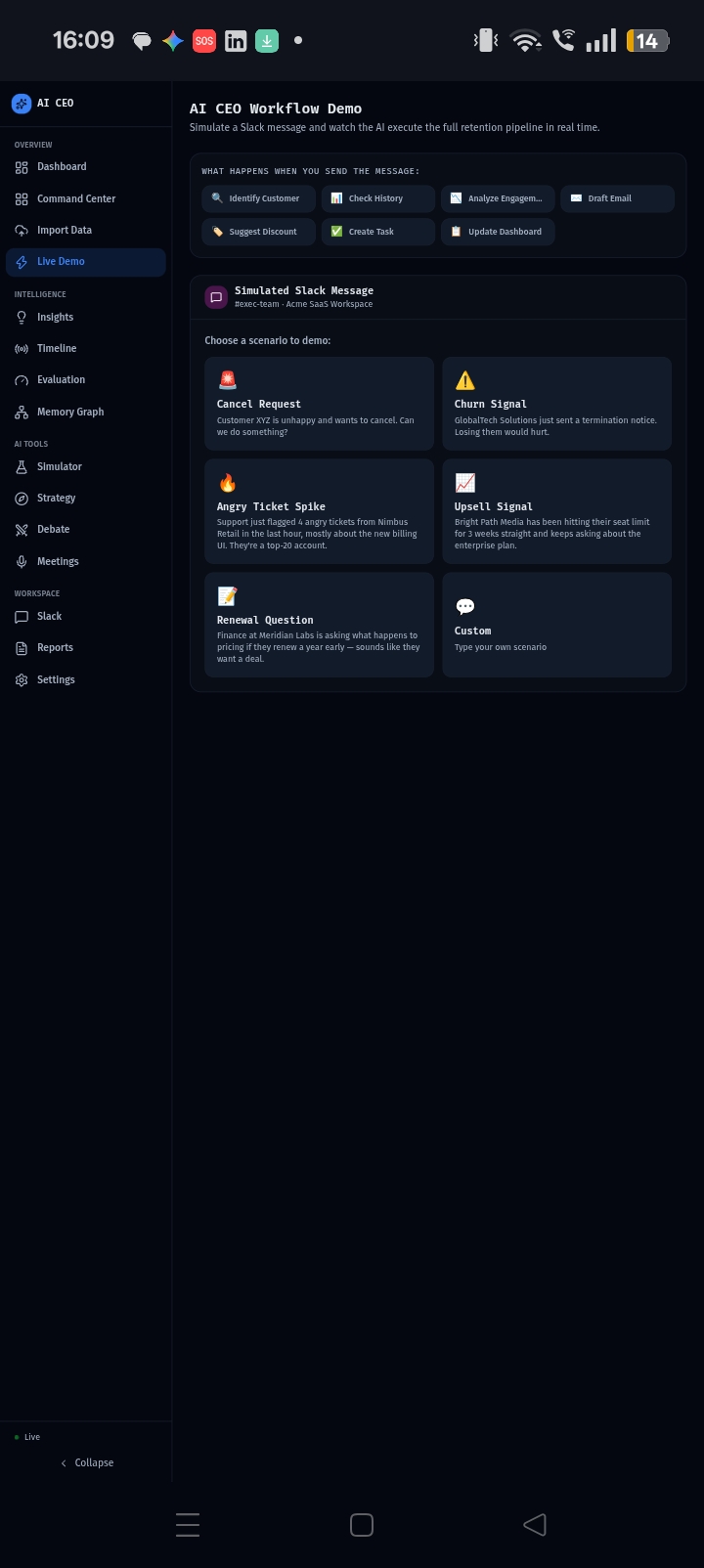
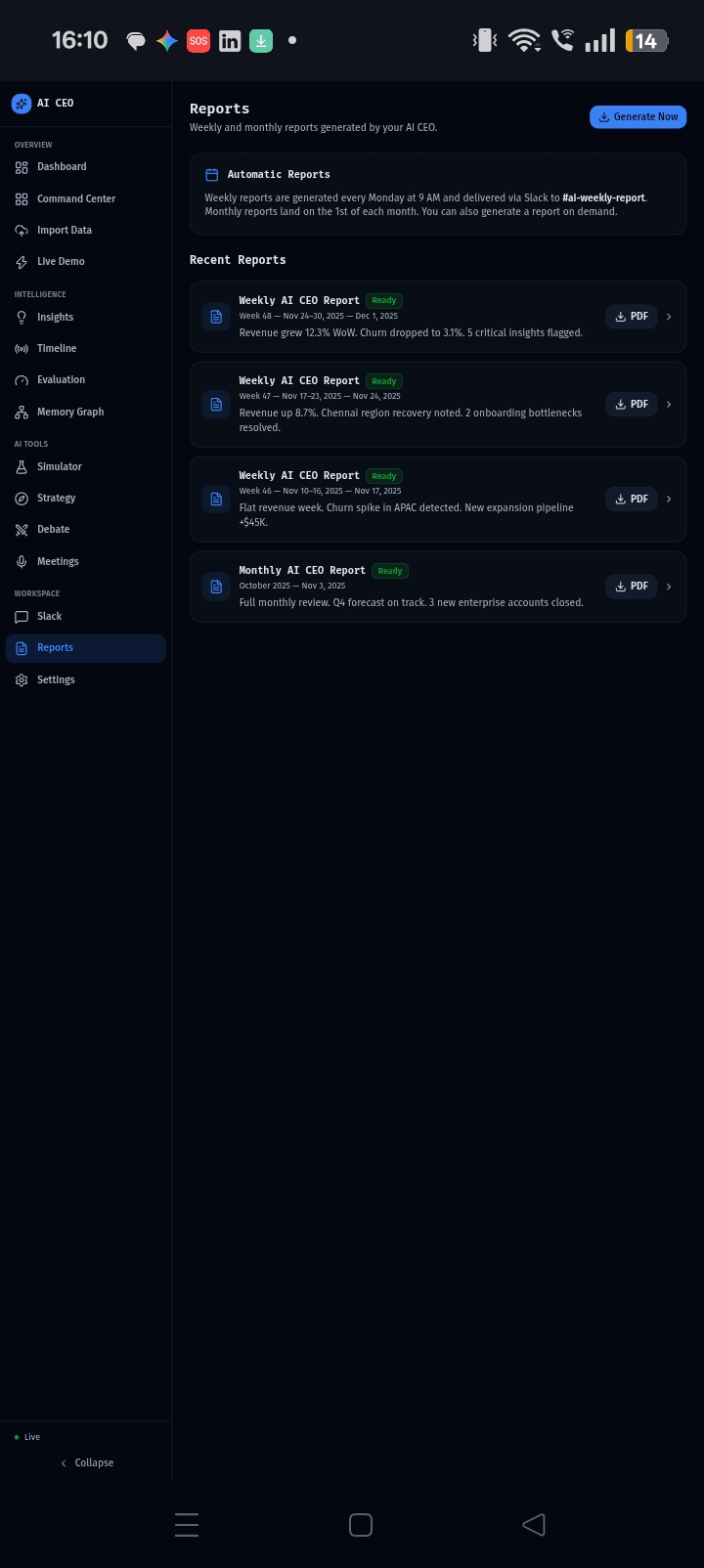
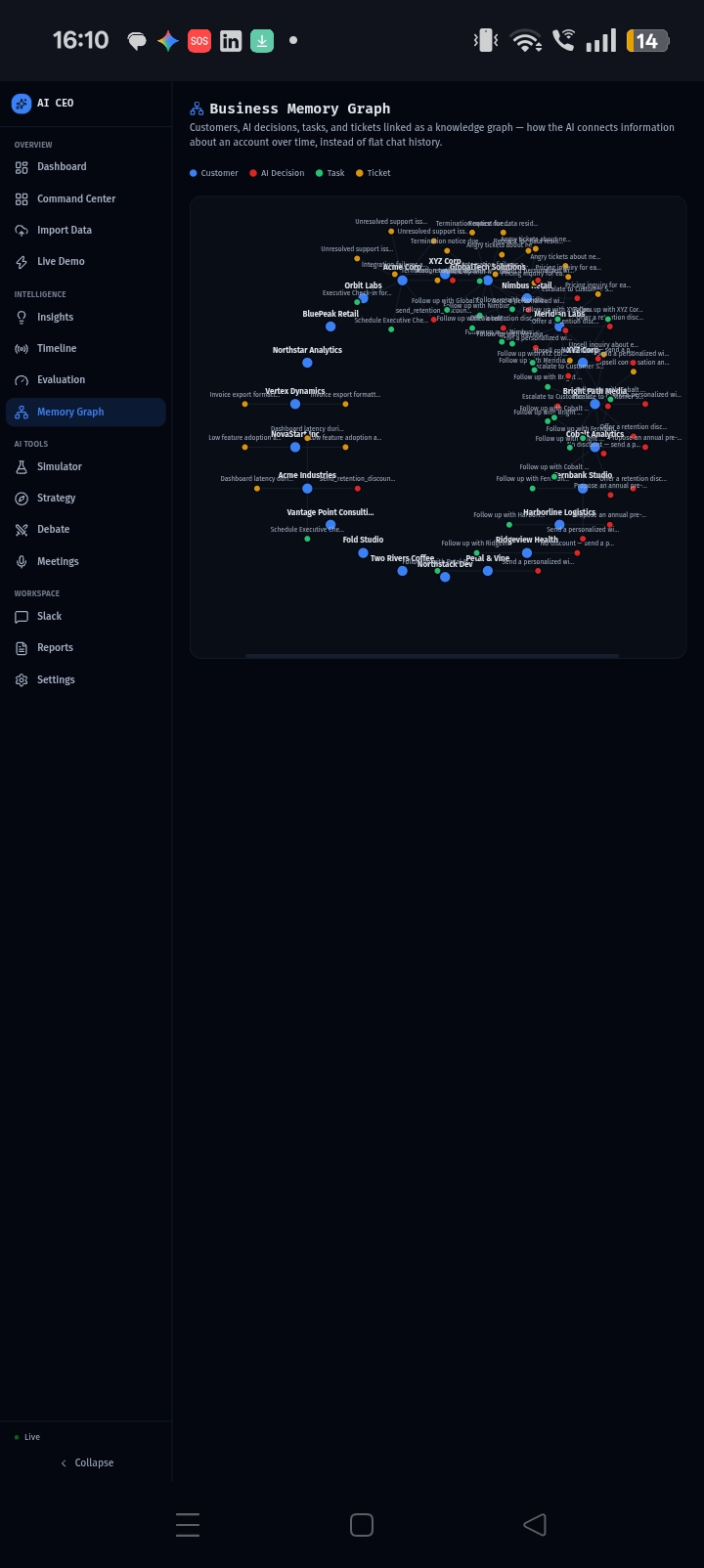
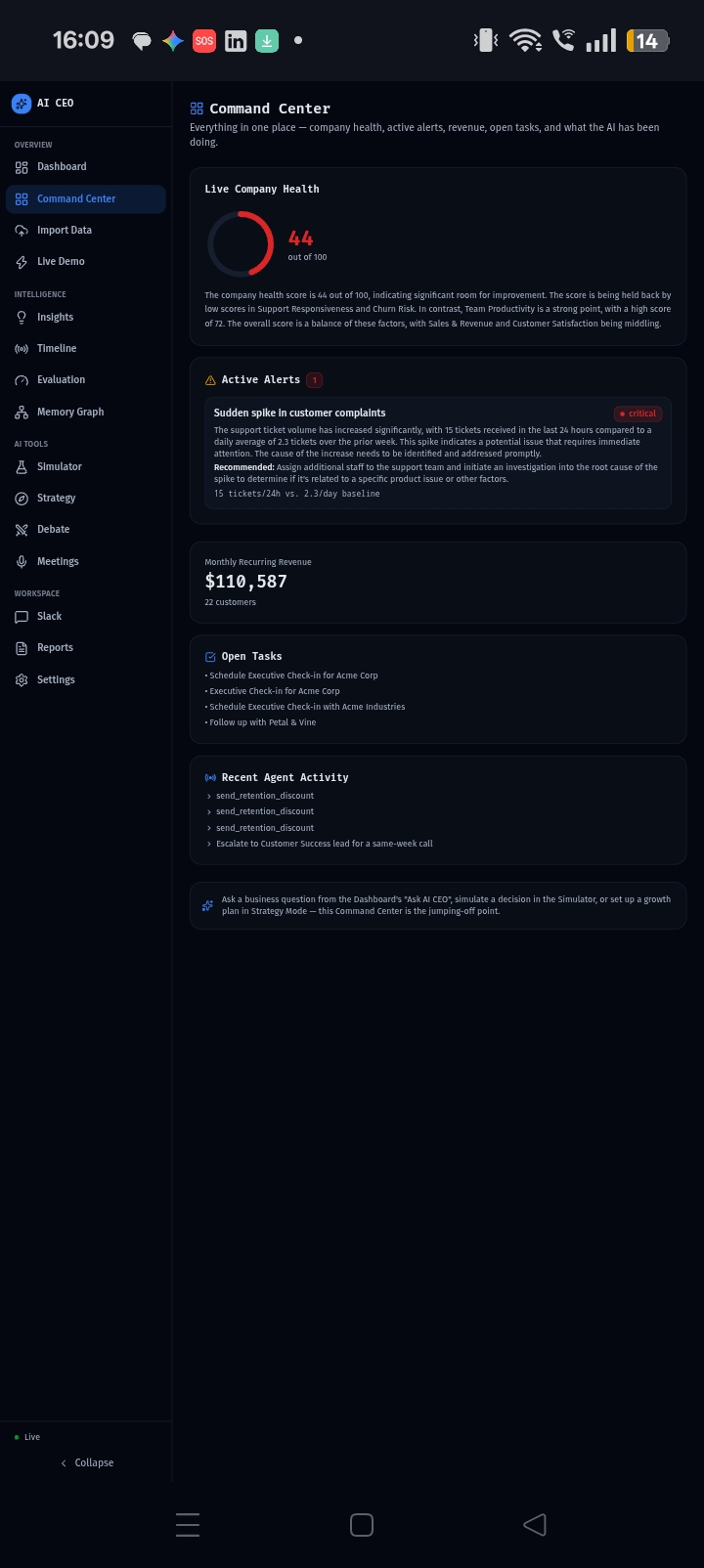
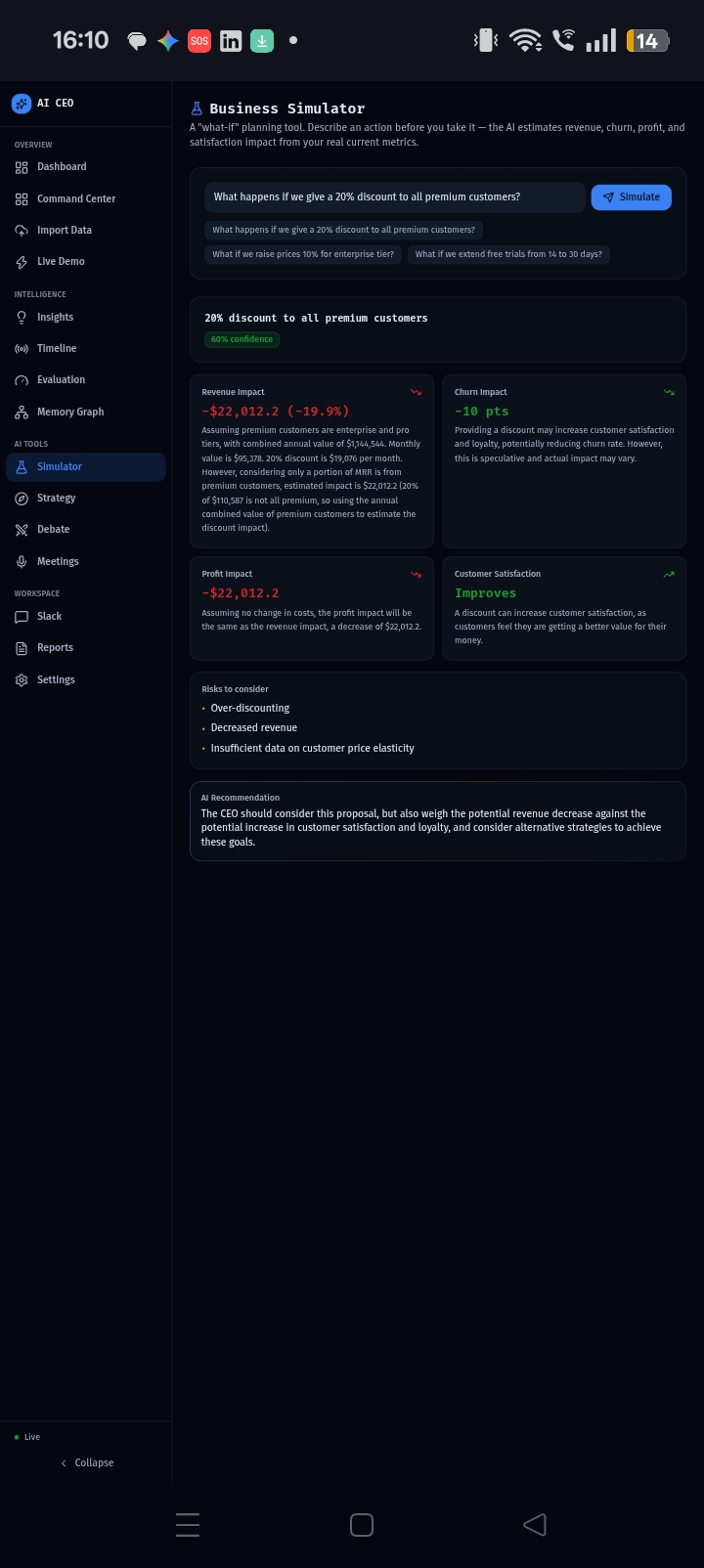
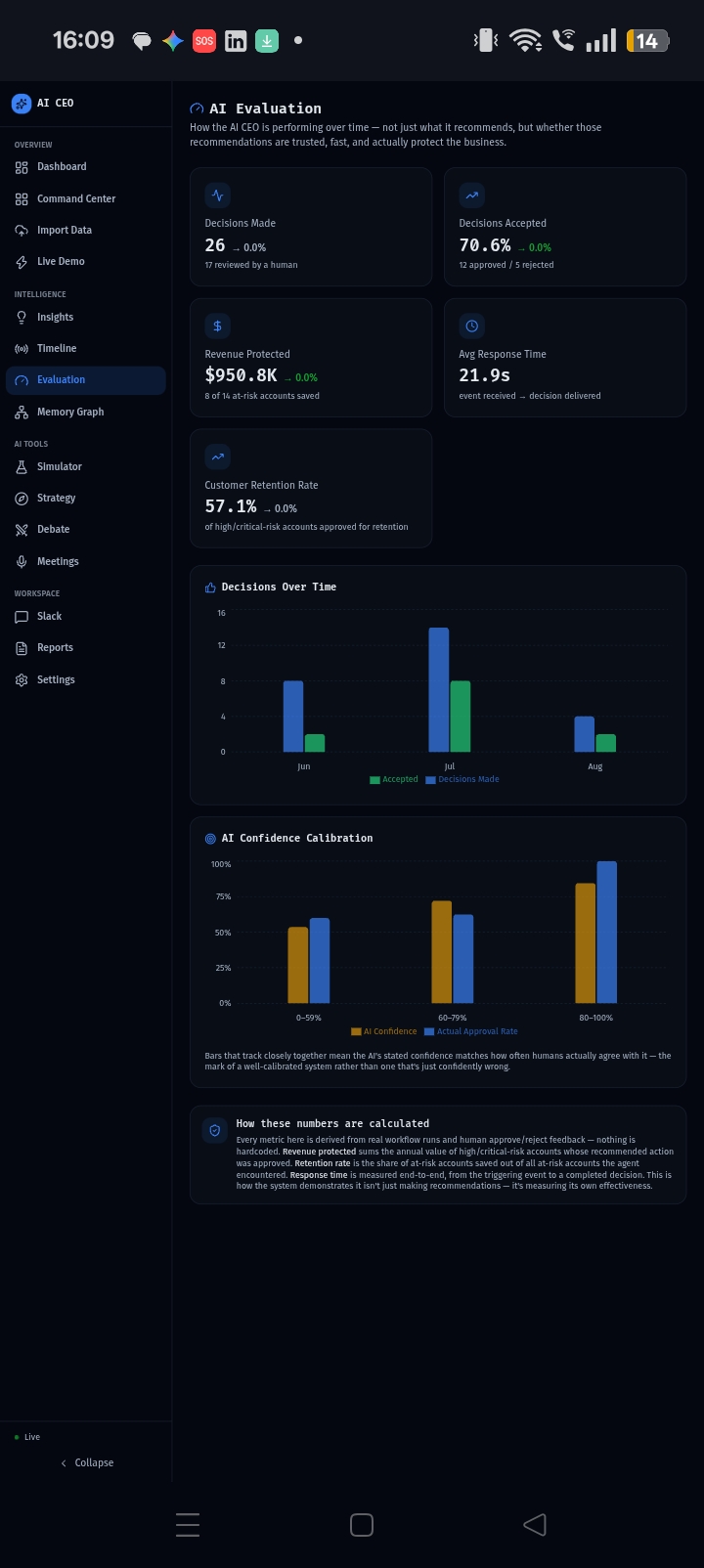
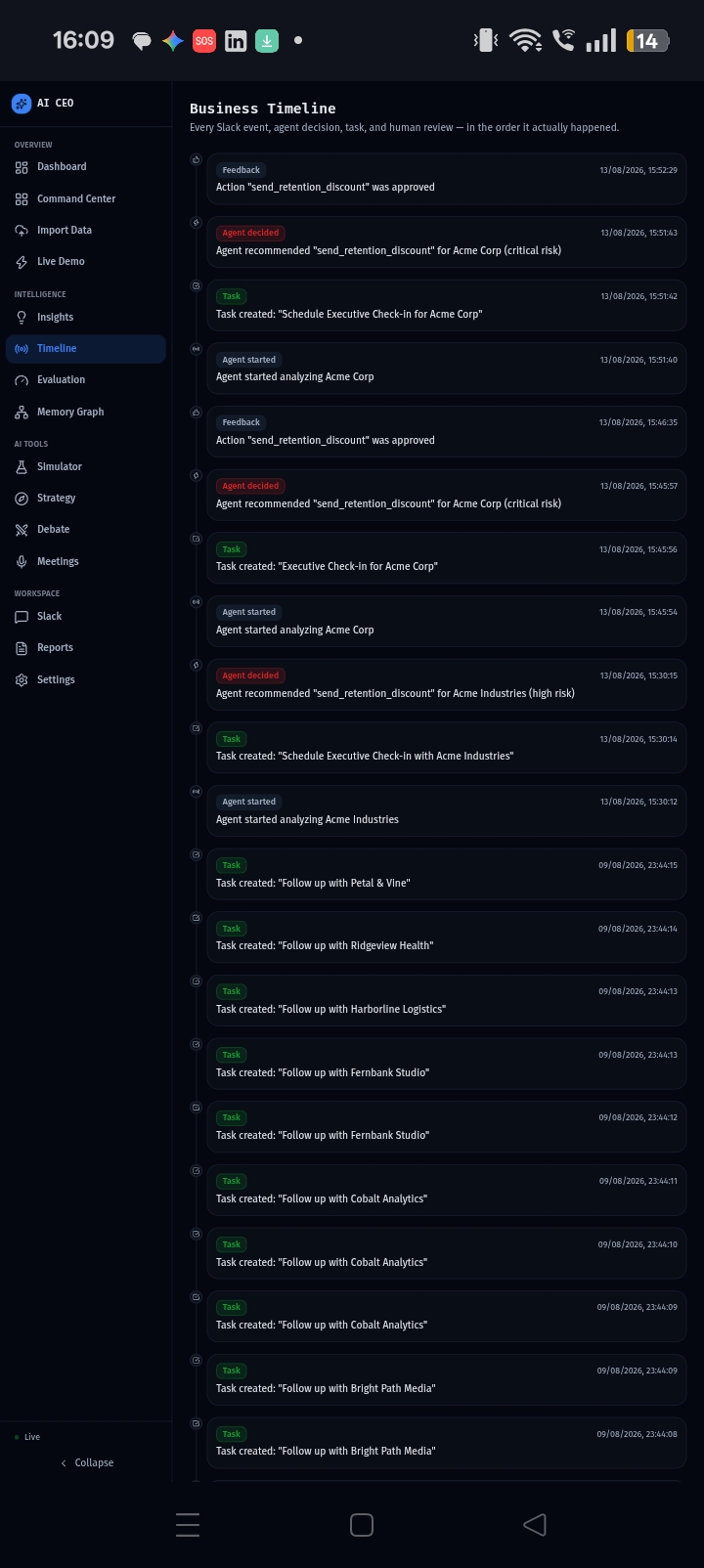
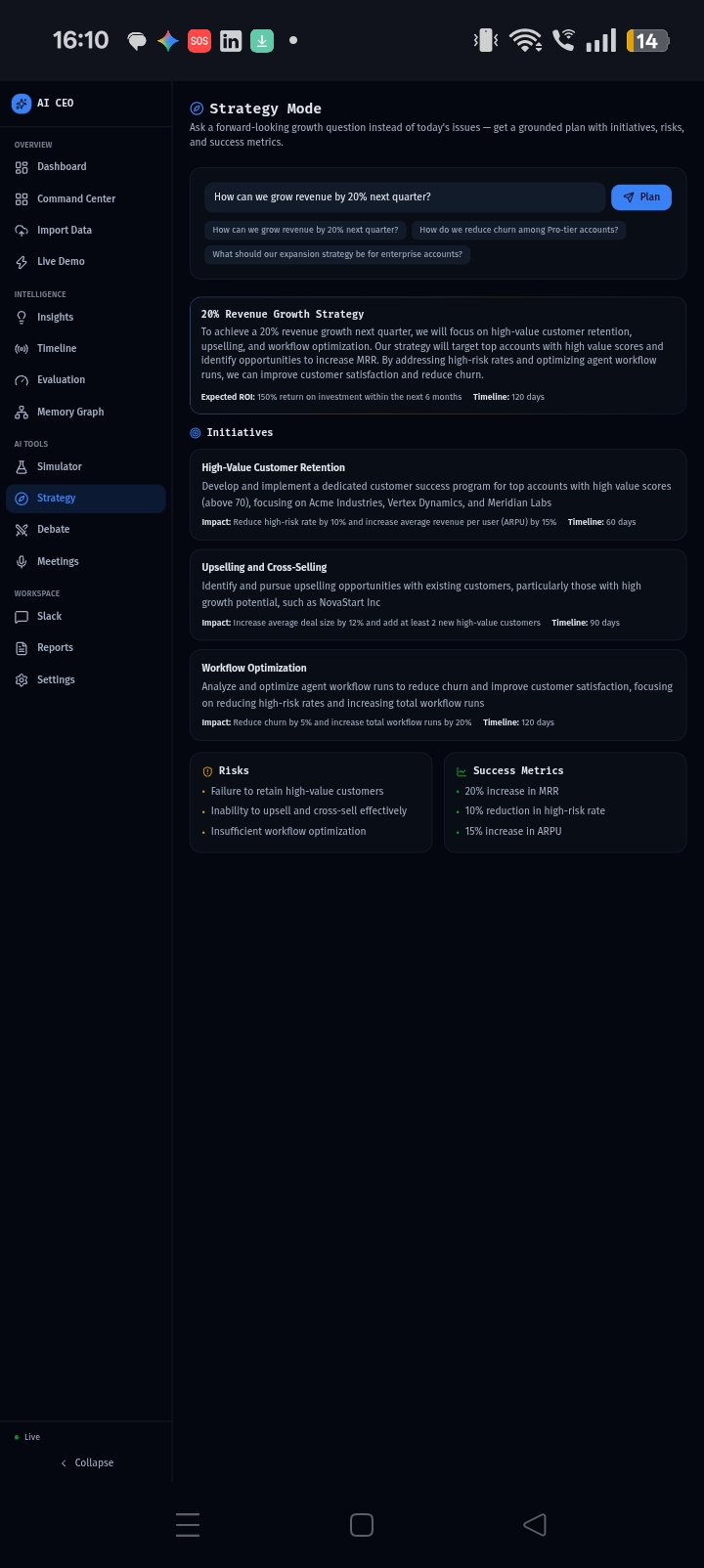
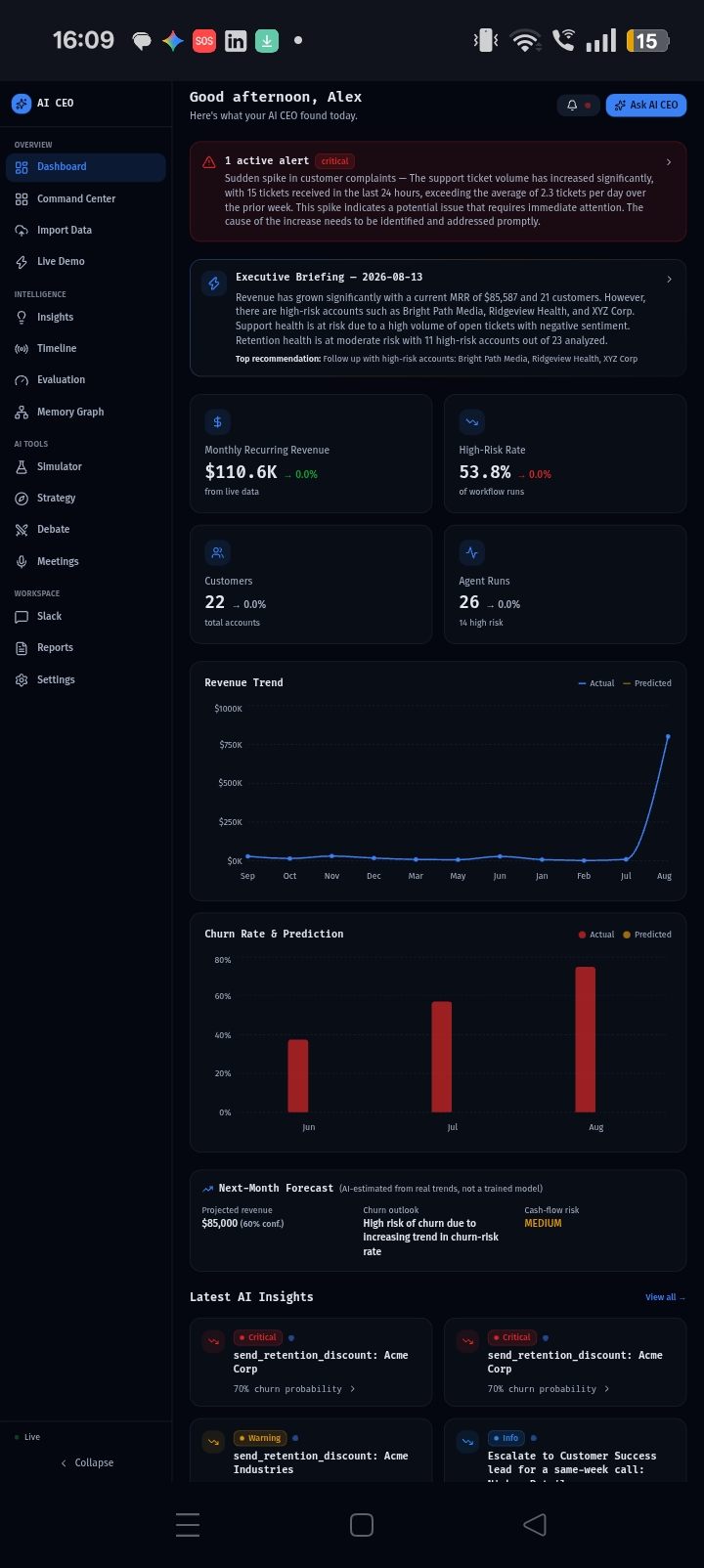
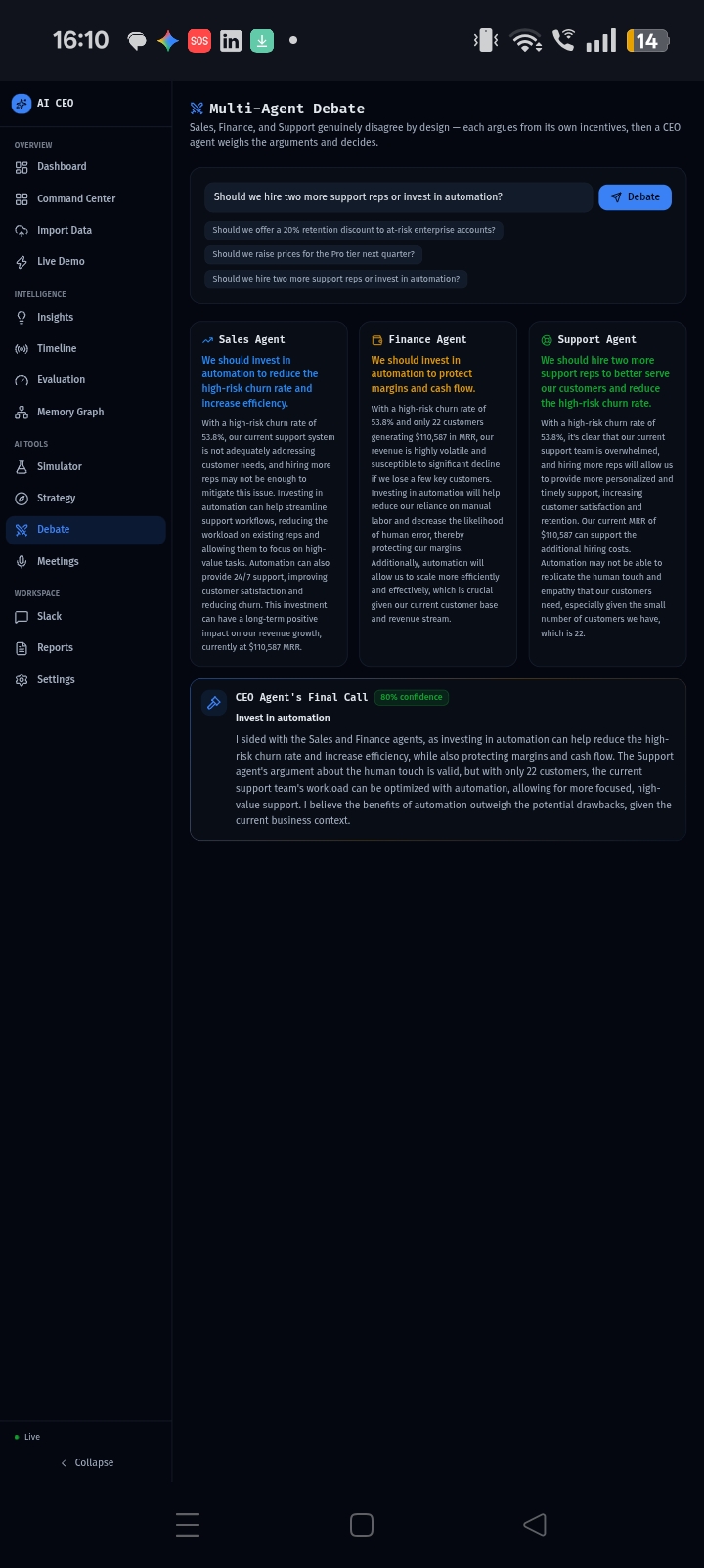
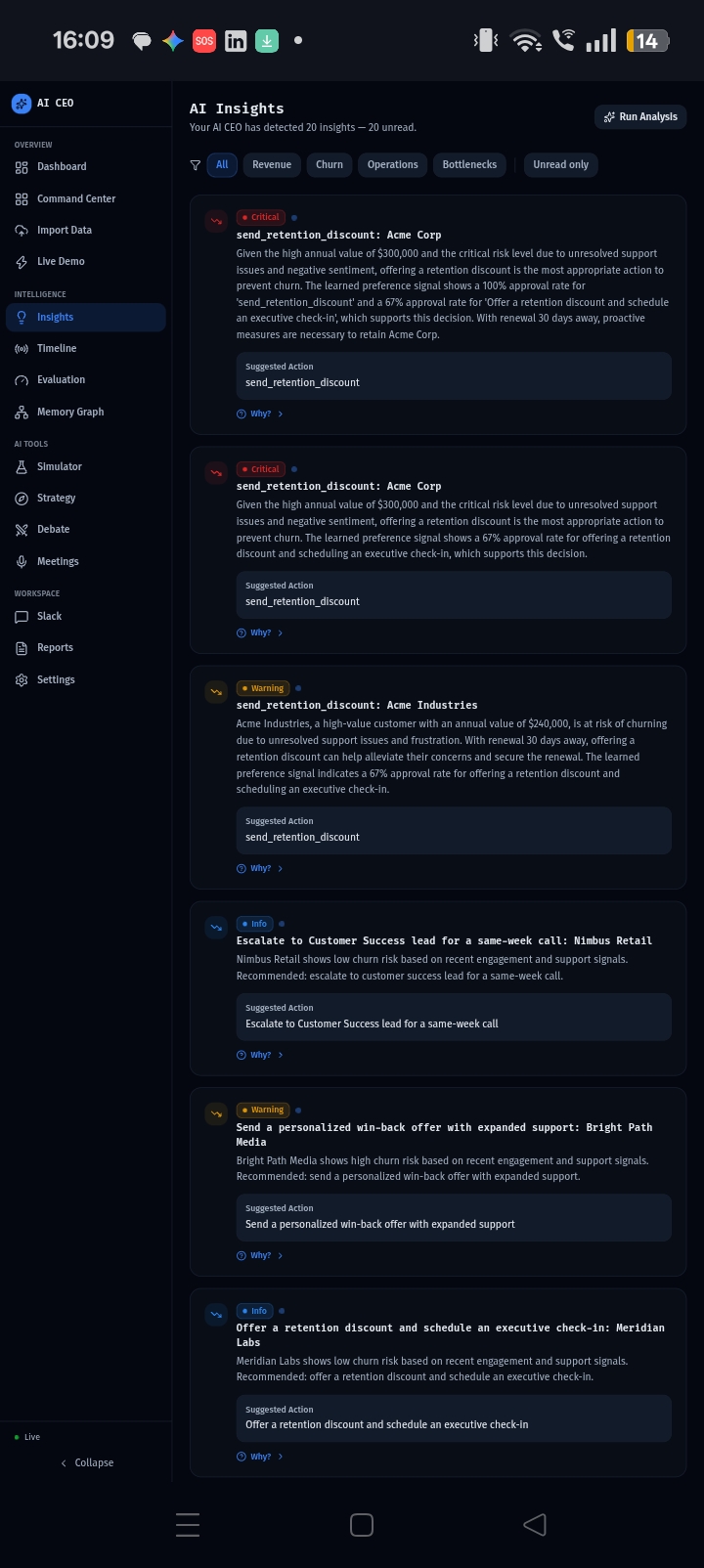
AI CEO turns business data into actionable, explainable decisions. It can: Monitor customer and operational signals Analyze customer sentiment and business context Detect churn risks, crises, and growth opportunities Score business and customer risk Use Sales, Finance, and Support agents to evaluate important decisions Have a CEO agent synthesize those recommendations Generate explainable recommendations with confidence scores Request human approval before consequential actions Execute approved actions through connected business systems Track outcomes and evaluate decision quality Provide executive dashboards and AI-generated briefings Simulate business scenarios such as discount strategies Maintain a visual business memory graph Generate strategic growth plans Transform meeting transcripts into summaries and action items Answer natural-language questions about business data Push real-time alerts and workflow updates through WebSockets Generate downloadable weekly CEO reports The central loop is: Business Data → AI Analysis → Decision → Human Approval → Real-World Action → Outcome → AI Evaluation
How we built it
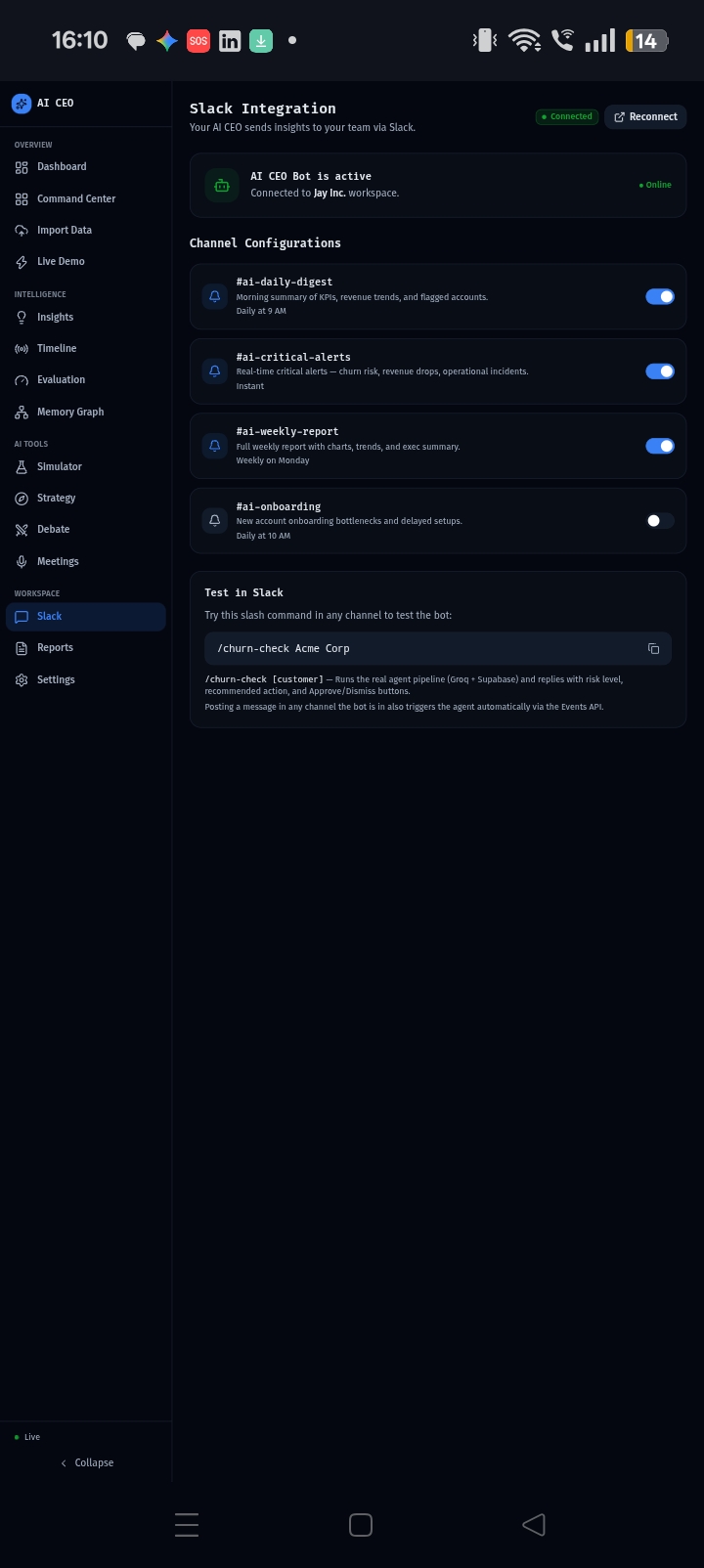
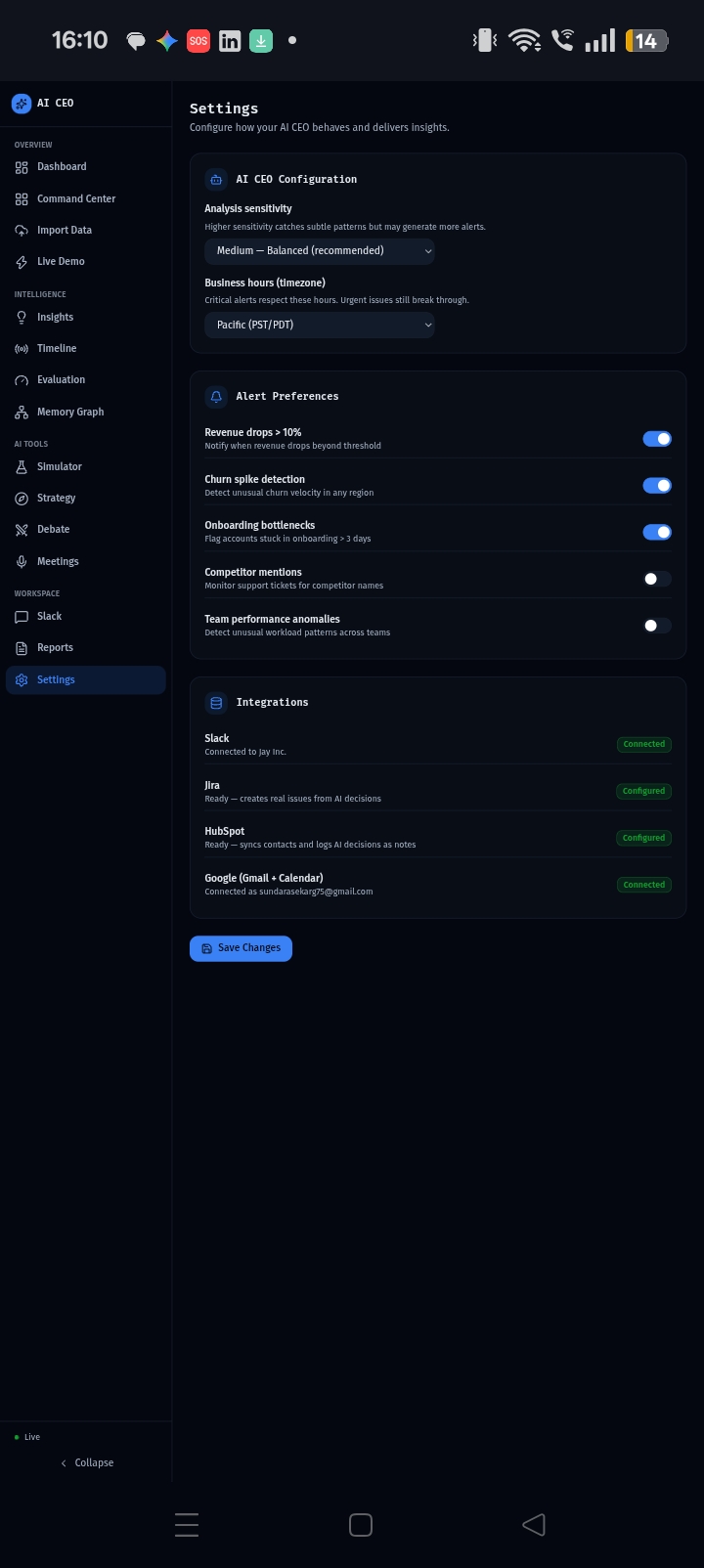
AI CEO is a full-stack SaaS application built around an agentic decision pipeline. Frontend I built the executive interface with: React 18 TypeScript Vite React Router Tailwind CSS Recharts Framer Motion Lucide Icons The frontend provides dashboards, command center views, AI insights, decision timelines, simulations, strategy tools, evaluation metrics, and the business memory graph. Backend The backend uses: Node.js Express TypeScript tsx Zod Native WebSockets The backend coordinates the agent pipeline, business workflows, AI tools, integrations, real-time events, and decision logging. AI Layer The current implementation uses Groq-hosted Llama 3.3 inference. The AI architecture includes specialized agents for: Sales → Finance → Support → CEO The agents evaluate a business situation from different perspectives before the CEO agent produces the final recommendation. Data & Integrations Business state is persisted using Supabase / PostgreSQL. AI CEO also connects to operational systems including: Slack Jira HubSpot Gmail Google Calendar This allows an approved AI recommendation to move beyond generated text and become an actual business action. The application is deployed with the frontend on Vercel and backend on Render, with Supabase providing the hosted database and Groq providing LLM inference.
Challenges we ran into
One of the biggest challenges was designing an AI workflow that was more than simply sending a prompt to an LLM. The system needed to retrieve the right business context, reason about it, coordinate multiple agents, produce an explainable recommendation, wait for human approval, execute actions through external systems, and record the outcome. Another major challenge was integrating multiple external services with very different APIs and authentication requirements, including Slack, Jira, HubSpot, Gmail, and Google Calendar. I also had to make the application feel genuinely real-time. Native WebSockets were used to push AI decisions, crisis alerts, approval feedback, and agent activity to connected dashboards. Finally, deploying a full-stack application with separate frontend and backend environments required careful configuration of environment variables, CORS, API URLs, OAuth redirects, and production services.
Accomplishments that we're proud of
I'm particularly proud that AI CEO goes beyond generating AI responses. The system connects the entire workflow: Detect → Reason → Explain → Approve → Execute → Measure → Evaluate I'm also proud of the multi-agent architecture. Instead of relying on a single AI perspective, Sales, Finance, and Support agents independently evaluate important decisions before the CEO agent synthesizes them. Another accomplishment is the human-in-the-loop architecture. AI can recommend and execute approved actions, but consequential decisions remain under human supervision. The real-time WebSocket system, business memory graph, scenario simulator, executive intelligence dashboard, and integrations make the project feel like a complete business operating system rather than a simple AI demo.
What we learned
Building AI CEO taught me that creating an AI application is much more than integrating an LLM. I learned how important it is to design the entire decision lifecycle, including context retrieval, reasoning, explainability, human oversight, execution, and evaluation. I also learned more about: Multi-agent system design Agent orchestration Human-in-the-loop AI Real-time WebSocket architecture OAuth-based integrations REST APIs Full-stack deployment AI confidence and evaluation Business data modeling Designing AI systems that can take actions safely Most importantly, I learned that AI becomes much more useful when it is connected to real workflows and measurable outcomes rather than isolated inside a chat interface.
What's next for AI CEO Business Intelligence
AI CEO is designed to grow into a more autonomous business operating layer. Future plans include: More business-system integrations More specialized AI agents Improved decision evaluation and confidence calibration Stronger long-term business memory More advanced predictive analytics More sophisticated business simulations Automated experiment and A/B-test planning Deeper CRM intelligence More powerful executive reporting Expanded autonomous workflows with configurable approval policies The long-term vision is simple: AI shouldn't just tell a business what happened. It should understand what is happening, why it matters, what could happen next, what should be done, and—when a human approves—help make it happen.
Built With
- 3.3
- agentic
- ai
- api
- business
- css
- express.js
- generative
- groq
- human-in-the-loop
- learning
- llama
- machine
- multi-agent
- node.js
- oauth
- postgresql
- react
- rest
- saas
- supabase
- tailwind
- typescript
- vite
- websockets

Log in or sign up for Devpost to join the conversation.