-
-
Traffic-prediction
About the Project: AI-Based Traffic Prediction System
Inspiration:
Urban traffic congestion is more than just an inconvenience—it wastes time, increases fuel consumption, raises stress levels, and significantly contributes to air pollution and carbon emissions. As cities grow, traffic management systems often remain reactive rather than predictive.
The inspiration for this project came from observing daily traffic bottlenecks and realizing that most congestion is predictable when historical patterns, time of day, weather conditions, and urban activity are analyzed together. This motivated us to build an AI-driven traffic prediction system that can forecast congestion before it happens and help individuals and city planners make smarter mobility decisions.
What We Learned:
Through this project, we gained hands-on experience across the full software development lifecycle: Applying machine learning models for time-series traffic prediction Working with real-world datasets that are noisy, incomplete, and inconsistent Understanding the importance of feature engineering (time, day, weather, traffic density) Building data-driven dashboards for meaningful visualization Deploying and integrating a full-stack web application Improving code quality through modular design and documentation We also learned how predictive systems can contribute to sustainability by reducing unnecessary vehicle idling and emissions.
How We Built It:
The system follows a modular, scalable architecture: Data Collection & Preprocessing Historical traffic data was cleaned and structured. Features such as peak hours, weekdays vs weekends, and weather conditions were extracted to improve prediction accuracy. Machine Learning Model We trained predictive models (such as regression and time-series forecasting) to estimate future traffic density.
Backend API: A backend service handles data processing and model inference, exposing prediction results via REST APIs.
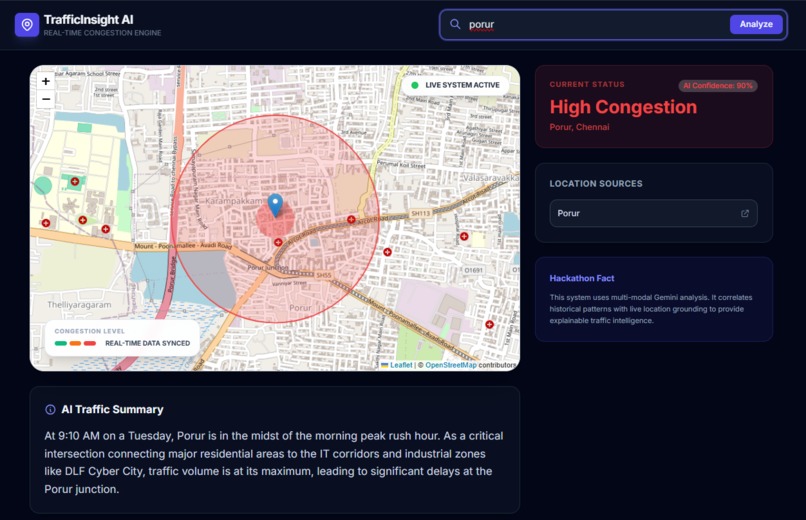
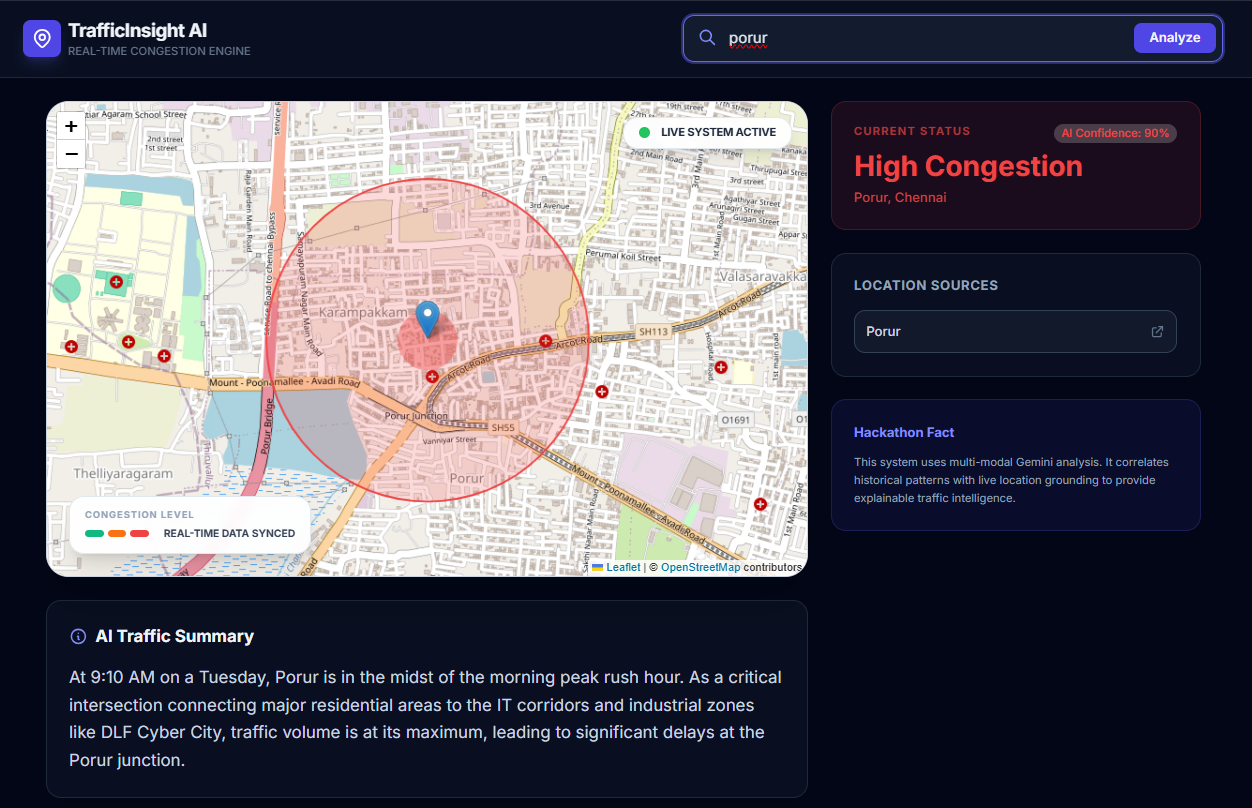
Frontend Interface: A web-based dashboard visualizes: Predicted congestion levels Peak-hour trends Traffic heatmaps and analytics Deployment The application is deployed as a live, end-to-end system, demonstrating real-world usability.
Challenges We Faced:
Data Quality Issues: Traffic datasets often contained missing or inconsistent records, requiring extensive preprocessing. Model Accuracy vs Performance: Balancing prediction accuracy with fast response times was challenging. Feature Selection: Identifying which variables truly influence congestion required experimentation and iteration. Visualization Clarity: Presenting complex predictions in a way that is intuitive and meaningful for users took multiple design revisions. Overcoming these challenges strengthened both our technical skills and our understanding of building production-ready AI systems.
Impact and Future Scope:
This project demonstrates how predictive analytics and AI can transform traffic management from reactive to proactive. With further development, the system could support: Real-time data integration Smart route recommendations Carbon emission reduction tracking City-scale traffic optimization
Our goal is to contribute toward smarter, greener, and more efficient urban mobility systems.
Built With
- fastapi
- github
- pandas
- python
- react.js
- scikit-learn
- vercel

Log in or sign up for Devpost to join the conversation.