-
-
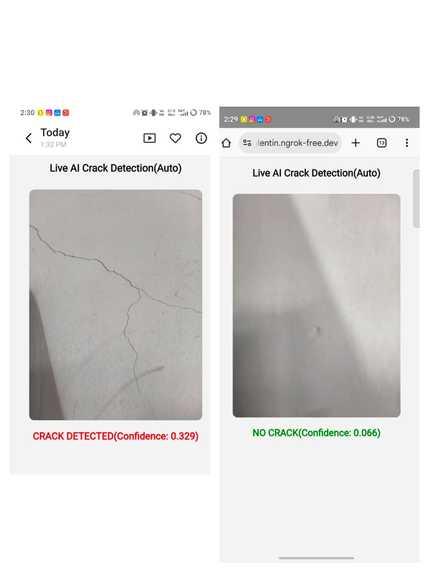
Crack No-Crack live detection screenshot

Inspiration
Cracks in buildings, walls, and concrete structures are often ignored in their early stages due to the lack of affordable and continuous inspection systems. Most inspections are still performed manually, which is time-consuming, costly, and prone to human error. Small or hairline cracks are especially difficult to notice and can later lead to serious structural damage. This problem inspired us to explore how artificial intelligence and computer vision can assist in early-stage crack detection. We wanted to build a simple and practical AI-based system that can detect surface cracks from live video and demonstrate how automation can support infrastructure monitoring.
What it does
Our project is an AI-based real-time crack detection system that analyzes live video input and classifies surfaces as Crack or No-Crack. The system processes video frames using a trained deep learning model and displays the prediction directly on the video feed. The goal of the system is to detect both visible cracks and subtle hairline cracks while reducing false detections caused by surface textures, shadows, or lighting variations.
How we built it
We built the system using a deep learning approach based on transfer learning. A convolutional neural network based on MobileNet architecture was used for crack classification. The model was trained on a publicly available surface crack dataset containing crack and non-crack images. All images were resized to 224×224 pixels and normalized before training. For real-time operation, video is captured from a camera connected to the local system. The local application is exposed securely using ngrok allowing live access to the video stream. Each video frame is passed through the trained model, and the output label (CRACK DETECTED or NO CRACK) is overlaid on the live video.
Challenges we ran into
One of the main challenges was detecting thin and hairline cracks, which often resemble background textures or shadows. Limited availability of diverse real-world crack data also made it difficult to achieve perfect generalization. Another challenge was maintaining real-time performance while running the model on limited hardware resources. We had to balance detection accuracy with inference speed to ensure smooth live video processing.
Accomplishments that we're proud of
Built a working real-time crack detection prototype Successfully detected visible and hairline cracks Reduced false positives using negative samples Integrated deep learning with live video processing Developed a lightweight and scalable system prototype
What we learned
Through this project, we gained practical experience in deep learning, transfer learning, and real-time computer vision systems. We learned how to preprocess image data, train and fine-tune neural networks, and deploy models for live inference. We also learned the importance of building realistic AI prototypes that balance performance, efficiency, and usability.
What's next for AI-Based Real Time Crack Detection System
In the future, we plan to improve the system by implementing crack segmentation instead of binary classification. We also aim to train the model on larger and more diverse datasets and optimize it for deployment on mobile and edge devices. Additional future improvements include crack severity estimation, integration with smart infrastructure systems, and drone-based inspection for large-scale monitoring.

