-
-
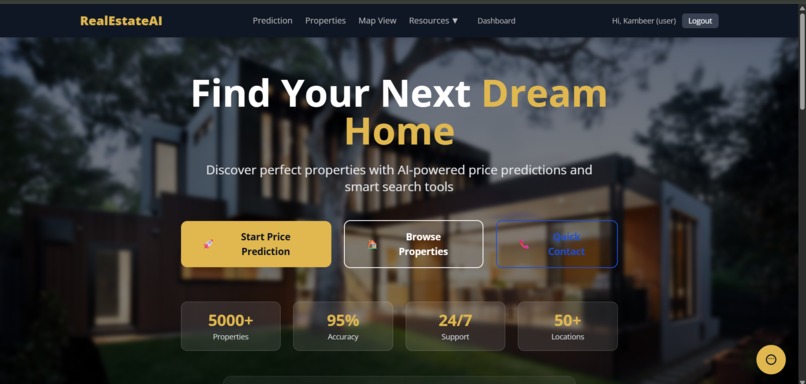
Interface of the application.

Inspiration
Real estate is often the most significant financial investment a person makes in their lifetime. However, the market is frequently opaque, with prices driven by subjective opinions, speculation, or inconsistent advice from agents. We realized that while data exists everywhere, it isn't always accessible or understandable for the average buyer or seller. We wanted to bridge this gap. Our inspiration came from the desire to bring transparency and trust to the property market using the power of Artificial Intelligence. We wanted to build a tool that doesn't just guess a price, but scientifically calculates it.
What it does
The AI-based real Estate Evaluation System acts as an intelligent digital appraiser.
- Input: Users provide key details about a property, such as location, square footage, number of bedrooms (BHK), and amenities.
- Process: The system feeds this data into a trained Machine Learning model that compares it against thousands of historical records and current market trends.
- Output: It instantly generates a precise estimated market value for the property. Beyond just a price tag, it helps users understand why a property is valued at that rate, empowering them to negotiate better, whether they are buying or selling.
How we built it
We approached this project using a standard Data Science lifecycle: Data Collection & Cleaning: We utilized a comprehensive real estate dataset. We used Pandas and NumPy to clean the data, handle missing values, and remove outliers (like errors in data entry) to ensure accuracy. Machine Learning: The core engine is built using Python and Scikit-Learn. We experimented with various algorithms (Linear Regression, Decision Trees, and Random Forest) to find the model that offered the highest accuracy. Backend & Frontend: To make the model usable, we wrapped it in a web interface using Streamlit (or Flask). This allows users to interact with the complex code through a simple, clean dashboard.
Challenges we ran into
Data Quality: The biggest hurdle was "dirty data." Real estate datasets often have missing fields or unrealistic values (e.g., a house with 0 bedrooms). Cleaning this required significant effort. Feature Selection: Deciding which factors actually impact price was difficult. We had to determine if things like "proximity to a gym" mattered as much as "square footage." Overfitting: Initially, our model worked perfectly on training data but failed on new inputs. We had to tune our hyperparameters to ensure the AI was generalizing well to real-world scenarios.
Accomplishments that we're proud of
High Accuracy: We achieved a high R-squared score, indicating that our model's predictions are very close to actual market values. User Experience: We transformed a complex Python script into a user-friendly web application that anyone—technical or not—can use. Real-World Application: Building a tool that solves a genuine financial problem rather than just a theoretical concept.
What we learned
The Power of Data Preprocessing: We learned that a model is only as good as the data you feed it. 80% of our time was spent cleaning data. Algorithm Selection: We gained a deeper understanding of regression algorithms and how different models handle large datasets. Deployment: We learned how to take a model from a VS Code IDE and deploy it as a functioning web app.
What's next for AI Based Real Estate Evaluation System
Geospatial Integration: We plan to add a map view (using Google Maps API) so users can visualize price heatmaps in different neighborhoods. Image Analysis: Integrating Computer Vision to analyze photos of the house (interior condition) to adjust the price evaluation automatically. Real-Time Data: Connecting the system to live property listing APIs to ensure the evaluation reflects the market changes day-by-day.


Log in or sign up for Devpost to join the conversation.