-
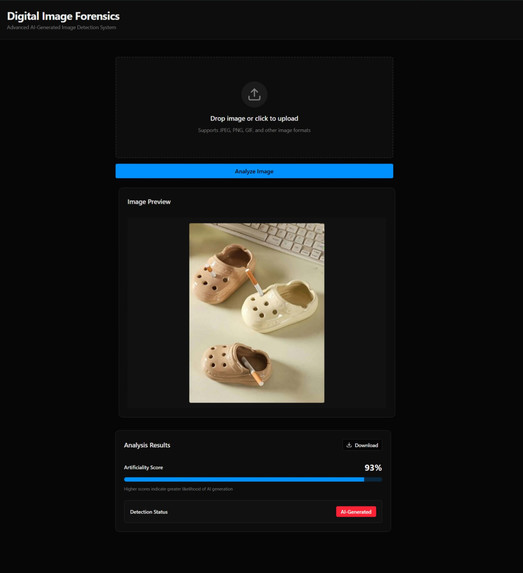
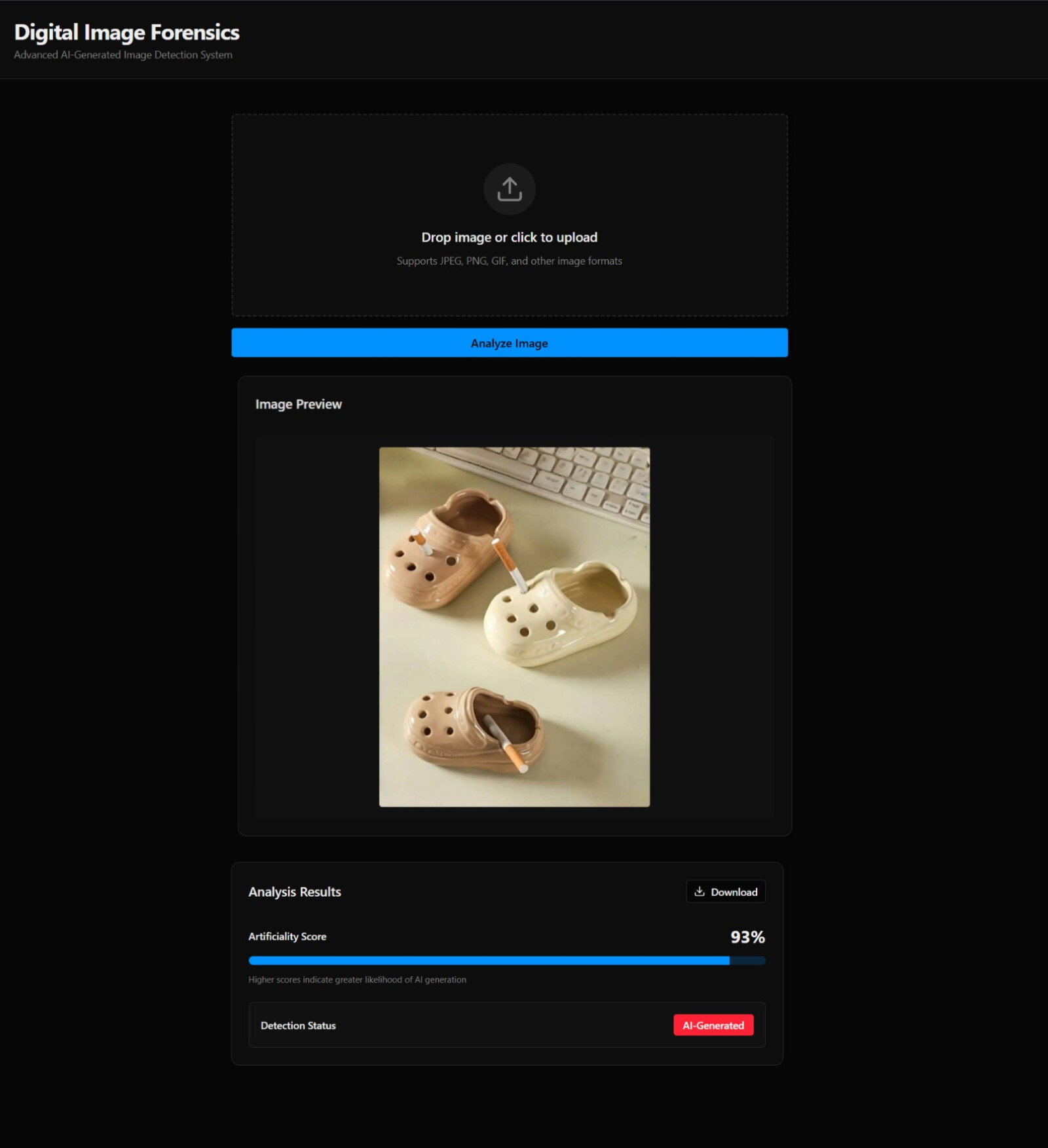
Working Interface of the developed web application.
Inspiration
The rapid rise of AI-generated images has blurred the line between real and fake digital content, creating serious risks in misinformation, cybercrime, and digital trust. We were inspired to build a solution that empowers users to quickly and reliably verify image authenticity without relying on complex or opaque AI models.
What it does
The AI-Based Digital Image Forensics Web Application analyzes uploaded images to determine whether they are real, suspicious, or AI-generated. It uses explainable computer vision techniques to evaluate sharpness consistency and micro-level edge patterns, producing an artificiality score that helps users understand how likely an image is to be AI-generated.
How we built it
We built the application using Python, OpenCV, and Flask for the backend, with a clean HTML/CSS-based web interface for accessibility. The system performs grayscale conversion, patch-based analysis, Laplacian sharpness measurement, and Sobel edge detection to detect AI-like smoothness patterns. Thresholds were calibrated using real and fake image datasets to ensure reliable classification.
Challenges we ran into
One of the main challenges was selecting thresholds that balance false positives and false negatives across different image qualities. Handling variations in image resolution and lighting conditions was also difficult. Additionally, designing a system that is both accurate and explainable, without relying on heavy deep learning models, required careful experimentation and tuning.
Accomplishments that we're proud of
We successfully developed a fully functional, lightweight web application capable of detecting AI-generated images in real time. The system provides transparent forensic reasoning instead of black-box predictions and runs efficiently without high computational requirements. Achieving meaningful detection accuracy using classical computer vision techniques is a key accomplishment.
What we learned
Through this project, we gained strong hands-on experience in digital image forensics, computer vision, and web deployment. We learned how AI-generated images differ from real ones at a micro-texture level and how explainable methods can be more trustworthy in forensic contexts than opaque models.
What's next for AI-Based Digital Image Forensics Web Application
Next, we plan to integrate deep learning models alongside the existing forensic logic to improve robustness against advanced AI images. We also aim to add blockchain-backed integrity verification, metadata analysis, and video/deepfake detection, transforming the system into a comprehensive and trustworthy digital forensics platform.

Log in or sign up for Devpost to join the conversation.