-
-

Home Page
-
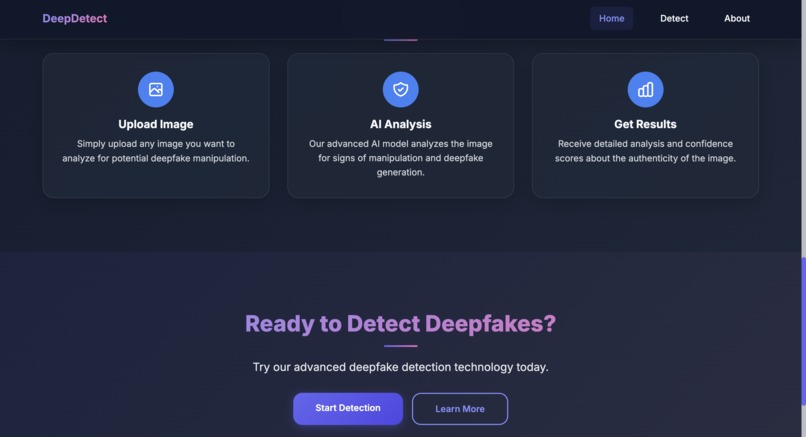
Home Page
-
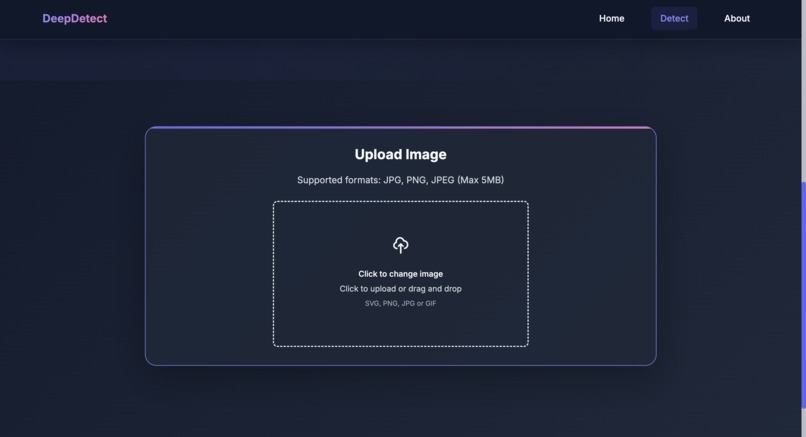
Detection
-

About


Inspiration
The rise of deepfake media poses a growing threat in today’s digital world—spreading misinformation, enabling identity theft, and fueling cyber fraud. With our background in AI and computer vision, we were motivated to build a solution that could detect manipulated images early and accurately. This project was born out of a desire to leverage deep learning to restore trust in digital content.
What it does
Our project is an AI-based Deepfake Detection Model that classifies input images as either real or fake. It uses a fine-tuned EfficientNetB0 CNN model, enhanced with custom layers, to identify subtle inconsistencies introduced by generative AI. The model was trained on a curated dataset and achieves high accuracy in distinguishing authentic visuals from tampered ones.
How we built it
Dataset: We curated and preprocessed a dataset of real and AI-generated images. Preprocessing: Images were resized to 224x224, normalized, and augmented with flips, zooms, and rotations. Architecture: Base Model: EfficientNetB0 pretrained on ImageNet. Custom Layers: GlobalAveragePooling, Dense, Dropout, and Softmax. Training Strategy: Trained for ~30 epochs with early stopping and learning rate reduction callbacks. Managed class imbalance using class_weight. Hyperparameters: batch size = 32, learning rate = 0.001.
Challenges we ran into
Overfitting was a significant challenge, especially due to the limited number of real-world fake images. Generalization: The model performed well on clean data but faced difficulties with heavily augmented or noisy samples. Class imbalance required careful weight tuning and validation metric monitoring. Balancing training time and accuracy while using computational resources efficiently.
Accomplishments that we're proud of
Achieved 98% training accuracy and up to 91% validation accuracy. Successfully implemented a high-performing model with EfficientNetB0 and tuned it to detect fake images with strong precision. Built a clean and scalable deep learning pipeline, with callbacks, class balancing, and preprocessing automation. Overcame overfitting through effective use of dropout and early stopping.
What we learned
The importance of data hygiene in deep learning workflows. How to fine-tune pretrained CNNs and integrate them with custom layers. Handling imbalanced classification tasks using class weights and advanced metrics. Applying evaluation metrics like AUC, precision, and recall to assess real-world performance beyond accuracy.
What's next for AI based Deepfake Detection Model
Extend to video detection using Temporal CNNs and 3D CNNs. Apply Grad-CAM and LIME for visual model interpretability. Develop and deploy a REST API for integration with content moderation tools. Explore audio deepfake detection using CRNNs and spectrogram analysis. Ensemble modeling and increasing real-world dataset diversity to further improve robustness.
