-
-
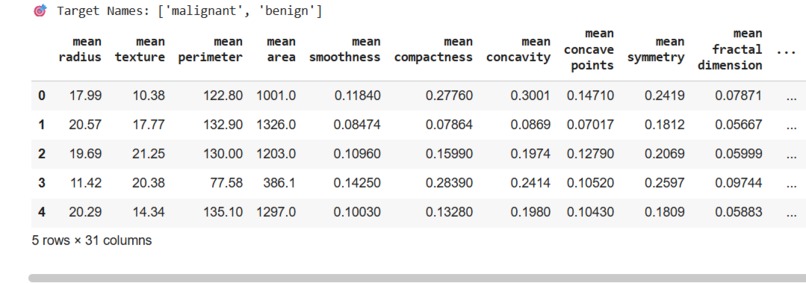
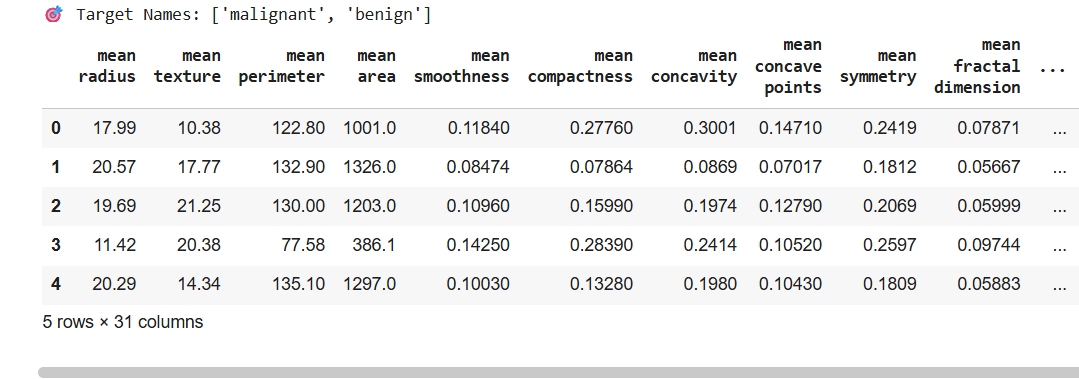
“Preview of the breast cancer dataset showing key clinical features used for training the AI model.”
-
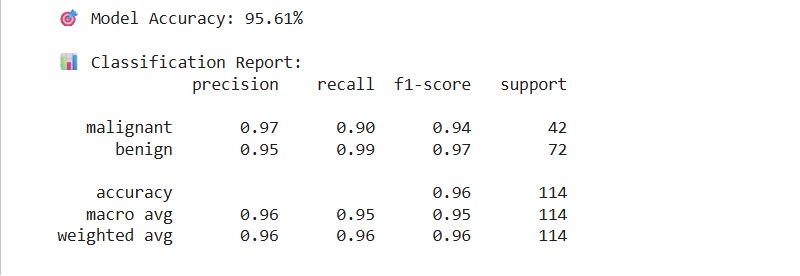
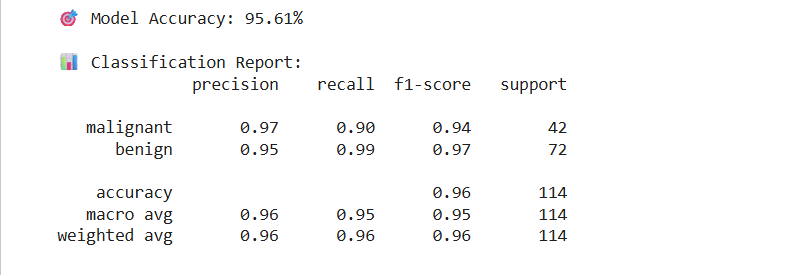
“Detailed classification report showing accuracy, precision, recall and F1-score of the XGBoost classifier.”
-
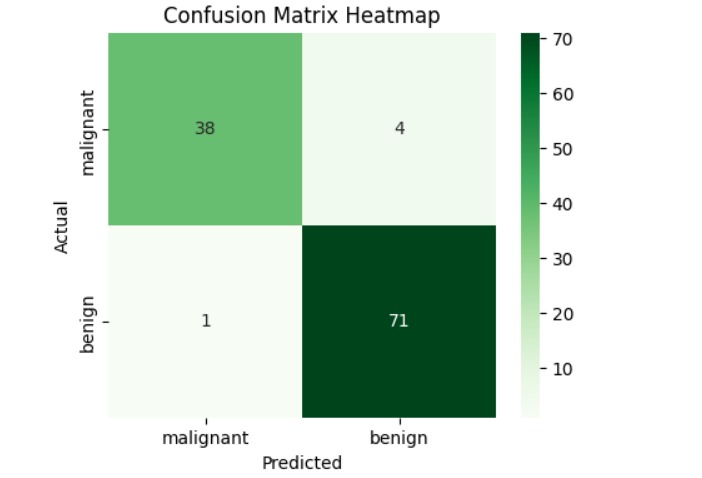
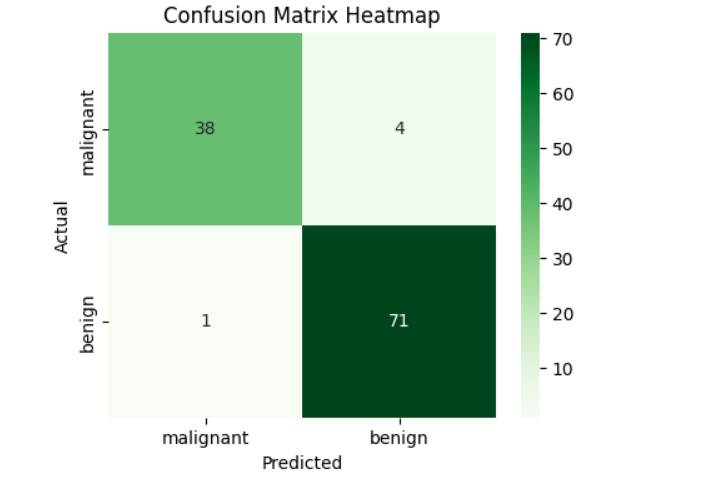
Confusion matrix demonstrating the model’s classification performance on test data.”
-
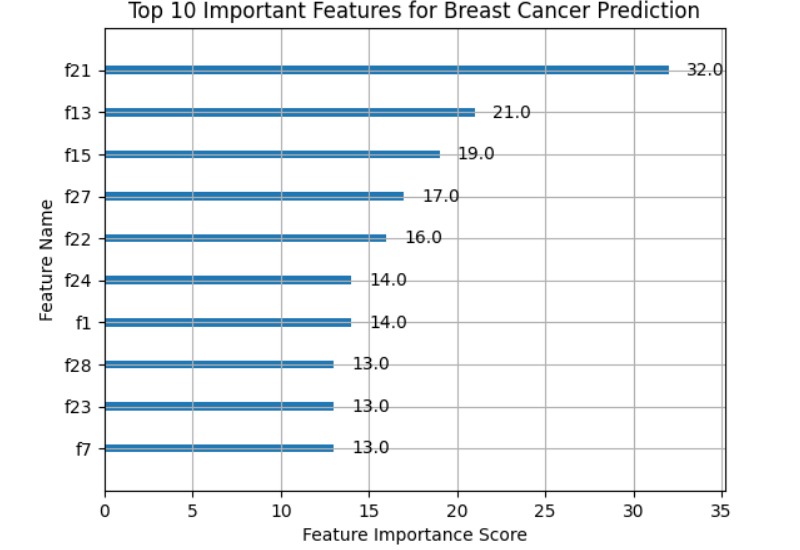
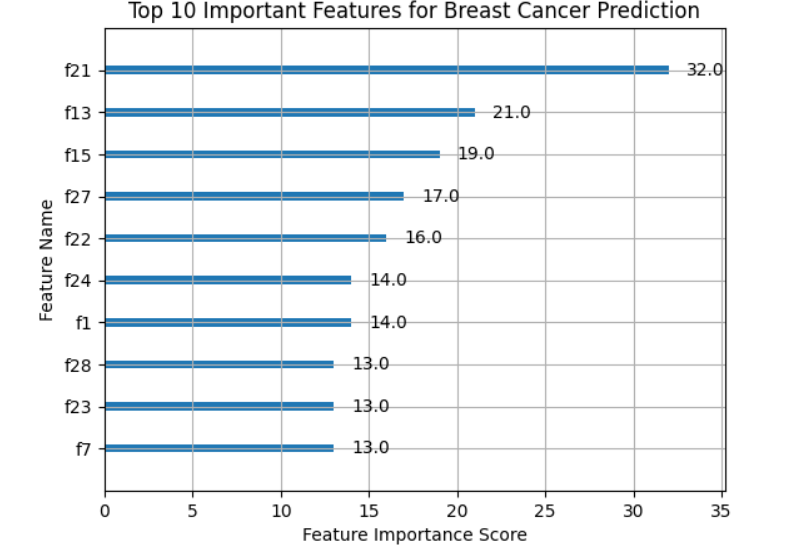
“Top influential medical features identified by the XGBoost model for tumor prediction.”
-
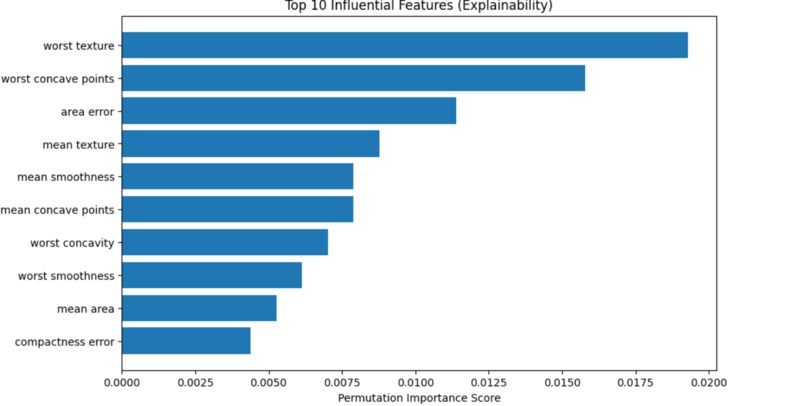
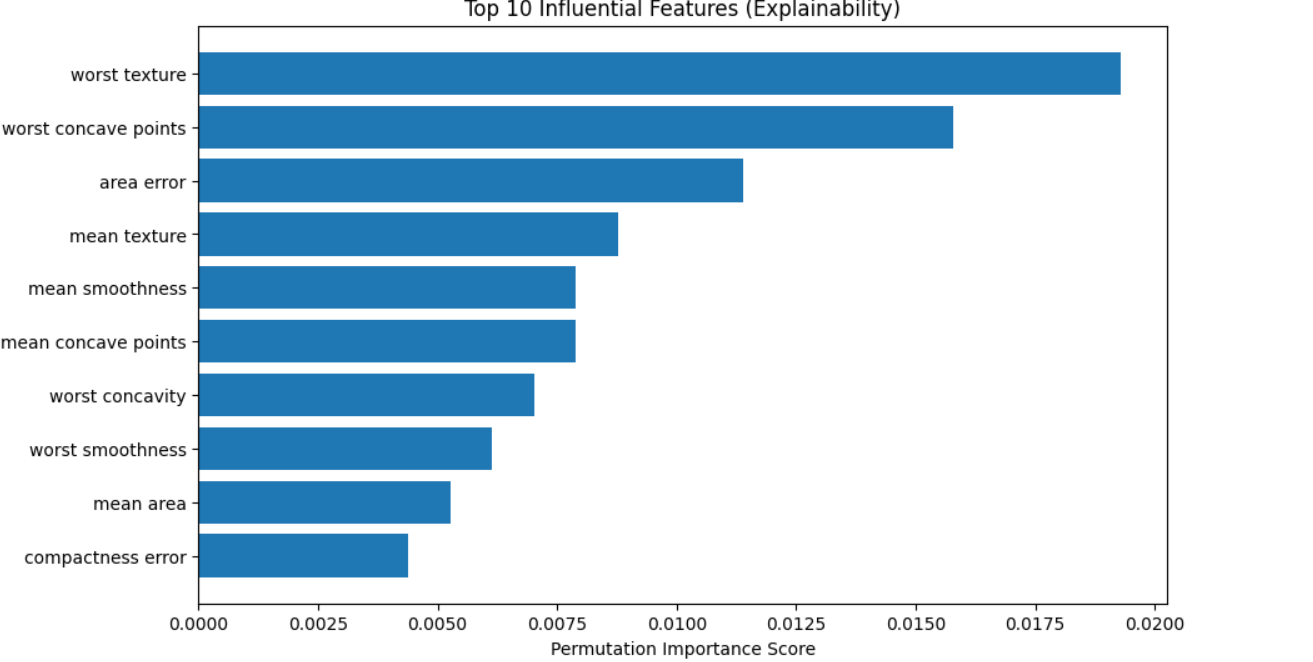
Permutation-based explainability showing how each feature impacts model prediction accuracy.”
-
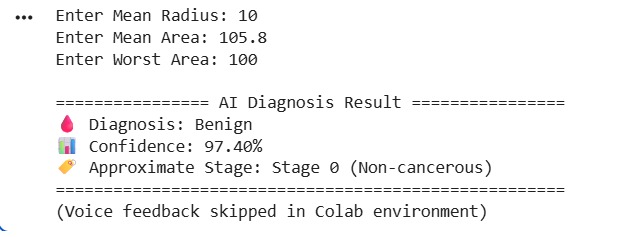
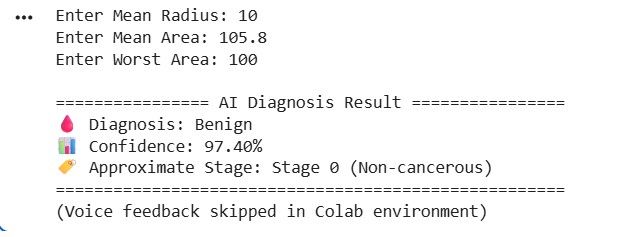
“Real-time manual input diagnosis output showing prediction, confidence score and stage approximation.”
🧠 AI-Based Breast Cancer Detection System — Project Story
✨ Inspiration
Breast cancer is one of the most common cancers affecting women worldwide, yet early detection is still a major challenge—especially in rural and semi-urban areas where radiologists and advanced imaging equipment are limited. I wanted to create something that could genuinely help save lives. This inspired me to build an AI system that can assist doctors by predicting tumor type early, estimating stage, and offering explainability, all without needing expensive mammography machines. The idea was simple: make early diagnosis faster, cheaper, and accessible to everyone.
🔍 What it does
Our system is a complete AI-driven diagnostic assistant that:
Predicts whether a breast tumor is Benign or Malignant using clinical features.
Estimates the probable cancer stage (0–IV) using feature-based medical logic.
Provides explainability using feature importance & permutation analysis.
Allows manual input so doctors can test real patient parameters in seconds.
Generates an automatic medical report including diagnosis, confidence, stage, and model info.
Runs fully in a low-cost environment (Google Colab / normal laptop).
It acts like a fast, reliable second opinion for medical professionals.
🛠️ How we built it
Started by importing essential ML libraries (NumPy, Pandas, Scikit-Learn, Matplotlib, XGBoost).
Loaded and cleaned the breast cancer dataset.
Performed feature scaling for model stability.
Trained an XGBoost classifier achieving high accuracy and reliable predictions.
Created a manual input interface for real-time tumor prediction.
Added stage approximation logic using domain-based thresholds.
Integrated visual explainability for doctors using feature influence charts.
Developed an automatic report generator exporting diagnosis results in a .txt file.
Optimized the workflow to run smoothly in cloud environments.
The entire pipeline works end-to-end with just a few clicks.
⚠️ Challenges we ran into
Ensuring clean, medically meaningful preprocessing for consistent predictions.
Implementing explainability in a way that is visually clear and useful for doctors.
Avoiding SHAP limitations in Colab and switching to permutation explainability.
Designing a stage-approximation method that feels intuitive and clinically aligned.
Keeping the model lightweight and deployable even without GPUs.
Each challenge pushed me to improve the system and make it more practical.
🏆 Accomplishments we're proud of
Achieved a complete end-to-end diagnostic pipeline (train → predict → explain → report).
Built a model that is accurate, interpretable, and extremely easy to use.
Created a solution that does not depend on costly imaging equipment.
Made a low-cost, scalable diagnostic tool suitable for real-world hospital use.
Integrated stage prediction and automated reporting — features rarely included together.
Successfully prepared a professional presentation & working demo video.
This feels like a genuinely impactful innovation for healthcare.
📚 What we learned
How machine learning can transform medical diagnostics when used responsibly.
The importance of explainability in healthcare — doctors must trust the model.
How to build scalable AI workflows using Python and cloud platforms.
How to design solutions that balance accuracy, usability, and cost.
The real-world gap in early cancer detection and how technology can help bridge it.
This project taught me not just ML, but also empathy and responsibility.
🚀 What’s next for AI-Based Breast Cancer Detection System
Integrating a user-friendly web interface for hospitals and clinics.
Deploying the model as an API-based screening tool for telemedicine platforms.
Expanding the dataset to achieve even higher accuracy and generalization.
Partnering with NGOs and government health programs to test in real screenings.
Adding additional modules for risk score prediction, recurrence analysis, and treatment suggestion.
Moving towards real clinical validation with healthcare professionals.
My long-term goal is to transform this prototype into a full-scale AI screening assistant that helps thousands of women through early cancer detection.
Built With
- data
- google-colab
- joblib
- machine-learning
- matplotlib
- numpy
- pandas
- python
- scikit-learn
- shap
- standardscaler
- xgboost

Log in or sign up for Devpost to join the conversation.