
🐄 Animal Image Classification using Computer Vision & Deep Learning
📌 About the Project
This project focuses on the classification of animal images, specifically identifying Cow, Buffalo, and Bull, using computer vision and deep learning techniques. The objective of the project is to analyze animal images, extract meaningful features, and accurately classify the animal type. The system is designed as a desktop-based intelligent application that allows users to upload multiple images and view predictions in real time.
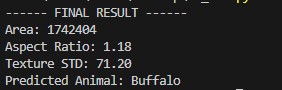
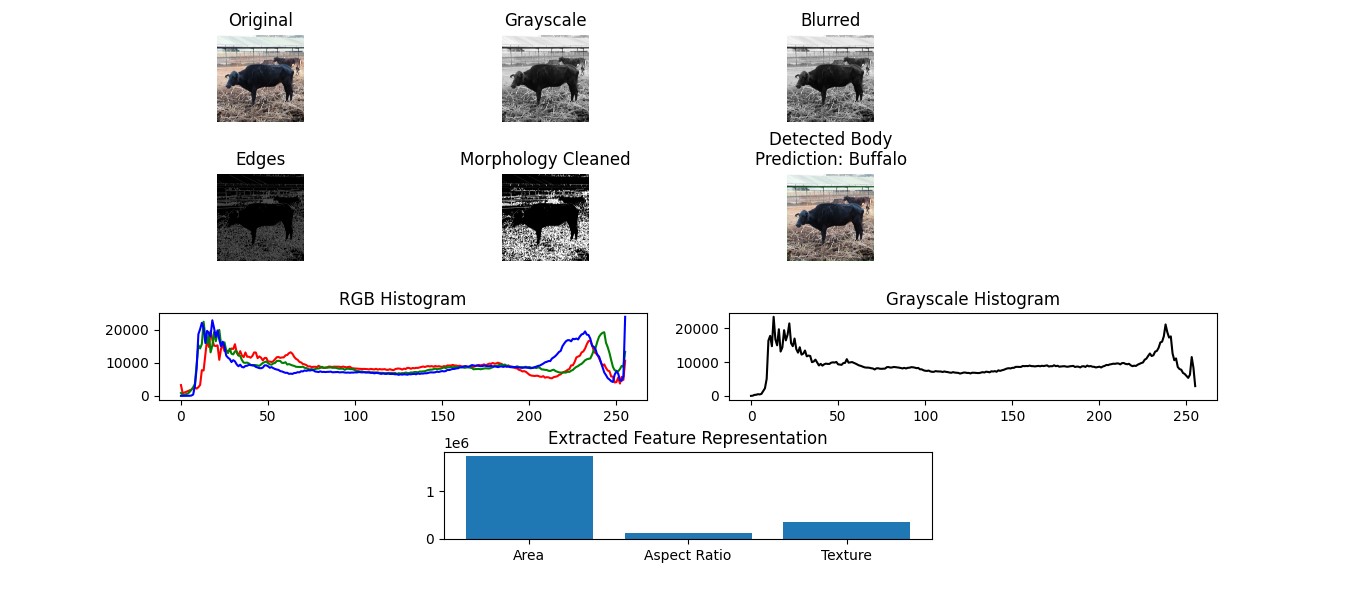
The project initially began as a rule-based image processing system using OpenCV for feature extraction such as area, aspect ratio, texture, and edge density. To improve accuracy and make the system closer to real-world AI applications, the project was later extended towards a data-driven deep learning approach using Convolutional Neural Networks (CNNs).
🌟 Inspiration
The inspiration for this project came from my growing interest in Artificial Intelligence, Machine Learning, and real-world problem solving, along with my experience as a Smart India Hackathon (SIH) 2025 Finalist. Participating in SIH exposed me to industry-level problem statements where accuracy, scalability, and automation are critical.
Observing how AI-driven solutions are used in agriculture, animal monitoring, and safety systems motivated me to design an intelligent system that can automatically recognize animals from images, reducing human effort and error.
🧠 What I Learned
Through this project, I gained hands-on experience in:
- Image preprocessing techniques such as grayscale conversion, edge detection, and morphological operations
- Feature extraction methods including texture analysis and shape-based features
- Designing and training Convolutional Neural Networks (CNNs)
- Understanding the difference between rule-based systems and true AI models
- Using transfer learning with pre-trained models to improve accuracy
- Integrating Tkinter-based GUI for real-time interaction
- Storing prediction results in a MySQL database for future analysis
Mathematically, the CNN learns feature representations by applying convolution operations:
[ \text{Feature Map} = \text{Input Image} * \text{Kernel} + \text{Bias} ]
🛠️ How I Built the Project
Image Acquisition Users can upload animal images multiple times without restarting the application.
Preprocessing Images are resized, normalized, and enhanced to reduce noise and improve feature clarity.
Feature Extraction (Initial Phase)
- Contour area
- Aspect ratio
- Texture standard deviation
- Edge density
Model Training (AI Phase) A CNN model is trained on a labeled animal dataset (Cow, Buffalo, Bull). The model automatically learns visual patterns such as body structure, texture, and shape.
Prediction & Visualization The system displays prediction results along with processed images and graphical representations of extracted features.
Database Integration Each prediction is logged into a MySQL database with timestamped records for tracking and analysis.
⚠️ Challenges Faced
- Collecting and organizing a diverse animal image dataset
- Differentiating visually similar animals such as cow and buffalo
- Handling variations in lighting, angle, and background
- Improving accuracy beyond rule-based thresholds
- Integrating deep learning models with a GUI application
- Optimizing performance for real-time predictions
These challenges helped me understand why deep learning models outperform traditional image processing approaches in real-world scenarios.
🚀 Future Scope
- Training on larger and more diverse datasets
- Using advanced models like MobileNet, ResNet, or EfficientNet
- Adding confidence scores for predictions
- Deploying the system as a web or mobile application
- Extending classification to more animal categories
🎯 Conclusion
This project represents a transition from traditional image processing to real AI-based classification systems. Inspired by Smart India Hackathon (SIH) 2025, it demonstrates how deep learning can be applied to practical problems with high accuracy and scalability, making it suitable for real-world deployment.

