-
-
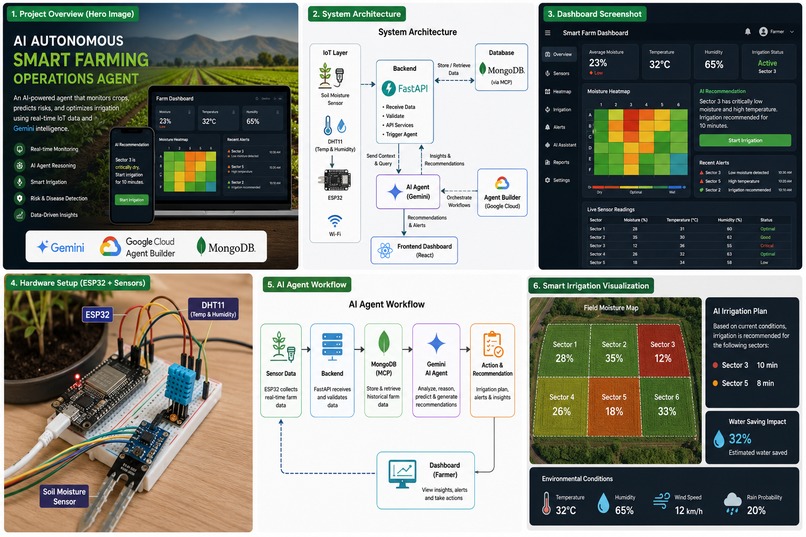
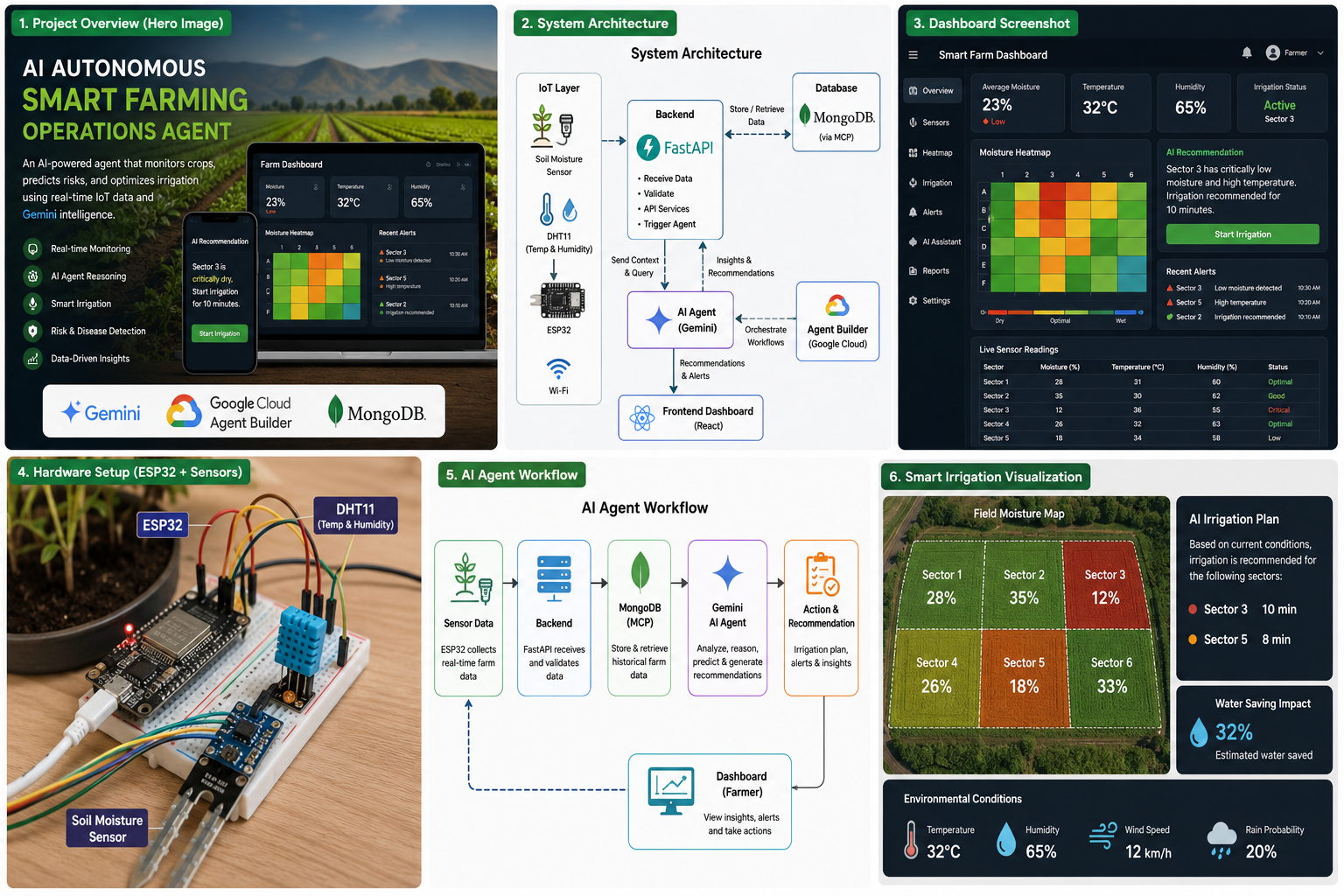
images of project info
Inspiration
Agriculture remains one of the most important industries in the world, yet many farmers still rely on manual observation and traditional irrigation methods. This often leads to water wastage, delayed disease detection, uneven irrigation, and inefficient crop management.
Our inspiration came from observing how difficult it is for farmers to continuously monitor large agricultural fields in real time. We wanted to build a system that goes beyond dashboards and notifications — an intelligent AI agent capable of understanding farm conditions, reasoning through problems, and autonomously recommending actions.
Instead of building another chatbot, we envisioned an AI-powered farming assistant that can actively analyze sensor data, identify risks, optimize irrigation, and help farmers make better decisions using real-time intelligence.
This project combines:
Artificial Intelligence IoT-based monitoring Autonomous decision-making Real-time analytics Multi-step agent workflows
to create a smarter and more sustainable farming ecosystem.
What it does
Our project is an AI-powered autonomous farming operations agent built using Gemini, Google Cloud Agent Builder, and MongoDB MCP integration.
The system continuously collects live agricultural data from IoT sensors connected to an ESP32 microcontroller. The AI agent then analyzes the data, reasons through farm conditions, and recommends or automates actions.
The agent can:
Monitor soil moisture, temperature, and humidity Detect dry or risky farm sectors Recommend irrigation strategies Predict possible crop health issues Store and retrieve historical farm data Generate intelligent farming insights Assist farmers through AI-driven recommendations
Unlike traditional systems that simply display sensor values, our agent performs multi-step reasoning to accomplish real farming tasks.
How we built it
Step 1 — IoT Data Collection
Sensors connected to the ESP32 continuously monitor:
Soil moisture Temperature Humidity
The readings are transmitted to the backend server through Wi-Fi.
Step 2 — Data Storage with MongoDB
The incoming farm data is stored inside MongoDB collections using the MongoDB MCP integration. Historical records are maintained for future analysis and intelligent recommendations.
Example stored data:
{ "sector": "Sector 3", "moisture": 21, "temperature": 34, "humidity": 68, "timestamp": "2026-05-07T10:20:00Z" } Step 3 — AI Agent Reasoning
Gemini-powered agents analyze the incoming data and perform multi-step reasoning:
Identify critical sectors Compare historical patterns Predict irrigation requirements Detect abnormal conditions Generate actionable recommendations
Example:
“Sector 3 has critically low moisture levels and high temperature. Irrigation is recommended for 10 minutes to avoid crop stress.”
Step 4 — Dashboard Visualization
The frontend dashboard visualizes:
Real-time sensor readings Moisture heatmaps Alerts and warnings AI-generated insights Irrigation recommendations
This helps farmers quickly understand the condition of their farms.
Tech Stack Component Technology AI Reasoning Gemini Agent Framework Google Cloud Agent Builder Database MongoDB MCP Integration MongoDB MCP Backend FastAPI Frontend React IoT Controller ESP32 Sensors Soil Moisture + DHT11 Hosting Railway / Render Media Handling Cloudinary Key Features Autonomous AI Agent
The system performs intelligent reasoning instead of only displaying raw data.
Real-Time Monitoring
Live agricultural data is continuously analyzed.
Smart Irrigation Recommendations
The agent identifies dry sectors and optimizes water usage.
Multi-Step Agent Workflow
The AI agent plans, reasons, retrieves data, and generates actions.
MongoDB MCP Integration
The agent interacts with structured agricultural data using MCP tools.
Scalable Architecture
The system is designed to support larger farms and future automation features.
Intelligent Farm Analysis
The irrigation logic is based on real-time environmental conditions:
$$ I = f(M, T, H) $$
Where:
( I ) = Irrigation recommendation ( M ) = Soil moisture ( T ) = Temperature ( H ) = Humidity
The AI agent dynamically evaluates these variables to make smarter irrigation decisions.
Challenges we ran into
- Designing Multi-Step Agent Workflows
Creating an agent that could reason through farming problems was significantly more complex than building a simple chatbot.
We had to design workflows where the AI:
retrieves live data, understands farm conditions, evaluates risk, and generates actionable outputs.
- IoT Data Reliability
Sensor readings can fluctuate frequently due to environmental factors. Stabilizing and validating real-time data streams was a major challenge.
- MCP Integration
Integrating MongoDB MCP into the agent workflow required understanding how agents interact with structured tools and external systems.
- Real-Time Visualization
Building a responsive dashboard capable of handling live updates and farm heatmaps required careful frontend optimization.
Accomplishments that we're proud of
What we learned
This project taught us:
how AI agents differ from traditional chatbots, how MCP enables tool-based AI systems, how Gemini can perform reasoning and task execution, how IoT systems integrate with AI workflows, and how real-time systems can improve agriculture.
We also learned how important sustainable technology solutions are for solving real-world problems.
What's next for AI Autonomous Smart Farming Operations Agent
We plan to extend the project with:
Automatic irrigation control AI-based crop disease detection Weather-aware irrigation planning Voice-controlled farming assistant Drone and satellite integration Predictive yield analytics
Conclusion
Our goal was to build more than a monitoring dashboard. We wanted to create an intelligent farming companion capable of understanding agricultural conditions and helping farmers make better decisions through AI-powered automation.
By combining:
Gemini reasoning, Google Cloud Agent Builder, MongoDB MCP, and IoT sensor systems,
we created a practical example of how autonomous AI agents can solve real-world challenges in agriculture.
This project demonstrates how AI can move beyond conversation and become an active problem-solving partner in precision farming.
Built With
- agentic-ai
- arduino
- artificial-intelligence
- cloudinary
- css3
- data
- dht11-sensor
- esp32
- fastapi
- gemini-api
- github
- google-cloud-agent-builder
- html5
- iot
- javascript
- mongodb
- mongodb-mcp
- python
- railway
- react
- real-time-monitoring
- render
- rest-api
- soil-moisture-sensor


Log in or sign up for Devpost to join the conversation.