-
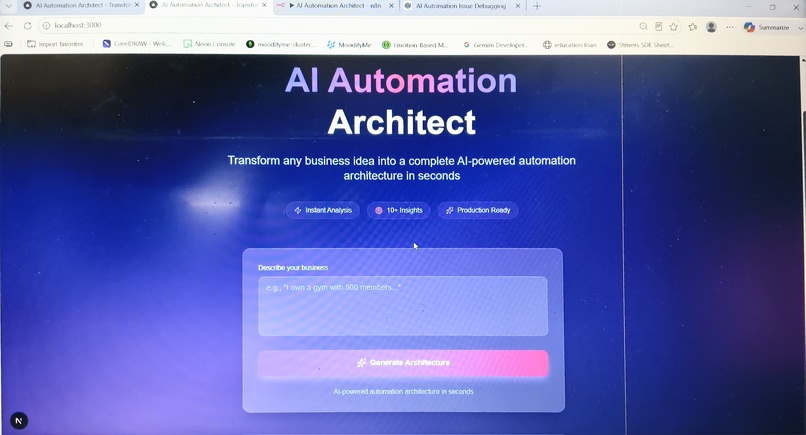
Landing Page
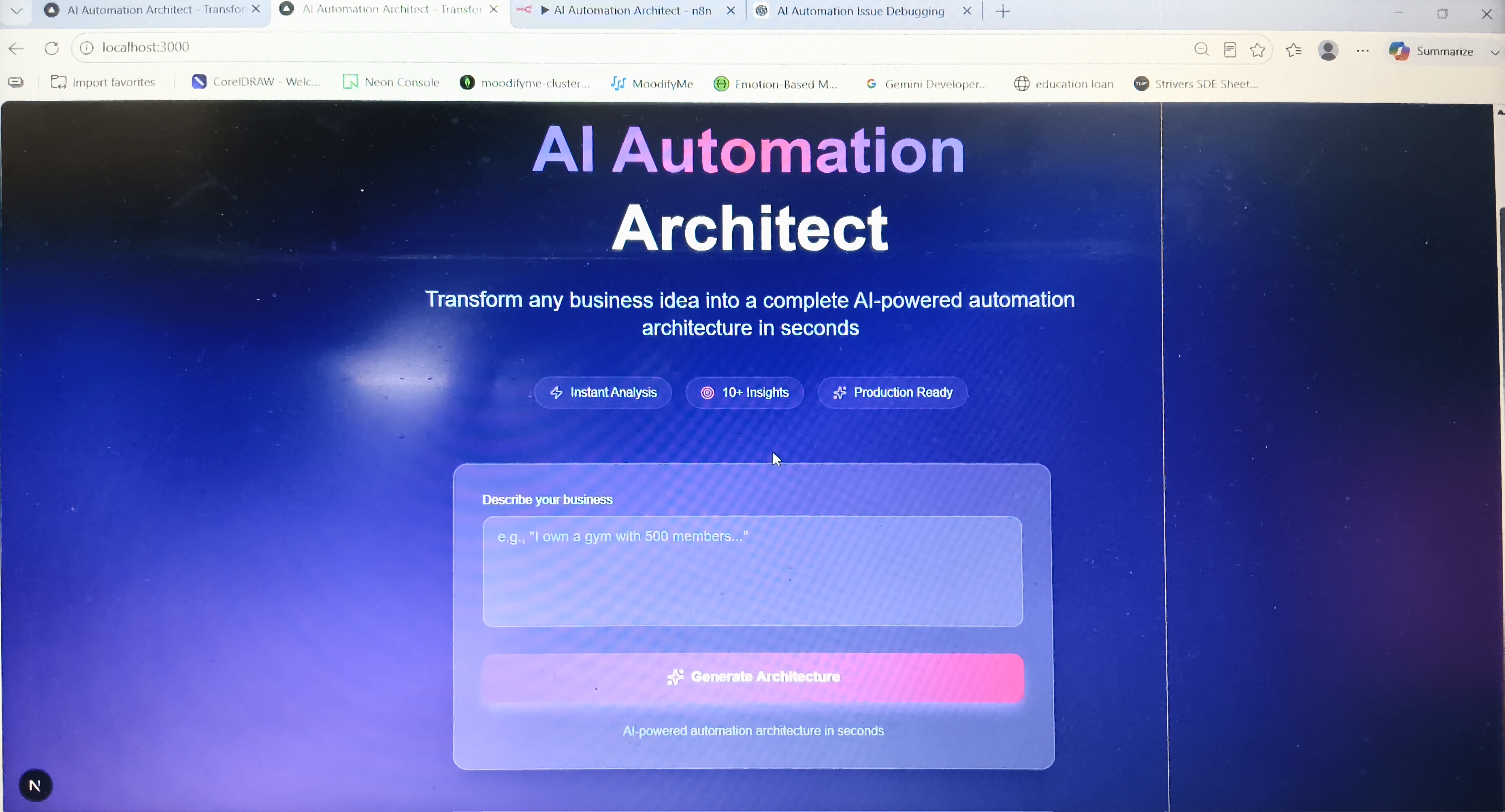
AI Automation Architect
Inspiration
Businesses know they need automation, but most don't know where to start. Translating a business idea into a CRM structure, database schema, workflows, and production-ready automations typically requires multiple consultants, architects, and developers.
We asked a simple question:
What if a business owner could describe their business in plain English and instantly receive a complete automation architecture?
That idea became AI Automation Architect — an AI-powered system that transforms business requirements into automation blueprints and executable workflows.
What It Does
AI Automation Architect acts as an AI Solutions Architect for businesses.
A user starts by describing their business, operations, and challenges. The platform then:
- Analyzes the business model and processes
- Identifies automation opportunities and bottlenecks
- Designs a CRM architecture
- Generates a database schema
- Creates workflow architectures
- Produces an AI Blueprint for review
- Generates production-ready n8n workflow structures
The entire journey follows:
Business Description → AI Analysis → CRM Design → Database Design → Workflow Design → AI Blueprint → Approval → n8n Workflow Generation
This dramatically reduces the time required to move from business discovery to automation implementation.
How We Built It
The platform combines AI reasoning with structured workflow generation.
Frontend
- Multi-step architecture dashboard
- Interactive workflow visualization
- AI Blueprint review and approval interface
- Business analysis and CRM visualization components
AI Layer
- Business understanding and process analysis
- Automation opportunity identification
- CRM and database design generation
- Workflow architecture planning
- Structured blueprint generation
Automation Layer
- Workflow transformation engine
- n8n-compatible workflow generation
- Node and connection mapping
- Deployment-ready automation structures
The system maintains context across each stage, allowing outputs from one phase to inform the next while preserving a consistent architecture.
Challenges We Ran Into
One of the biggest challenges was maintaining consistency across multiple AI-generated stages.
Early versions generated incomplete structures, inconsistent schemas, and outputs that were difficult for the frontend to render reliably. We had to design strict output formats and validation layers to ensure that each stage produced predictable, structured data.
Another challenge was separating business-level architecture from implementation-level workflows. AI often wanted to jump directly into technical workflow generation before properly defining the CRM, database, and process architecture. Creating a staged pipeline helped solve this issue.
We also faced challenges in translating high-level business descriptions into actionable automation logic while keeping the outputs understandable for non-technical users.
What We Learned
Building AI Automation Architect taught us that AI performs significantly better when complex problems are broken into structured stages rather than solved in a single prompt.
We learned the importance of:
- Multi-step AI orchestration
- Schema-driven generation
- Human-in-the-loop approval workflows
- Consistent data contracts between AI and frontend systems
- Converting business knowledge into executable automation logic
Most importantly, we learned that automation design is not just a technical problem—it's a business understanding problem first.
Accomplishments That We're Proud Of
- Built an end-to-end AI automation architect
- Generated CRM and database designs automatically
- Created structured workflow blueprints from plain-language business descriptions
- Implemented an approval layer before workflow generation
- Successfully bridged the gap between business analysis and automation implementation
What's Next for AI Automation Architect
Our vision is to evolve AI Automation Architect into a complete autonomous automation platform.
Future plans include:
- One-click deployment to n8n
- Multi-platform workflow generation
- CRM integration generation
- Agentic workflow optimization
- Continuous business process monitoring
- AI-driven workflow improvement recommendations
Ultimately, we want to make enterprise-grade automation architecture accessible to every business, regardless of technical expertise.
Tagline: From Business Description to Production-Ready Automation.

Log in or sign up for Devpost to join the conversation.