-
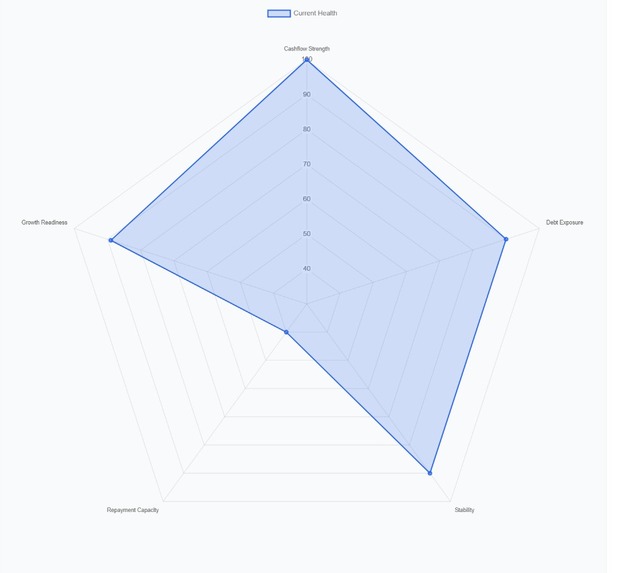
Graphical view of report
-
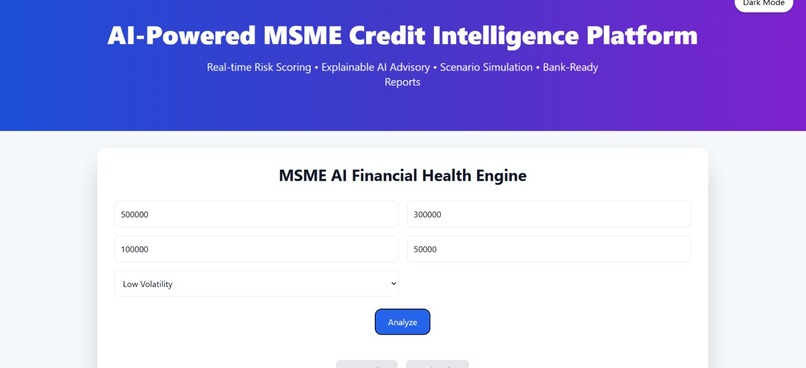
Input
-
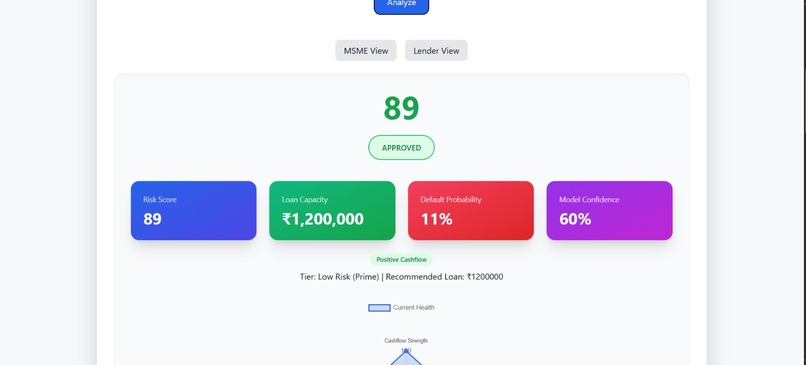
Scores
-
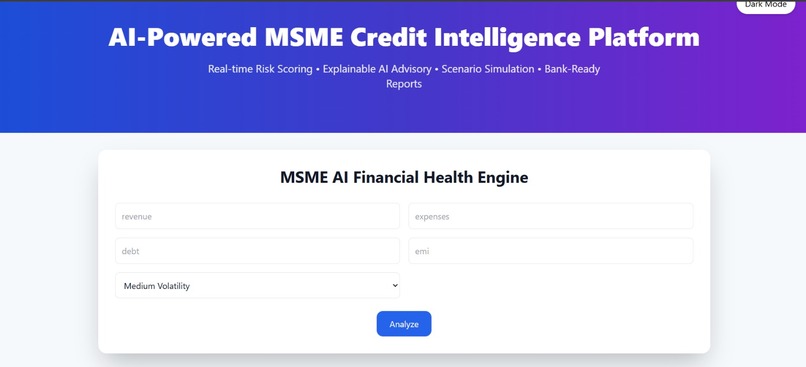
-
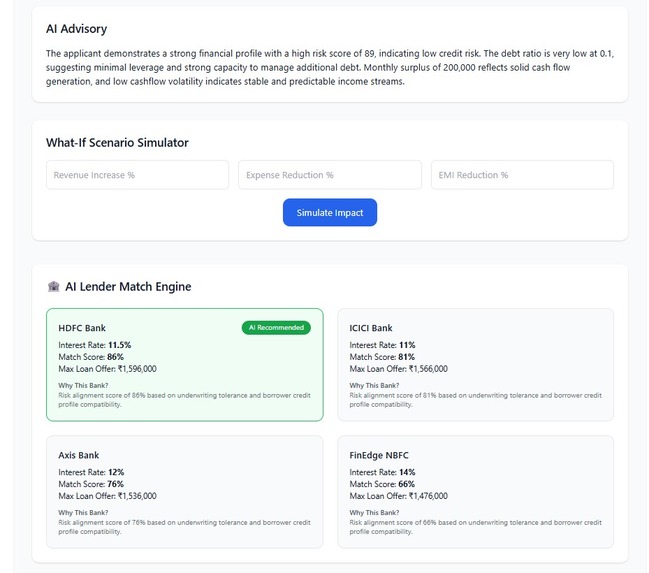
AI advisor


AI-Assisted Financial Advisory Engine Inspiration
Micro, Small and Medium Enterprises (MSMEs) contribute significantly to economic growth, yet many struggle to secure loans due to rigid and opaque credit evaluation systems. Traditional models often rely heavily on historical credit scores and collateral, ignoring real-time cashflow behavior and financial discipline.
We were inspired by a simple but powerful idea:
What if MSMEs could understand and improve their financial readiness before approaching lenders?
Instead of building a loan approval system, we decided to build an AI-assisted financial readiness engine that helps businesses assess risk, understand weaknesses, and simulate improvements.
What it does
The AI-Assisted Financial Advisory Engine evaluates a business’s financial health using structured inputs and generates an explainable risk assessment.
Inputs
Monthly Revenue
Monthly Expenses
Existing Debt
Monthly EMI
Revenue Stability (Low / Medium / High)
Core Calculations
- Cashflow Surplus Surplus = Revenue − Expenses − EMI Surplus=Revenue−Expenses−EMI
Debt Ratio
Debt Ratio
Existing Debt Monthly Revenue Debt Ratio= Monthly Revenue Existing Debt
Risk Score
Risk Score
100 − 𝑃 surplus − 𝑃 debt − 𝑃 volatility Risk Score=100−P surplus
−P debt
−P volatility
System Outputs
Based on these calculations, the system generates:
Risk Score (0–100)
Risk Tier (Low, Moderate, High, Critical)
Suggested loan readiness insight
AI-generated explanation of weaknesses
Practical improvement suggestions
We also built a “What If” simulator that allows users to see how increasing revenue or reducing expenses affects their risk profile in real time.
How we built it
We used the MERN stack (MongoDB, Express, React, Node.js) with OpenAI integration.
Backend
Implemented a deterministic rule-based financial scoring engine.
Designed structured penalty logic based on surplus, debt ratio, and volatility.
Built REST APIs to calculate and return score, tier, and financial metrics.
AI Layer
Integrated OpenAI to generate structured financial explanations.
The AI is used strictly for interpretation, not numerical computation.
This separation ensures stability, transparency, and consistency.
Frontend
Developed a clean React-based financial input form.
Designed a result panel displaying:
Risk Score
Risk Tier
AI-generated insights
Implemented an interactive scenario simulator for financial improvement analysis.
The architecture is modular, transparent, and scalable.
Challenges we ran into
- Avoiding Overengineering
It was tempting to build a machine learning-based credit model. However, training reliable ML models requires high-quality financial datasets, which are not feasible within a hackathon environment. We deliberately chose a rule-based system for clarity and robustness.
- Explainability vs. Accuracy
Using AI for explanation required careful prompt engineering to prevent hallucinated financial conclusions while maintaining professional and consistent reasoning.
- Scope Control
Financial systems can quickly expand into authentication systems, dashboards, integrations, and multi-role architectures. We strictly controlled scope to ensure a stable, working MVP within time constraints.
Accomplishments that we're proud of
Built a fully functional financial scoring engine within hackathon constraints.
Successfully combined deterministic scoring with AI-driven explainability.
Developed an interactive financial improvement simulator.
Created a system that is defensible, scalable, and technically structured.
Maintained clarity and simplicity without sacrificing depth.
What we learned
Simplicity outperforms complexity under time pressure.
Explainable AI is more valuable than black-box AI in financial contexts.
Deterministic financial models are easier to validate and defend.
Product positioning is as important as technical implementation.
Interactive simulations significantly enhance user engagement.
What's next for AI-Assisted-Financial-Advisory-Engine
Integration with real accounting or GST transaction data.
API layer for fintech lenders as a pre-screening tool.
Addition of advanced financial metrics such as liquidity ratios and seasonal modeling.
Risk clustering using real-world financial datasets.
Deployment as a SaaS-based advisory platform for MSMEs.
Built With
- api
- axios
- css3
- express.js
- git
- html5
- javascript
- mongodb
- node.js
- openai
- react.js
