Inspiration
What it does
Inspiration
Scientific research increasingly relies on AI-assisted tools for writing, coding, and analysis. While these tools improve productivity, they also introduce new challenges for academic integrity, including unsupported claims, citation inconsistencies, unclear methodology descriptions, and reduced research transparency.
As researchers, we often spend significant time manually reviewing manuscripts and checking whether conclusions are sufficiently supported by evidence. We wanted to build an AI assistant that helps researchers, reviewers, and editors identify potential integrity risks before publication.
What it does
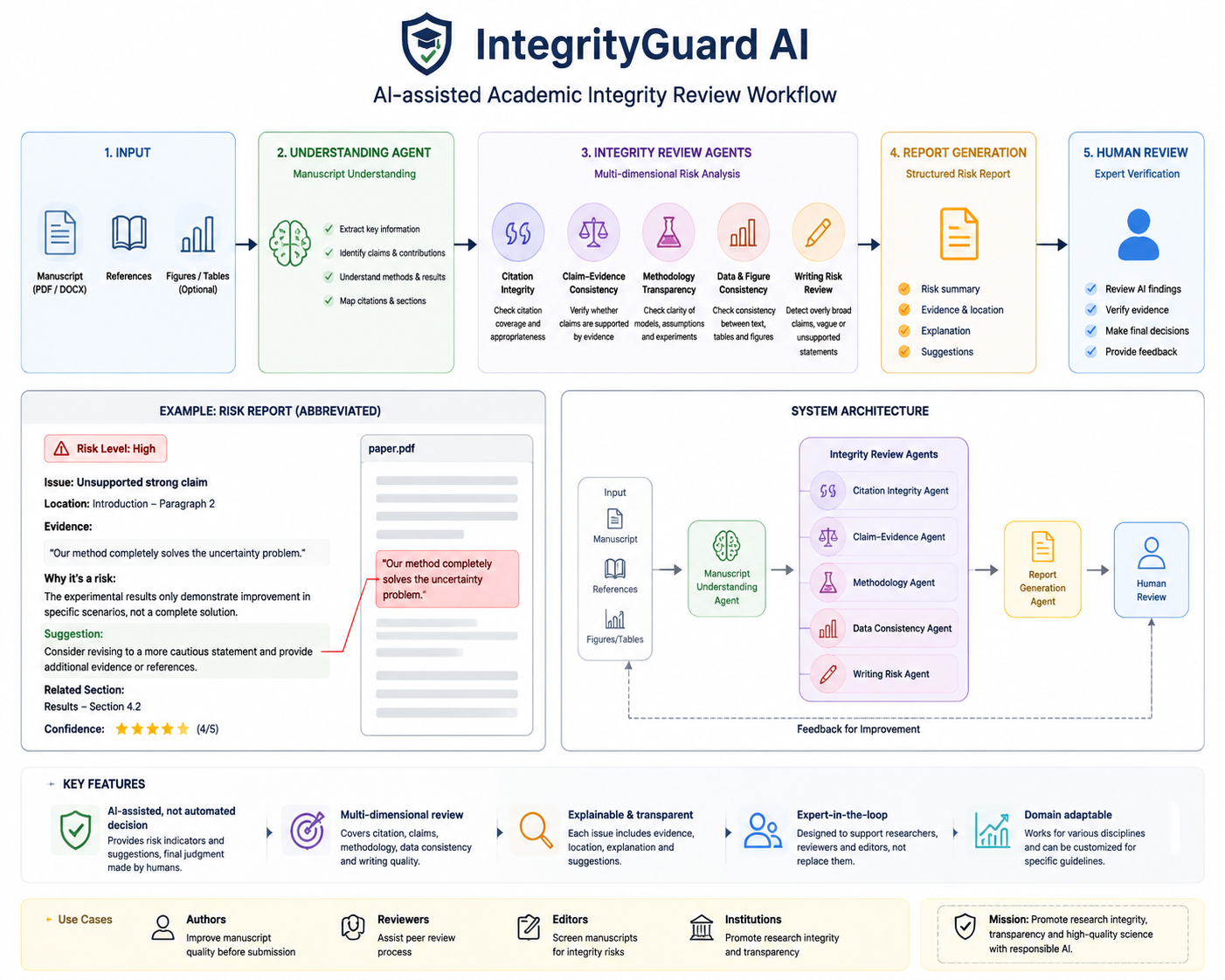
IntegrityGuard AI is an AI-assisted academic integrity review workflow that analyzes research manuscripts and provides structured risk reports.
The system focuses on identifying potential issues rather than making automatic judgments. It helps users review:
- Citation integrity: whether important claims are supported by appropriate references.
- Claim-evidence consistency: whether conclusions are supported by experimental results.
- Methodology transparency: whether models, assumptions, and experiments are clearly described.
- Data and figure consistency: whether tables, figures, and descriptions appear consistent.
- Research writing risks: overly broad claims, unsupported statements, and unclear contributions.
The output provides risk locations, explanations, and actionable suggestions for human review.
How we built it
We built IntegrityGuard AI using OpenAI models with a structured agent workflow.
The workflow decomposes manuscript review into multiple specialized analysis tasks:
- Manuscript understanding agent extracts research objectives, methods, experiments, and conclusions.
- Integrity review agents evaluate different risk categories.
- A report generation agent summarizes findings and produces revision suggestions.
The system uses structured prompts and reusable review templates to make the analysis more consistent and reproducible.
Challenges we ran into
Academic integrity is a complex problem. AI models should not replace editors or reviewers, and automatically determining misconduct is neither reliable nor appropriate.
The main challenge was designing a workflow that identifies potential risks while avoiding false accusations. We addressed this by focusing on evidence-based warnings and requiring human verification.
Accomplishments that we're proud of
We developed a practical AI workflow that transforms traditional manual manuscript checking into an interactive review process.
Instead of simply generating text, IntegrityGuard AI provides structured feedback that researchers can use to improve transparency, rigor, and research quality.
What we learned
Building this project showed us that AI agents are most valuable when they support expert workflows rather than replace human expertise.
By combining domain knowledge with AI reasoning capabilities, we can create tools that improve research efficiency while maintaining academic standards.
What's next
Future improvements include:
- Integration with reference management systems.
- More advanced citation verification.
- Support for scientific figures and experimental data analysis.
- Custom review workflows for different research fields. ## How we built it
Challenges we ran into
Accomplishments that we're proud of
What we learned
What's next for AI-assisted academic integrity review workflow
Built With
- academic
- agents
- ai
- api
- engineering
- github
- gpt-4o
- gpt-5
- language
- large
- machine
- markdown
- models
- natural
- openai
- processing
- prompt
- python
- research

Log in or sign up for Devpost to join the conversation.