Ícaro - AI Assistant
Inspiration
Ícaro started as an attempt to build something similar to Windows Voice Access, where users can control the computer using numbered voice commands. While experimenting with it, I realized:
"This is too basic. I want something that can do much more."
That led me to ask myself:
"What if I could build an AI assistant that adapts to me, instead of forcing me to adapt to the limitations of an application?"
As I began working on the project, I discovered that most existing AI assistants are excellent at specific tasks, but very few give users full control over their architecture, allow them to freely choose AI models, or provide a true voice-first experience. Many of them still rely primarily on typing, while I wanted my assistant to be driven by voice commands, integrate external tools, and serve as a platform for experimenting with new technologies.
As a Software Engineering student passionate about Artificial Intelligence and Cybersecurity, I decided to turn that curiosity into a real project.
What it does
Ícaro is a modular AI assistant designed for development, automation, and productivity.
Currently, it can:
- Integrate multiple AI providers through APIs, allowing different AI models to be used interchangeably.
- Process voice input.
- Execute specialized tools and AI agents.
- Organize functionality through a modular architecture.
- Support future feature integrations without modifying the project's core architecture through its Features system.
The project is designed with scalability, flexibility, and experimentation in mind.
How we built it
The project was built using a modular architecture that allows every component to evolve independently.
Technologies used:
- Python
- C++ (Features)
- Visual Studio Code
- Git & GitHub
- AI model APIs
- Agent-based architecture
- Audio processing services
- Modular Features system
Throughout development, the project went through multiple refactors to keep the codebase clean, maintainable, and ready for future expansion.
Challenges we ran into
One of the biggest challenges was realizing that integrating multiple technologies is much more difficult than it initially seems.
Some of the challenges included:
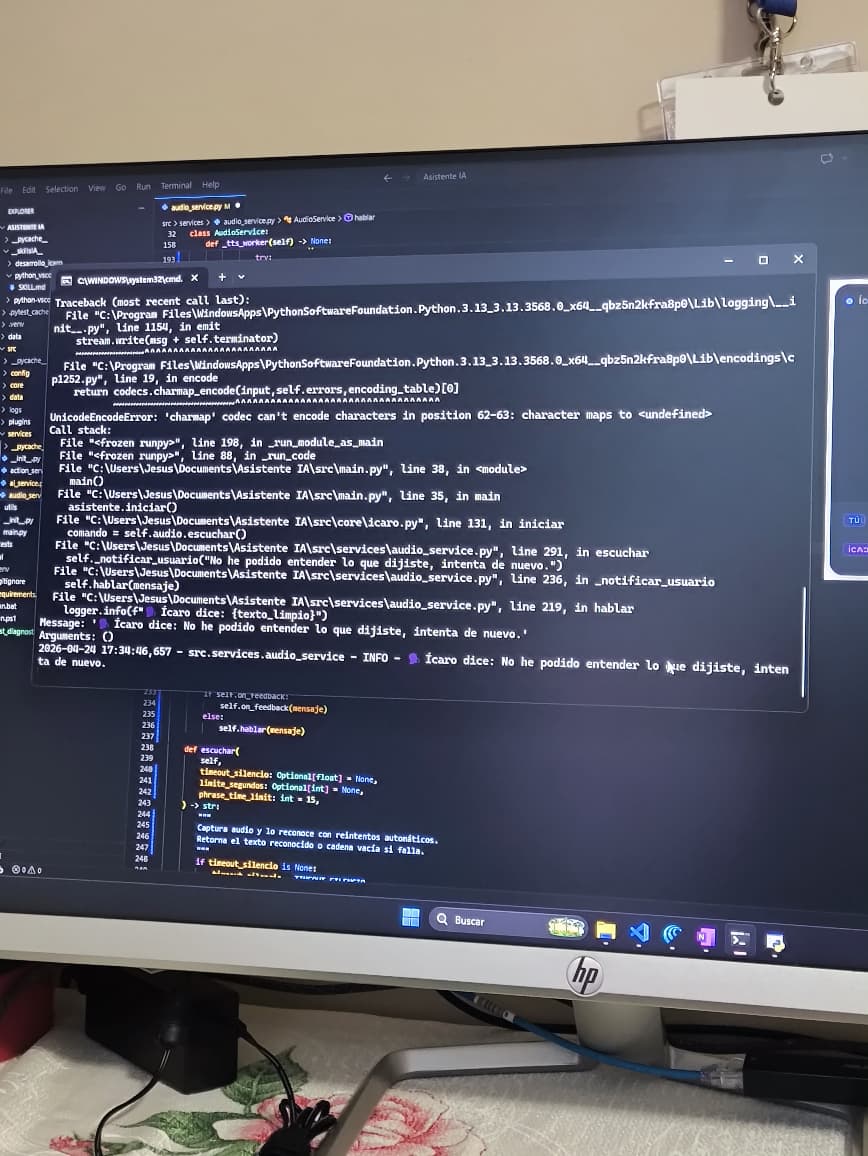
- Integrating Python and C++ for audio processing.
- Optimizing voice recognition using Voice Activity Detection (VAD).
- Supporting multiple AI models with a unified architecture.
- Keeping the project organized as it continued to grow.
- Designing a flexible architecture without sacrificing simplicity.
- Balancing performance, modularity, and maintainability.
Many experiments did not work as expected, but every failed attempt became an opportunity to learn something new and improve the overall design.
Accomplishments that we're proud of
We're proud to have:
- Designed a scalable architecture.
- Built a fully modular AI assistant.
- Successfully integrated multiple technologies into a single project.
- Created a solid foundation for future expansion.
- Learned how to solve real-world engineering problems throughout development.
Beyond its current features, our biggest accomplishment is building a project with long-term potential that continues to evolve and improve over time.
What we learned
This project taught us that building an AI assistant involves much more than simply connecting an API.
Throughout development, we learned about:
- Modular software design.
- Cross-language integration.
- Component-based architecture.
- Performance optimization.
- Iterative software development.
- The importance of experimenting, failing, learning, and improving.
Every obstacle pushed us to explore new technologies and design more robust solutions.
What's next for Ícaro
Our goal is to continue transforming Ícaro into a smarter, more autonomous AI assistant.
Our next milestones include:
- Improving voice recognition and audio processing.
- Adding long-term memory.
- Expanding the specialized AI agent system.
- Integrating external tools through the Model Context Protocol (MCP).
- Automating more complex workflows.
- Supporting both local and cloud-based AI models.
- Improving performance and user experience.
- Adding features focused on software development and cybersecurity.
Ícaro continues to evolve with every new idea, experiment, and lesson learned. Rather than becoming a finished product, our vision is to build a research and development platform that continuously grows alongside advances in AI.


Log in or sign up for Devpost to join the conversation.