-
-
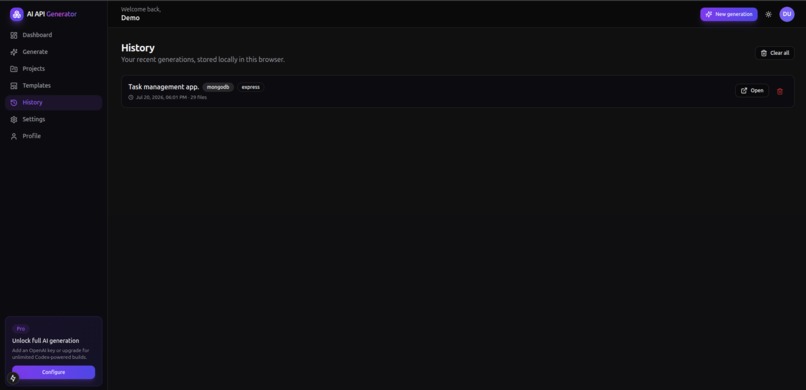
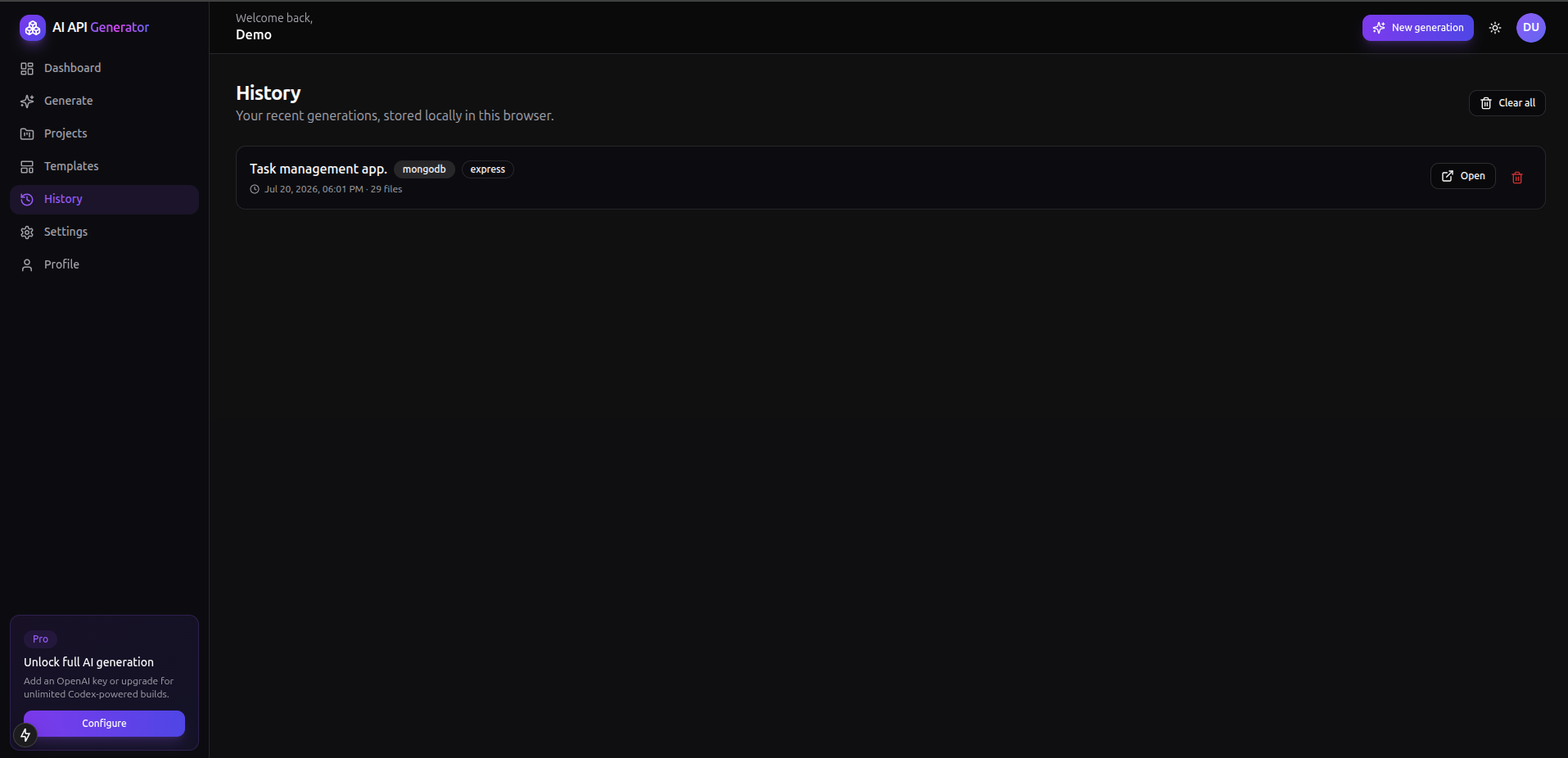
History
-
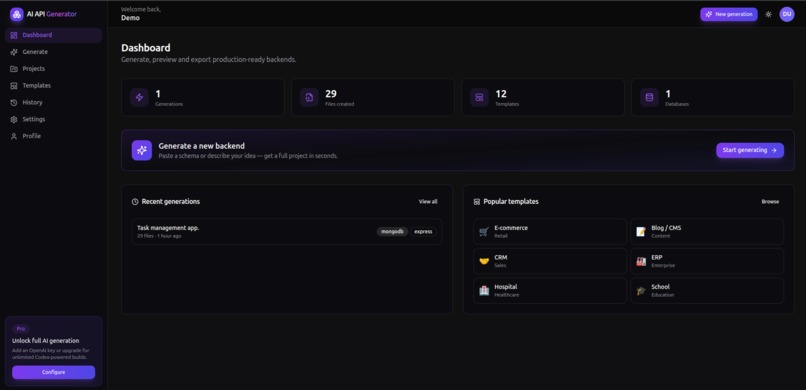
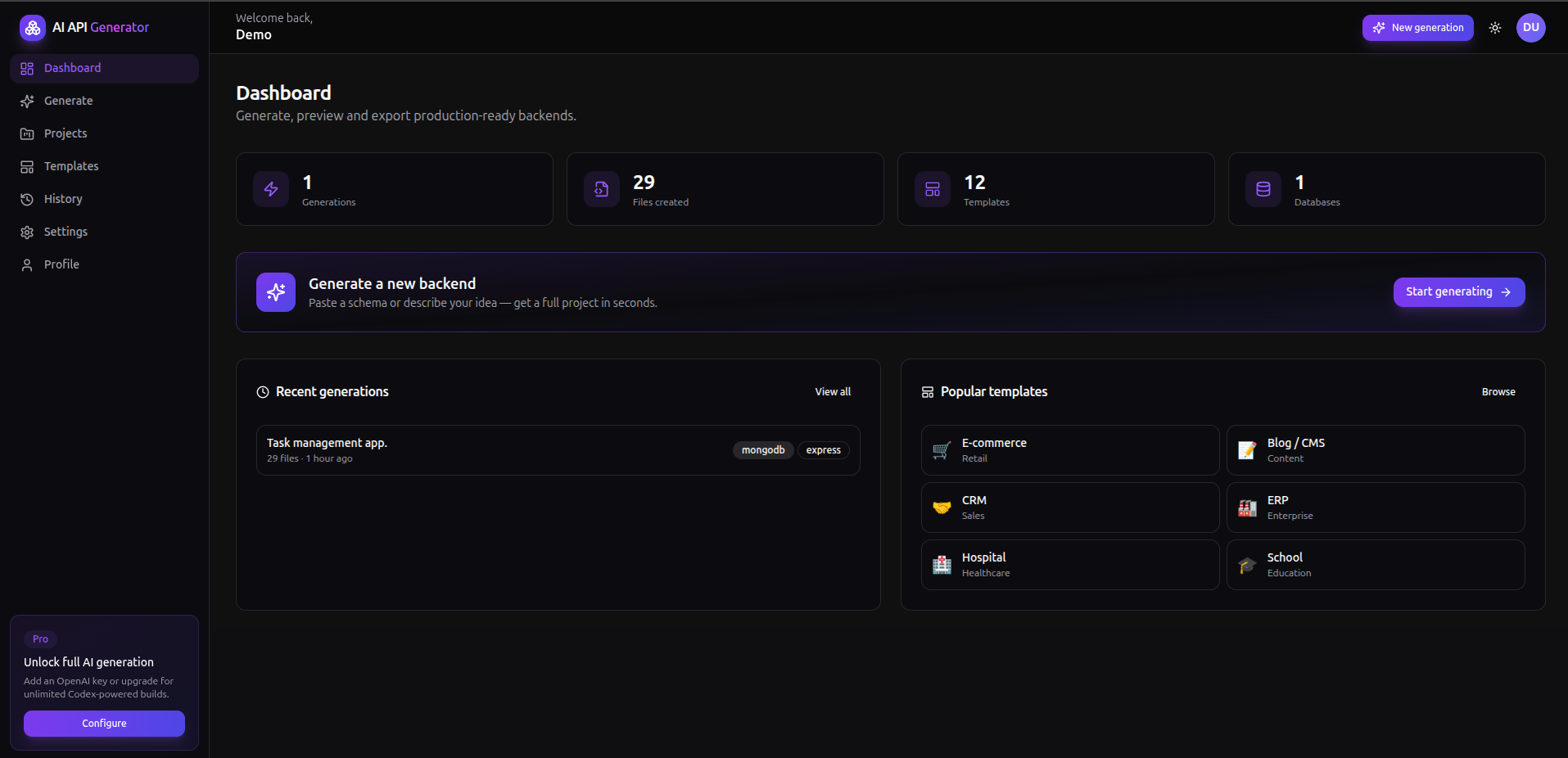
Dashboard
-
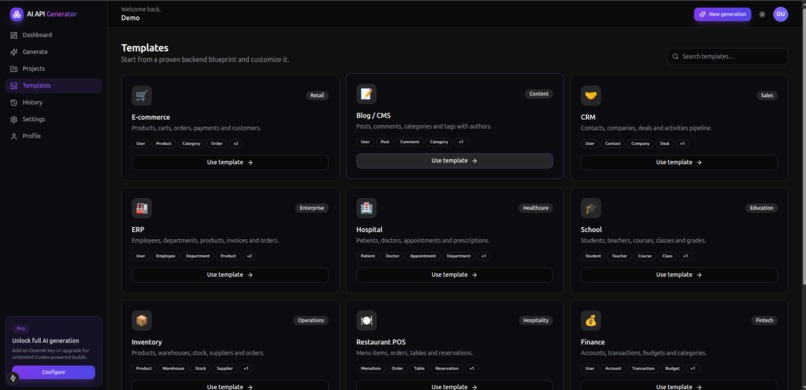
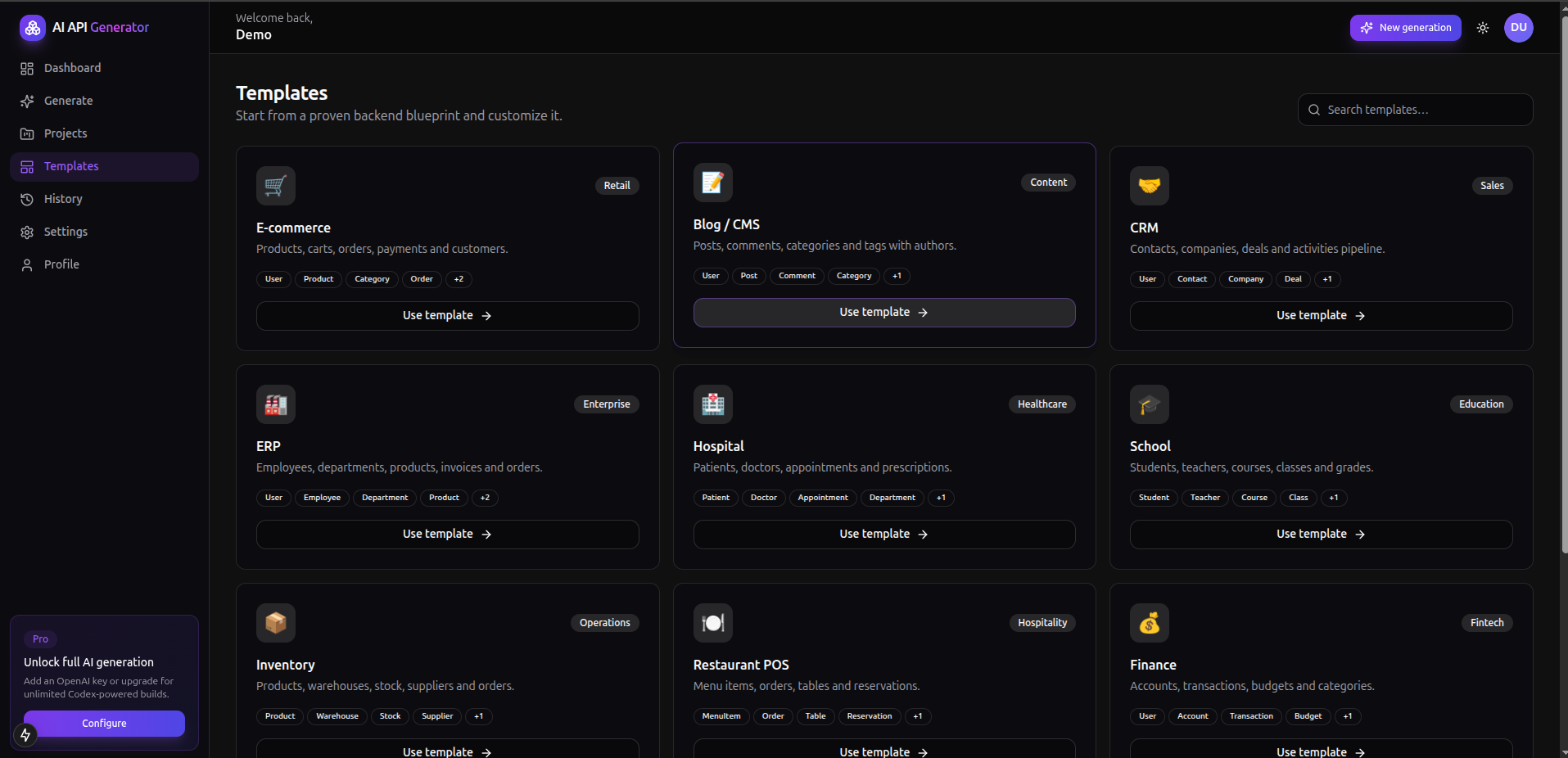
Pre Defined Templates
-
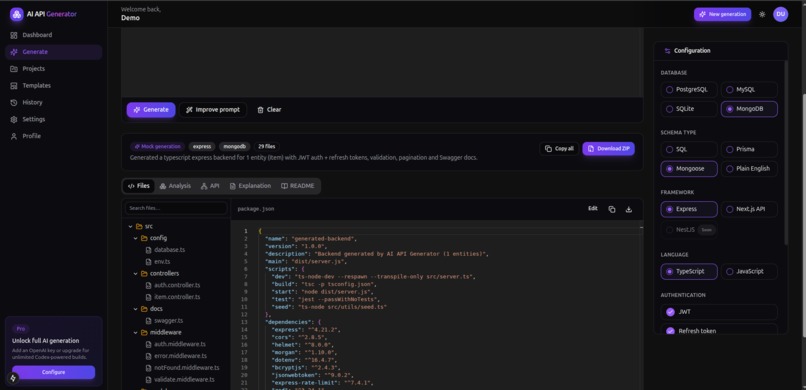
API Generation
-
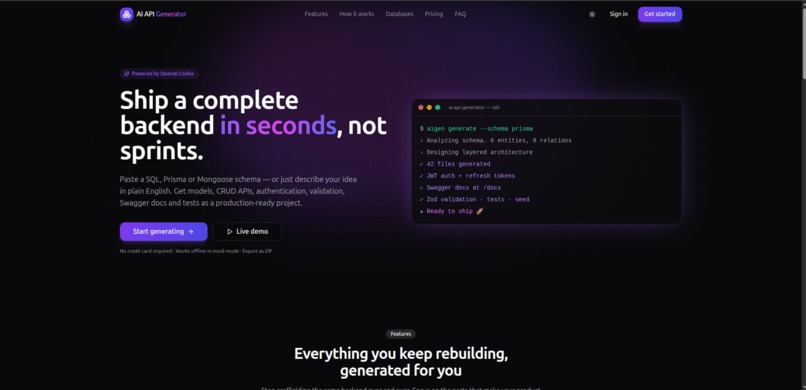
Home Page
Inspiration
Every backend engineer has lived the same Groundhog Day: a new project starts, and before you can write a single line of the logic that actually matters, you're rebuilding the same scaffolding for the hundredth time, models, CRUD endpoints, authentication, validation, pagination, error handling, API docs, tests, seed scripts. It's hours (sometimes days) of undifferentiated plumbing.
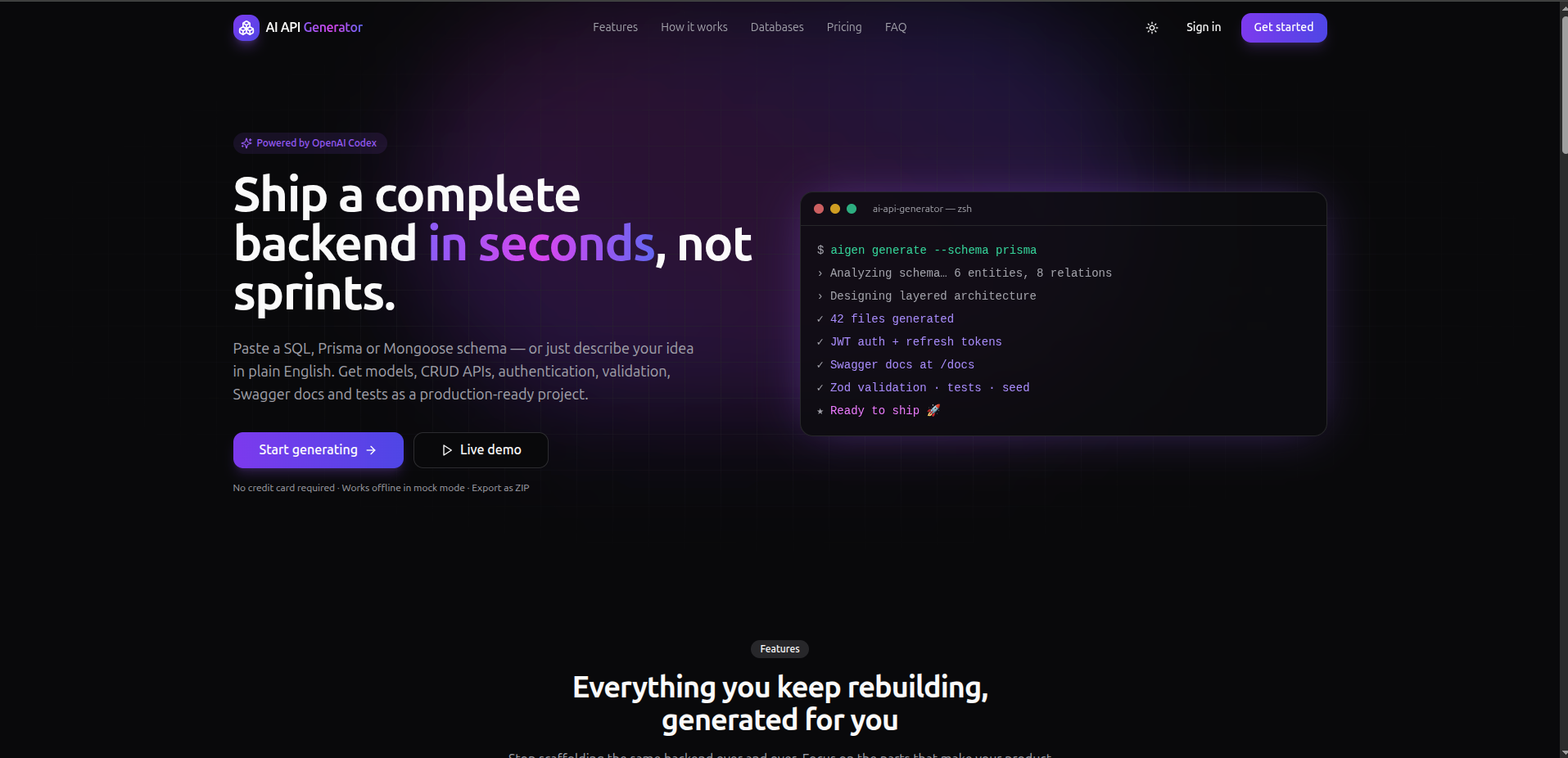
We realized that a schema, whether it's SQL, Prisma, Mongoose, or even just a sentence like "build an e-commerce backend", already contains everything needed to infer that entire backend. The structure is implicit; someone just has to write it out. That "someone" is exactly what modern reasoning models are good at. So we asked: what if you could go from schema to a complete, production-ready, downloadable backend in seconds? That question became AI API Generator.
What it does
AI API Generator turns any data model into a full backend project.
You give it one of four inputs, a SQL schema, a Prisma schema, Mongoose schemas, or a plain-English description, and it produces a complete, runnable project:
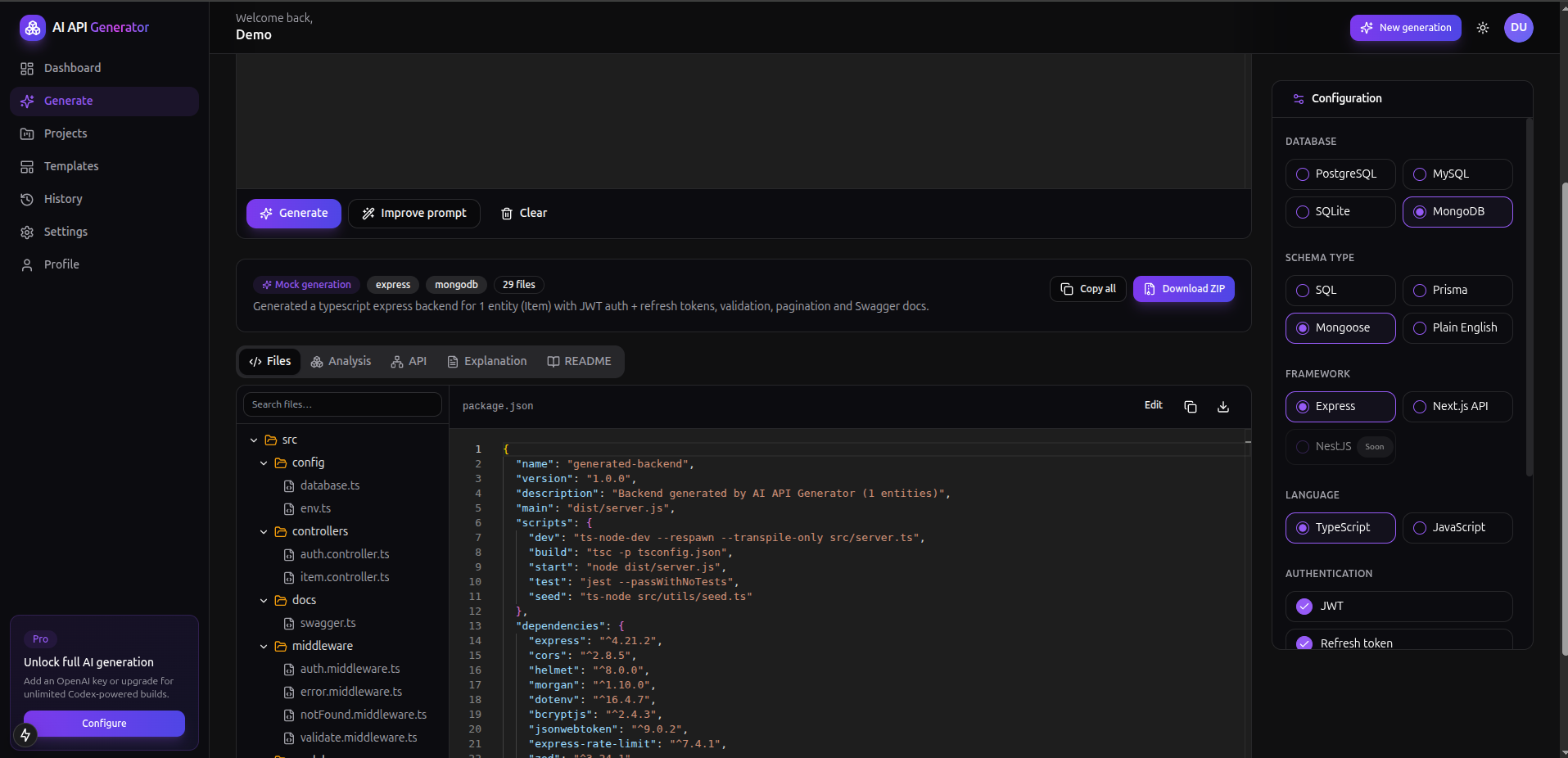
Models, controllers, services, and routes for every entity, in a clean layered architecture JWT authentication with refresh tokens, bcrypt password hashing, and route guards Validation (Zod / Joi), centralized error handling, rate limiting, CORS, and security headers Pagination, filtering, sorting, and search on every list endpoint Swagger / OpenAPI documentation, unit-test templates, seed data, .env.example, and a thorough README The app first analyzes your schema, extracting entities, fields, relationships, primary/foreign keys, enums, and indexes, then designs the architecture and generates every file. You browse the result in a file-tree explorer with a Monaco editor, edit files inline, preview the generated API endpoints, read an AI explanation of the architecture, and export the whole thing as a ZIP or copy files individually. Eleven starter templates (E-commerce, CRM, Hospital, ERP, HRMS, and more) get you going instantly, and every generation is saved to local history.
Crucially, it works with or without an OpenAI key, a deterministic mock generator produces the same structured output offline, so the full experience is always usable.
How we built it
Frontend: Next.js 15 (App Router) + React 19 + TypeScript, Tailwind CSS, and a hand-built shadcn-style component library. Framer Motion for animation, Monaco for the editor, TanStack Query + Axios for data, React Hook Form + Zod for forms, with full dark mode, skeleton loaders, toasts, and empty/error states. AI layer: The OpenAI Responses API drives generation. We engineered versioned, per-format prompt templates that pin the model to a strict JSON output contract (summary, architecture, analysis, files[], endpoints[], readme, explanation), plus a separate "Improve Prompt" flow that rewrites rough ideas into detailed specs. Schema analysis: A dependency-free analyzer parses SQL DDL, Prisma models, Mongoose schemas, and English descriptions into a normalized entity graph that both powers the analysis panel and grounds the generator. Backend: Next.js API routes with JWT sessions (jose) in httpOnly cookies with automatic access-token refresh, bcrypt hashing, Zod-validated inputs, and an in-memory rate limiter. Security: Untrusted schema input is sanitized and wrapped strictly as data inside delimited blocks with explicit anti-prompt-injection instructions; generation is authenticated and rate-limited. Export: JSZip + FileSaver assemble the generated files into a downloadable project.
Challenges we ran into
Making LLM output reliably structured. Free-form model responses don't drop cleanly into a file tree. We solved it with a rigid JSON schema contract, defensive JSON extraction/parsing, and a graceful fallback that degrades to a locally generated project if the model response ever fails — the user always gets a usable result. A demo that works with zero setup. We wanted judges to experience the full product without an API key, so we built a deterministic mock generator that emits the exact same GenerationResult shape from the parsed schema — real, coherent, runnable code, generated offline. Parsing four very different input formats into one consistent entity model — regex-based extraction across SQL constraints, Prisma attributes, Mongoose refs, and inferring structure from plain English. Prompt-injection hardening, since schema input is untrusted and flows into a model prompt. UX for large generated projects — rendering a real file tree, wiring Monaco with per-file language detection and theming, and keeping edits/state coherent across dozens of files.
Accomplishments that we're proud of
A genuinely end-to-end product, not a demo: landing page, auth, dashboard, generator, file explorer, Swagger preview, history, templates, settings, and ZIP export — all working. Generated code that's actually production-shaped, layered architecture, real auth, validation, pagination, docs, and tests, not toy snippets. The offline mock mode, which means the app is fully functional the moment you clone it. A clean, extensible architecture: adding NestJS, FastAPI, GraphQL, Docker, or CI/CD is a matter of adding generators, not rewriting the app. Polished, responsive UI with dark mode, it looks and feels like a real SaaS product. And it builds clean and passes end-to-end testing (login → generate → export verified against the running server).
What we learned
Prompt engineering is product engineering. Reliability came from constraining the model with an explicit output contract and treating every response as untrusted until parsed and validated. Grounding beats guessing. Doing our own deterministic schema analysis before prompting produced far more consistent, tailored results than relying on the model to infer structure alone. Graceful degradation is a feature. Designing the mock path and the fallback-on-failure path made the whole product more robust and demoable. Practical lessons across the Next.js 15 App Router (server/client boundaries, route handlers, Suspense for useSearchParams), edge-safe JWTs with jose, and integrating Monaco cleanly in a modern React app.
What's next for AI API Generator
More frameworks & languages: NestJS, FastAPI, Laravel, Spring Boot, and Go; the architecture is already built to accept them. More paradigms: GraphQL and gRPC generation alongside REST. Ship it, don't just download it: Dockerfiles, Kubernetes manifests, CI/CD pipeline generation, GitHub push integration, and one-click deploy. Deeper AI: streaming generation with live progress, iterative refine-by-chat on generated code, and automatic relationship/diagram visualization. Team features: shared workspaces, saved custom templates, SSO, and audit logs. Persistent backend (Postgres/Prisma) for accounts and cloud-saved projects beyond local history.
Built With
- axios
- bcryptjs
- express.js
- framer-motion
- jose
- jszip
- jwt
- lucide-react
- monaco-editor
- mongoose
- next.js
- node.js
- openai
- openai-responses-api
- prisma
- react
- react-hook-form
- swagger
- tailwindcss
- tanstack-query
- typescript
- zod


Log in or sign up for Devpost to join the conversation.