Inspiration
This project was inspired by the urgent need for early detection of Alzheimer’s disease, a condition that affects millions of people worldwide. While AI and machine learning cannot replace medical diagnosis, they can help educate, raise awareness, and demonstrate the potential of technology in healthcare. The goal of this project is to simplify complex cognitive assessments into an accessible, interactive tool, allowing anyone to understand the factors that may contribute to Alzheimer’s risk.
What it does
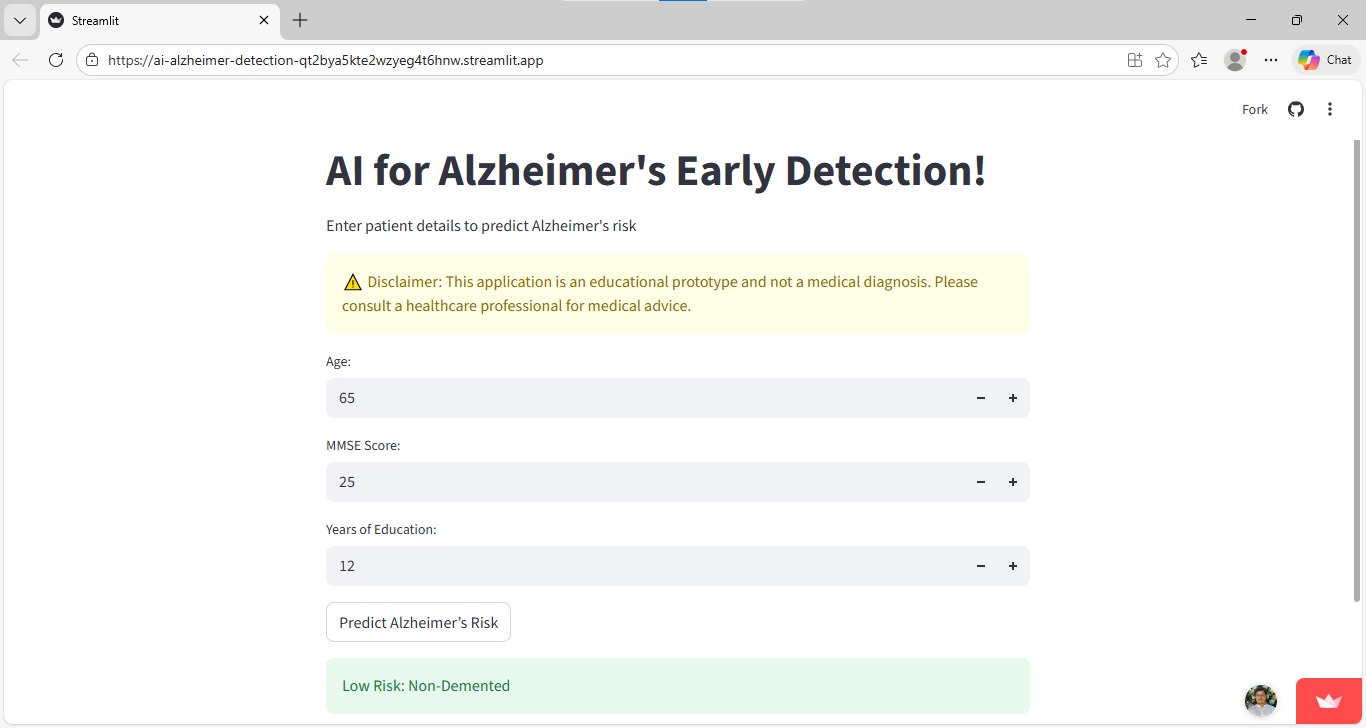
Accepts user input: Age, MMSE (Mini-Mental State Exam) score, and Years of Education. Uses a trained Logistic Regression model to predict Alzheimer’s risk. Displays clear results: “High Risk (Demented)” or “Low Risk (Non-Demented)”. Includes a disclaimer: Educational purpose only, not a medical diagnosis. Built with Python, Pandas, Scikit-learn, and Streamlit for an interactive web experience.
How we built it
Data Collection: Created a small dataset (alzheimer.csv) with key cognitive and demographic features: Age, MMSE Score, and Years of Education. Data Processing: Used Pandas to clean, organize, and convert categorical labels into numeric format for modeling. Model Training: Trained a Logistic Regression model using Scikit-learn, splitting data into train/test sets for evaluation. Evaluation: Checked model accuracy and ensured predictions align with logical patterns. Deployment: Built an interactive web app using Streamlit, where users can input data and see Alzheimer’s risk predictions in real-time. Responsible AI: Added a disclaimer to inform users that this is an educational tool, not a medical diagnosis.
Challenges we ran into
Small Dataset: Limited data made it challenging for the model to generalize well, and perfect accuracy on the test set could be misleading. Data Representation: Converting categorical labels to numeric values and ensuring proper train-test split required careful handling. Logical Accuracy: Ensuring predictions made sense for realistic cognitive scores and ages, especially for borderline cases. Deployment Learning Curve: Understanding Streamlit for the first time and connecting the ML model to an interactive web interface. Responsible AI: Including proper disclaimers and making users aware that the model is for educational purposes only, not medical diagnosis.
Accomplishments that we're proud of
Successfully trained a Logistic Regression model to predict early Alzheimer’s risk with a simple dataset.
uilt an interactive Streamlit web app that allows users to input data and receive predictions in real-time. Implemented responsible AI practices, including a clear disclaimer for educational purposes. Learned and applied end-to-end AI project workflow: data processing → model training → evaluation → deployment.
What we learned
Pandas & Data Processing: How to clean and organize data, convert categorical values to numeric, and prepare it for machine learning. Machine Learning Basics: Understanding features (X), target (y), train-test split, and training a Logistic Regression model. Model Evaluation: Checking model accuracy and interpreting predictions logically. Streamlit Deployment: Creating an interactive web app to input data and display ML predictions. Responsible AI Practices: Adding disclaimers and emphasizing educational purpose to avoid misinterpretation. Project Workflow: How to go from dataset → ML model → web app → deployment in a real hackathon setting.
What's next for AI Alzheimer Detection
Expand Dataset: Collect more real-world data to improve model accuracy and generalization. Advanced ML Models: Experiment with Random Forests, XGBoost, or Neural Networks for better prediction performance. Explainable AI: Show which factors (Age, MMSE, EDUC) contributed most to the prediction for transparency. Multi-Language Support: Make the app usable in different languages for broader accessibility. Mobile-Friendly Interface: Adapt the app for mobile devices so caregivers can use it on-the-go. Integration with Healthcare APIs: Allow secure sharing of results with medical professionals for further analysis.
Built With
- numpy
- pandas
- python
- scikit-learn
- streamlit


Log in or sign up for Devpost to join the conversation.