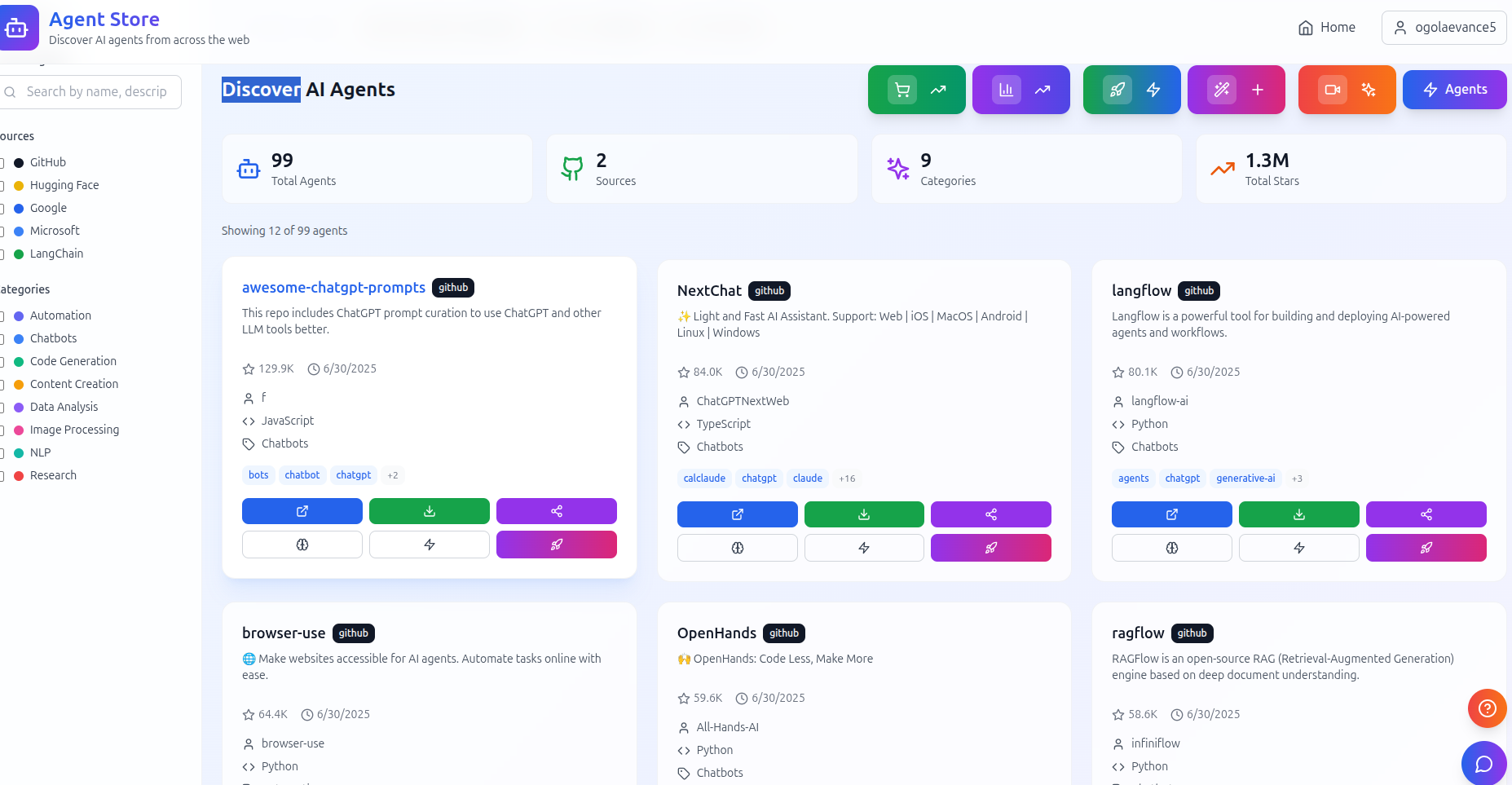
Agent Marketplace Project: Empowering Coders and Non-Coders
Inspiration
The inspiration for the Agent Marketplace stemmed from the growing popularity of AI agents and the lack of a centralized, accessible platform where both developers and non-coders could discover, build, and share personalized agents tailored to their lifestyles. I noticed that while platforms like GitHub hosted numerous agent projects, they were often fragmented, lacked user-friendly interfaces, or were inaccessible to non-technical users. My goal was to create a "one-stop shop" where anyone—coders building complex automation or non-coders seeking lifestyle assistants—could find, create, or sell agents. This vision was further fueled by my participation in the Hugging Face Agents & MCP Hackathon, where I explored tools like SmolAgents and no-code platforms like Mistral’s La Plateforme, aiming to democratize agent creation. The idea of empowering users to craft agents that fit their daily routines (e.g., a fitness coach or travel planner, shpping and etc suing A2A) while enabling developers to monetize their work drove this project.
What I Learned
Building the Agent Marketplace taught me several key lessons:
- No-Code Accessibility: Non-coders need intuitive interfaces to create personalized agents. Platforms like Mistral’s Agent Builder and Google Vertex AI showed me how natural language prompts can enable anyone to define agent behaviors (e.g., “Suggest vegan meals for my busy schedule”).
- Agent Ecosystem: Scraping sources like GitHub and categorizing agents by use case (e.g., productivity, data analytics) revealed the diversity of agent applications and the importance of clear documentation (e.g., setup guides, use case analysis).
- User Engagement: Features like friendly tones, social sharing, and smart recommendations significantly increase user adoption, as seen in my M-Pesa savings app, where engagement was key.
- Marketplace Dynamics: Balancing free and paid features (e.g., a $20 price cap for agents) ensures accessibility while incentivizing creators, similar to app store models.
- Technical Integration: Combining tools like bolt.new for user interfaces, Tavus for video explanations, and APIs for agent functionality taught me how to create seamless, multi-tool workflows.
6** A2A ecosystem for multi-agent communication
How I Built the Project
The Agent Marketplace was designed as a comprehensive platform with several core components, built using a mix of no-code and code-based tools to cater to both coders and non-coders:
Agent Aggregation:
- I developed a web scraper to collect publicly available agents from sources like GitHub, Hugging Face, and other repositories. Each agent was analyzed for functionality, setup requirements, and use cases, creating a centralized database.
- Example: For an agent like a “Travel Planner,” the platform provides a description (e.g., “Plans weekend trips under $200”) and setup guide.
User-Friendly Interface:
- For agents lacking interfaces (e.g., those in raw code form), I used Gradio to create temporary, interactive web interfaces. This allowed non-coders to interact with agents via simple inputs, similar to my prior Gradio-based agent store.
- Example: A user enters “Plan a workout” into a Gradio interface, and the agent responds with a tailored routine.
Agent Creation with Tavus:
- Integrated Tavus to enable users to create video descriptions of their agents. Users record a greeting and explain their agent’s purpose (e.g., “This agent tracks my water intake and suggests recipes”), making it easier to showcase and sell.
- Non-coders could use pre-built templates or A2A (Agent-to-Agent) workflows to define agent behaviors without coding.
Marketplace and Monetization:
- Built a marketplace where creators upload agents (free or paid, capped at $20). Users can purchase agents once and use them offline, though updates require a subscription (basic, premium tiers).
- Example: A coder uploads a data analytics agent, sets a $10 price, and earns revenue; a non-coder buys it for personal use.
Smart Recommendations and Dashboard:
- Implemented a recommendation system using basic natural language processing (NLP) to suggest agents based on user inputs (e.g., “I need a productivity agent” → recommends a task manager agent).
- Created a personalized dashboard showing agent categories, usage history, and progress, enhancing user engagement.
- Example: A user inputs “I’m a student, need study help,” and the system suggests a study planner agent.
Social Sharing:
- Added features to share agents on social media platforms, increasing visibility and community engagement, inspired by my M-Pesa app’s focus on user adoption.
The platform was built using Python for backend logic (e.g., scraping, NLP), Gradio for interfaces, Tavus for video creation, and no-code tools like Zapier for workflow automation, ensuring accessibility for non-coders.
Challenges Faced
Data Aggregation:
- Challenge: Scraping diverse sources like GitHub was complex due to inconsistent documentation and agent formats.
- Solution: Standardized agent metadata (e.g., name, use case, setup guide) using a custom parsing script, though it required manual curation for some entries.
Non-Coder Accessibility:
- Challenge: Ensuring non-coders could create and use agents without technical knowledge.
- Solution: Leveraged no-code platforms like Mistral’s Agent Builder for inspiration and integrated Gradio’s simple interfaces. However, balancing flexibility with simplicity was tricky.
Marketplace Scalability:
- Challenge: Managing a marketplace with free and paid agents while ensuring fair pricing and quality control.
- Solution: Set a $20 price cap and implemented a review system for agent quality, but scaling moderation for many submissions was time-intensive.
User Engagement:
- Challenge: Encouraging users to adopt and regularly use the platform, especially non-coders unfamiliar with AI agents.
- Solution: Added smart recommendations, friendly tones, and social sharing, inspired by app engagement strategies. (e.g., usage streaks) was planned but not fully implemented due to time constraints.
Integration Complexity:
- Challenge: Combining tools like , Tavus, and Zapier into a cohesive platform.
- Solution: Used APIs and modular workflows, but debugging cross-platform issues required extensive testing.
Conclusion
The Agent Marketplace bridges the gap between coders and non-coders, offering a platform to discover, create, and share personalized AI agents. Inspired by the need for accessible AI tools, it leverages no-code interfaces, smart recommendations, and social features to make agents likable and useful. While challenges like data aggregation and scalability persisted, the project taught me how to balance technical complexity with user-friendliness, paving the way for future enhancements like gamification and broader integrations.
Built With
- bolt.new
- supabase
- tavus


Log in or sign up for Devpost to join the conversation.