Inspiration
As AI agents become more powerful, enterprises are rapidly deploying them for customer support, software development, research, and automation. However, organizations face a major challenge: they can see what happened through observability platforms, but understanding why an AI agent failed, where money is being wasted, and how to fix issues still requires days of manual investigation. We were inspired to create a system that transforms raw telemetry into actionable intelligence, helping teams build reliable, cost-efficient, and trustworthy AI agents.
What it does
AIRE (AI Agent Reliability Engineer) is an intelligent reliability platform that continuously analyzes AI agent behavior using Dynatrace observability data, OpenTelemetry traces, and Google Cloud AI services.
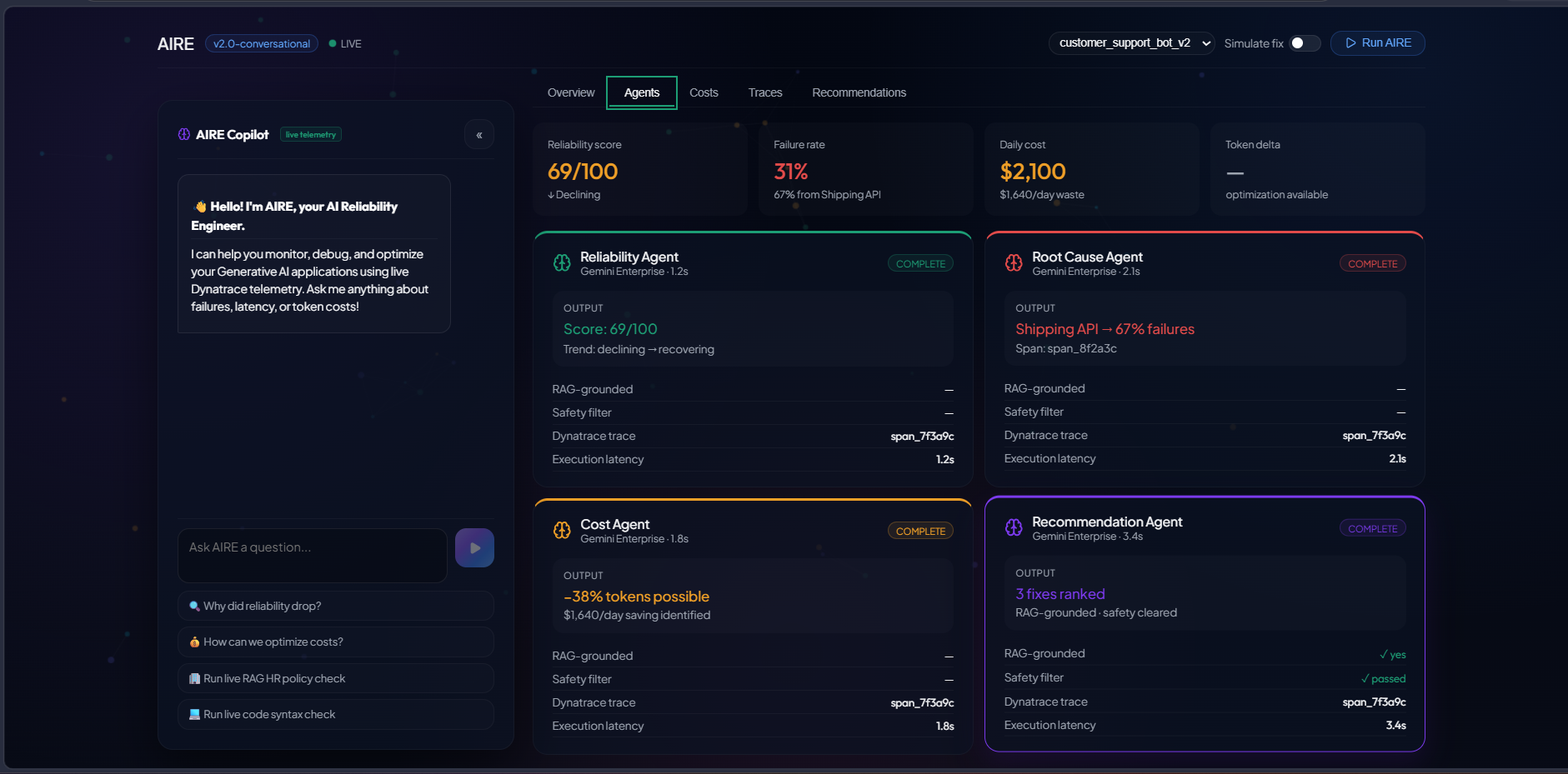
The platform employs four specialized Gemini-powered agents:
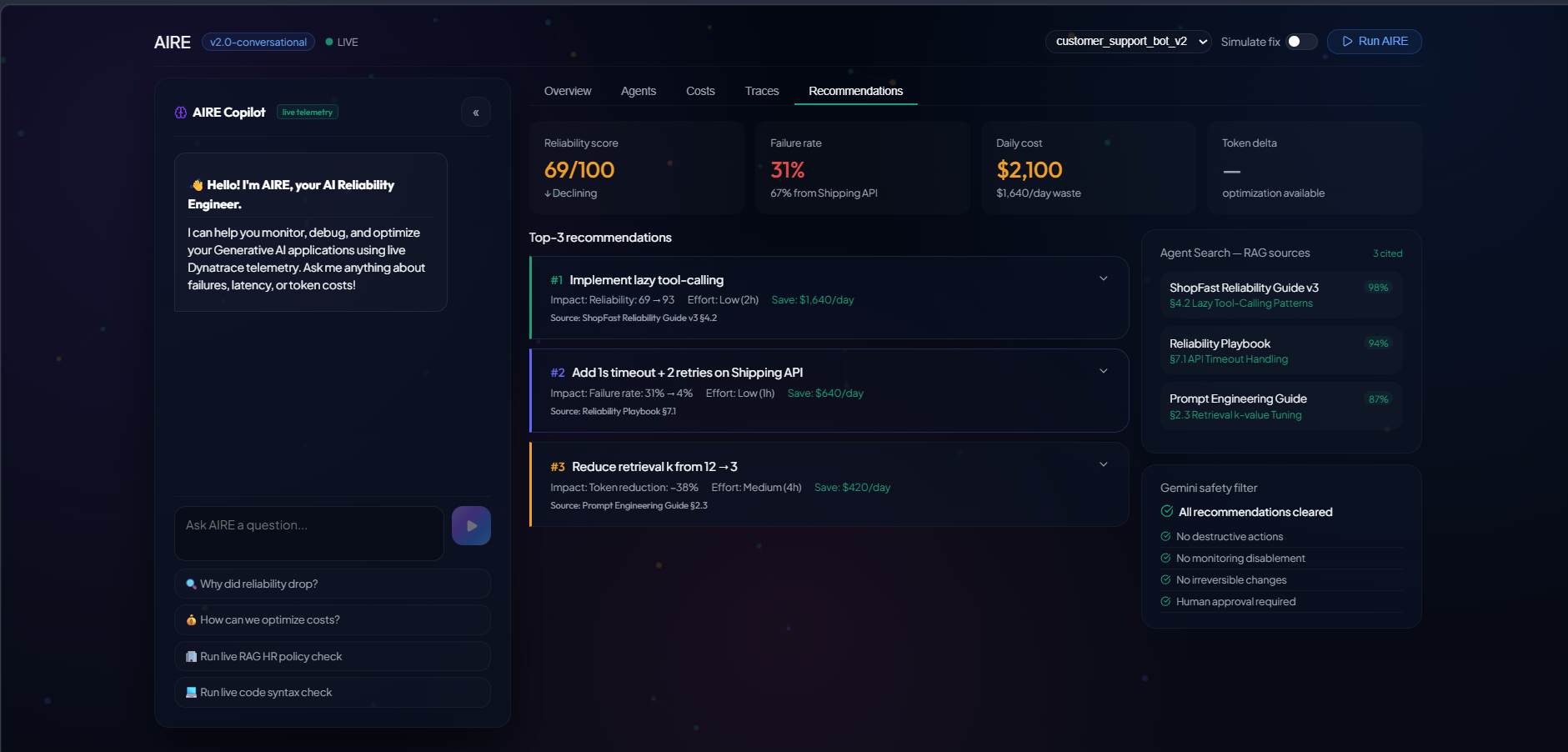
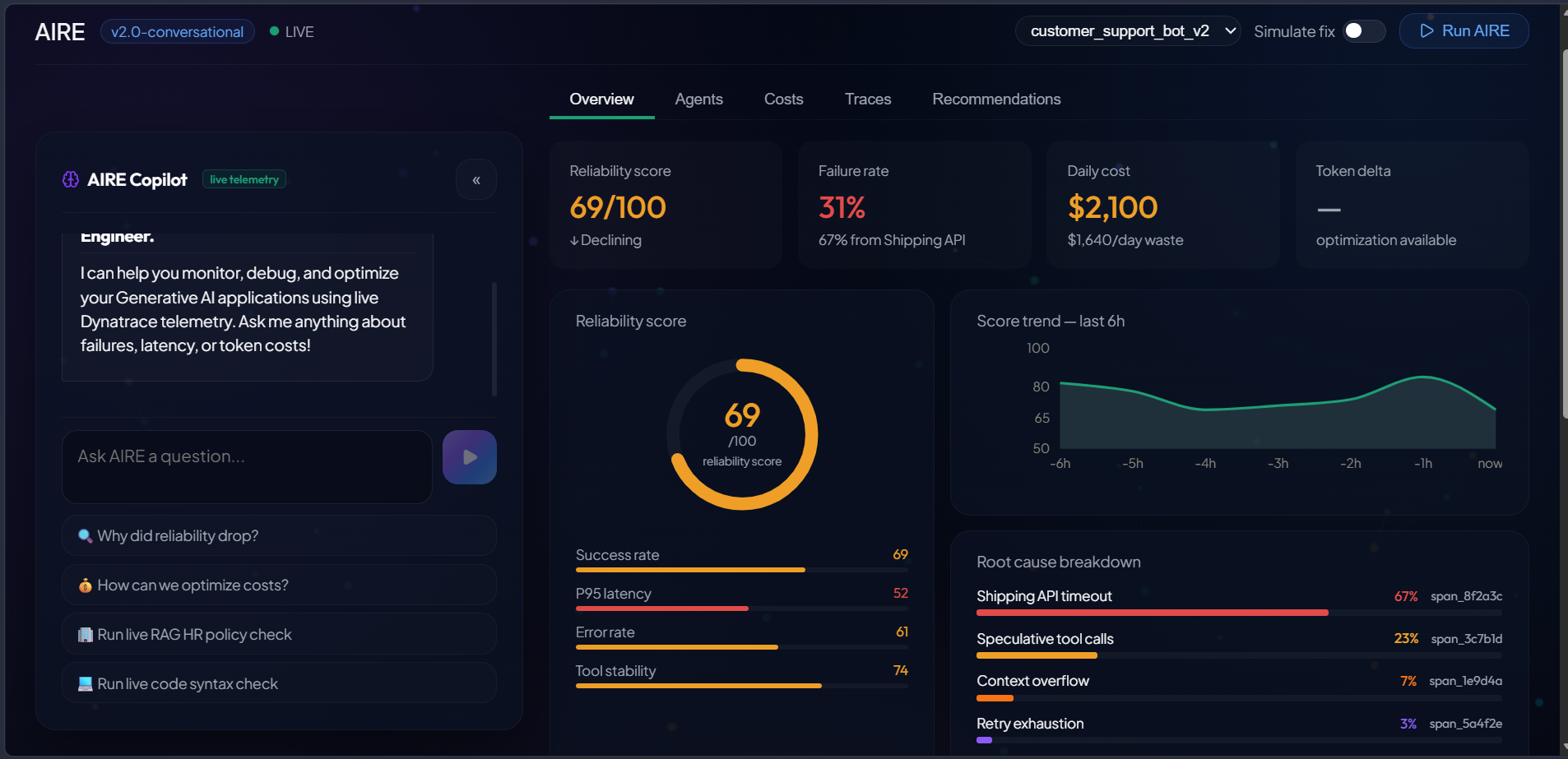
Reliability Analysis Agent calculates a composite reliability score based on success rates, latency, error rates, and tool stability. Root Cause Diagnosis Agent identifies the underlying causes of failures by correlating telemetry, tool usage, and prompt patterns. Cost Optimization Agent detects token waste, unnecessary tool calls, and oversized context windows while estimating potential savings. Recommendation Synthesis Agent combines insights from all agents and generates safe, actionable recommendations grounded in enterprise knowledge bases.
The result is an AI-powered reliability engineer that automatically diagnoses problems, quantifies impact, and recommends fixes before issues affect production systems.
How we built it
We built AIRE on a cloud-native architecture powered by Dynatrace and Google Cloud.
OpenTelemetry captures prompts, model calls, tool invocations, latency, retries, and token usage from AI agents. Dynatrace collects and stores the telemetry as structured observability data. Bindplane normalizes and routes telemetry streams for intelligent processing. Four Gemini-powered agents analyze reliability, root causes, cost efficiency, and optimization opportunities. Agent Search and RAG capabilities ground recommendations in internal documentation and operational playbooks. FastAPI services orchestrate the analysis pipeline and expose APIs for reliability scoring and diagnostics. Safety validation ensures recommendations remain secure, explainable, and auditable. Challenges we ran into
One of our biggest challenges was translating low-level telemetry into meaningful business insights. AI failures are rarely caused by a single factor; they often involve a combination of latency spikes, tool failures, prompt issues, and retrieval inefficiencies.
Another challenge was building reliable scoring metrics that accurately represent agent health while remaining interpretable for engineering teams. We also had to ensure that recommendations were grounded in documented best practices rather than generating potentially misleading suggestions.
Accomplishments that we're proud of Built a complete multi-agent architecture capable of autonomous reliability analysis. Created a composite reliability scoring system that converts complex telemetry into a simple 0–100 score. Enabled automatic root-cause analysis using observability traces and failure correlation. Developed cost optimization capabilities that identify token waste and estimate potential savings. Integrated enterprise knowledge retrieval to provide grounded, explainable recommendations. Designed an end-to-end workflow that reduces diagnosis time from days to minutes.
What we learned
Throughout the project, we learned that observability data becomes exponentially more valuable when paired with intelligent reasoning systems. We also discovered that reliability, cost efficiency, and explainability must be treated as interconnected challenges rather than separate problems.
Building AIRE reinforced the importance of telemetry standardization, traceability, and grounding AI-generated recommendations in trusted organizational knowledge.
What's next for AI Agent Reliability Engineer
Our next goal is to transform AIRE from a diagnostic platform into a proactive autonomous reliability system.
Future enhancements include:
Real-time reliability monitoring and alerting. Predictive failure detection before incidents occur. Automated remediation workflows for common issues. Multi-cloud and multi-model support. Reliability benchmarking across teams and applications. Executive dashboards with ROI and cost-saving analytics. Continuous learning from historical incidents and resolutions.
Ultimately, we envision AIRE becoming the trusted AI Reliability Engineer for every enterprise AI deployment, ensuring that AI systems remain reliable, cost-effective, transparent, and production-ready at scale.
Built With
- agentic
- analysis
- analytics
- api
- apis
- backend
- bindplane
- code
- compose
- computing
- cost
- css3
- data
- development
- distributed
- docker
- dynatrace
- fastapi
- generation
- generative
- github
- iam
- infrastructure
- integrations
- javascript
- jsx
- manager
- numpy
- opentelemetry
- optimization
- otlp
- pandas
- pydantic
- pytest
- pytest-asyncio
- pytest-cov
- pytest-mock
- python
- react
- rest
- sdk
- serverless
- standards
- storage
- tenacity
- trace
- tracing
- ui
- uvicorn
- vertex
- vite
- vs
- yaml


Log in or sign up for Devpost to join the conversation.