-
-
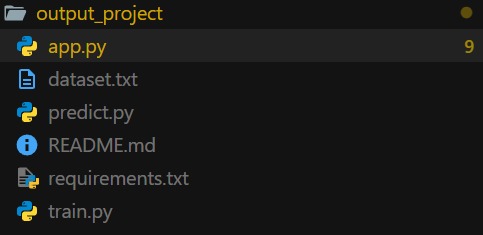
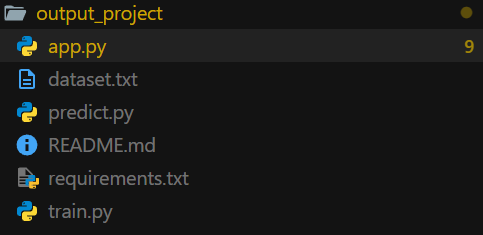
output_project folder (where all the files from generated prompt is saved)
-
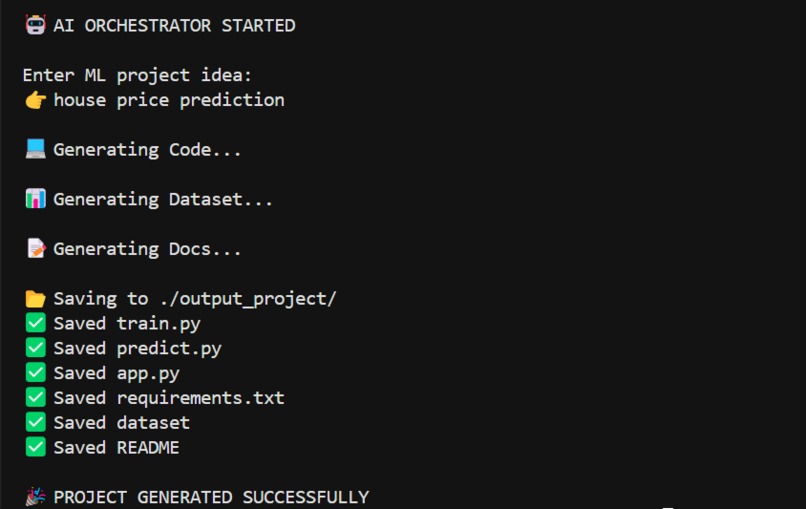
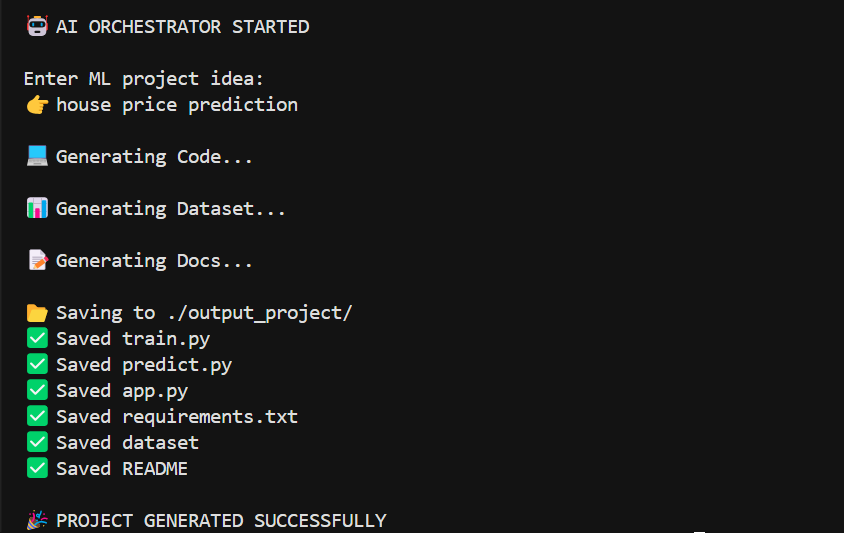
Output terminal
Inspiration
The inspiration for this project came from a simple question:
What if a user could generate a complete machine learning project just by describing their idea?
Most ML workflows require repetitive manual steps like data preparation, model selection, training, and API deployment. I wanted to automate this entire pipeline using multiple collaborating AI agents. These help people with non tech background to create a lot of projects on their own.
What it does
I built a Multi-Agent AI Orchestrator System that takes a single user prompt and automatically generates a complete machine learning project.
The system consists of specialized agents:
- Requirements Agent → understands and structures the problem
- Planning Agent → designs ML architecture and workflow
- Code Agent → generates full working Python ML project
- Dataset Agent → creates dataset schema and sample data
- Documentation Agent → generates professional README documentation
All agents are powered by Groq LLM (Llama 3.1)for fast and reliable execution.
How we built it
The system is built in Python using a modular agent-based architecture.
Each agent performs a specific task and passes structured output to the next stage.
The pipeline works as follows:
[ \text{User Prompt} \rightarrow \text{Requirements Agent} \rightarrow \text{Planning Agent} \rightarrow \text{Code Agent} \rightarrow \text{Dataset Agent} \rightarrow \text{Documentation Agent} ]
Finally, all outputs are saved into a fully runnable ML project inside the output_project/ folder.
Challenges we ran into
Some major challenges I faced include:
- Handling API rate limits and failures from LLM providers especially with gemini-2.0-flash. I used gemini-2.0-flash,gemini-2.0-pro,gemini-1.5-flash etc but due to its limited count I was not able to continue further.
- Designing a stable fallback system when APIs fail
- Parsing structured outputs from LLMs reliably
- Ensuring consistent file generation across multiple agents -A lot of trial and error in different agents. -It was difficult to generate files but finally it was a success. The project generates files, instructions, code inside project_output.
I solved these by simplifying the system and making Groq the primary execution engine for stability.
Accomplishments that we're proud of
-Completing a hackathon on my own. -Finding a problem and fully implementing the solution and that too in a fully working environment. -Help a lot of people to generate projects based on the same.
What we learned
The final system can generate:
- Complete ML training pipeline
- Prediction scripts
- Flask API for deployment
- Dataset generation
- Documentation
from just a single user prompt.
What's next for AI-Agent Orchestrator
In the future, I plan to:
- Add memory-based agents
- Introduce LangGraph orchestration
- Add UI dashboard for interaction
- Support OpenAI + Gemini + Groq dynamic routing -And a lot more.

Log in or sign up for Devpost to join the conversation.