Inspiration
Local governments around the world face a structural challenge: policy planning still depends heavily on the discretion of individual officials, resulting in limited transparency, weak traceability, and fragmented accountability.
Our team set out to solve this by building a multi-agent policy planning system that embodies public-sector principles such as explainability, consistency with law, and fairness.
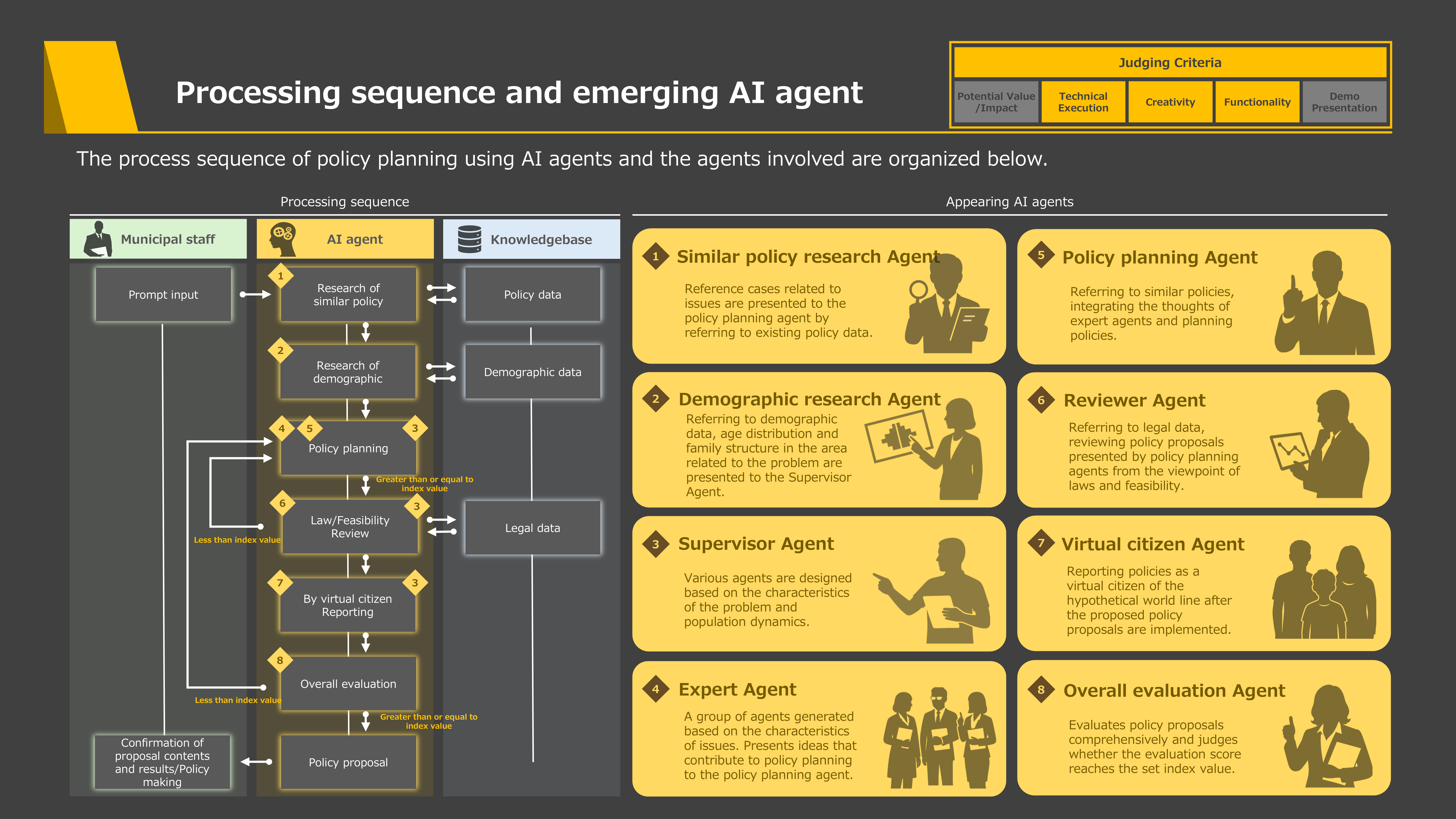
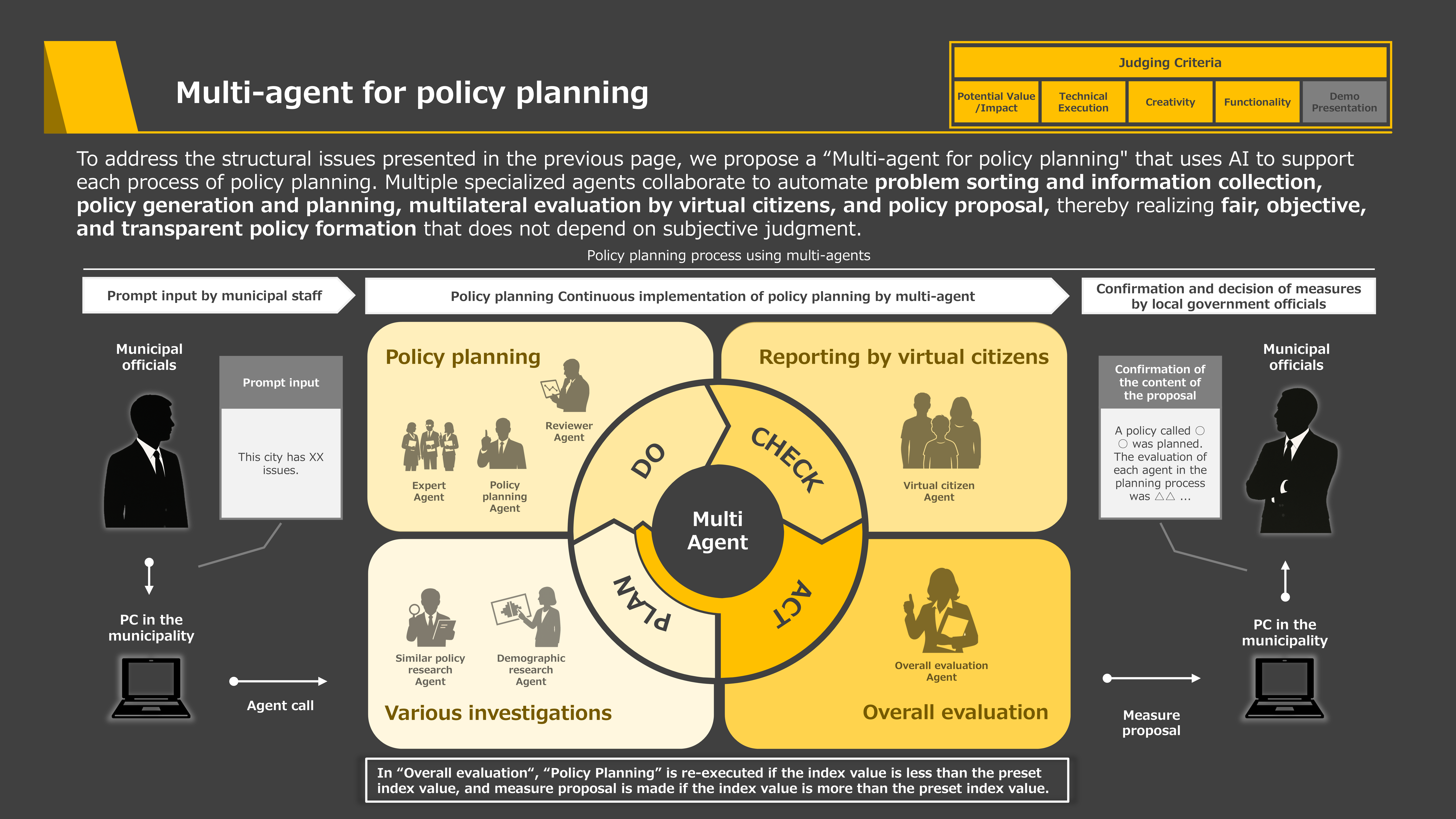
Instead of “one large model doing everything,” we adopt a role-specialized multi-agent composition, where each agent is responsible for a distinct stage of reasoning, mirroring the institutional design of democratic decision-making.
What it does
The system supports an end-to-end policy cycle:
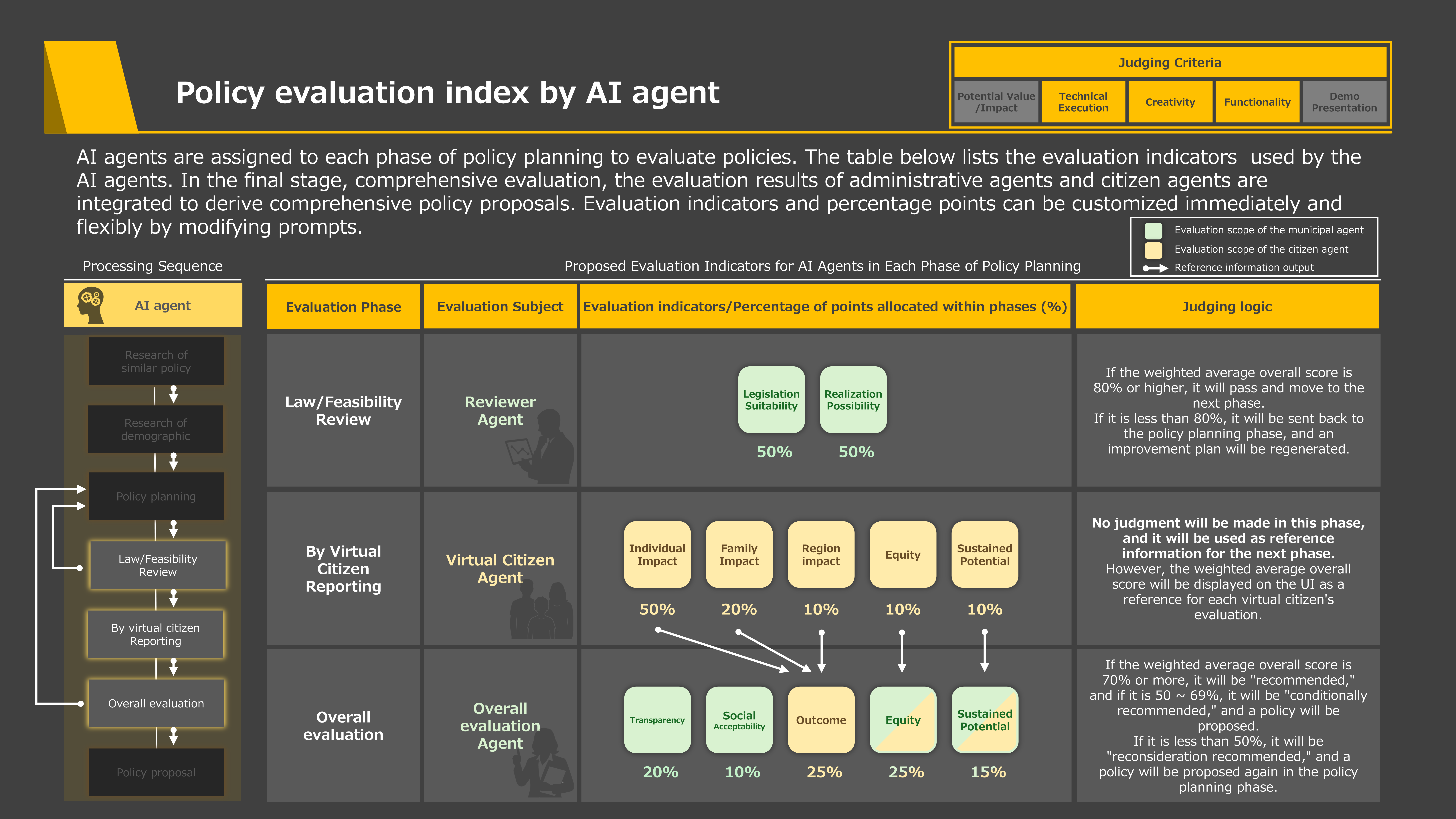
- Broad research and demographic analysis
- Expert-driven policy construction
- Legal and feasibility review
- Virtual citizen impact simulation
- Comprehensive scoring and approval
If the policy does not reach the threshold score, the process automatically loops back:
Proposal → Review → Improvement → Re-evaluation → Threshold Pass
Only policies that survive this multi-layered audit are surfaced for final human decision.
How we built it
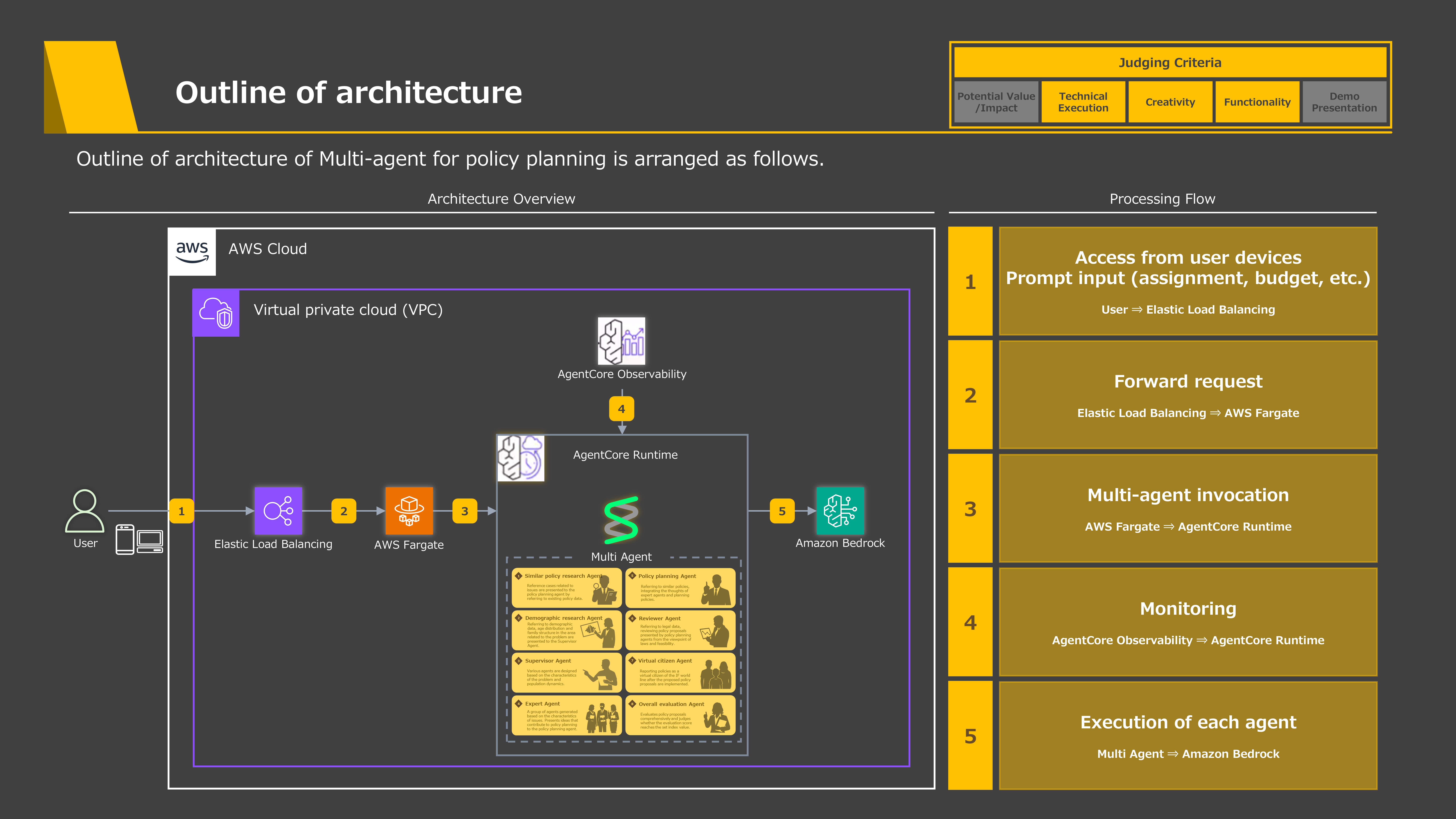
We built the system on AWS Bedrock AgentCore as the orchestration layer, supported by multiple specialized agents implemented using Bedrock and Strands SDK primitives.
The architecture runs on AWS Fargate behind an ELB, enabling a fully containerized and reproducible deployment.
Each agent references domain-specific data (demographic statistics, ordinances, precedents, and virtual citizen evaluations) and collaborates through structured prompts that encode EBPM logic models.
Challenges we ran into
Two major challenges emerged:
- Public-sector accountability requires not only “being correct” but also “proving why it is correct.” This mandated explicit reasoning disclosure, not black-box AI behavior.
- We could not rely on a monolithic agentic model—a single LLM cannot simultaneously perform investigation, legal review, value judgment, and fairness evaluation. The multi-agent architecture was not an optimization choice, but a requirement for institutional equivalency and due-process transparency.
Accomplishments that we're proud of
We successfully translated real governance logic—not private-sector workflow metaphors—into an AI architecture.
The system demonstrates that AI can justify, not merely generate, policies; it can preserve democratic legitimacy instead of replacing it.
The result is a reproducible framework for fair, evidence-based policy design.
What we learned
The more “public” the domain, the more institutional traceability matters.
We learned that explainability is not a UX feature—it is a governance guarantee.
Multi-agent AI is uniquely suited to replicate separation of roles, procedural fairness, and iterative legitimacy checks.
What’s next for the AI Agent Global Hackathon
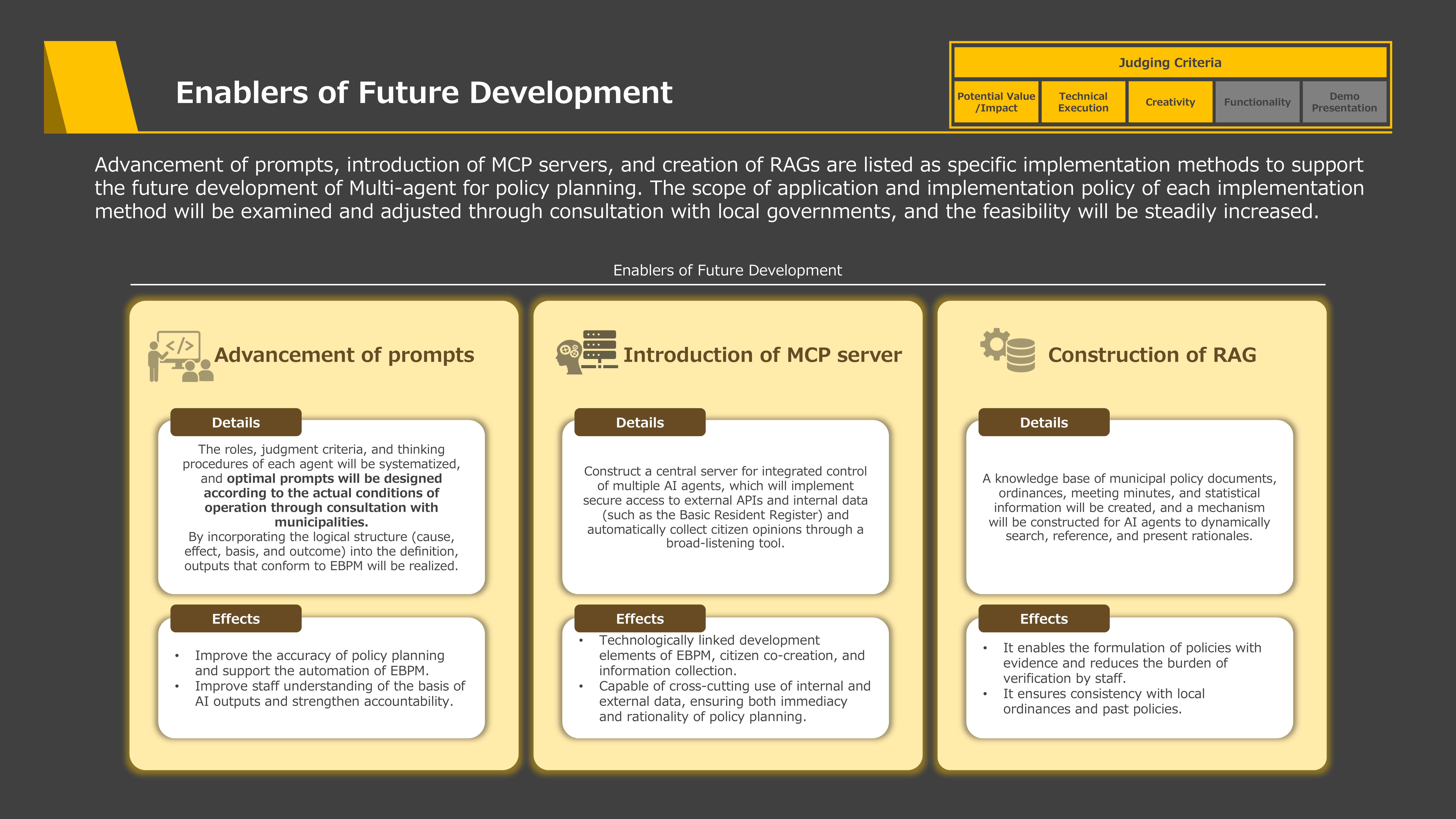
Next, we will expand three enablers:
- Advanced prompting → formalize agent logic and judgment criteria
- MCP-based secure data integration → connect municipal datasets and external APIs
- RAG knowledge bases → unify legislative, statistical, and precedent data
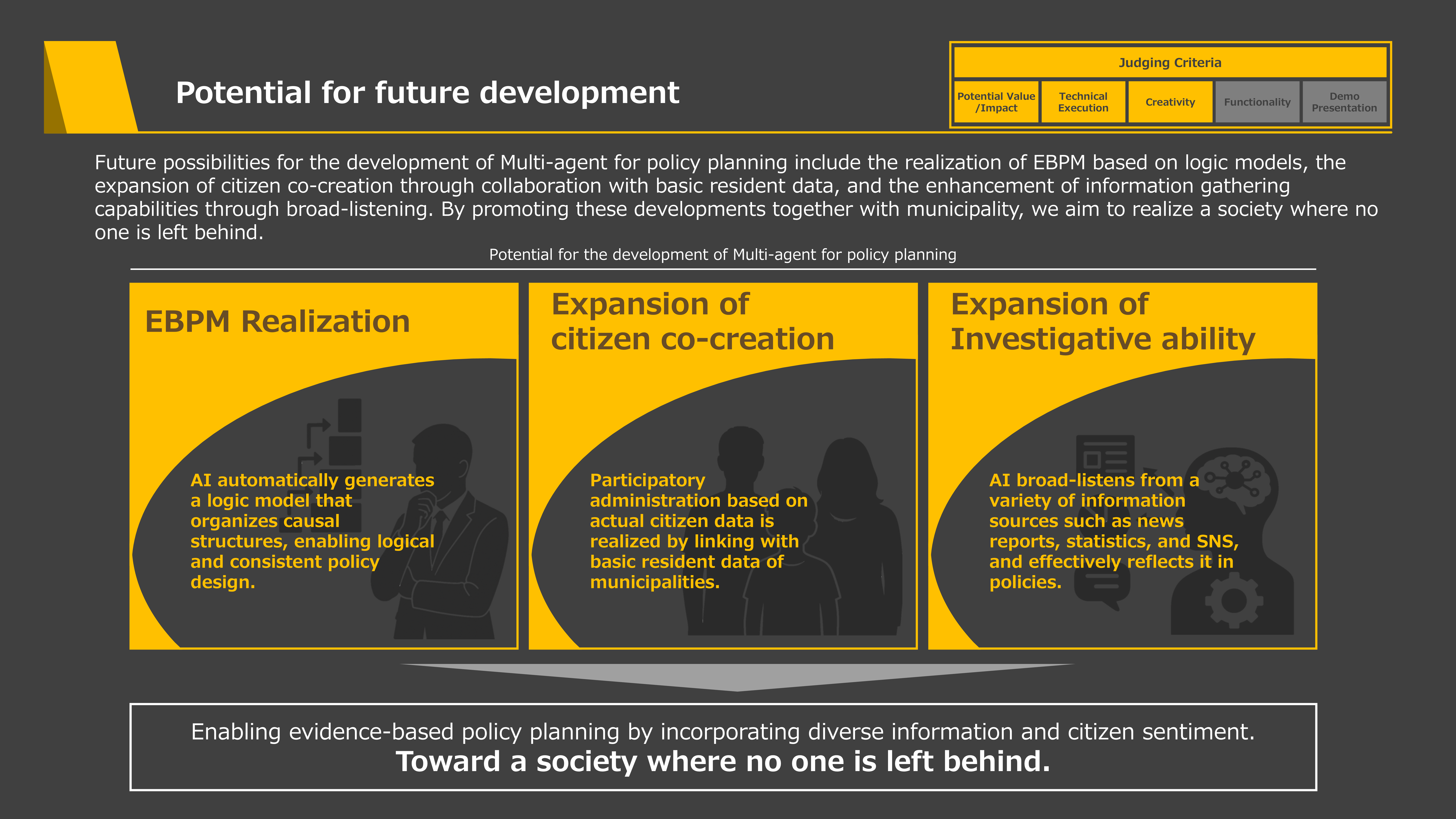
These will allow the system to evolve into a fully EBPM-aligned, production-ready public-administration platform.
Built With
- bedrock
- bedrockagentcore
- python
- strands


Log in or sign up for Devpost to join the conversation.