-
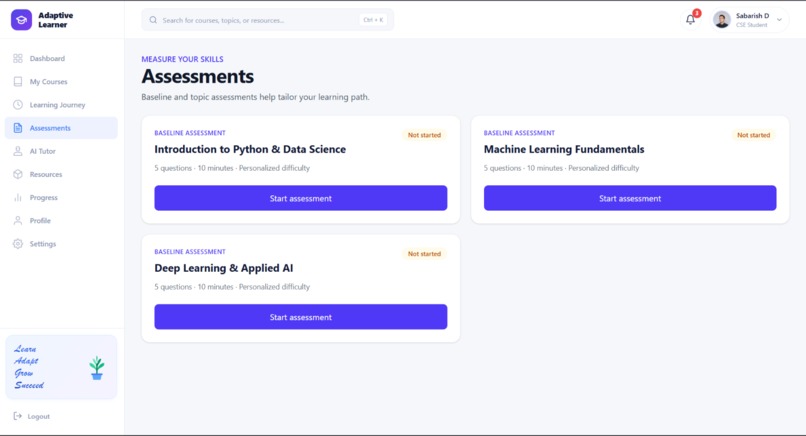
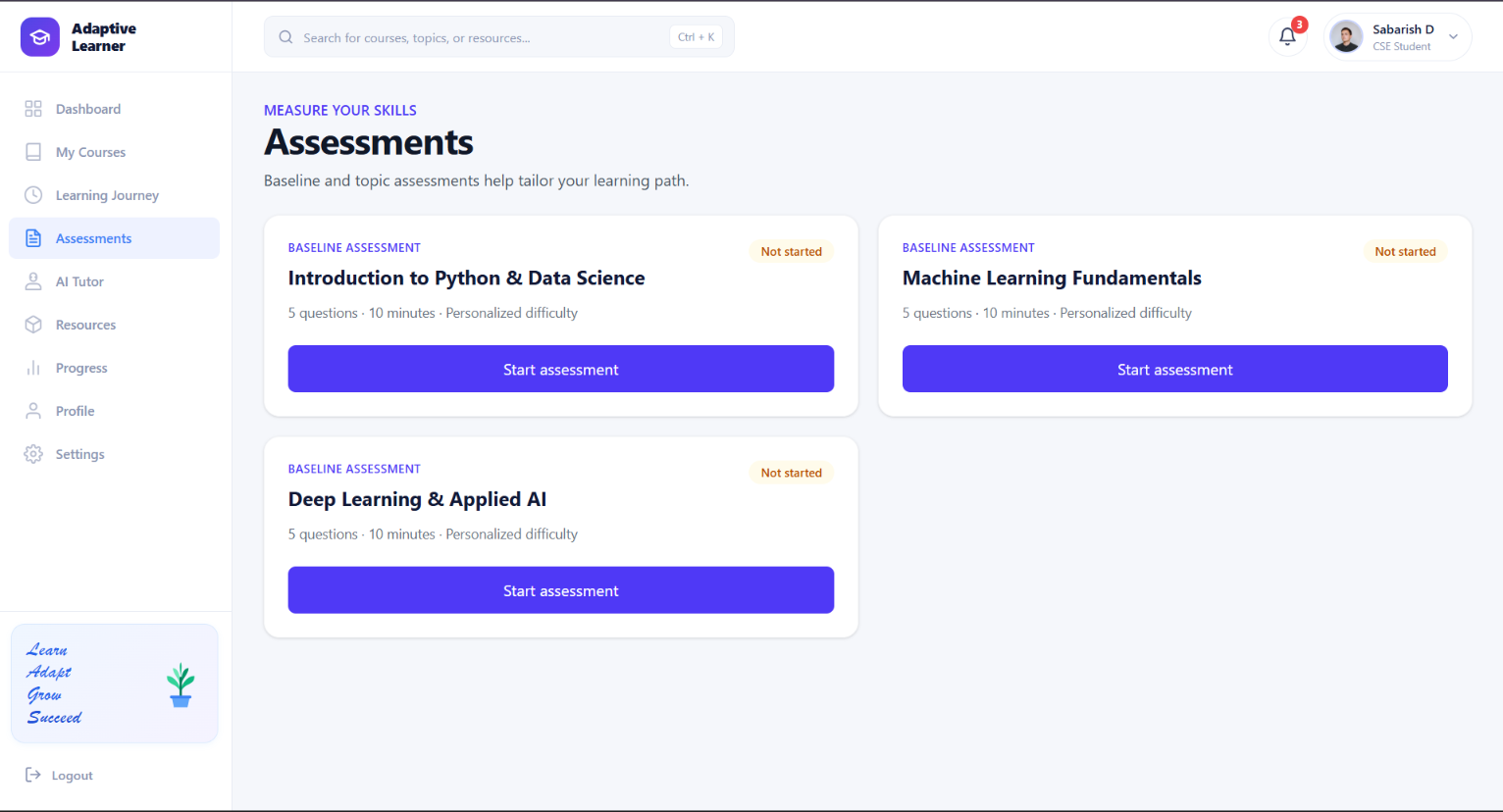
ASSMENT
-
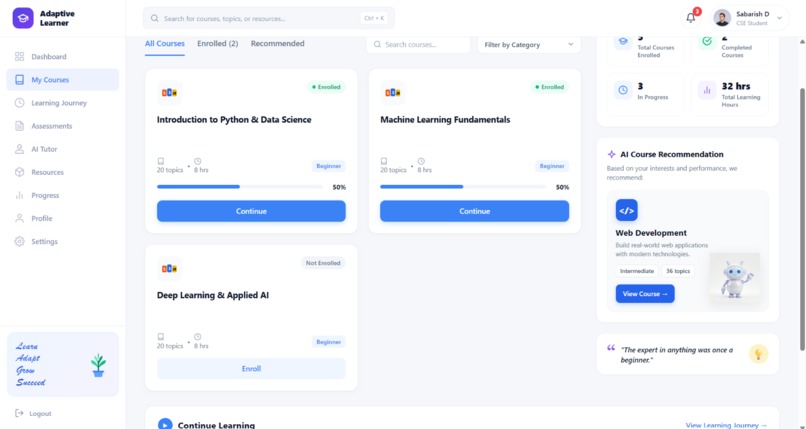
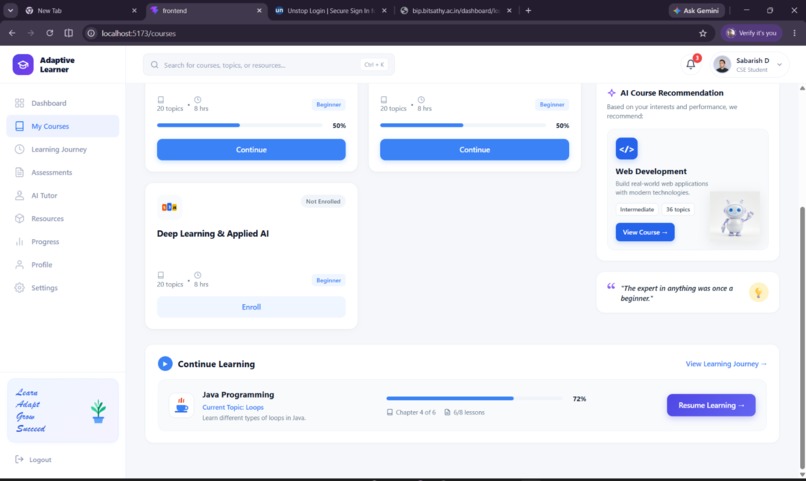
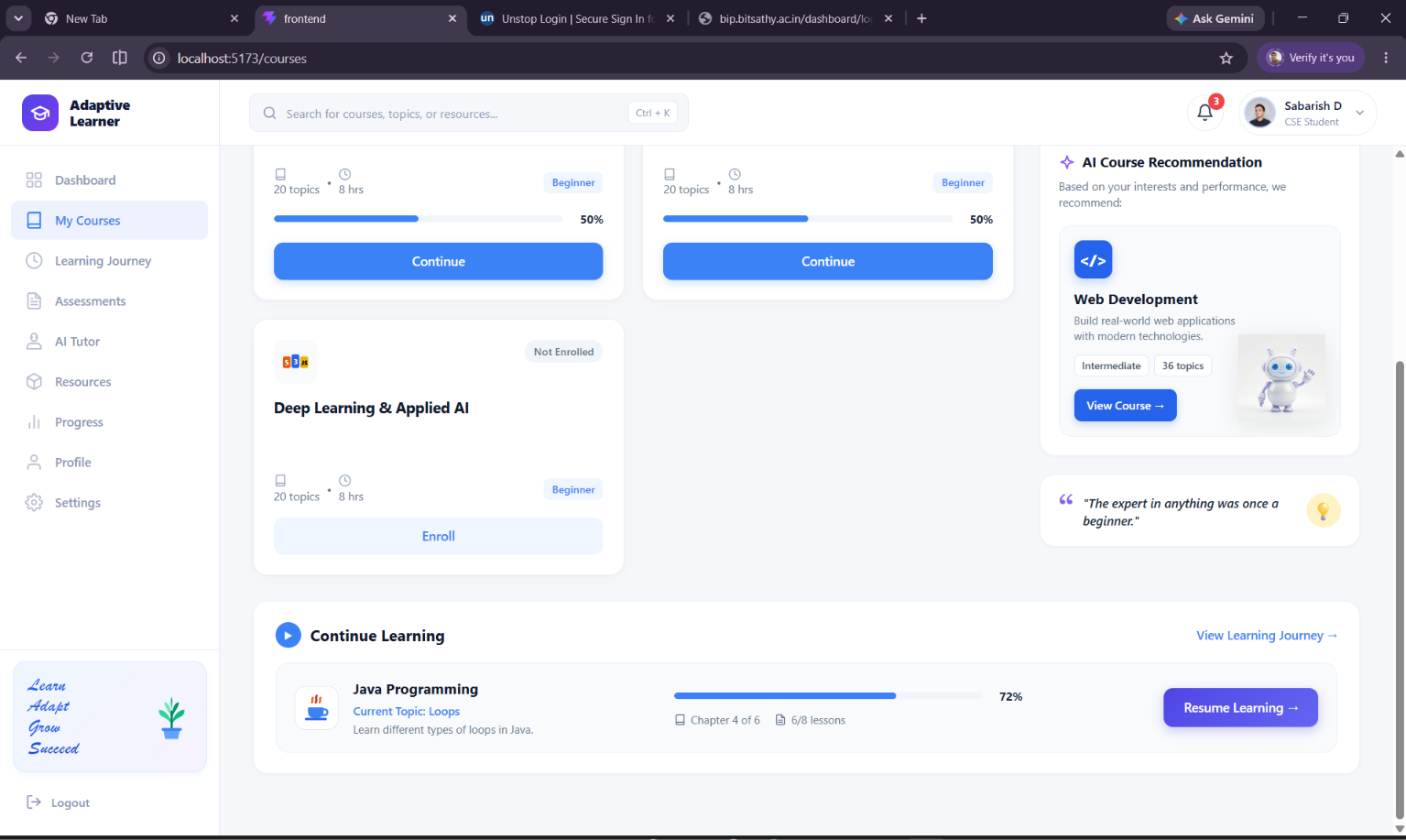
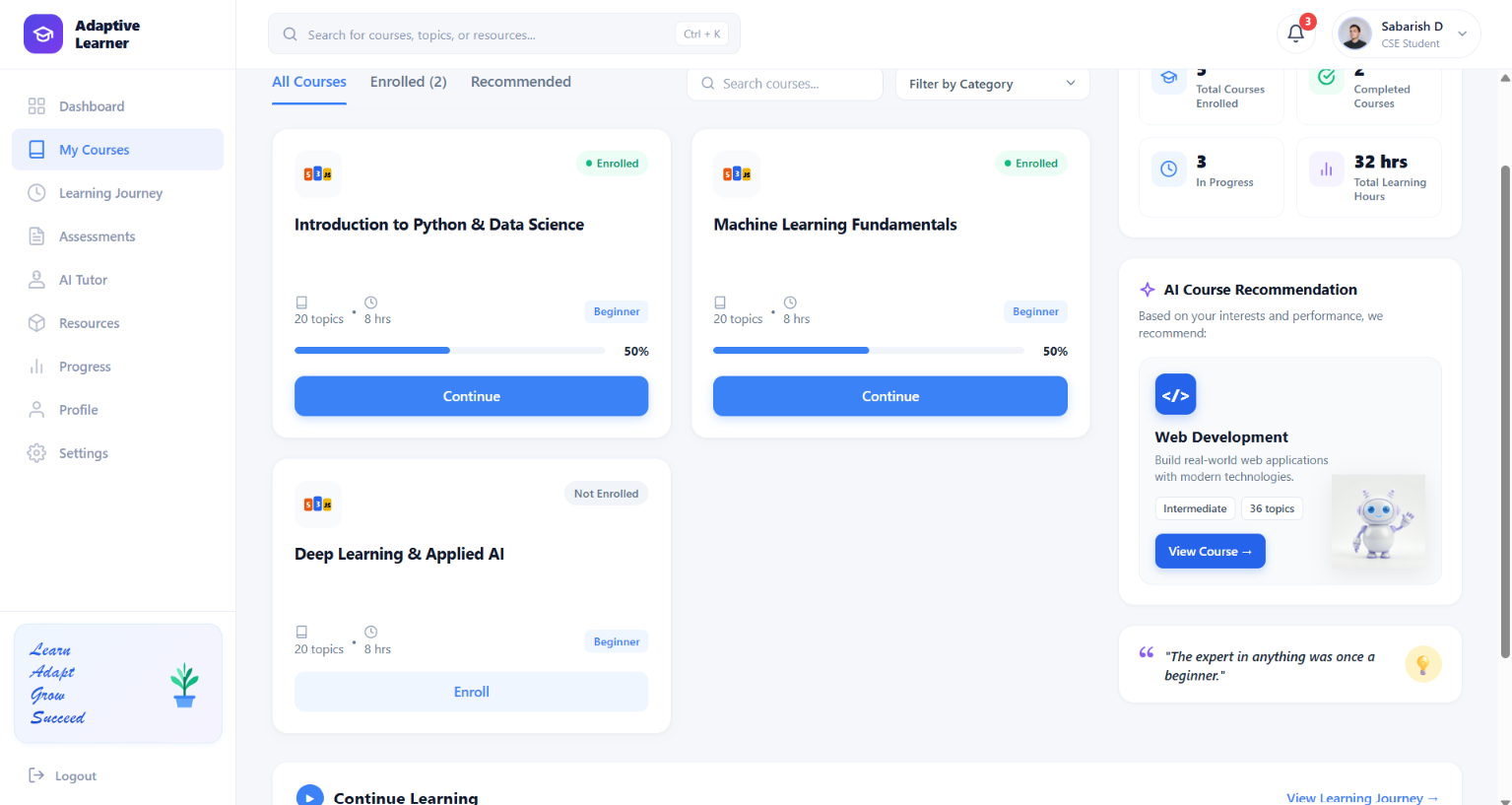
MY COURSE
-
RESOURCES
-
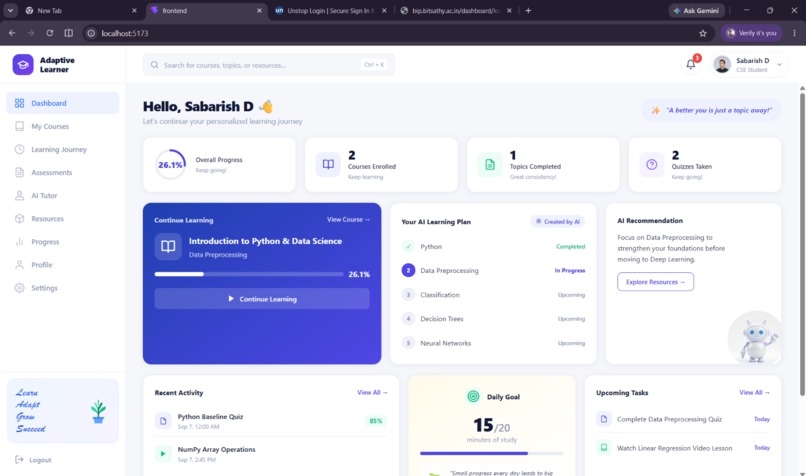
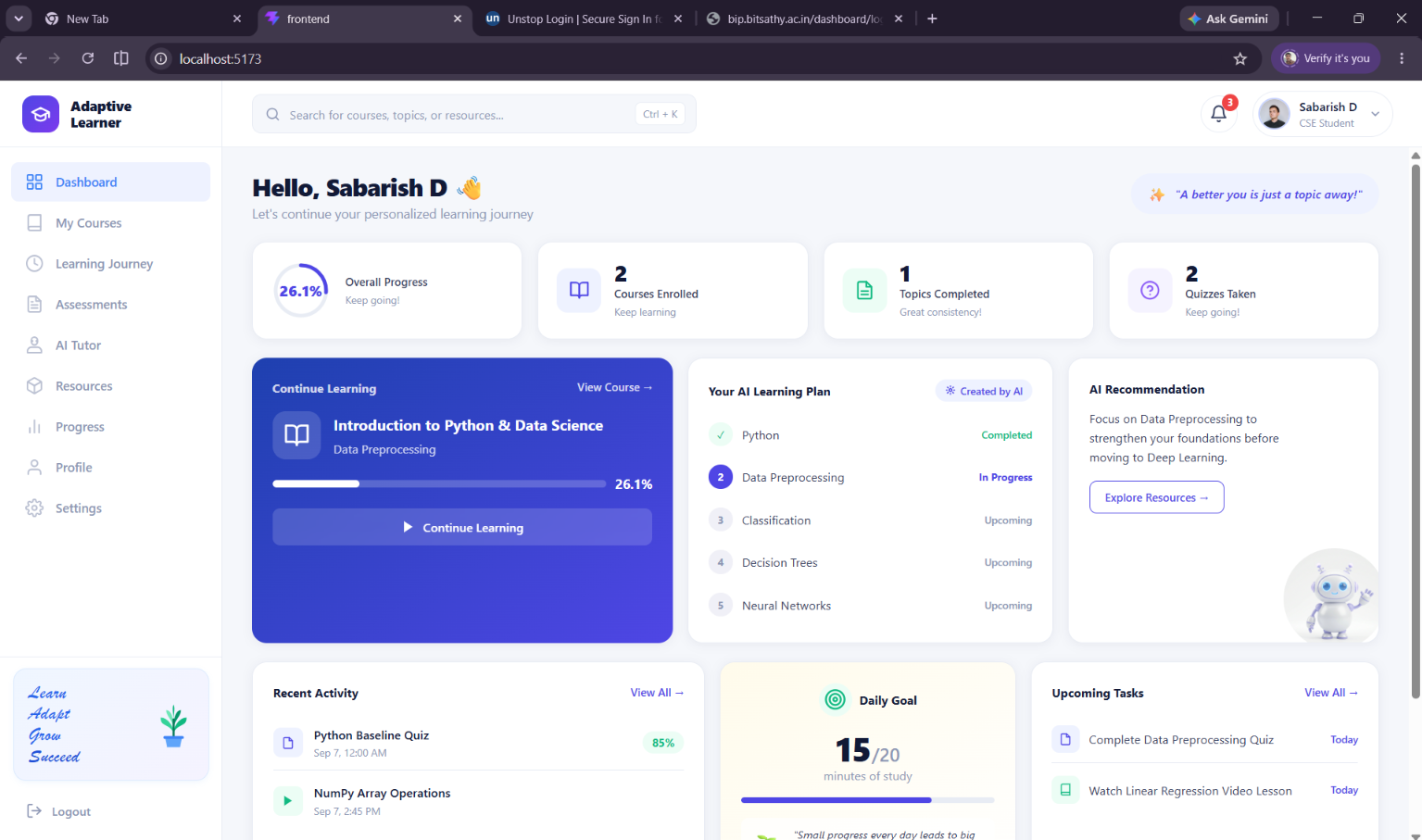
HOME
Inspiration
Many students learn programming through the same fixed sequence, even though their strengths and weaknesses are different. A student may already understand variables and conditional statements but struggle with loops or problem solving. We wanted to build a system that identifies these individual learning gaps instead of forcing every student to follow the same path.
This inspired us to create Adaptive Learner, an AI-powered learning platform that creates a personalized learning journey based on each student's assessment performance, selected interests, and progress.
What the Project Does
The student first registers or logs in and selects a course such as Java, Python, C++, C, or SQL. Before starting the learning journey, the student takes a baseline assessment containing MCQs and programming questions.
The assessment results are analyzed topic by topic. For example, if a student performs well in variables and conditional statements but has difficulty with loops, the system identifies loops as a learning gap.
Based on this performance, the AI generates an adaptive learning path. The student can see topics such as Basics, Variables & Operators, Conditional Statements, Loops, Methods, and OOP Concepts, with their current status and recommended next topic.
Adaptive Learning
The main feature of the project is that the learning path is not fixed.
When a student selects a particular topic, the system provides topic-specific learning activities such as MCQs, coding questions, mixed-concept questions, explanations, and practice exercises. After completing the activities, the student's performance is recorded.
If the student performs poorly, the system can recommend additional practice and related concepts. If the student demonstrates sufficient understanding, the system can recommend moving to the next concept.
For example, a student learning Java may select Loops. The system can provide questions covering for loops, while loops, nested loops, and loop control. The student's results are then used to determine whether additional practice is required.
AI Integration
We use Google Gemini as the main AI component for analyzing assessment results and generating personalized learning recommendations, explanations, notes, and learning content.
For programming-related tasks, we plan to integrate an open-source coding model such as Qwen-Coder through Ollama. This component can assist with generating coding practice questions, code explanations, hints, and programming exercises.
The backend controls the communication between the application, AI services, assessment system, and database. AI-generated responses are processed and validated before being shown to the student.
Learning Resources
For every selected topic, the platform can provide relevant learning resources. YouTube integration is planned to retrieve suitable educational videos, including English and Tamil resources, so students can learn using content that matches their preferred language and topic.
The platform can also display AI-generated study notes and explanations along with the recommended resources.
How We Built It
The project is designed as a web-based application with a frontend, backend, database, AI services, authentication, assessment engine, and learning-resource integration.
The frontend provides the student dashboard, course selection, assessments, learning journey, topic pages, AI recommendations, and progress tracking.
The backend manages authentication, student data, courses, questions, assessment results, topic performance, learning-path generation, AI requests, and resource recommendations.
The database stores student profiles, enrolled courses, assessment attempts, topic scores, progress, questions, and learning-path information.
Challenges
One of the main challenges was designing a system where AI recommendations are based on actual student performance rather than generating the same learning path for everyone.
Another challenge was connecting assessment results with individual topics and converting those results into meaningful recommendations. We also had to consider how to handle AI-generated content reliably and how to integrate programming questions, learning resources, and progress tracking into one platform.
What We Learned
Through this project, we learned how to design an AI-powered educational system, connect frontend and backend services, work with APIs, structure assessment data, integrate generative AI, and create a personalized learning workflow.
The most important learning was that AI should not simply generate content. It should use the student's actual learning data to make the next learning activity more relevant.
Future Improvements
In the future, we plan to improve the recommendation engine using more student performance data, add stronger code evaluation, support more programming languages, improve multilingual learning resources, and continuously adapt the learning path as the student's knowledge changes.
Our goal is to make Adaptive Learner a platform where every student receives a learning journey based on what they already know, what they struggle with, and what they need to learn next.

Log in or sign up for Devpost to join the conversation.