


AI 4 Alzheimers
About the Project
Alzheimer's disease is a progressive neurological disorder that affects millions of families. What inspired us to build AI 4 Alzheimers was the major gap in early detection. In many healthcare systems, MRI scans must be manually evaluated by specialists, which is time consuming and requires deep expertise. Delays in diagnosis often reduce the effectiveness of treatment and long term patient care.
We believed that artificial intelligence could assist doctors in making faster and more accurate decisions. That belief became the foundation of this project.
Problem It Solves
 • Early stage Alzheimer's cannot be easily identified through conventional clinical methods.

 • Manual MRI evaluation is slow and requires expert radiologists.

 • Shortage of specialists leads to delayed diagnosis.

 • Late detection negatively impacts treatment outcomes.

 • There is no simple digital platform for rapid MRI based screening.
How the Project Solves the Challenge
CNN Based Deep Learning Model
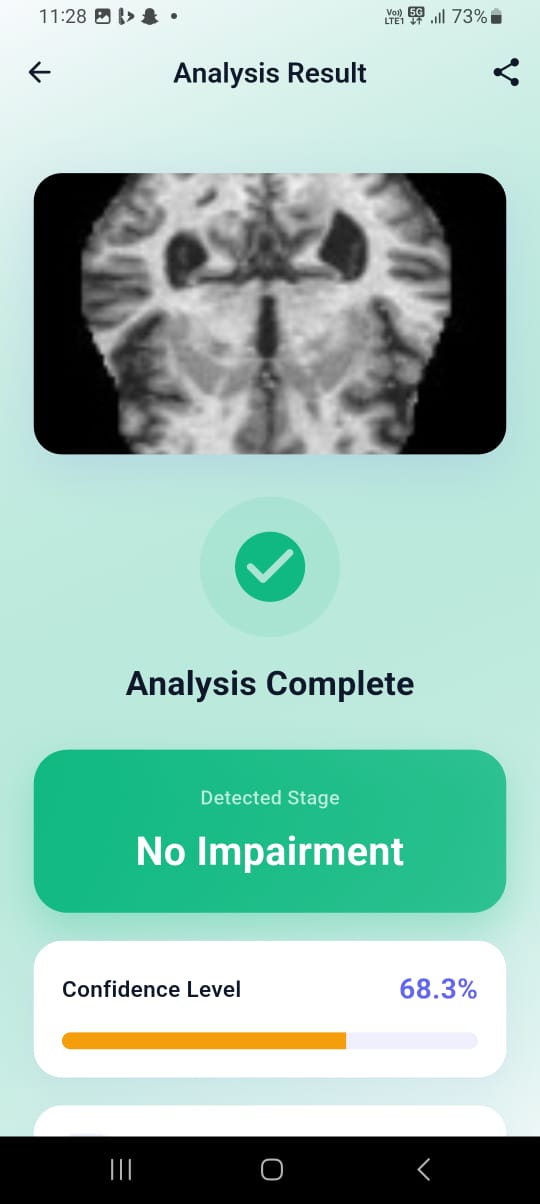
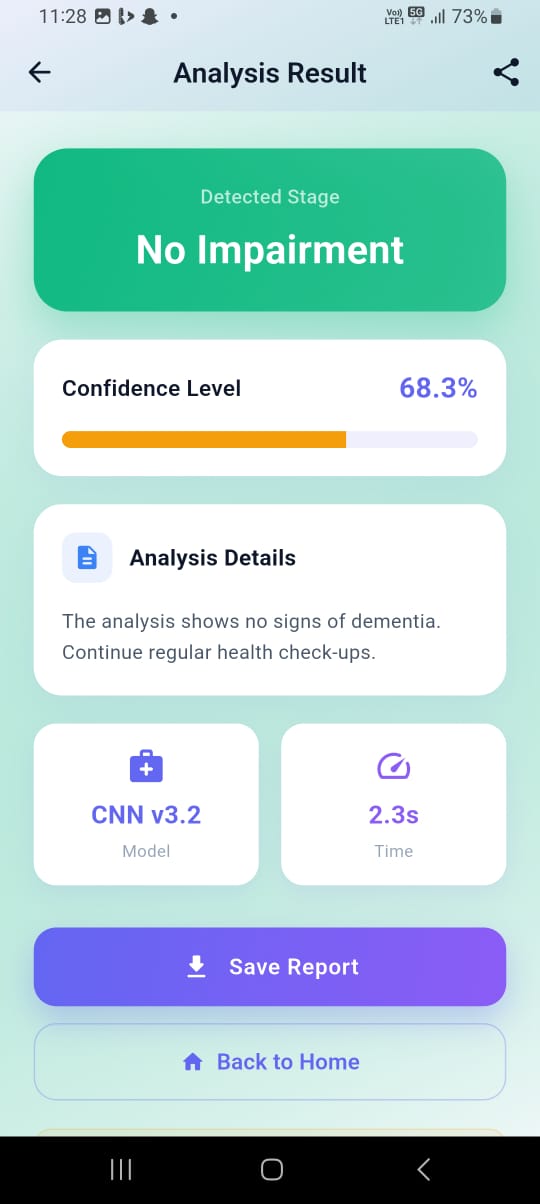
We built a Convolutional Neural Network to analyze brain MRI images and classify Alzheimer's into four categories:
  • Non Demented

  • Very Mild Demented

  • Mild Demented

  • Moderate Demented
The convolution operation can be represented as $$ \text{FeatureMap}(i, j) = \sum_{m} \sum_{n} \text{Image}(i + m, j + n) \cdot \text{Kernel}(m, n) $$
The model optimizes classification using Cross Entropy Loss $$ \text{Loss} = -\sum_{i=1}^{C} y_i \log(\hat{y}_i) $$
Where:
 • y_i is the true label

 • y hat_i is the predicted probability

 • C is the number of classes
Web and Mobile Platform
A website interface for uploading MRI images
A Flutter mobile application for remote accessibility
Secure Sign In and Sign Up using Firebase Authentication
This enables remote screening and faster medical decision making.
Challenges We Faced
Imbalanced dataset Some Alzheimer’s stages had fewer MRI images. Solution: Applied data augmentation such as rotation, flipping, and zooming.
Model overfitting High training accuracy but low validation accuracy. Solution: Added Dropout layers, normalization, and tuned epochs.
Different MRI formats and sizes Caused input mismatches during inference. Solution: Built a unified preprocessing pipeline.
Deployment limitations Memory and dependency constraints during hosting. Solution: Optimized model architecture and reduced unnecessary dependencies.
Prediction speed versus accuracy Complex CNNs slowed inference. Solution: Fine tuned architecture to balance performance and speed.
Frontend integration issues Initial request and response mismatches. Solution: Standardized API communication and improved error handling.
AI 4 Alzheimers focuses on empowering early detection through intelligent technology and practical deployment.
Built With
- cnn
- css
- deep-learning
- docker
- fast-api
- firebase
- flutter
- javascript
- machine-learning
- python
- react
- tailwind


Log in or sign up for Devpost to join the conversation.