-
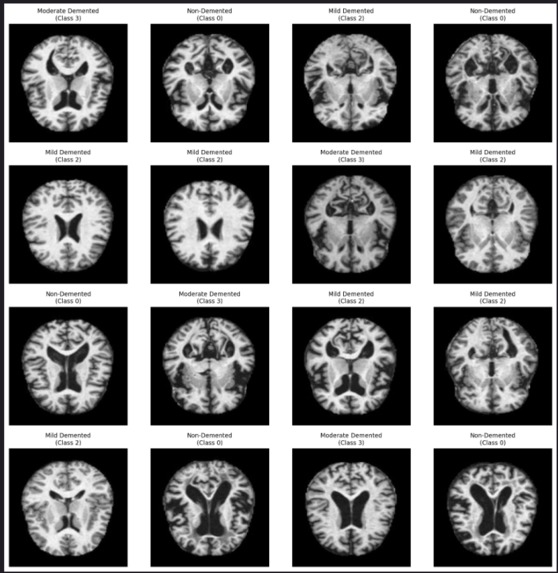
Image
-
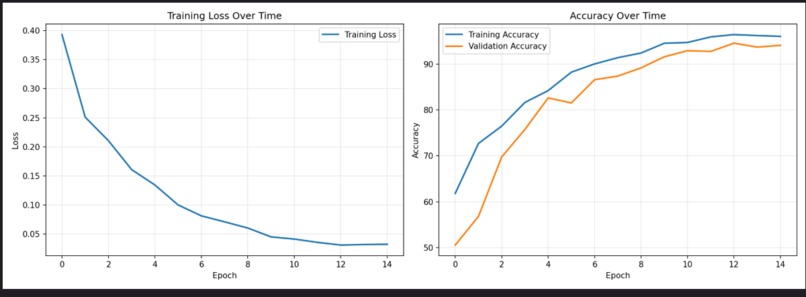
Graphs
-
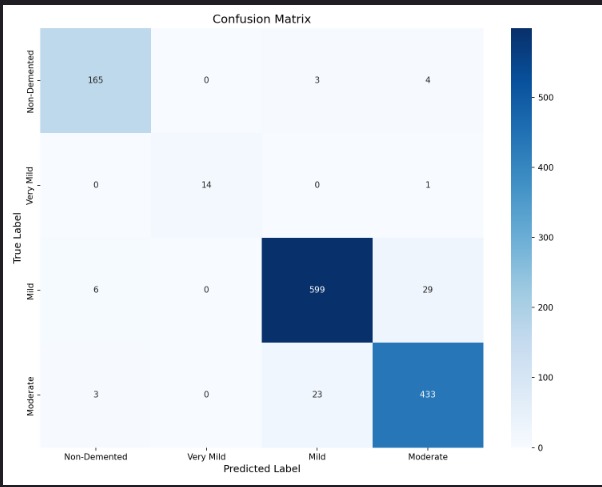
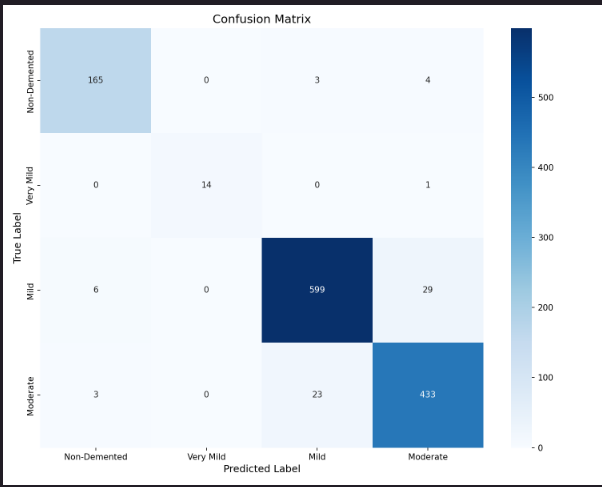
Confusion Matrix
-
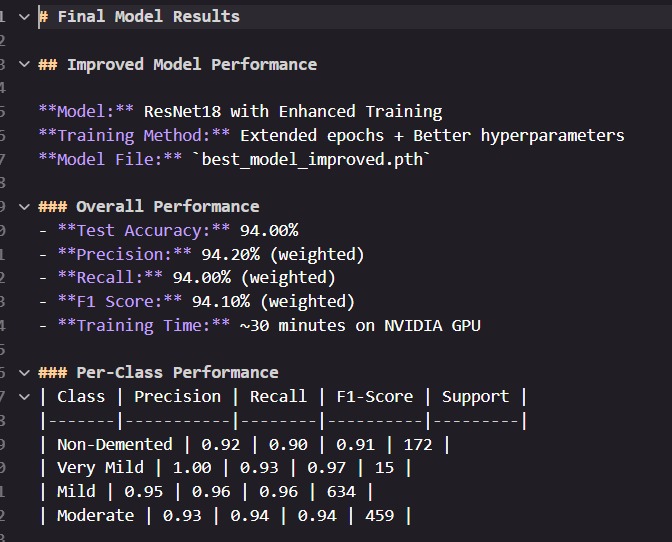
Overall Results



Every three seconds, someone in the world develops dementia. Today, over 55 million people are living with Alzheimer's disease, and this number may triple by 2050. We recognized that behind each statistic lies a person slowly losing cherished memories and families losing their most meaningful connections. This drove us to explore how artificial intelligence could intervene early enough to preserve those memories. The AI for Alzheimer's Hackathon provided the perfect opportunity to pursue a system capable of detecting Alzheimer's in its earliest stages, where treatment can still meaningfully slow progression.
Our AI model analyzes MRI brain scans and classifies them into four stages of Alzheimer's disease: Non-Demented, Very Mild, Mild, and Moderate. It is designed to catch subtle changes in brain structure that are extremely difficult to detect manually. With 94\% test accuracy and a 93\% recall for the Very Mild stage, the model acts as a clinical decision-support tool that can help radiologists identify early-stage Alzheimer's cases faster and more reliably.
We utilized a dataset of 5,120 MRI scans representing different progression stages of Alzheimer’s disease. We implemented a deep learning architecture based on the ResNet18 model pretrained on ImageNet to extract fine-grained structural features from MRI images. Severe class imbalance was addressed by applying weighted cross-entropy loss, targeted augmentation, regularization techniques, and iterative hyperparameter tuning. Through continuous experimentation, the model improved from an initial accuracy of 60\% to the final 94\% performance.
The dataset presented a major challenge with only 49 images in the Very Mild class, the most clinically critical stage for early detection. The model initially ignored this class entirely. This issue required careful techniques such as class weighting and aggressive augmentation to ensure proper learning. Additionally, overfitting due to limited data required the use of regularization strategies to maintain generalization.
We successfully developed a model capable of detecting early-stage Alzheimer's with strong recall, meaning it identifies most patients who need early intervention. Our approach not only reached 94\% overall accuracy but also demonstrated clinically meaningful behavior by focusing on subtle abnormalities. We are proud that our system has the potential to support doctors and ultimately improve patient outcomes.
We learned that real-world medical data often brings challenges such as imbalance and subtle class differences, requiring thoughtful solutions beyond standard deep learning practices. We also gained valuable experience in model optimization, medical imaging considerations, validation strategies, and the importance of interpretability in healthcare AI. Most importantly, we learned how each incremental improvement contributes to meaningful progress.
Our next steps include expanding to 3D volumetric MRI data, integrating additional modalities such as patient demographics and cognitive scores, and implementing explainable AI methods to highlight relevant brain regions. We aim to collaborate with clinical partners to evaluate real-world performance and continue advancing toward a deployable screening tool that can significantly improve early Alzheimer’s diagnosis and care.


Log in or sign up for Devpost to join the conversation.