-
-
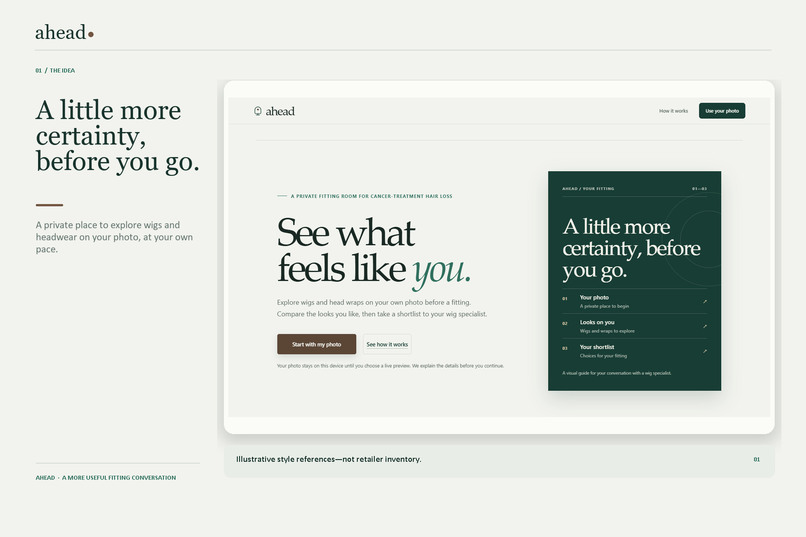
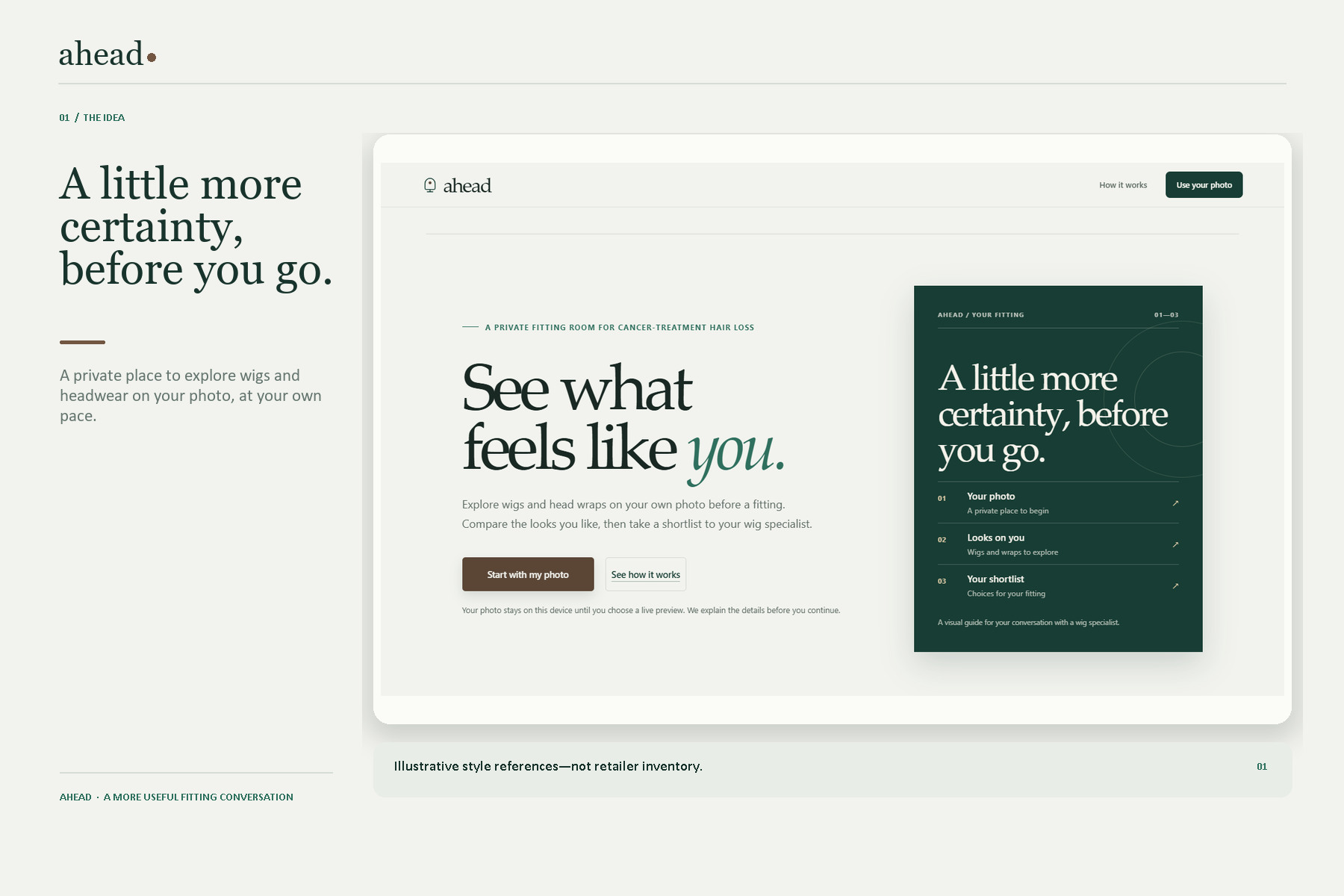
A private place to explore what feels like you.
-
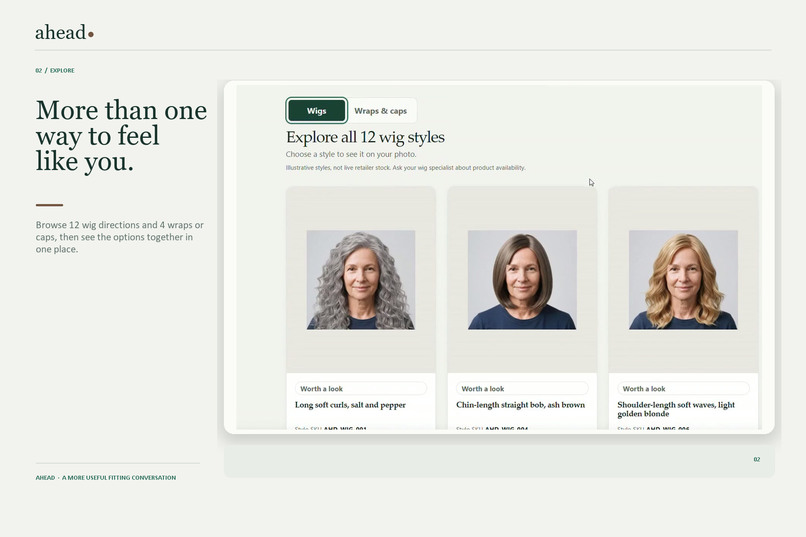
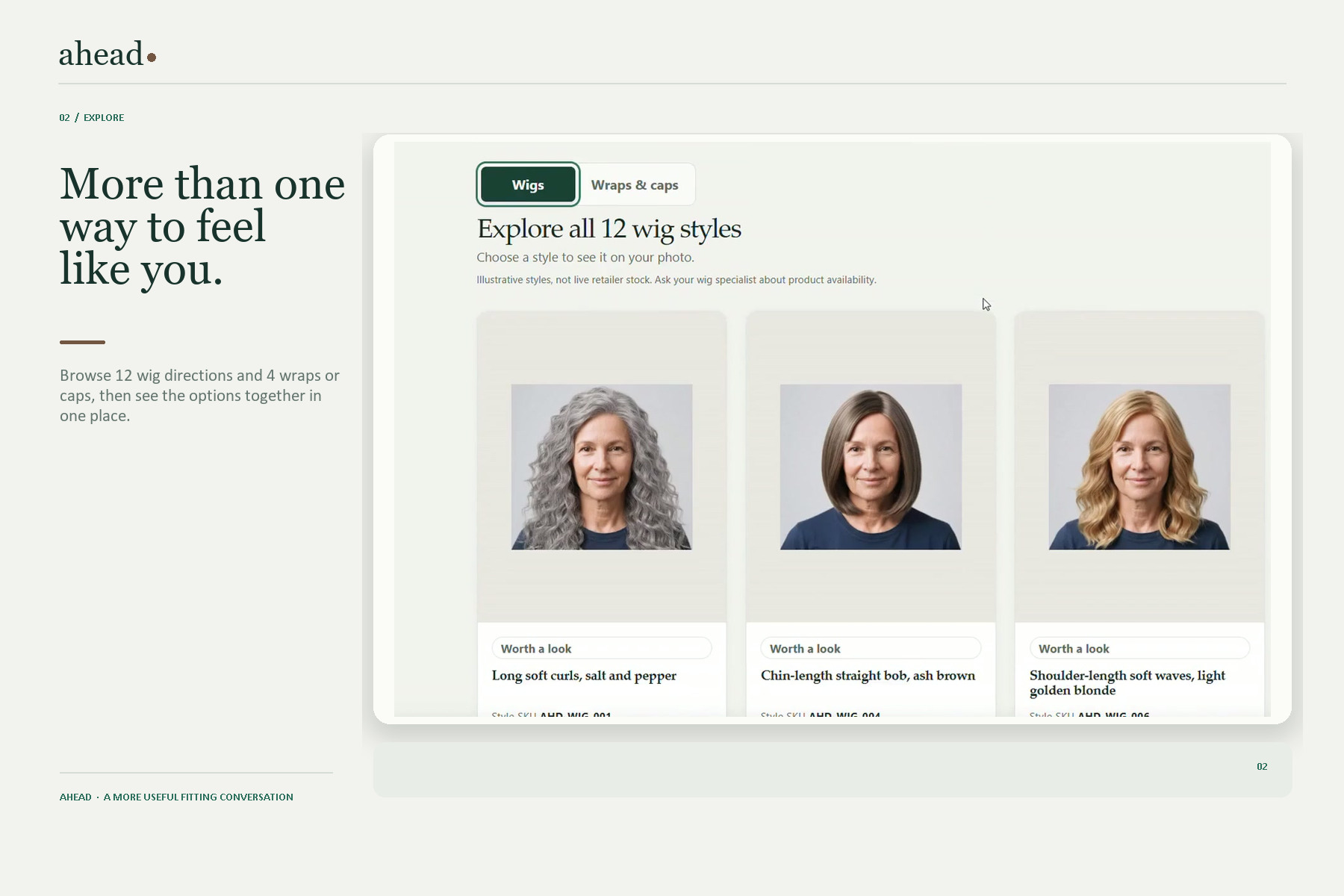
Twelve wig styles and four headwear options, previewed on one photo.
-
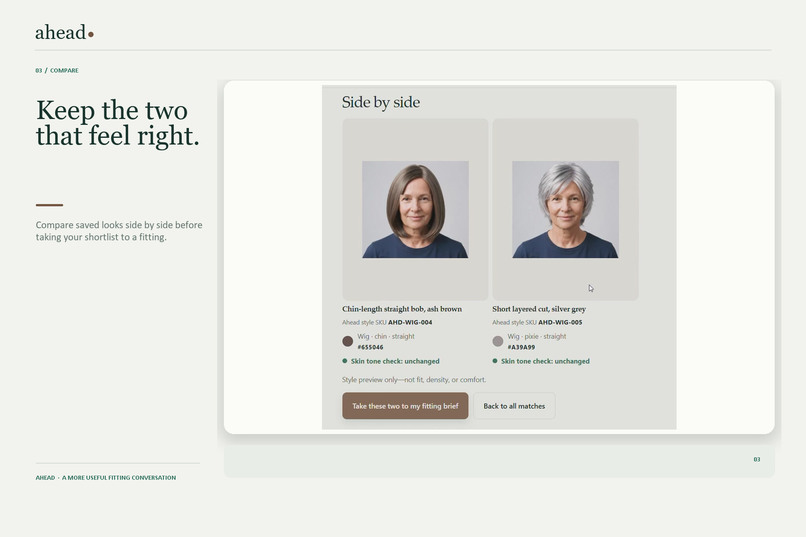
Compare your preview with the model reference before choosing a shortlist.
-
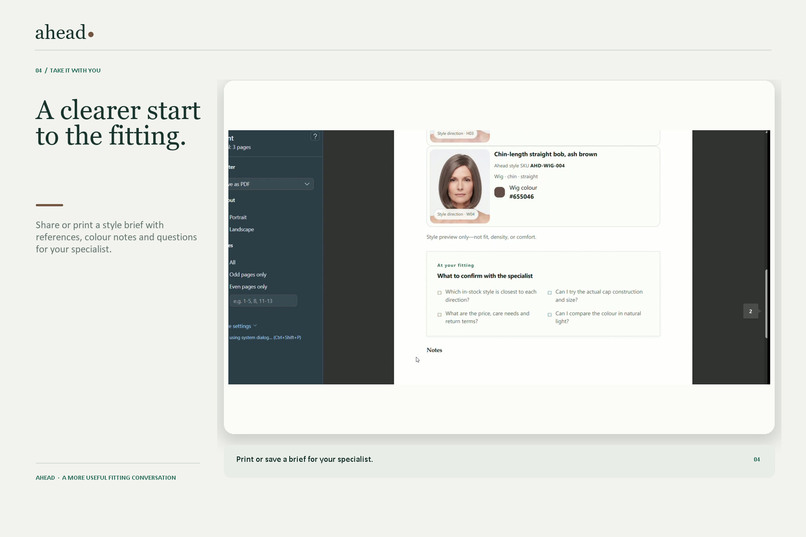
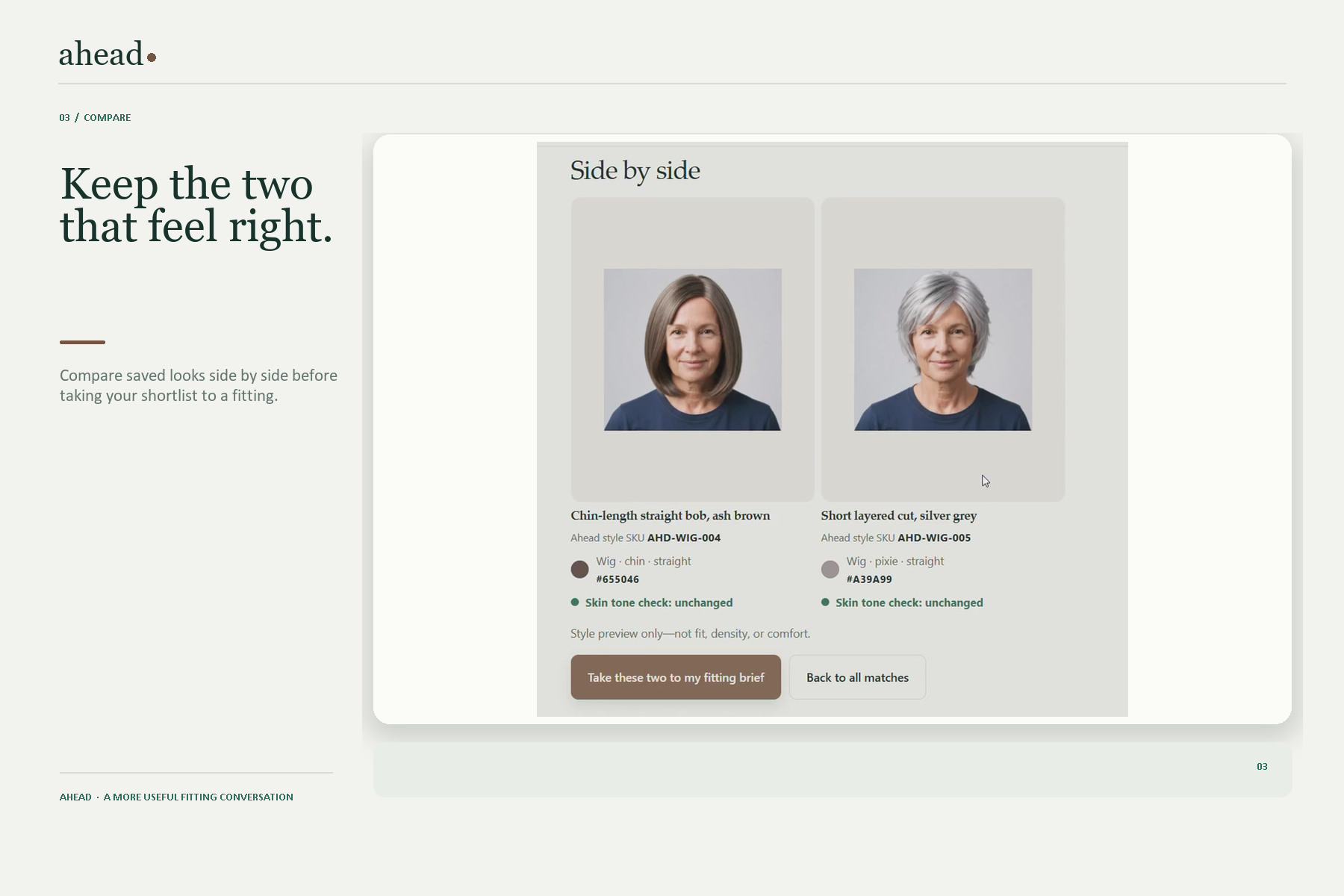
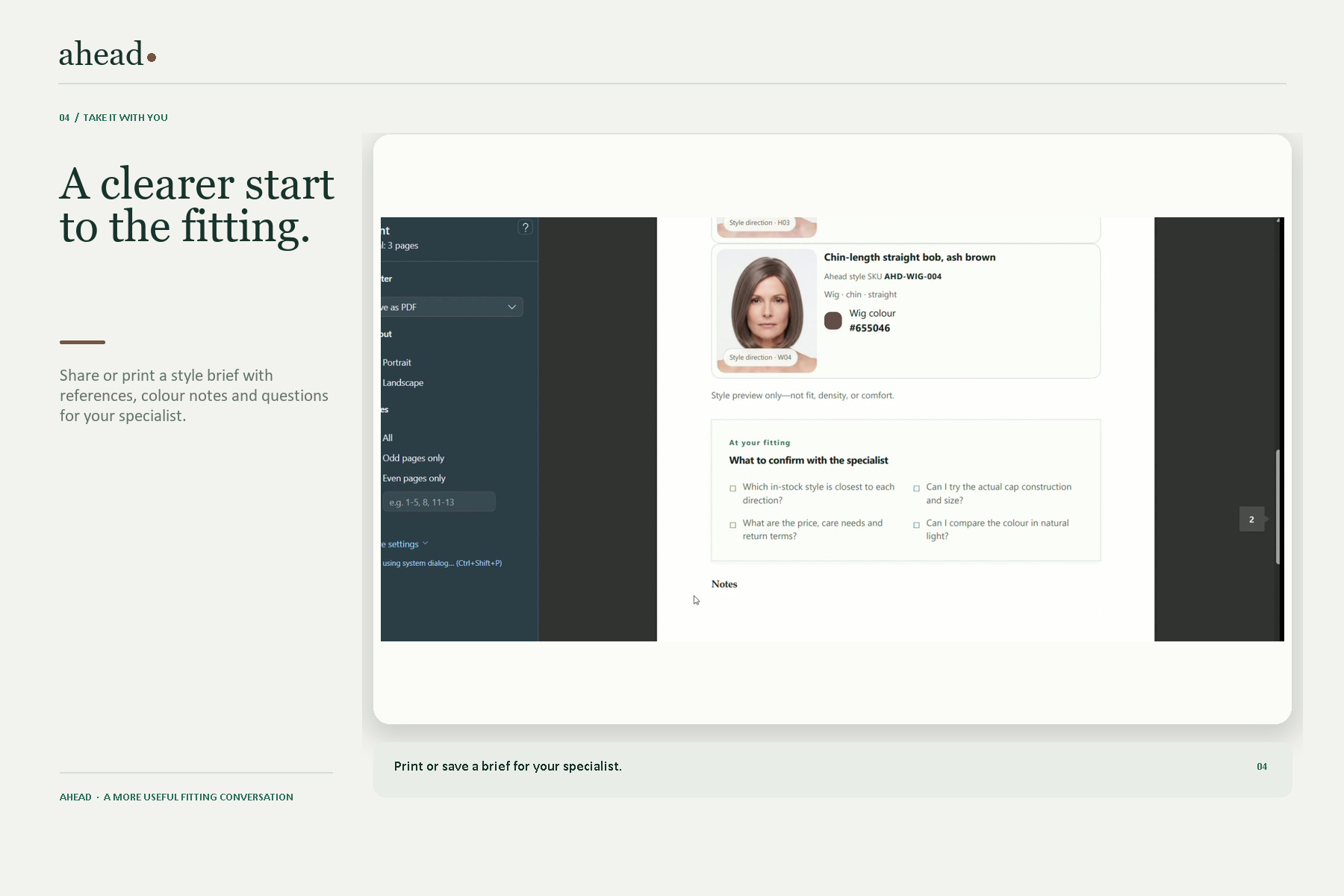
Save the looks you want to discuss at your fitting. Take a clear, photo-free fitting brief to your specialist.
Inspiration
Hair loss during cancer treatment can make an already difficult time feel even more exposed. Choosing a wig or head covering adds another question: Can I picture myself in this?
Most product photos answer with someone else’s face. Ahead starts with the person making the choice. We wanted to give someone a private place to explore possibilities at their own pace—before a fitting, before a purchase, and without pressure to decide.
Ahead is built around a simple belief: a person deserves to see their options on themselves, not just on a model.
What it does
Ahead is a private fitting room for people navigating treatment-related hair loss. With the person’s permission, it uses their photo to preview:
- 12 wig styles
- 4 wraps and caps
- A model reference alongside the personal preview
- A side-by-side comparison and fitting shortlist
- A shareable or printable brief to take to a wig specialist
The brief carries style references, colour notes, and questions—not the person’s photo. It helps turn “I might like this” into a clearer fitting conversation.
Ahead is a shopping companion, not a medical tool or retailer. Its catalogue is illustrative: the style codes are Ahead references, not retailer SKUs, and the app does not claim live stock, pricing, fit, comfort, or checkout.
How we built it
Ahead is a Next.js and TypeScript web app integrated with Perfect Corp.’s YouCam Hair Transfer v2.1 API.
When someone requests a live preview, Ahead’s server sends the source photo and a reference image of a person wearing the selected style. It creates a YouCam task, tracks that task while rendering completes, and returns the result through Ahead. The API key stays server-side, and each result remains tied to the style that requested it.
We built the experience around the realities of image generation: explicit user action before a paid render, request caching, credit and daily limits, per-style task tracking, and clear handling for pending or failed results. Ahead also checks the rendered face and skin tone for visual drift. Those integrity checks are Ahead’s safeguards—not a YouCam feature.
Judges can explore recorded sample previews without spending API units. The live own-photo path uses YouCam.
Challenges we ran into
A task being accepted does not mean its image is ready. YouCam renders asynchronously, so we had to track each task through completion and make sure a finished image returned to the correct style. A mismatch here can show the wrong look under the wrong label—a small technical bug with a very personal impact.
The second challenge was visual integrity. Hair transfer can change parts of the face or shift skin tone. We added checks around the face region and made the product treat a visually questionable render as a quality issue, rather than assuming every successful API response is good enough.
We also had to make every paid call deliberate. Retries, duplicate requests, or uncontrolled parallel renders can burn credits. Ahead uses explicit actions, caching, and usage limits to keep API use visible and bounded.
Accomplishments that we’re proud of
We built a complete journey from photo to fitting conversation—not just a try-on screen:
- A person can explore 16 style directions across wigs and headwear.
- They can compare a personal preview with its model reference and save looks.
- They can take a photo-free fitting brief to a specialist.
- The YouCam integration handles asynchronous tasks, credit safeguards, and style-to-result matching.
- Sample mode gives judges a way to experience the product without a live API call or API units.
Most of all, we’re proud that the product gives the person control: their photo, their pace, their shortlist, their next conversation.
What we learned
We learned that integrating an image API is only the beginning. A trustworthy experience also needs to handle time, failure, identity, privacy, and cost. “The API returned an image” is not the same as “this result is useful to the person looking at it.”
We also learned to be precise about AI’s role. Ahead can help someone explore style and colour. It cannot tell them whether a wig fits, feels comfortable, is medically suitable, or is available to buy. That is why the specialist remains part of the experience.
What’s next for Ahead: A Fitting Room
Next, we want to take Ahead from an illustrative catalogue to a specialist-connected fitting journey.
That means working with wig specialists and retailers to map style directions to real products, verified stock, prices, and availability—then learning whether a photo-based shortlist helps people prepare for fittings and makes style discovery easier for specialists.
We also want to test the experience with people who have lived through treatment-related hair loss and with the professionals who support them. Their feedback should shape the language, privacy choices, preview quality, and fitting brief.
The ambition is bigger than showing more wigs. It is to make the first step toward finding a look feel more private, personal, and possible.
Built With
- groq
- mediapipe
- next.js
- node.js
- playwright
- react
- typescript
- upstash-redis
- vercel
- virtual-try-on
- youcam-api
- youcam-hair-transfer