Inspiration I started Annadatri, a student-led initiative, in late 2024 with a simple goal—to combat food waste and raise awareness about malnutrition through community drives. During one such drive, an NGO shared how they often struggle to collect food donations on time, even when there’s surplus food available nearby. That conversation became my guiding light. While exploring this problem further, I realized how restaurants and eateries frequently dispose of perfectly edible food at the end of each day. Globally, food waste accounts for 8–10% of annual greenhouse gas emissions, making it a major contributor to climate change. That’s when Ahaarvritti was born—a platform designed to connect restaurants with NGOs and shelters in real time, ensuring surplus food finds its way to those who need it most instead of ending up in landfills.
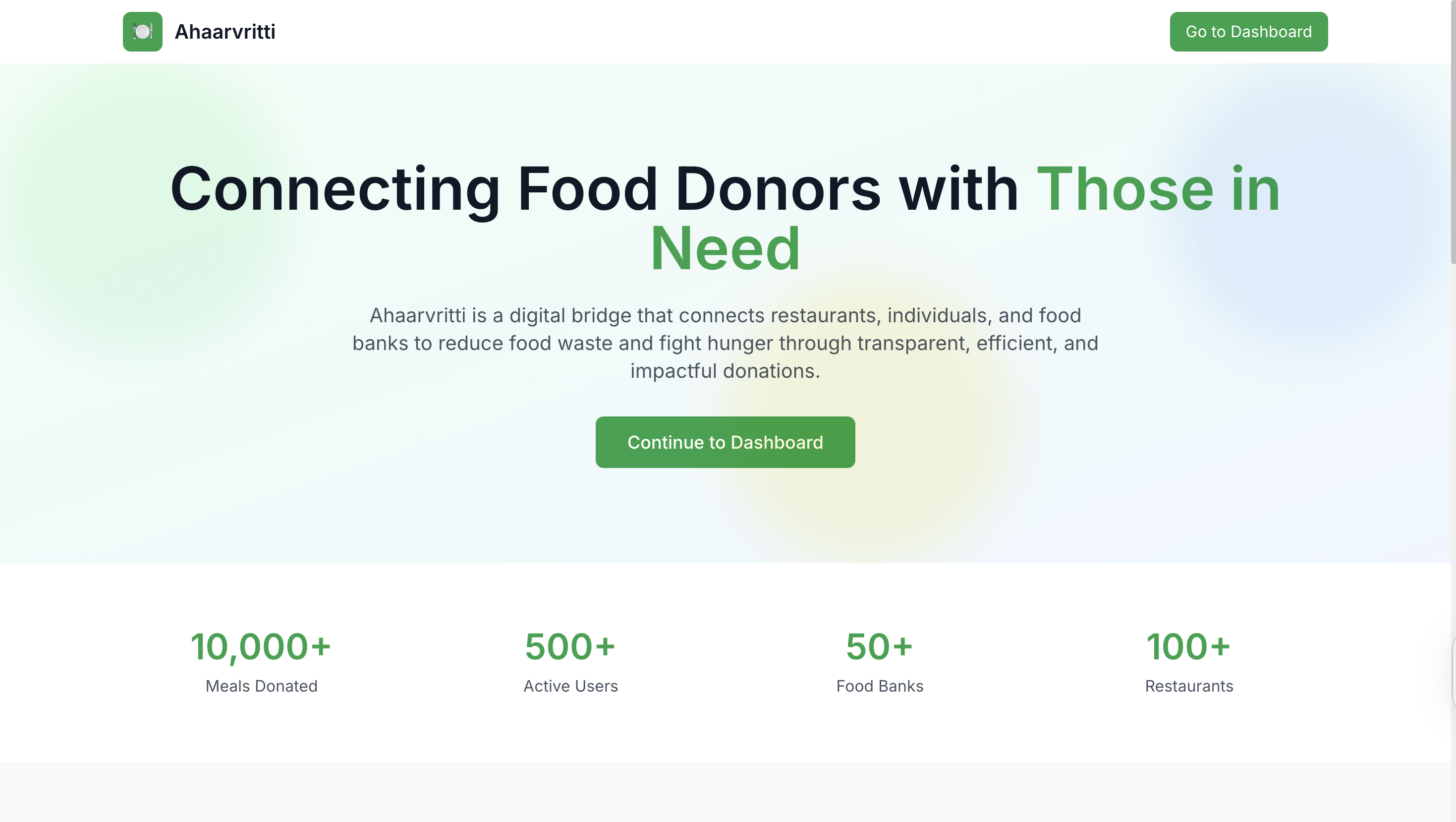
What it does -Ahaarvritti connects food donors such as restaurants, cafeterias, and individuals with NGOs, shelters, and food banks in need. -Restaurants can list surplus food along with details like type, quantity, and pickup time. -NGOs can view available food donations nearby and request pickups instantly. -The app sends real-time notifications when a donation is posted or accepted. -A dashboard helps track food saved, meals served, and carbon footprint reduced. -The overall goal is to create a sustainable, transparent network that reduces food waste and fights hunger.
How we built it -We used React.js to build a responsive and user-friendly frontend. -Node.js and Express power the backend, managing APIs, user authentication, and donation workflows. -MongoDB serves as our database for storing user details, donation records, and transactions. -Geolocation APIs were integrated to match restaurants and NGOs based on proximity. -The project is deployed using Vercel for the frontend and Render for backend hosting, ensuring scalability and smooth performance.
Challenges we ran into -Integrating real-time notifications and live data updates was technically complex. -Managing accurate geolocation data while preserving privacy required careful design. -Coordinating with NGOs to understand real-world food donation logistics took time and iteration. -Balancing UI simplicity with multiple functional layers was a creative challenge. -Ensuring consistency between database and frontend updates during testing was another hurdle.
Accomplishments that we're proud of -We successfully built a working prototype of Ahaarvritti within a short development period. -Partnered with local restaurants and an NGO for pilot testing. -Tracked over 50 meals saved and redistributed through our initial drive. -Raised awareness among communities about the environmental and social impact of food waste. -Designed a scalable framework that can easily expand to new locations.
What we learned -We learned how impactful technology can be when applied to real social issues. -Developing Ahaarvritti taught us the importance of human-centered design and collaboration. -We understood how technical innovation and social responsibility can intersect effectively. -We gained hands-on experience with real-time systems, APIs, and deployment processes. -Most importantly, we realized that sustainable change begins with small, consistent actions.
What's next for Ahaarvritti -We plan to develop a mobile version for faster and more accessible use. -Expand partnerships with restaurants, canteens, and NGOs to increase outreach. -Integrate AI-based analytics to predict food surplus and optimize distribution routes. -Introduce volunteer coordination and live pickup tracking features. -Launch awareness campaigns in schools and universities to encourage youth participation in reducing food waste.
Built With
- bcrypt
- css
- express.js
- figma
- geolocation-api
- git
- github
- google-maps
- html
- javascript
- json-web-tokens-(jwt)
- mongodb
- mongodb-atlas
- node.js
- react.js
- render


Log in or sign up for Devpost to join the conversation.