
Inspiration
Modern agriculture generates enormous amounts of operational data, yet much of that information remains fragmented across people, farms, organizations, and disconnected software. Operators often spend valuable time interpreting records instead of acting on trustworthy operational insight.
Our goal was not simply to build another farm management application, but to establish the foundation of an agricultural operating platform capable of serving the wider agricultural ecosystem through governed operational workflows and explainable operational intelligence.
What it does
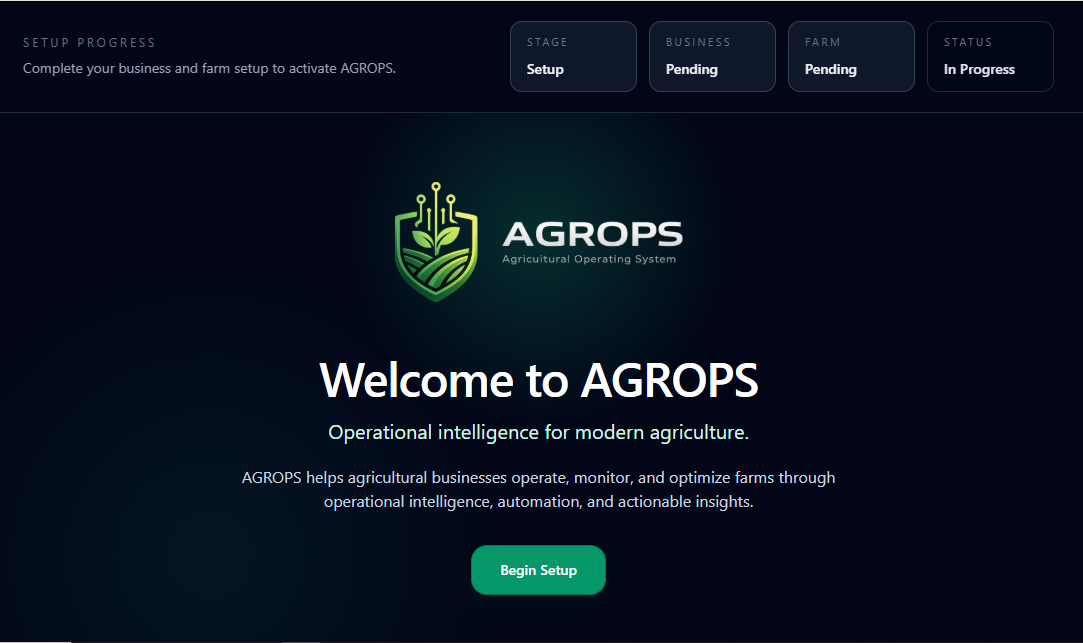
AGROPS is an agricultural operating platform designed to support the broader agricultural ecosystem through governed operational workflows and trustworthy operational intelligence.
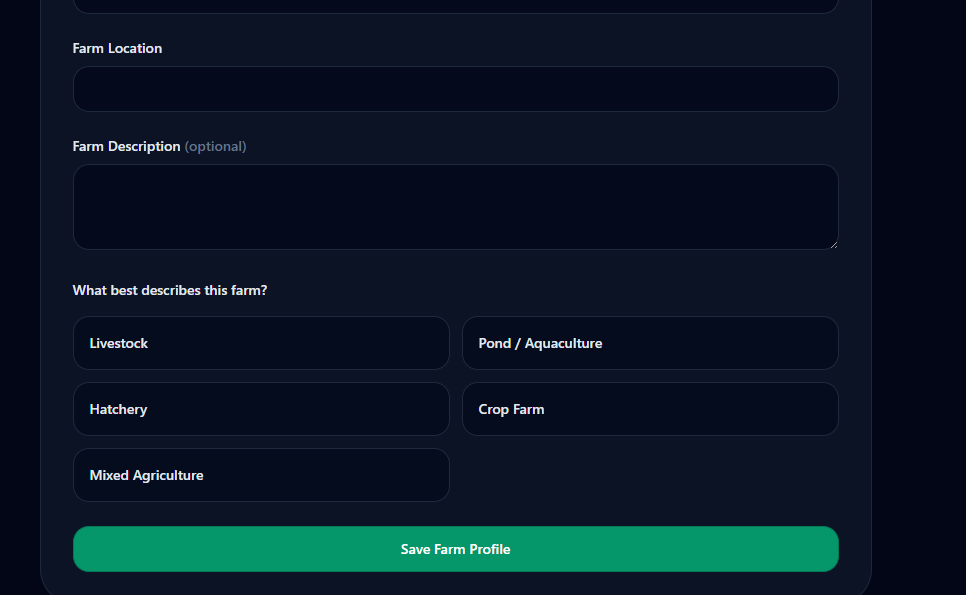
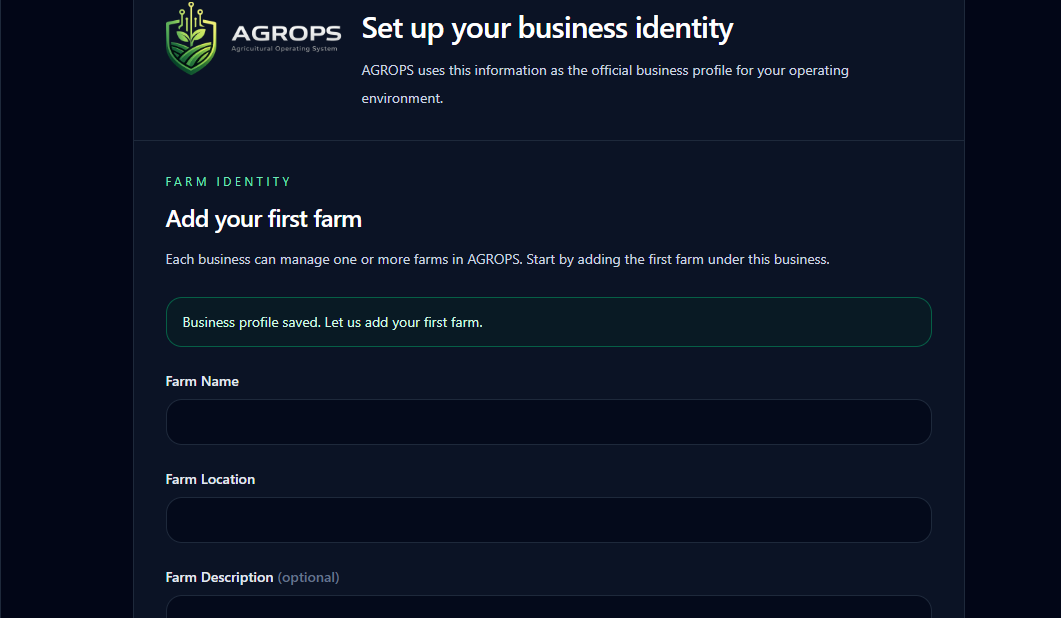
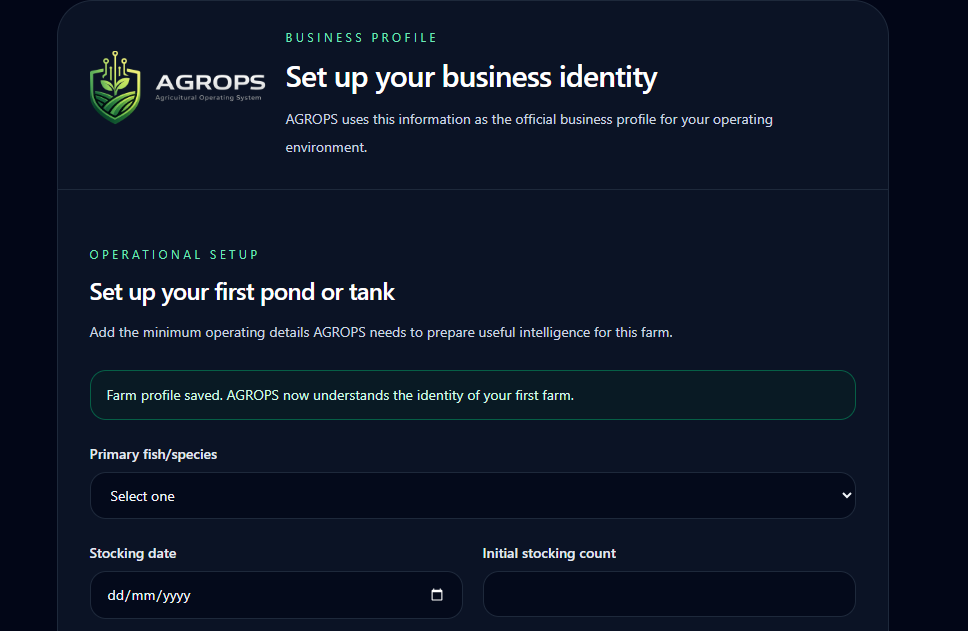
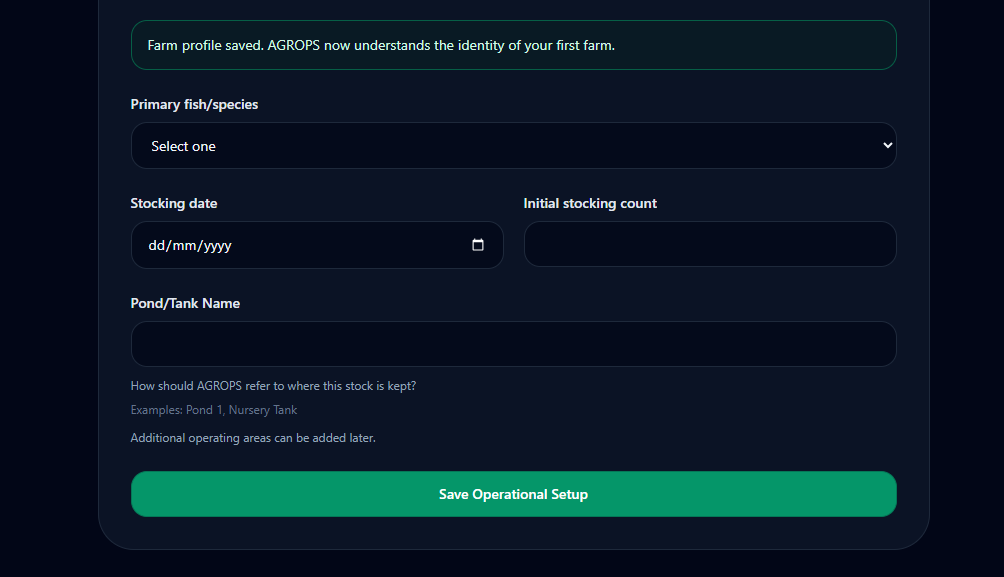
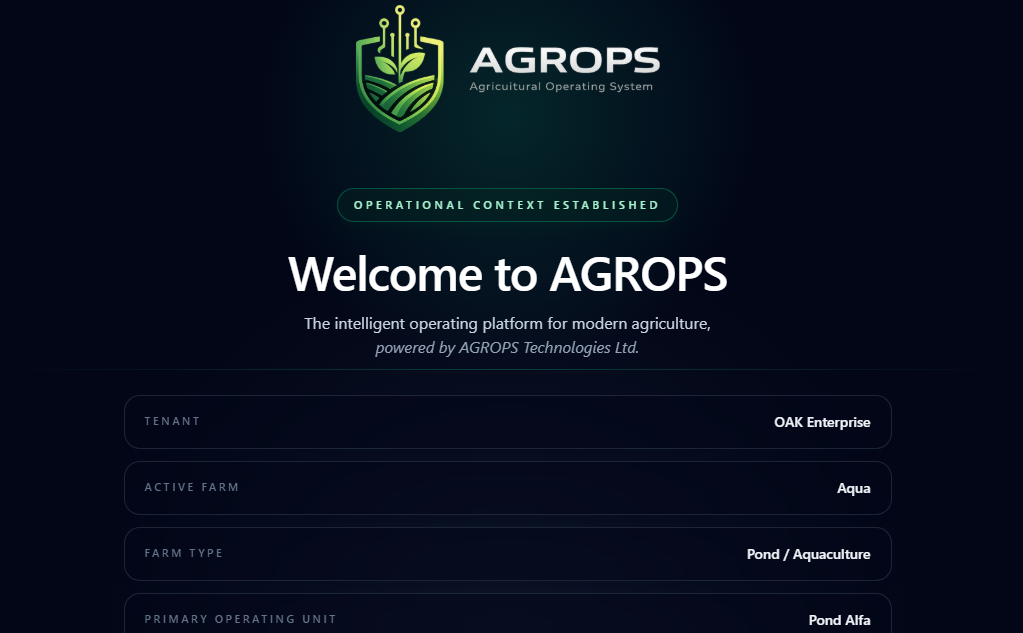
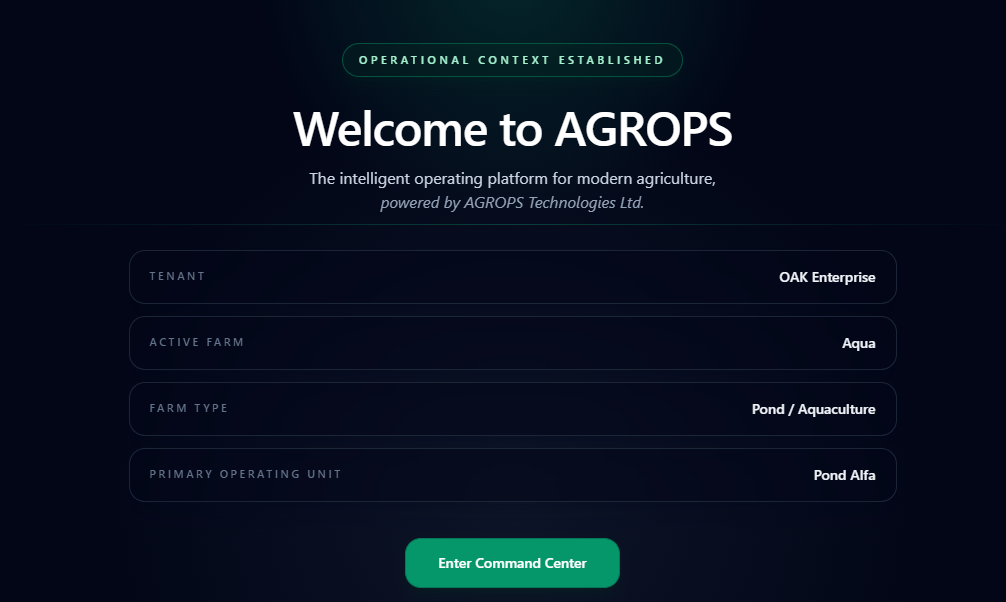
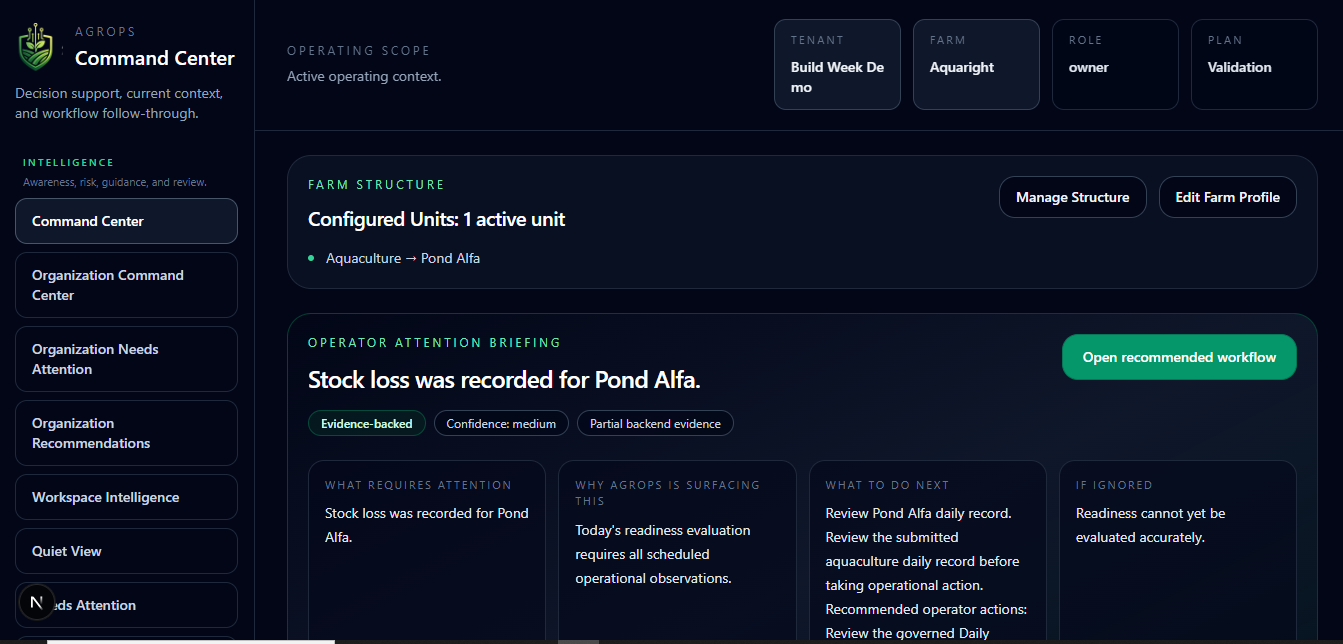
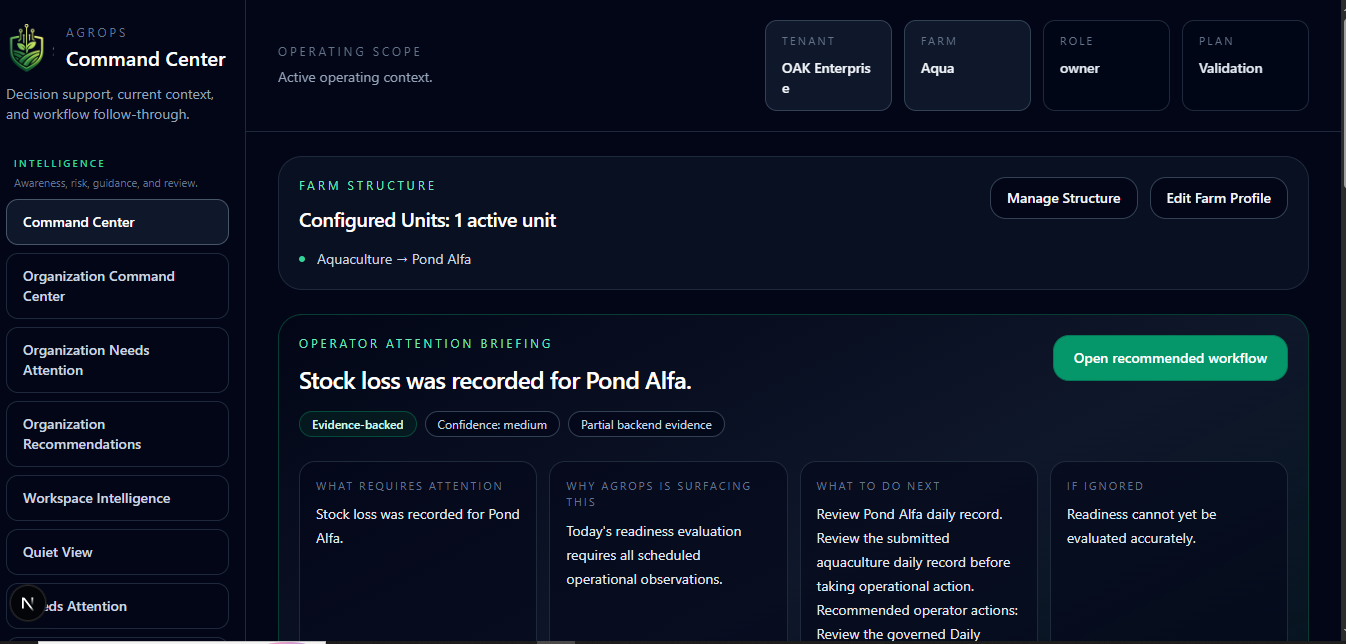
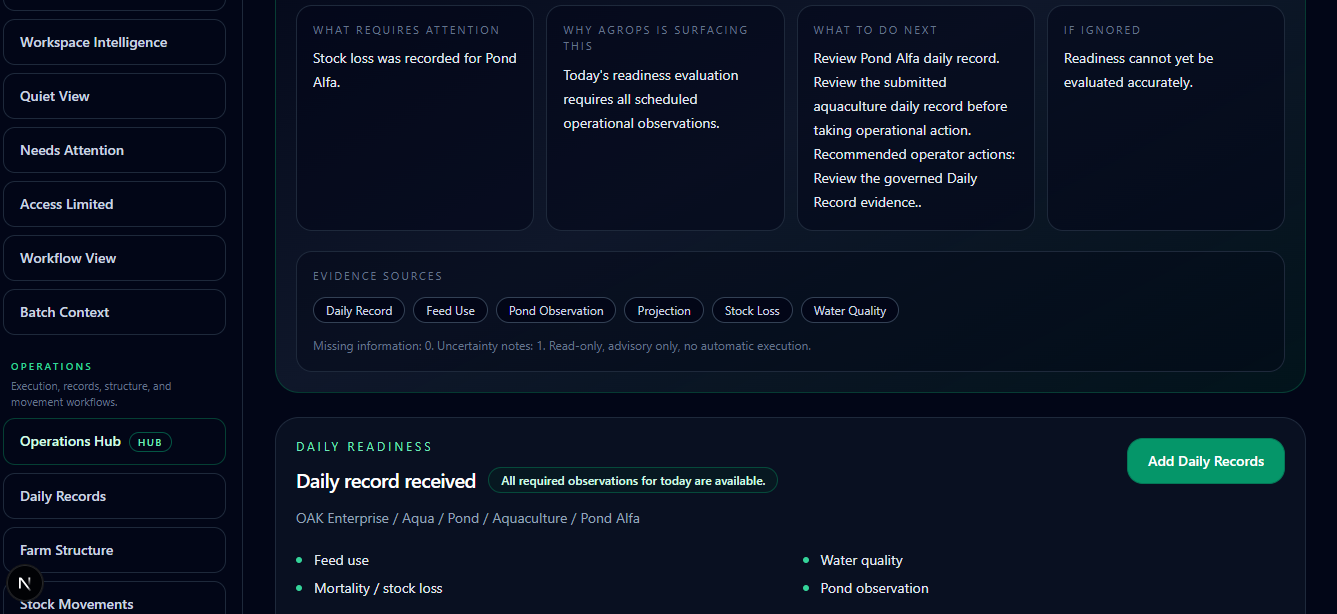
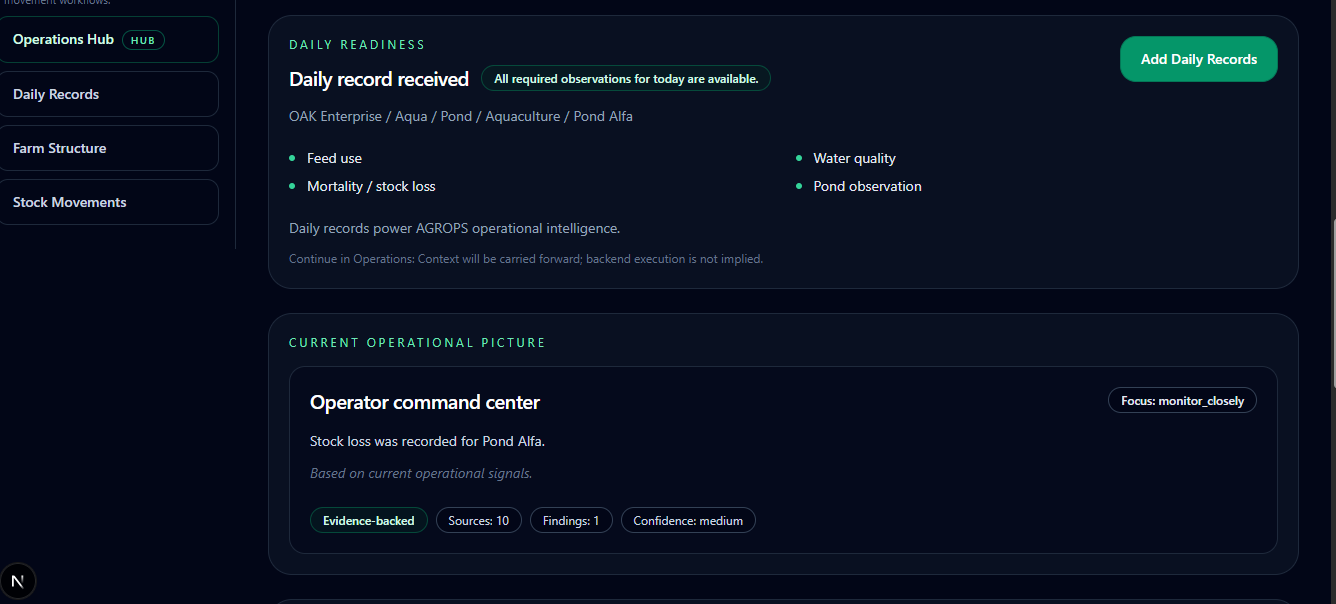
The platform enables agricultural organizations to establish governed operational contexts, capture daily operational evidence, reconstruct operational state, and generate explainable operational intelligence that helps operators understand what needs attention, why it matters, and what should happen next.
Rather than functioning as a traditional farm management application, AGROPS is being designed as a shared operational platform capable of supporting farms, cooperatives, veterinarians, consultants, extension officers, breeding organizations, feed manufacturers, hatcheries, processors, enterprises, regulators, research institutions, and government agencies through common, governed operational capabilities.
Importantly, AGROPS recommends—but people always make the final operational decisions.
How we built it
AGROPS is built around an event-driven architecture with governed operational workflows. Operational activities are validated as commands, recorded as canonical events, reconstructed into operational state projections, and transformed into trustworthy operational intelligence through a reusable Operational Intelligence Layer.
The platform has been designed from the beginning to remain domain-extensible, allowing additional agricultural sectors and organizational capabilities to be introduced without redesigning the core operational model.
Development followed a disciplined AI-assisted engineering workflow. GPT-5.6 supported architecture, planning, design critique, and implementation review, while Codex implemented bounded repository changes, regression tests, and documentation. Product decisions, validation, commits, and deployment remained under human direction.
Challenges we ran into
One of our biggest challenges was designing an intelligence layer that remained trustworthy rather than becoming a black-box recommendation engine. Every recommendation needed to be explainable, traceable to governed operational evidence, and produced without compromising operator authority.
Another significant challenge was balancing long-term platform architecture with the rapid delivery expected during Build Week. We needed to ensure that every implementation increment strengthened a reusable agricultural operating platform rather than introducing short-term solutions that would limit future expansion across agricultural domains and organizations.
Accomplishments that we're proud of
Our biggest achievement was transforming what initially began as an operational copilot initiative into a reusable Operational Intelligence Layer integrated within a broader agricultural operating platform.
Instead of simply generating recommendations, AGROPS establishes governed operational evidence, reconstructs operational state, produces explainable operational intelligence, and preserves human authority over every operational decision.
What we learned
Build Week reinforced that building trustworthy operational intelligence is as much an architectural challenge as it is an AI challenge. Intelligence becomes significantly more valuable when it is grounded in governed operational evidence, explainable to operators, and integrated into disciplined operational workflows.
We also learned the value of disciplined AI-assisted engineering. GPT-5.6 and Codex accelerated implementation, but the quality of the outcome depended on clear architectural direction, incremental validation, continuous testing, and deliberate human oversight. This approach enabled us to deliver meaningful capabilities while preserving a coherent long-term platform vision.
What's next for AGROPS – Operational Intelligence for Agriculture
Our long-term vision is to evolve AGROPS into a comprehensive agricultural operating platform supporting the entire agricultural ecosystem.
Beyond individual farms, we plan to provide governed operational capabilities for cooperatives, veterinarians, consultants, extension officers, breeding organizations, hatcheries, feed manufacturers, processors, research institutions, enterprises, financial institutions, regulators, and government agencies.
Future development will expand operational intelligence across livestock, aquaculture, crop production, mixed farming, and additional agricultural domains while introducing richer organizational collaboration, shared operational capabilities, explainable intelligence, automation, and production-scale deployment.
Ultimately, we envision AGROPS becoming the trusted operational platform that enables every participant in the agricultural value chain to collaborate through governed operational evidence rather than fragmented operational records.
Built With
- codex
- cqrs
- css
- design
- docker
- domain-driven
- event
- fastapi
- git
- github
- gpt-5.6
- html
- javascript
- next.js
- openai
- playwright
- postgresql
- pytest
- python
- react
- sourcing
- typescript
- ubuntu

Log in or sign up for Devpost to join the conversation.