-
-
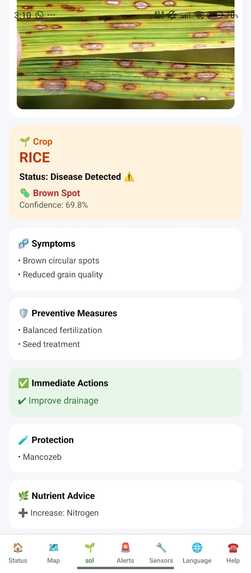
demo page of showing disease detected
//Inspiration
Farmers often detect crop diseases only after visible damage has already spread across the field. Manual inspection is time-consuming, expert advice is not always accessible, and overuse of pesticides increases cost and environmental harm. We were inspired to build AGROGUARD to provide early, automated, and affordable crop disease detection directly from the field using IoT and AI, without depending on smartphones or constant expert intervention.
// What it does
AGROGUARD is an IoT-enabled AI crop monitoring system that:
Automatically captures crop leaf images using ESP32-CAM
Collects temperature, humidity, and soil moisture data
Detects diseases in rice and sugarcane crops using a deep learning model
Provides crop-specific treatment and prevention recommendations
Displays real-time crop health insights through a web-based dashboard
Alerts users when disease risk or environmental stress is detected
//How we built it
Hardware Layer:
ESP32-CAM for image capture
ESP32 with DHT and soil moisture sensors for environmental data
Communication Layer:
Wi-Fi-based data transmission to the backend
AI Layer:
Trained a deep learning model on labeled crop disease images
Optimized the model for CPU-based inference
Backend Layer:
REST API for receiving sensor data and images
Disease prediction and recommendation engine
Frontend Layer:
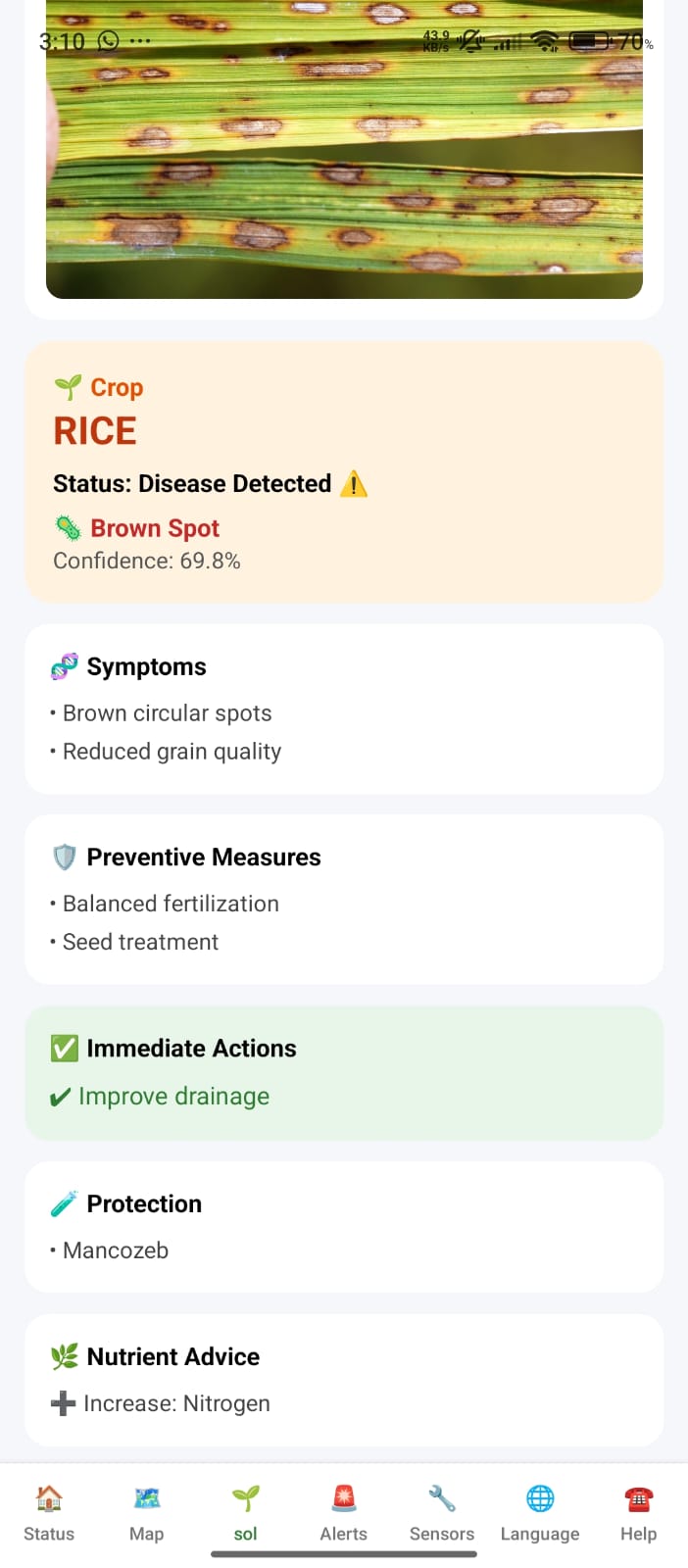
Web application displaying disease status, confidence score, and actionable recommendations
//Challenges we ran into
Handling image quality issues under varying outdoor lighting conditions
Managing limited processing power of edge devices
Ensuring reliable connectivity in agricultural environments
Balancing model accuracy with real-time performance
Designing recommendations that are simple and farmer-friendly
//Accomplishments that we're proud of
Built a fully automated system without using farmer smartphones
Successfully integrated IoT + AI + recommendation system
Achieved early-stage disease detection in real field conditions
Designed a low-cost and scalable architecture suitable for small farms
Created a solution with real social and agricultural impact
// What we learned
Real-world AI systems require hardware-software co-design
Data quality is as important as model complexity
Agriculture needs simple, actionable outputs, not just predictions
Edge and cloud systems must work together efficiently
Technology adoption depends on usability and trust
// What's next for AGROGUARD
Add support for more crops and diseases
Integrate weather forecasting for predictive disease alerts
Enable offline edge inference for low-connectivity areas
Introduce multilingual voice-based recommendations
Deploy pilot projects in real farming communities
Collaborate with agricultural departments and NGOs


Log in or sign up for Devpost to join the conversation.