AgroAgent — AI That Works With the Agricultural Web
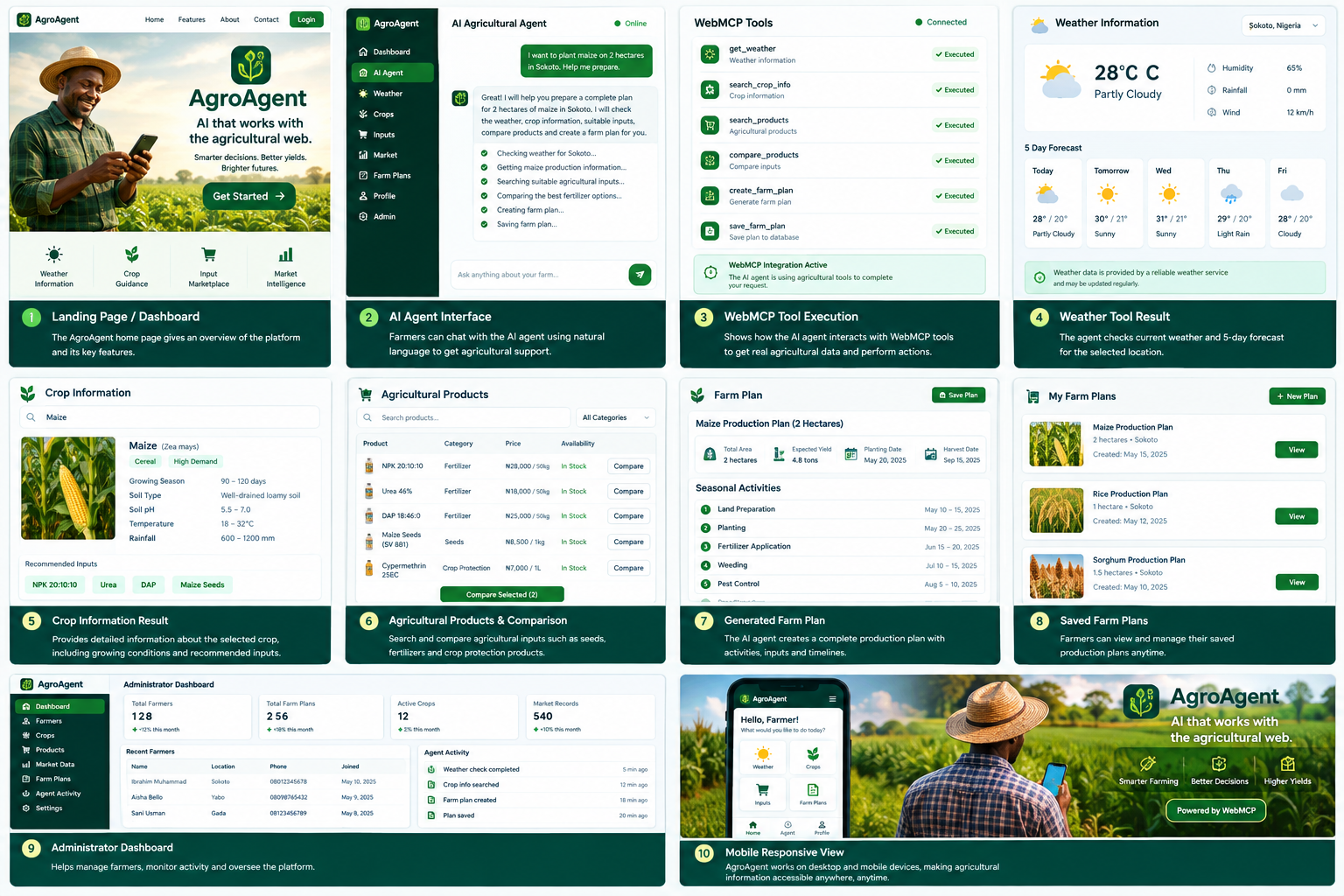
Inspiration Agriculture is one of the most important sectors for communities in Nigeria, yet many smallholder farmers still make critical decisions with limited access to timely information. Farmers need to know when to plant, what crops are suitable, which inputs to use, what the weather may look like, and where they can get better market information. The inspiration for AgroAgent came from my work developing Smart Agro Insight, an agricultural technology concept designed to help smallholder farmers access agricultural information and make better decisions using data and technology. I wanted to take that idea one step further. Instead of building another agricultural chatbot that simply gives farmers answers, I wanted to explore a future where an AI agent can actually interact with agricultural web services and tools on behalf of the farmer. This led to AgroAgent: an AI-powered agricultural web agent designed around WebMCP. The goal is to make the web more useful to farmers by allowing an AI agent to discover and interact with agricultural capabilities rather than simply generating text. The project was founded and developed by Yahaya Abubakar under YABTECH SMART AGRO INSIGHT ENTERPRISES. What It Does AgroAgent is an AI-powered agricultural decision-support platform for smallholder farmers, cooperatives and agribusiness users. A farmer can communicate with AgroAgent using natural language instead of navigating through many different agricultural services. For example, a farmer can ask: "I want to plant maize on 2 hectares in Sokoto. Help me prepare." AgroAgent is designed to break this request into useful agricultural actions. The platform includes WebMCP tools for: Weather information — checking weather conditions relevant to farming. Crop information — finding information about crops, growing conditions and risks. Agricultural inputs — searching for suitable seeds, fertilizer and crop-protection products. Product comparison — comparing available agricultural inputs. Farm planning — creating a production plan based on crop and farm size. Farm-plan saving — saving the generated plan for later use. The platform also includes: Farmer dashboard AI Agricultural Agent Weather dashboard Crop information Agricultural input marketplace Market intelligence Farm plans Farmer profiles Administrator dashboard WebMCP tool diagnostics The important difference is that AgroAgent is designed around the interaction between the farmer, the AI agent and web tools. Instead of: Farmer → AI → Answer we are building: Farmer → AI Agent → WebMCP Tools → Agricultural Information/Actions → Farmer How We Built It We started with the Smart Agro Insight agricultural concept and created a new WebMCP-focused application called AgroAgent. The prototype was designed as a modular web application so that the agricultural services and AI interaction layer can evolve independently. The application includes a responsive dashboard designed for both desktop and mobile users. We created a dedicated WebMCP tool layer containing six core tools: get_weather search_crop_info search_products compare_products create_farm_plan save_farm_plan The WebMCP implementation is structured around the browser's document.modelContext.registerTool() API so that the tools can be exposed to compatible AI agents. We also created a data layer that currently provides a local-storage fallback for prototype testing and a Supabase-ready database architecture for production development. The database structure includes entities for: Farmers Crops Products Market prices Farm plans Agent activity The administrator dashboard is designed to provide a central place to manage farmers, farm plans and platform activity. For the prototype, weather, market and agricultural product information is clearly identified as demo data. The architecture is designed so verified live APIs and Supabase can replace the demo layer as the project moves toward pilot implementation. Challenges We Ran Into One of our biggest challenges was understanding how to move beyond a conventional AI chatbot and build an application where the website itself exposes useful capabilities to an AI agent. WebMCP introduced a different way of thinking about web applications. Instead of designing only screens and buttons for humans, we had to think about what capabilities an AI agent should be able to discover and use. Another challenge was balancing ambition with the limited time available for the hackathon. Agriculture has a very large scope. We initially had many possible features including weather forecasting, market intelligence, farm records, crop recommendations, agricultural inputs, buyers, supply-chain information and administrative management. We therefore narrowed the first version to a focused workflow: helping a farmer plan maize production. We also faced the challenge of building a meaningful WebMCP implementation while keeping the application usable in environments where native WebMCP support may not yet be available. To solve this, the prototype includes a local testing fallback while keeping the actual WebMCP registration layer separate and ready for testing in a supported environment. Another challenge was ensuring that we did not present demo agricultural information as real-world advice. Therefore, demo weather and market information is explicitly labelled as prototype data and is intended to be replaced with verified sources before production deployment. Accomplishments We Are Proud Of We are proud that AgroAgent evolved from an agricultural idea into a working prototype with a clear agent + web tools architecture. One of our biggest accomplishments is creating a dedicated set of agricultural tools that can be registered through WebMCP rather than building only a traditional chatbot. We are particularly proud of the farm-planning workflow. A farmer can express a goal in natural language, and the application can identify the relevant agricultural operations required to produce a farm plan. We also built: A complete agricultural dashboard AI agent interface Six WebMCP tool definitions Agricultural crop database structure Agricultural input catalogue Market intelligence interface Farm-plan management Farmer profile Administrator dashboard Agent activity logging Supabase-ready database schema Mobile-responsive interface Open-source project structure Most importantly, AgroAgent demonstrates a different vision for agricultural technology: AI should not only tell farmers what to do; AI should be able to interact with useful agricultural services and help complete tasks. What We Learned We learned that building an AI application is not only about the AI model. The real value comes from connecting AI to useful tools, structured information and actions. WebMCP helped us think about the web as something an AI agent can interact with rather than simply something a human browses. We learned to design tools around clear actions and inputs. For example, instead of asking an AI to "know everything about agriculture," we can give it specific capabilities such as: Get weather. Search crop information. Search agricultural products. Compare products. Create a farm plan. Save a farm plan. We also learned the importance of building a focused MVP. A smaller workflow that works clearly is more valuable than a huge platform containing many unfinished features. Finally, we learned that agricultural technology must be built responsibly. Weather, market and agronomic information can affect real financial decisions, so production deployment must use reliable, verified data sources and clearly communicate uncertainty. What's Next for AgroAgent The next stage is to move AgroAgent from a prototype toward a real pilot implementation with farmers. Our priorities are:
- Real WebMCP deployment We will test the WebMCP tools in the supported environment and verify that AI agents can discover and execute them through the live application.
- Supabase integration We will connect the production database so farmer profiles, farm plans, products, market information and agent activity can be securely stored.
- Verified agricultural data We will replace demo weather and market information with reliable data sources and agricultural information appropriate for the target communities.
- Local agricultural intelligence We want AgroAgent to become increasingly useful for farmers in northern Nigeria, starting with Sokoto and expanding to other agricultural communities.
- More agent actions Future tools could allow the agent to: Find agricultural buyers Create market listings Track farm activities Monitor crop risks Generate production budgets Compare input costs Track market opportunities Support cooperative management
- USSD, SMS and mobile access Many farmers may not have reliable smartphones or internet access. We therefore plan to explore USSD and SMS access alongside the web and mobile experience.
- Pilot with real farmers The ultimate goal is to test AgroAgent with real smallholder farmers, agricultural cooperatives and agribusiness stakeholders, measure whether it improves decision-making, and continuously improve the system based on their feedback. Our long-term vision is to build an agricultural ecosystem where farmers do not have to search through many disconnected services themselves. They can simply tell an AI agent what they need, and the agent can interact with trusted agricultural web services to help them accomplish it. AgroAgent is our step toward an agricultural web where AI doesn't just answer — it acts. This version is suitable for a Devpost project description and keeps the distinction between the current prototype and future production features clear.

Log in or sign up for Devpost to join the conversation.