Inspiration
Despite growing advancements in smart agriculture, many small-scale farmers across Africa still face post-harvest losses due to inadequate packaging, limited access to market-ready branding, and a lack of tools that make their produce competitive in urban and international markets. These challenges are further exacerbated by language barriers, limited digital literacy, and a lack of tailored AI tools that speak directly to their needs.
Our team has seen firsthand how farmers struggle to tell their product’s story, to label it well, to present it attractively, or to meet documentation standards that buyers demand. This gap between harvest and market not only affects income but also undermines the incredible work that farmers do every day.
Inspired by this, we created PKL an AI-powered multilingual agro-packaging assistant that empowers farmers to generate professional packaging content, documentation, and market-ready information for their products in both English and Kiswahili. Our mission is to equip farmers, agribusinesses, and agricultural students with tools that bridge the knowledge gap between production and presentation, where impact meets innovation.
What it does
Prompta Grow is an AI-powered design assistant built to help small-scale farmers generate personalized branding and packaging visuals for their products.
Here's how it works:
- Image Upload: The farmer uploads an image of their product (e.g., honey, tomatoes, grains).
- Interactive Prompting: An AI agent initiates a conversation with the farmer, asking personalized questions about:
- The desired packaging theme
- Preferred colors
- Type of poster or branding needed
- Target market or message
- AI Image Generation: Based on the farmer’s responses, a unique branding image or packaging design is generated automatically using AI.
- Downloadable PDF: A PDF document containing the branding image and design details is generated for download — useful for reference or printing.
How we built it
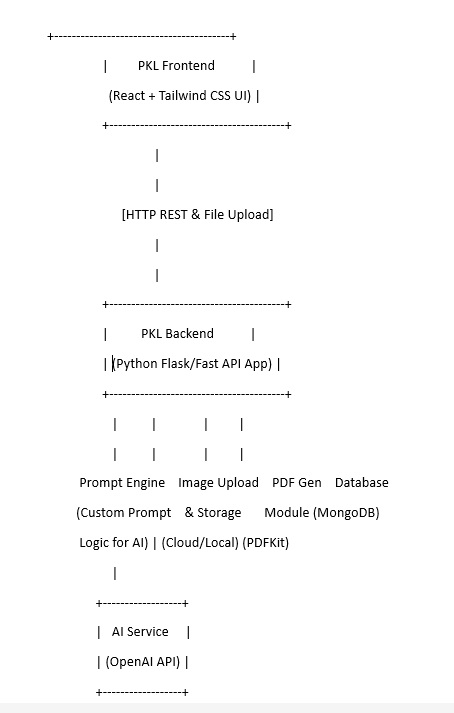
PLK is a full-stack AI-powered web application that empowers farmers by helping them design packaging and branding posters through guided prompts. It combines conversational AI, image generation, and PDF creation into a seamless user experience. Here's a breakdown of each component, the technologies used, and how the system operates.
Overall Architecture PLK is composed of a frontend, backend, and AI integration layer with PDF export functionality. Here's how each part works together: 1.Frontend Built using HTML, Tailwind CSS, and JavaScript, the frontend provides a clean, intuitive interface that: i)Allows farmers to upload product images ii)Prompts users with dynamic branding questions (e.g., preferred colors, themes, slogans) iii)Displays the final generated packaging/poster design
2.Backend Developed with FastAPI (Python), the backend is responsible for: i)Processing image uploads and form responses ii)Constructing dynamic prompts for the AI model iii)Generating the branding image using AI iv)Creating downloadable PDF documents for user reference
3.AI Integration A generative AI model is used to convert user responses into branding visuals. Prompts are carefully crafted based on form inputs to reflect the user’s vision for their packaging or poster.
4.PDF Export After image generation, the backend uses Python's FPDF library to compile the final design into a downloadable PDF,enabling farmers to print or share the output professionally.
Challenges we ran into
Prompt Alignment: Designing prompt flows that feel natural, contextual, and easy for non-tech-savvy farmers was challenging. We had to test multiple iterations to get the right balance.
Image Quality Control: Ensuring the uploaded product images met the minimum quality required for effective AI generation posed a hurdle, especially when farmers used low-resolution phone cameras.
Response Diversity: Farmers often gave vague or minimal answers, so training the AI to generate meaningful branding with limited input was tricky.
Language and Accessibility: Some users were more comfortable in their native languages, which highlighted the need for future multilingual support.
Output Accuracy: Getting consistent and accurate packaging visuals from AI required a lot of prompt fine-tuning and output validation.
Time Constraints: Building a working prototype within limited hackathon time meant we had to prioritize core features and leave some improvements for later.
Accomplishments that we're proud of
Built a Working AI Agent: Successfully developed an AI-driven prompt agent that interacts with farmers, collects branding preferences, and generates packaging designs tailored to their inputs.
User-Centered Design: Designed an intuitive interface that even first-time tech users could navigate easily, improving accessibility for rural farmers.
Seamless Image Upload & Output: Implemented a smooth flow from image upload to branded poster generation and PDF download, ensuring end-to-end usability.
Meaningful Prompts: Crafted context-aware and creative prompt flows that helped guide users through the branding journey effortlessly.
Team Collaboration: Worked effectively under time pressure and leveraged each team member’s strengths to deliver a polished prototype.
Social Impact Focus: Created a solution that has real-world value by empowering small-scale farmers to brand and market their products competitively.
What we learned
Prompt Engineering: We gained a deep understanding of how to structure effective and user-friendly prompts that guide users through an AI-powered design journey.
User Experience for Non-Tech Users: Learned how to design interfaces and flows that are intuitive for users who may not be tech-savvy, especially farmers.
AI Model Integration: Learned how to connect image generation models with user input dynamically, translating text responses into visual packaging designs.
Teamwork & Communication: Discovered the power of clear communication, especially when working under time constraints and tight deadlines.
End-to-End Workflow Design: Learned how to build a complete product cycle—from image input and prompt collection to AI generation and downloadable output.
What's next for PKL
- Model Fine-Tuning
- Voice Input Feature
- Mobile Optimization
- Print-Ready Branding Kits
- Partnerships with Agri-Hubs:


Log in or sign up for Devpost to join the conversation.