-
-
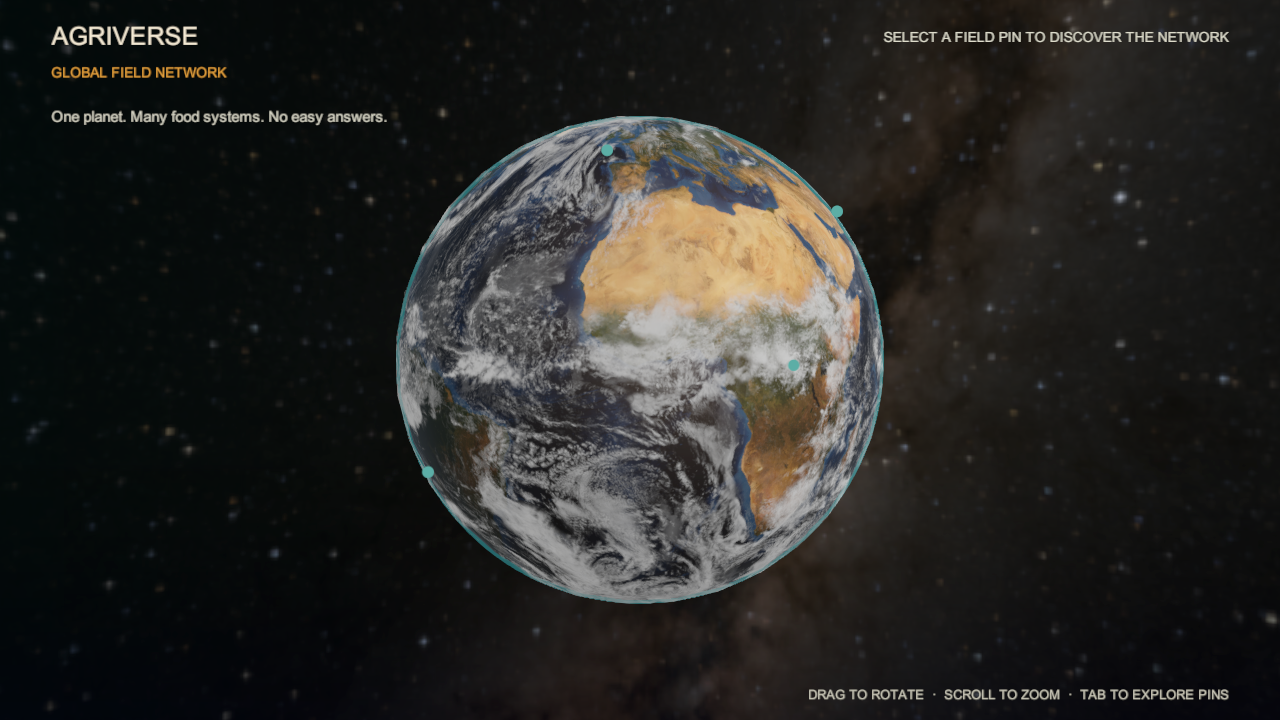
interative-globe
-
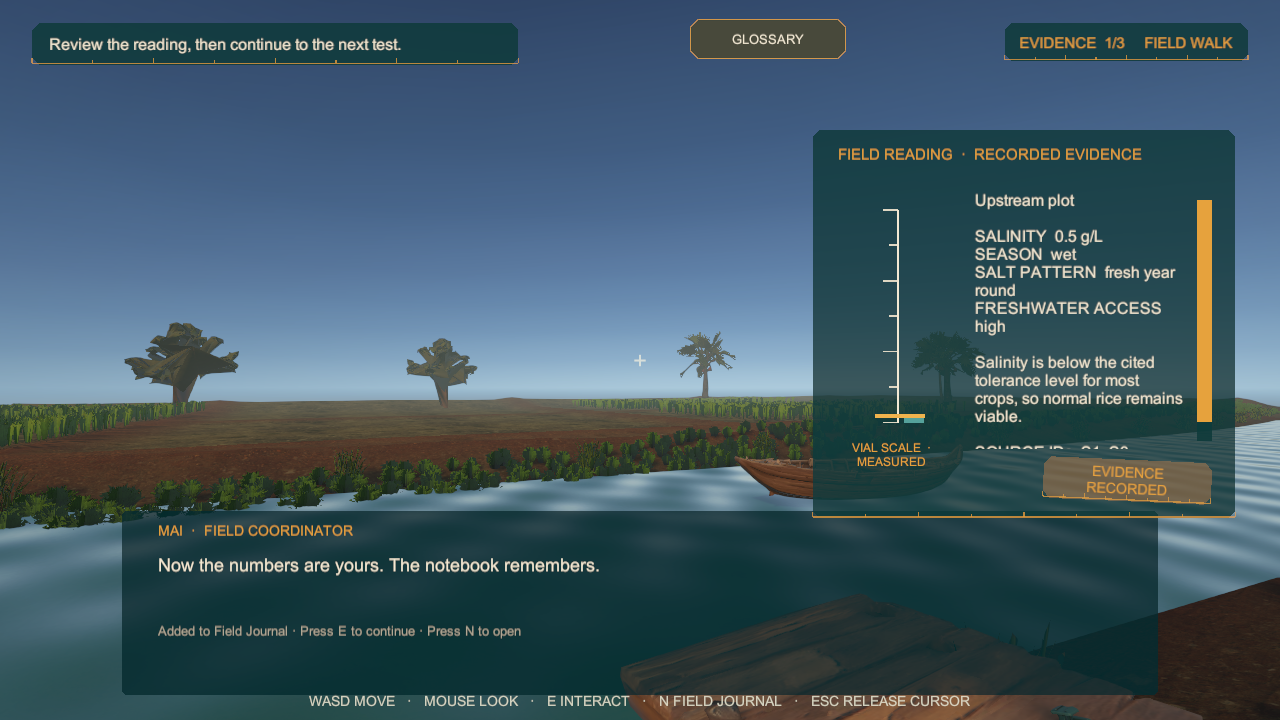
water-sampling
-
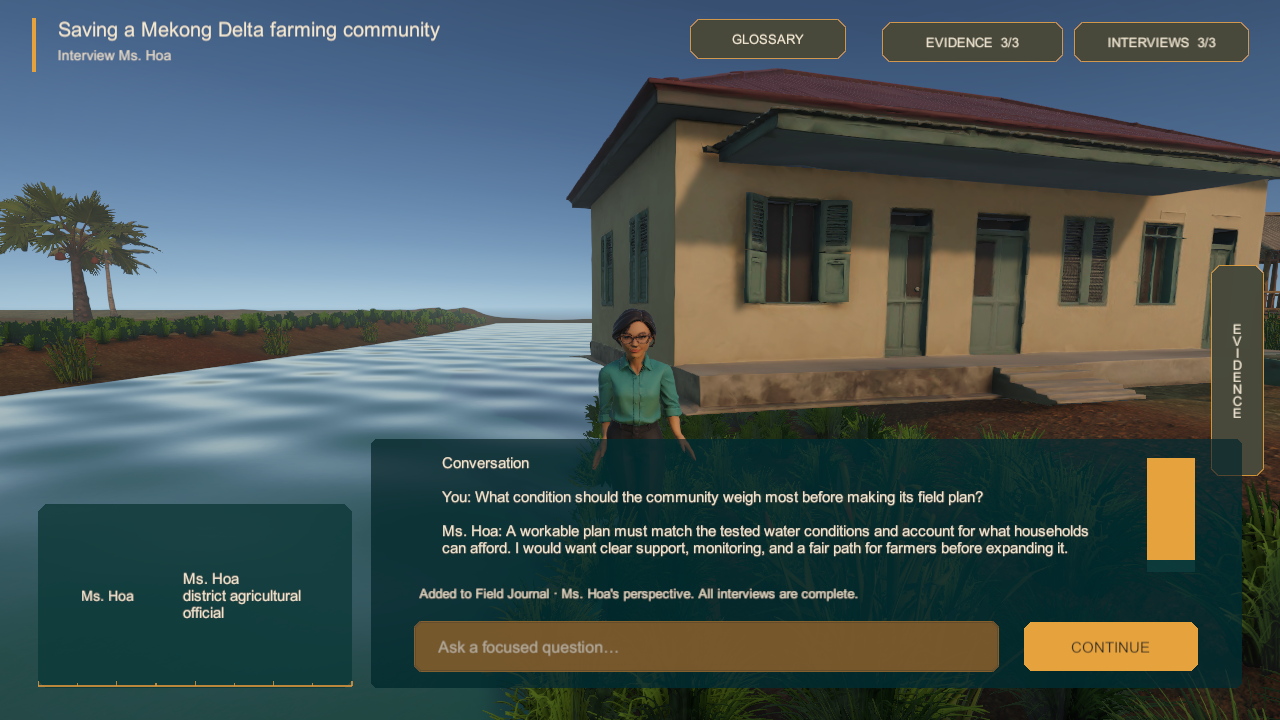
interview
-
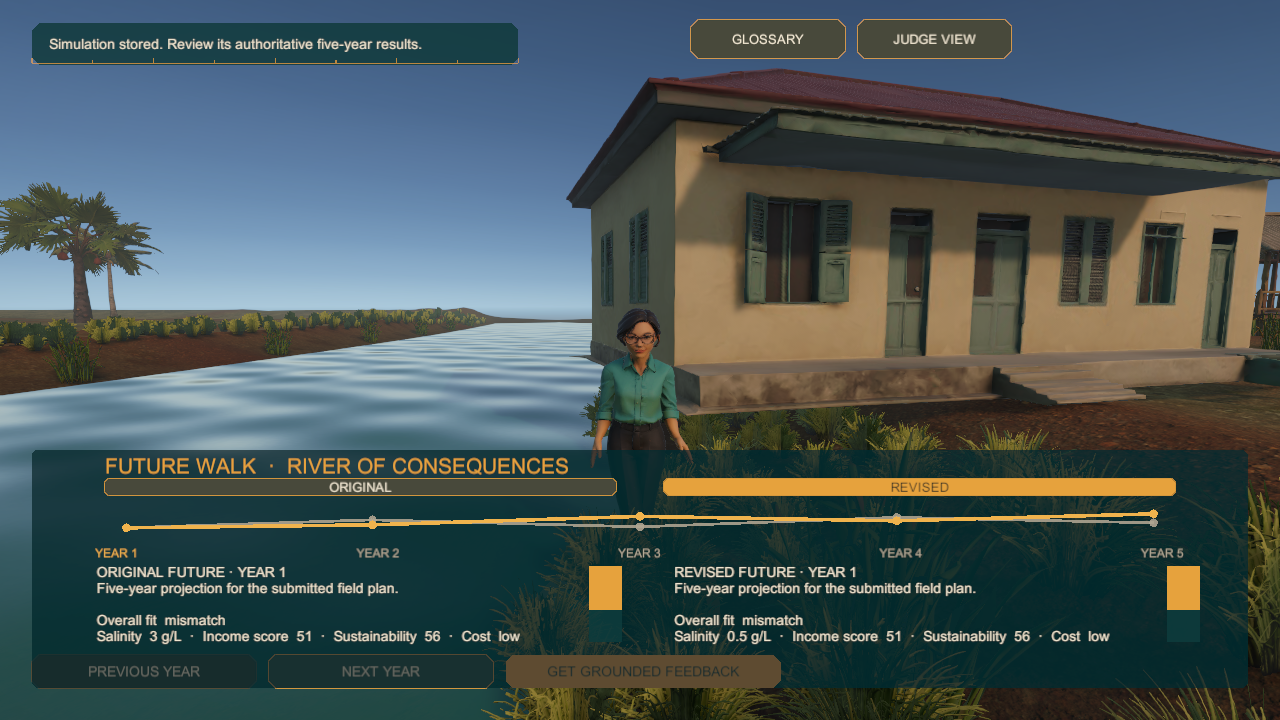
future-work-comparison
-
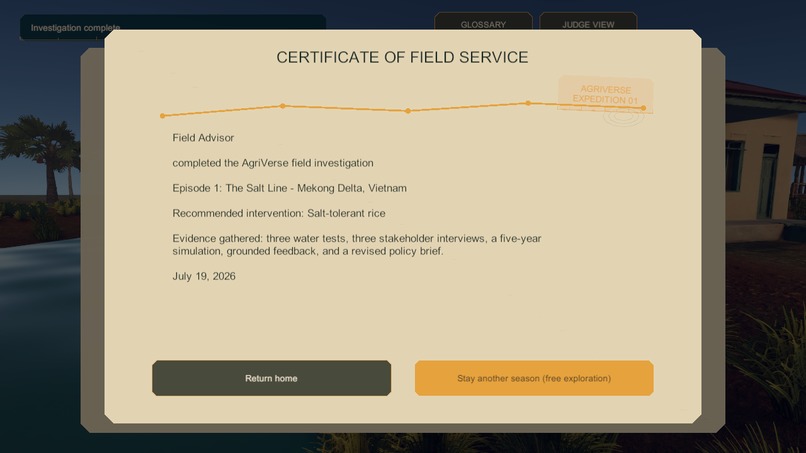
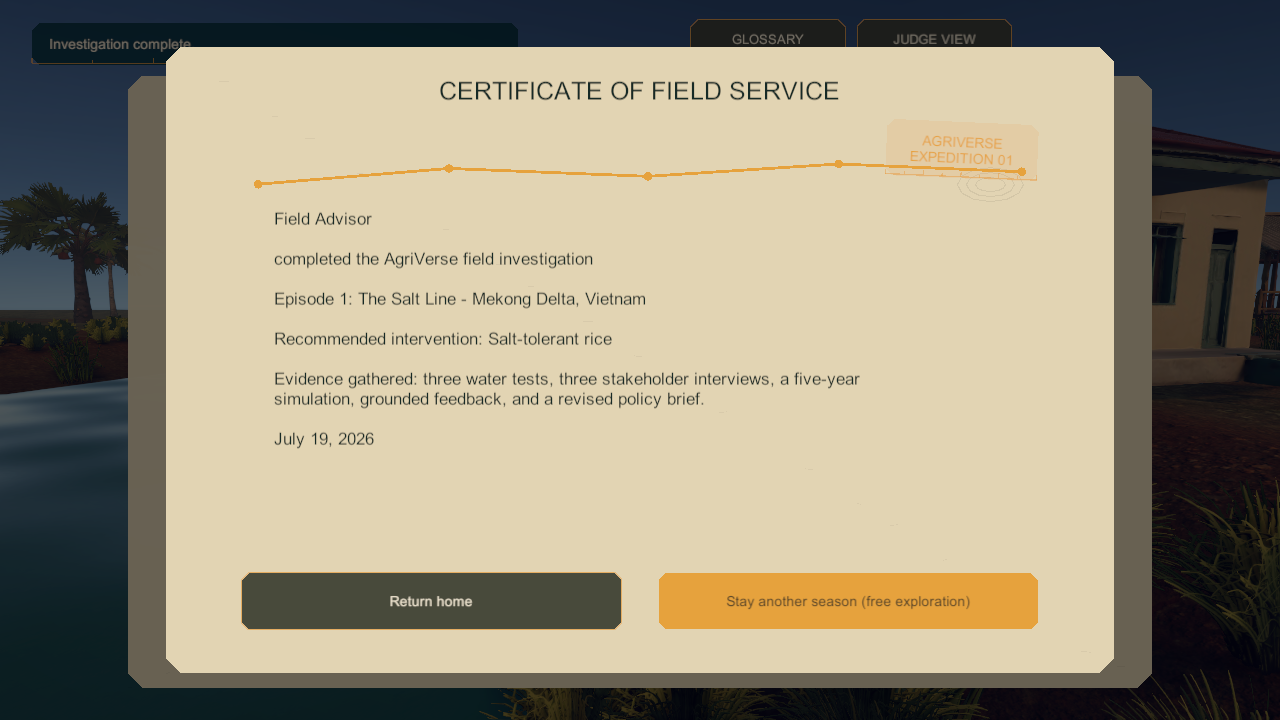
Certificate
Inspiration
Environmental science is often taught through static readings, charts, and predetermined answers. I wanted to create something more memorable: a game where students investigate a real crisis, listen to people who disagree, make a decision, and live with its consequences.
AgriVerse begins in Vietnam's Mekong Delta, where saltwater intrusion threatens rice farming and rural livelihoods. I chose to complete one grounded scenario from beginning to end instead of building many shallow locations. The central idea is simple: students should not receive an answer from a chatbot. They should gather evidence and learn by revising their own decisions.
What it does
AgriVerse is a first-person 3D environmental science simulation.
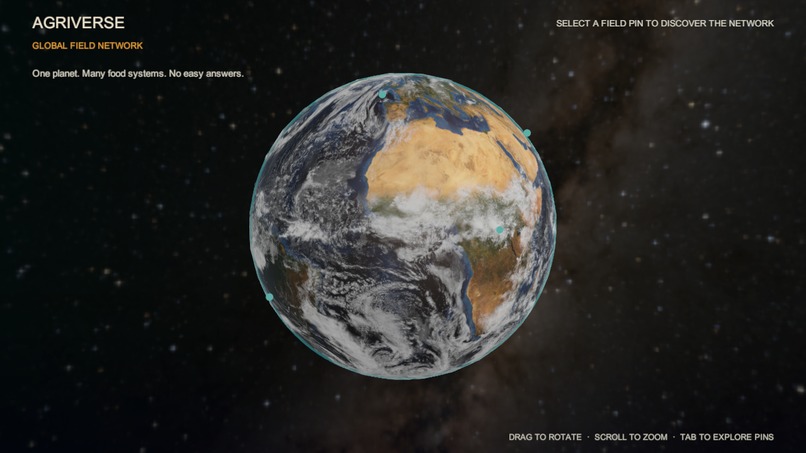
The player begins at an interactive globe containing a network of future field missions. They select Vietnam and arrive in the Mekong Delta, where they:
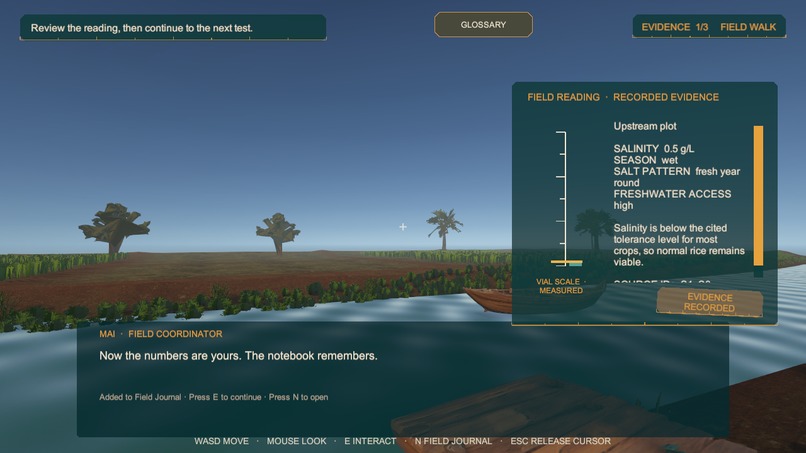
- Test water at three locations and record salinity evidence.
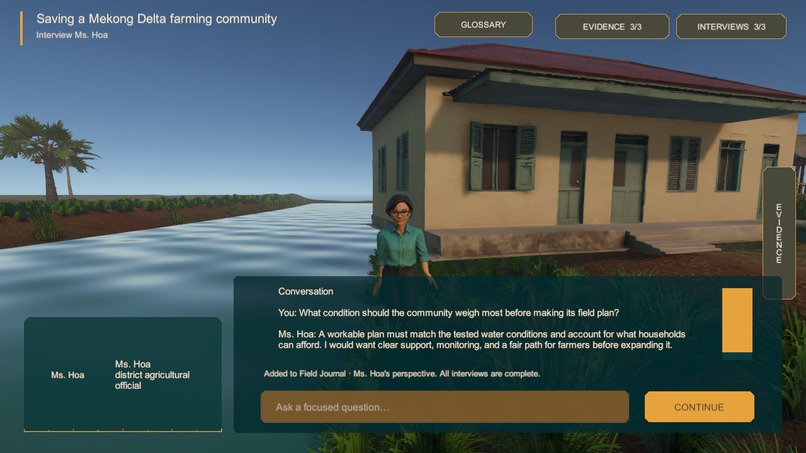
- Interview a farmer, an environmental researcher, and a district official.
- Discover that each stakeholder has different knowledge, priorities, and hidden concerns.
- Create an intervention using coverage, financial support, training, infrastructure, and timeline choices.
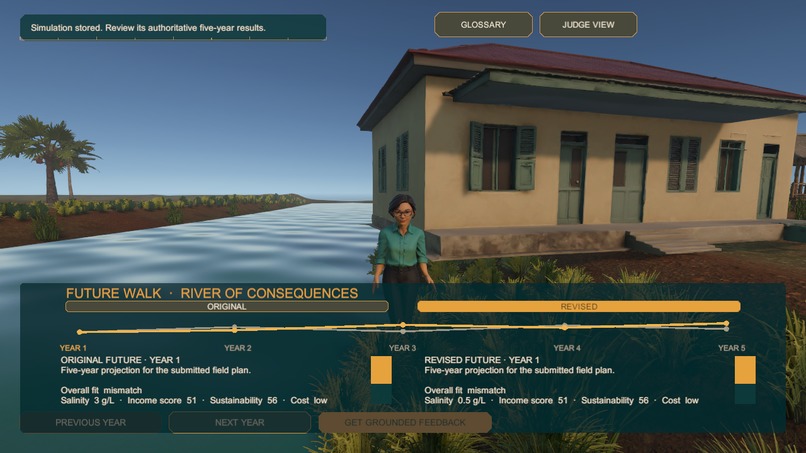
- Watch five years of agricultural, economic, and environmental consequences unfold.
- Receive research-grounded feedback identifying a meaningful weakness.
- Revise the original proposal and compare both outcomes.
- Generate a final policy brief and complete the expedition.
The goal is not to find one perfect answer. It is to understand evidence, tradeoffs, uncertainty, and the value of revision.
How we built it
I built AgriVerse with Codex as my implementation partner and GPT-5.6 as part of the game itself.
The 3D experience was created in Unity 6 using C# and the Universal Render Pipeline. A TypeScript and Express backend securely connects the game to the OpenAI Responses API. The production backend is hosted through Render, with the API key kept server-side.
GPT-5.6 powers four real runtime systems:
- Role-separated stakeholder agents with private goals and limited knowledge.
- A structured five-year consequence simulator.
- A retrieval-grounded feedback grader.
- A policy-brief generator.
Prompts are versioned files instead of strings hidden inside application code. Structured outputs are validated with schemas, and factual claims are checked against a cited Mekong Delta evidence corpus.
Codex accelerated the Unity systems, backend services, structured-output contracts, testing, security hardening, release automation, and debugging. I made the central product decisions: prioritizing a real game over a chatbot interface, completing Vietnam before expanding, framing failure as revision rather than punishment, and rejecting visual directions that did not feel immersive or coherent.
Challenges we ran into
The hardest challenge was combining an ambitious 3D game with a reliable educational loop under hackathon time constraints.
Early environments looked like primitive blockouts, while a photographic approach made Unity feel like a flat website. I learned to separate visual ambition from core product risk and moved toward a bounded, explorable 3D field environment with a consistent "Living Field Atlas" interface.
We also encountered Unity material and shader problems, unstable asset orientation, input-focus issues, overlapping interfaces, and contaminated build artifacts. Each issue required targeted regression tests rather than one-off visual fixes.
The AI systems created another challenge: stakeholder conversations had to feel open without inventing facts. We addressed this through role-separated prompts, strict schemas, citation validation, bounded inputs, and readable failure states.
Making the project available to judges also required a secure hosted backend. We added rate limits, concurrency controls, sanitized logs, an expiration window, and a durable spending cap so the downloadable game could use GPT-5.6 without exposing an API key.
Accomplishments that we're proud of
I am most proud that AgriVerse is a complete learning experience rather than a technical prototype.
The student can travel from the globe through investigation, interviews, planning, simulation, feedback, revision, comparison, and a final policy brief in one coherent journey. The stakeholder agents genuinely disagree, the simulator returns inspectable structured results, and the student must improve a flawed decision.
The final project includes a universal macOS build, a public source repository, documented asset provenance, a secure hosted backend, and extensive automated Unity and backend tests. Most importantly, GPT-5.6 is not decorative. It drives the educational mechanics while remaining grounded and testable.
What we learned
I learned that educational AI becomes more powerful when it creates productive uncertainty instead of immediately producing an answer.
Giving each stakeholder a different perspective makes conversation meaningful. Separating evidence, simulation, and explanation makes the system more trustworthy. Showing consequences is more effective than simply grading a response, and requiring revision turns failure into the actual learning moment.
I also learned that ambitious visual design needs clear gates. A complete, reliable experience with intentional art direction is stronger than an unfinished attempt at AAA scale.
What's next for AgriVerse
The next step is expanding the scenario engine into a global field network. Future missions could explore groundwater depletion in India, desertification in the Sahel, wildfire and water allocation in California, and deforestation pressures in Brazil.
I would also add richer character animation, more environmental reactions during the five-year Future Walk, Windows support, accessibility options, teacher-facing classroom tools, and student progress summaries.
The long-term vision is a world of evidence-driven environmental missions where students do not merely learn about complex systems. They enter them, make decisions, and discover why thoughtful revision matters.
Built With
- 3d
- ai
- api
- c#
- codex
- edtech
- education
- environmental
- express.js
- game
- game-based
- generative
- gpt-5.6
- macos
- node.js
- openai
- render
- science
- simulation
- typescript
- unity
- zod

Log in or sign up for Devpost to join the conversation.