-
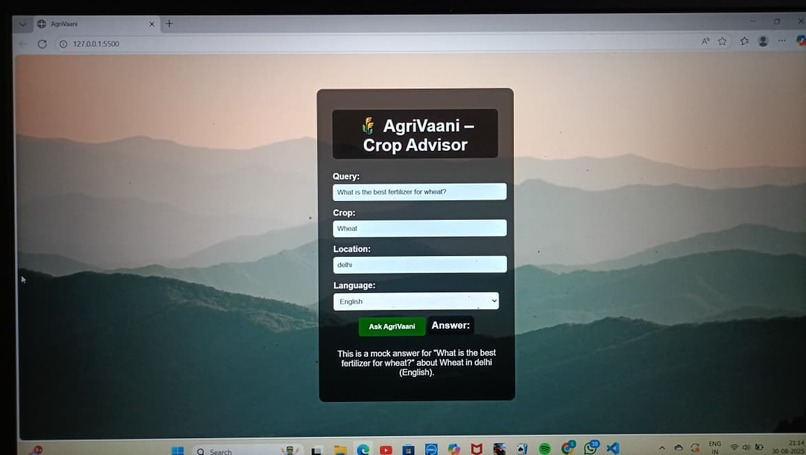
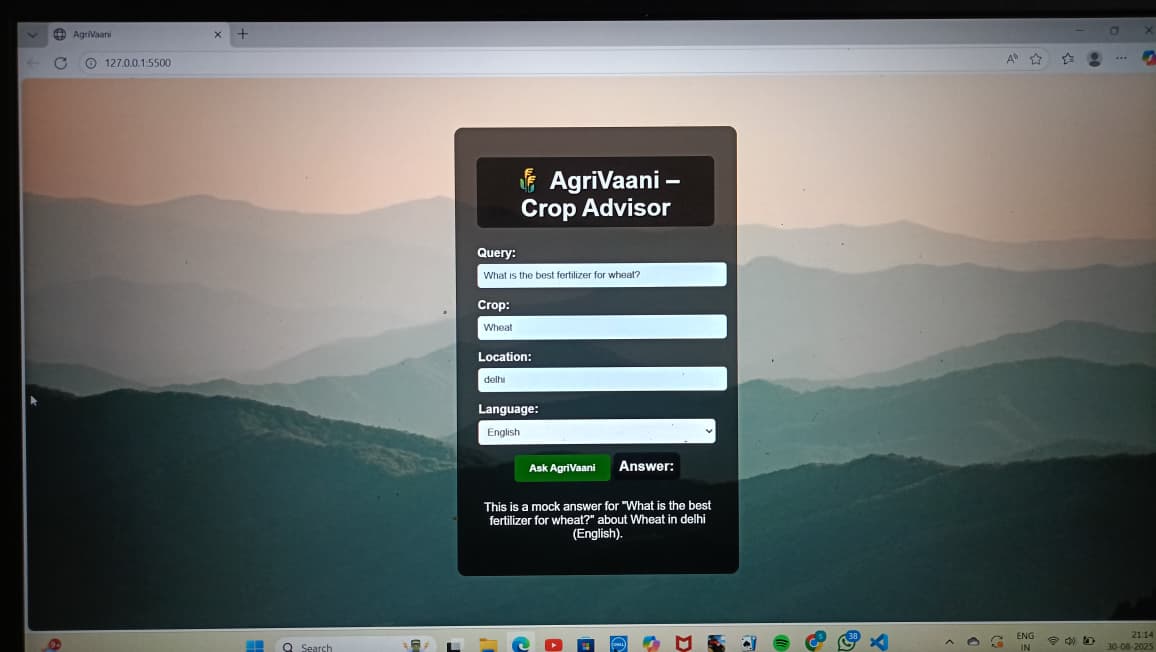
A genai- powered,voice-enabled crop advisory co-pilot
Agrivaani – Project Story
Inspiration
India is home to over 100 million farmers, many of whom lack timely access to expert agricultural advice due to:
*Language barriers *Low digital literacy *Limited access to agri-extension services
During our field research and conversations with smallholder farmers, we realized that traditional advisory channels (SMS, web portals) weren’t usable or accessible for the majority. However, voice interaction in local languages was a natural fit. That insight led us to ask:
"What if farmers could simply speak to an AI assistant in their own language and get personalized, expert advice?"
This became the seed of Agrivaani — a GenAI-powered, voice-enabled co-pilot that brings crop guidance to every farmer, regardless of literacy or language.
How We Built It
Agrivaani is a mobile-first, voice-driven web app powered by a Retrieval-Augmented Generation (RAG) pipeline and GenAI models.
Tech Stack:
Frontend:
- HTML/CSS/JavaScript (mobile-friendly UI)
Backend:
- Python (FastAPI)
- LangChain for orchestration *Node.js
GenAI / NLP:
- OpenAI GPT-4 or LLaMA 3 for language generation
- Whisper / Web Speech API for Speech-to-Text (STT)
- gTTS / Bhashini / Web Speech API for Text-to-Speech (TTS)
- Translation using IndicNLP and Google Translate API
Datasets:
Curated PDFs and CSVs from:
ICAR, IMD, Agmarknet, eNAM
Fertilizer/Pesticide databases (IFFCO, Krishi apps)
Krishi Vigyan Kendra (KVK) advisories
Workflow:
- Voice/Text Input: Farmer asks a query in their local language.
- Translation & Contextualization: Query is translated (if needed) and enriched with context like location (pincode) and crop.
- RAG Pipeline:
- Vector search fetches relevant agri documents.
- LLM generates a coherent, farmer-friendly response.
- Output: Response is returned in text + audio, translated into the farmer's local language.
What We Learned
- How to build an end-to-end RAG pipeline for a real-world use case.
- Working with multilingual NLP models and speech interfaces (Whisper, TTS).
- The importance of human-centered design in tech-for-good solutions — especially in low-resource, rural contexts.
- Integrating geolocation (pincode) to personalize agricultural advice.
Challenges We Faced
- Multilingual Complexity:
- Translating agricultural terms (e.g., fertilizer names, pest types) accurately between English and Indian languages is tough.
- Many dialects and variations exist within a single language.
- Speech Interfaces:
- Speech-to-text accuracy varies with accent and background noise.
- Some tools (like Whisper) are compute-heavy and hard to run in real-time on low-end devices.
- Dataset Curation:
- Public agri datasets are often unstructured PDFs or poorly formatted data.
- Required manual cleaning and tagging to ensure useful retrieval.
- Connectivity & Device Constraints:
- Target users often have low-end smartphones and patchy internet.
- Hence, the need to keep the app lightweight and offline-friendly where possible.
Impact & Vision
Agrivaani aims to become the AI co-pilot for Indian farmers, breaking barriers of language and literacy. By combining GenAI, voice technology, and local knowledge, it empowers farmers to:
- Make informed decisions about crop care
- Improve yield and reduce losses
- Gain confidence in using digital tools
Built With
- css
- html
- javascript
- node.js
- openai


Log in or sign up for Devpost to join the conversation.