-
-
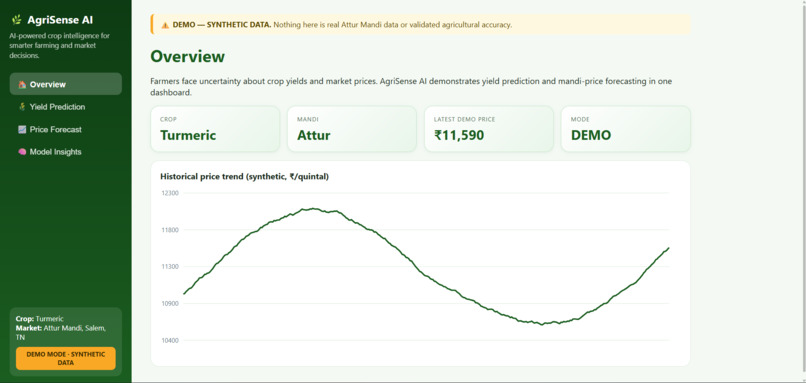
graph view
-
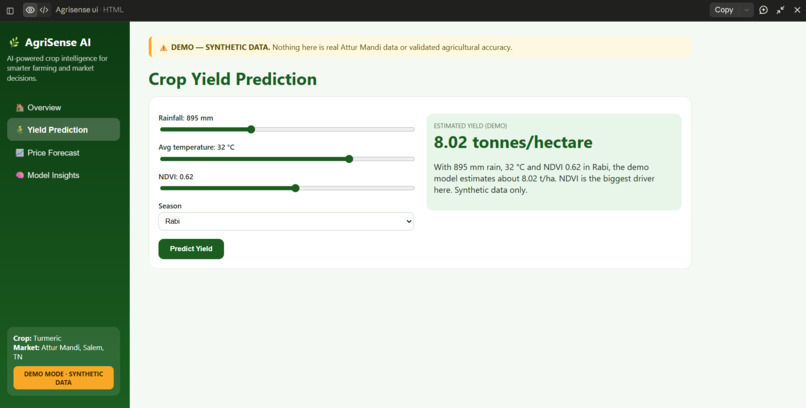
PREDICTION ENGINE
-
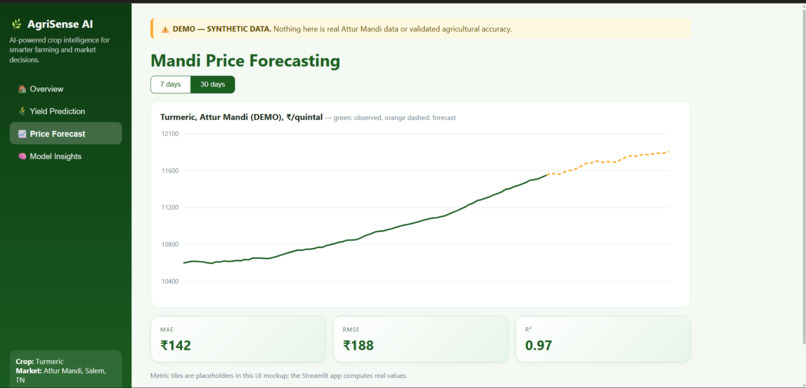
RESULT PAGE
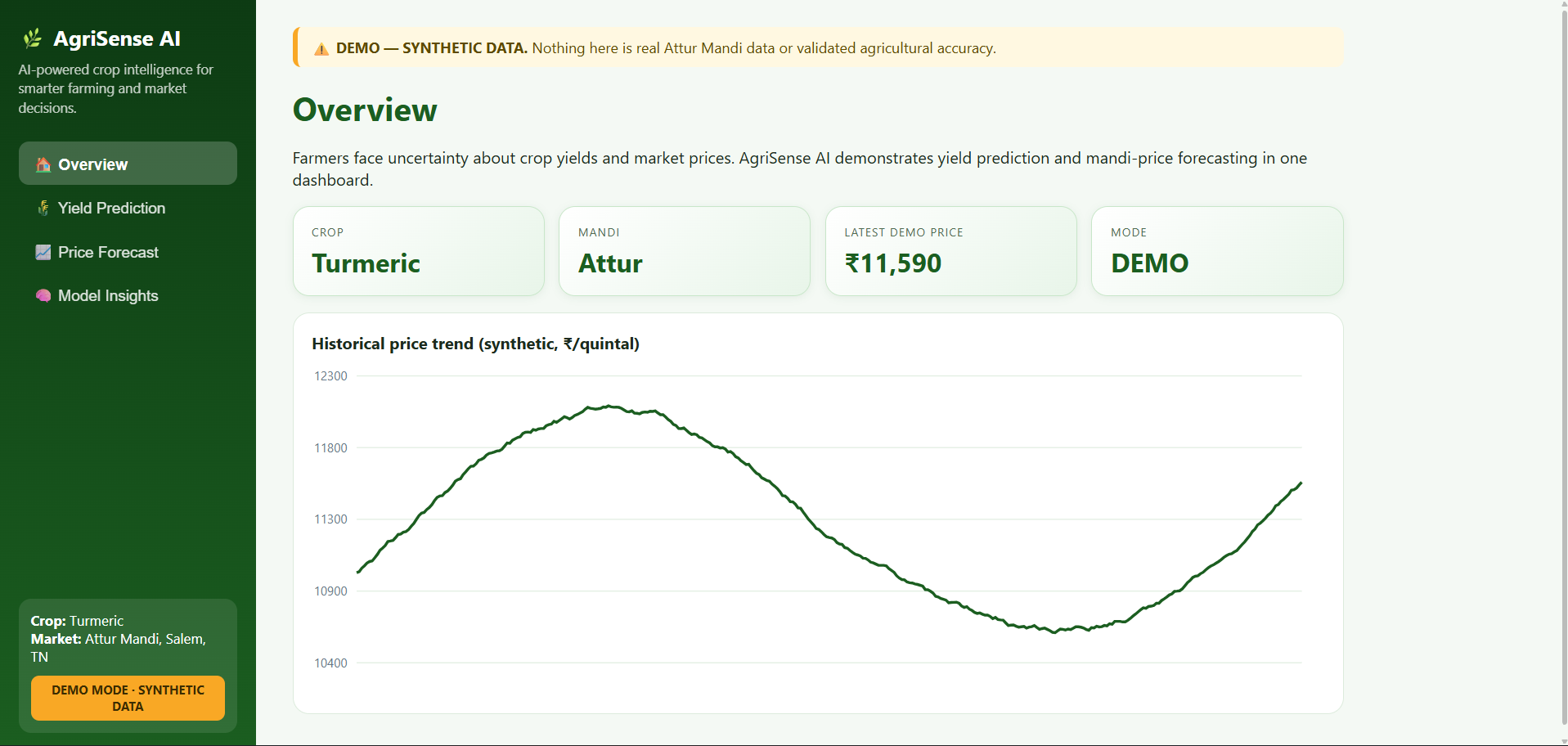
AgriSense AI: Turmeric Yield and Mandi Price Forecasting
Inspiration
Agriculture is affected by two major uncertainties: how much a crop will produce and what price it may receive in the market. Weather conditions, crop health, seasonal changes, and market supply can influence farmers' decisions. However, these factors are often analyzed separately, making it difficult to connect field conditions with potential market outcomes.
This inspired us to develop AgriSense AI, a multimodal AI project that explores how satellite imagery, weather data, agricultural records, and historical mandi prices can work together to support smarter agricultural decisions.
What It Does
AgriSense AI focuses on turmeric cultivation and aims to connect crop-health monitoring with market-price forecasting.
The proposed system has three key capabilities:
- Remote Sensing-Based Crop Analysis: Use satellite-derived vegetation indicators, such as NDVI, to analyze crop conditions over time.
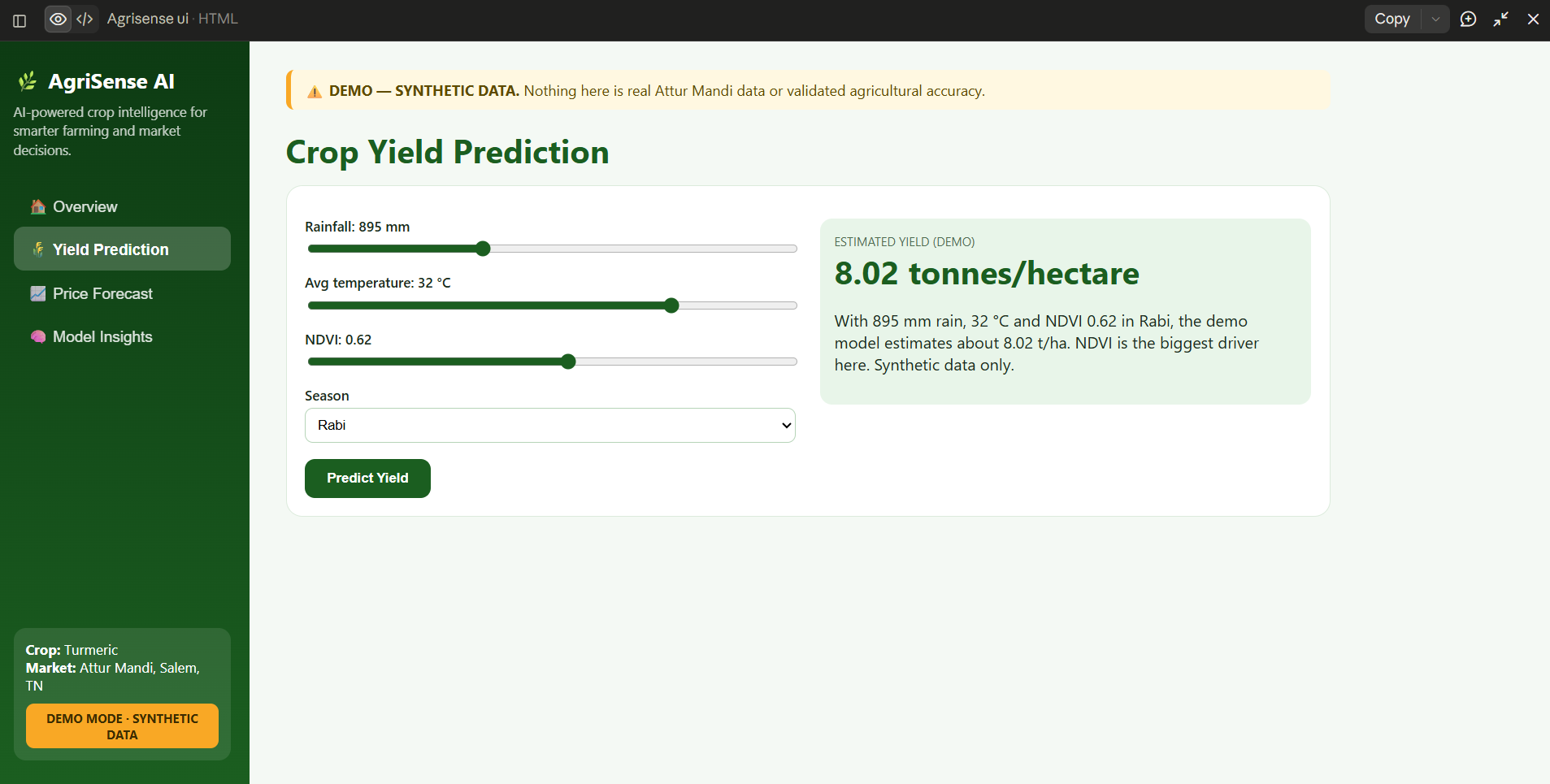
- Crop Yield Prediction: Combine crop-health indicators, weather variables, and agricultural data to estimate turmeric yield when suitable historical yield labels are available.
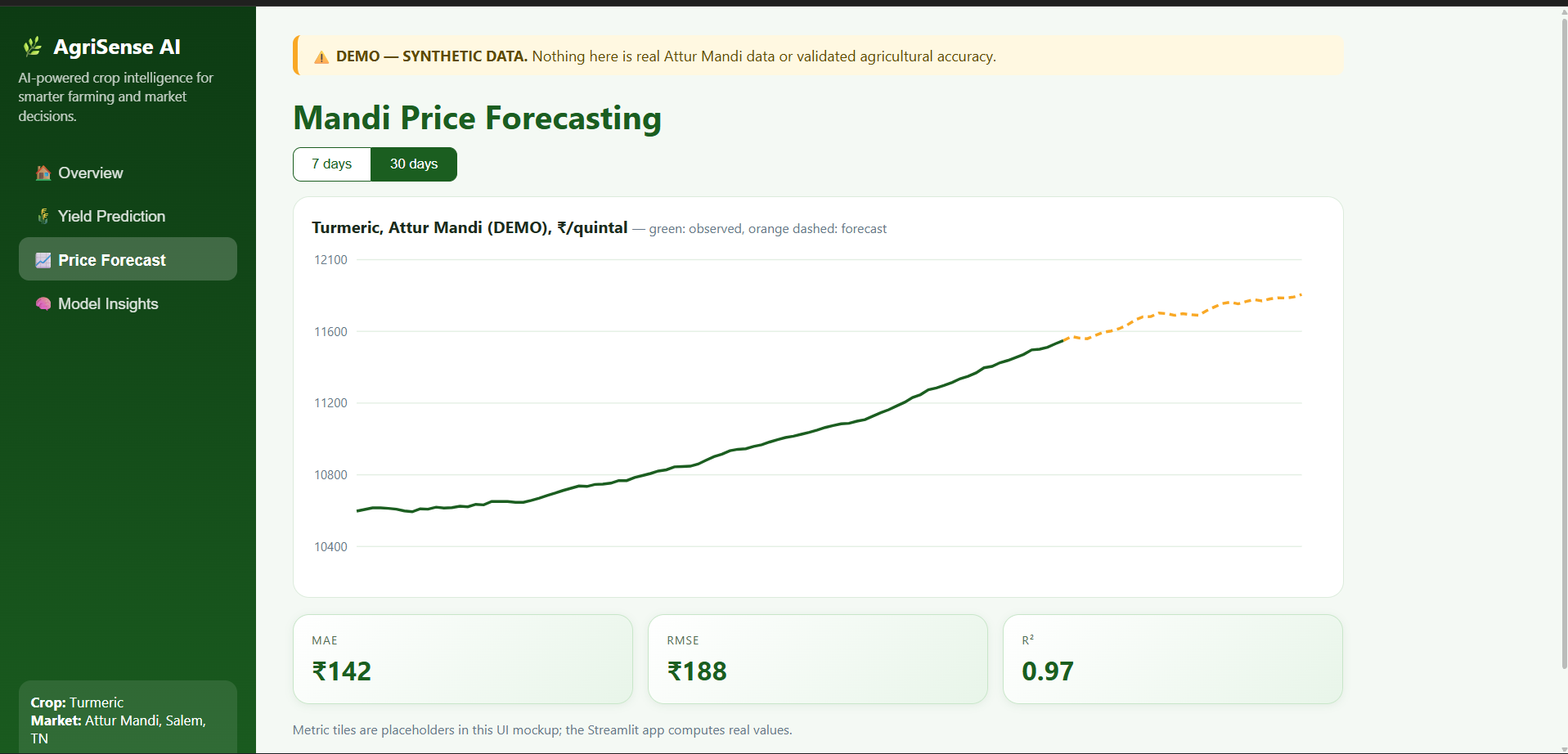
- Mandi Price Forecasting: Analyze historical market prices and available supply indicators to forecast potential turmeric price trends.
The initial geographic focus is Attur Mandi in Salem district, Tamil Nadu, subject to the availability of reliable, market-specific data.
How We Built It
The project follows a modular machine-learning pipeline.
1. Data Collection and Integration
Relevant satellite observations, weather measurements, agricultural statistics, and historical mandi-price records are collected and prepared for analysis.
2. Feature Engineering
Satellite observations can be converted into vegetation indices, while weather and agricultural datasets provide additional features. Market records are organized chronologically to capture price trends and seasonality.
3. Crop Yield Modeling
A regression model can learn relationships between environmental conditions, vegetation indicators, and observed crop yields. Model performance must be evaluated against held-out agricultural records.
4. Mandi Price Forecasting
A separate forecasting pipeline analyzes historical prices and relevant market variables. Chronological validation is used to reduce information leakage and assess performance on unseen periods.
5. Interactive Application
The planned web dashboard brings the system's outputs together through charts, prediction interfaces, market trends, and model insights.
Why Multimodal AI?
Different data sources reveal different aspects of agricultural production. Satellite imagery provides spatial information about vegetation, weather data describes environmental conditions, agricultural records provide production context, and mandi data captures market behavior.
By combining these complementary sources, AgriSense AI aims to connect crop conditions with expected production and market trends rather than treating each prediction as an isolated task.
Challenges and Learning
A key challenge is integrating datasets that differ in geographic coverage, resolution, frequency, and reporting format. Satellite observations must be aligned with the correct crop locations and growing seasons, while price forecasts must be evaluated without using future information.
Another important challenge is data reliability. Accurate yield modeling requires appropriate ground-truth yield records, and credible mandi-price forecasting requires trustworthy historical market data. Synthetic data can help demonstrate application workflows, but it cannot establish real-world predictive accuracy.
Through this project, we are exploring remote sensing, feature engineering, machine learning, time-series forecasting, model evaluation, and the practical integration of heterogeneous agricultural data.
Expected Impact
AgriSense AI aims to make agricultural information more accessible by connecting crop-health insights, yield estimates, and mandi-price forecasts in one decision-support platform.
Our long-term vision is to help farmers and agricultural stakeholders make more informed production and marketing decisions through data-driven insights.
AgriSense AI: Connecting what we observe from space with the decisions farmers make on the ground.
Built With
- agriculture
- data
- data-science
- machine-learning
- multimodal-ai
- ndvi
- numpy
- pandas
- plotly
- python
- remote-sensing
- satellite-imagery
- scikit-learn
- streamlit
- time-series-forecasting
- weather

Log in or sign up for Devpost to join the conversation.