-
-
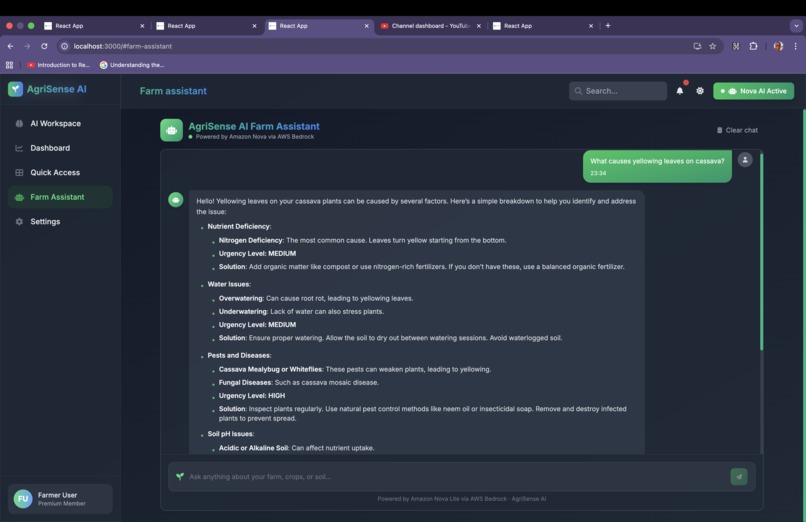
AI Assistant in Action
-
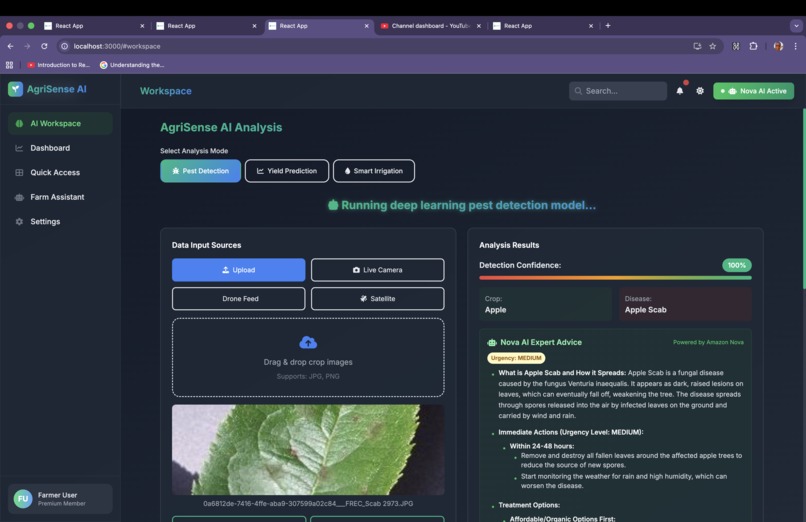
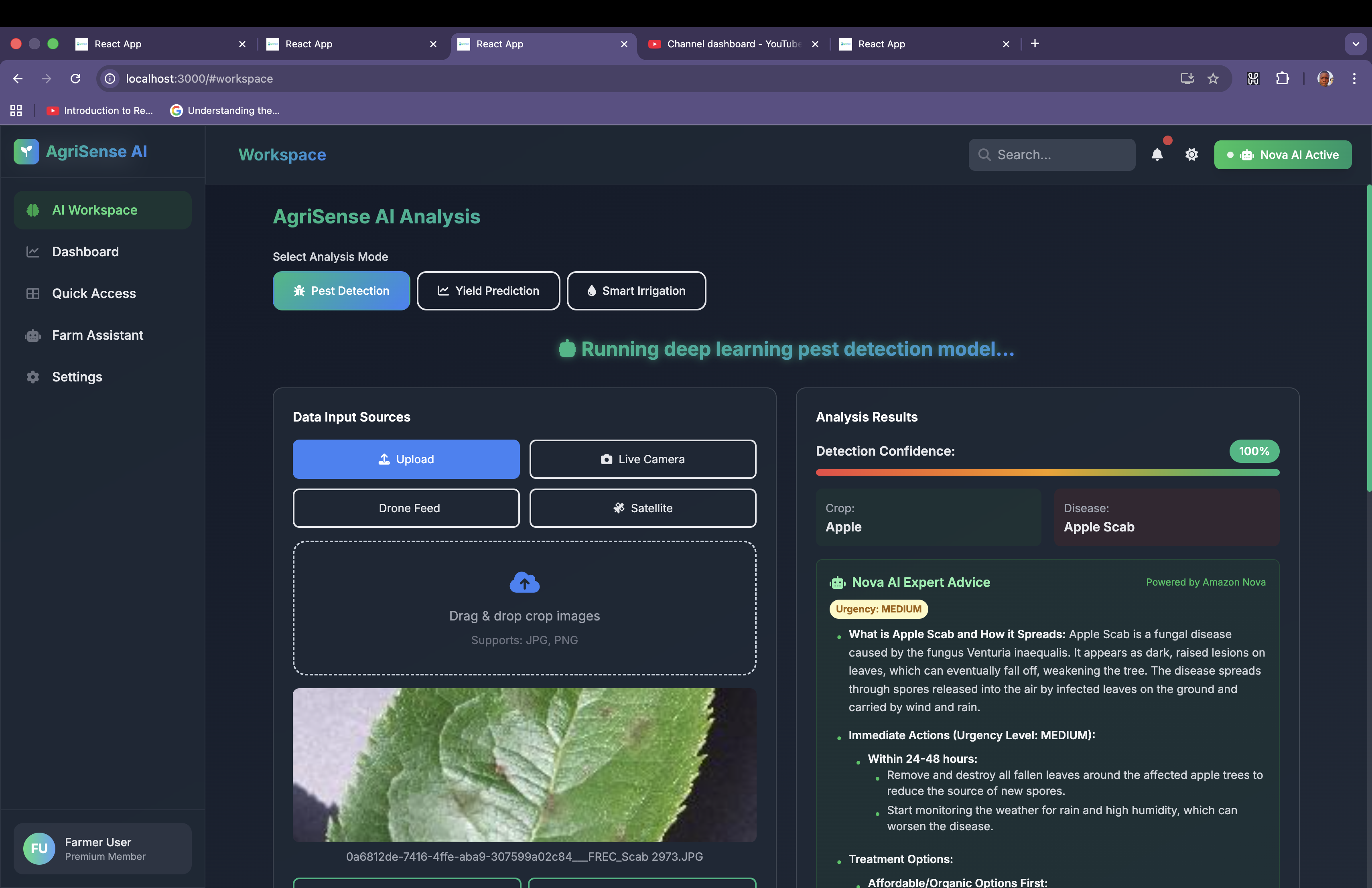
plant disease detection through images
-
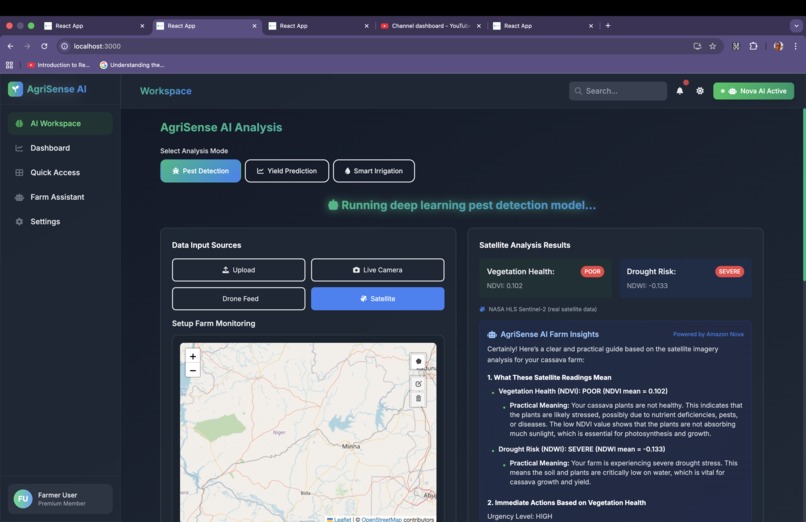
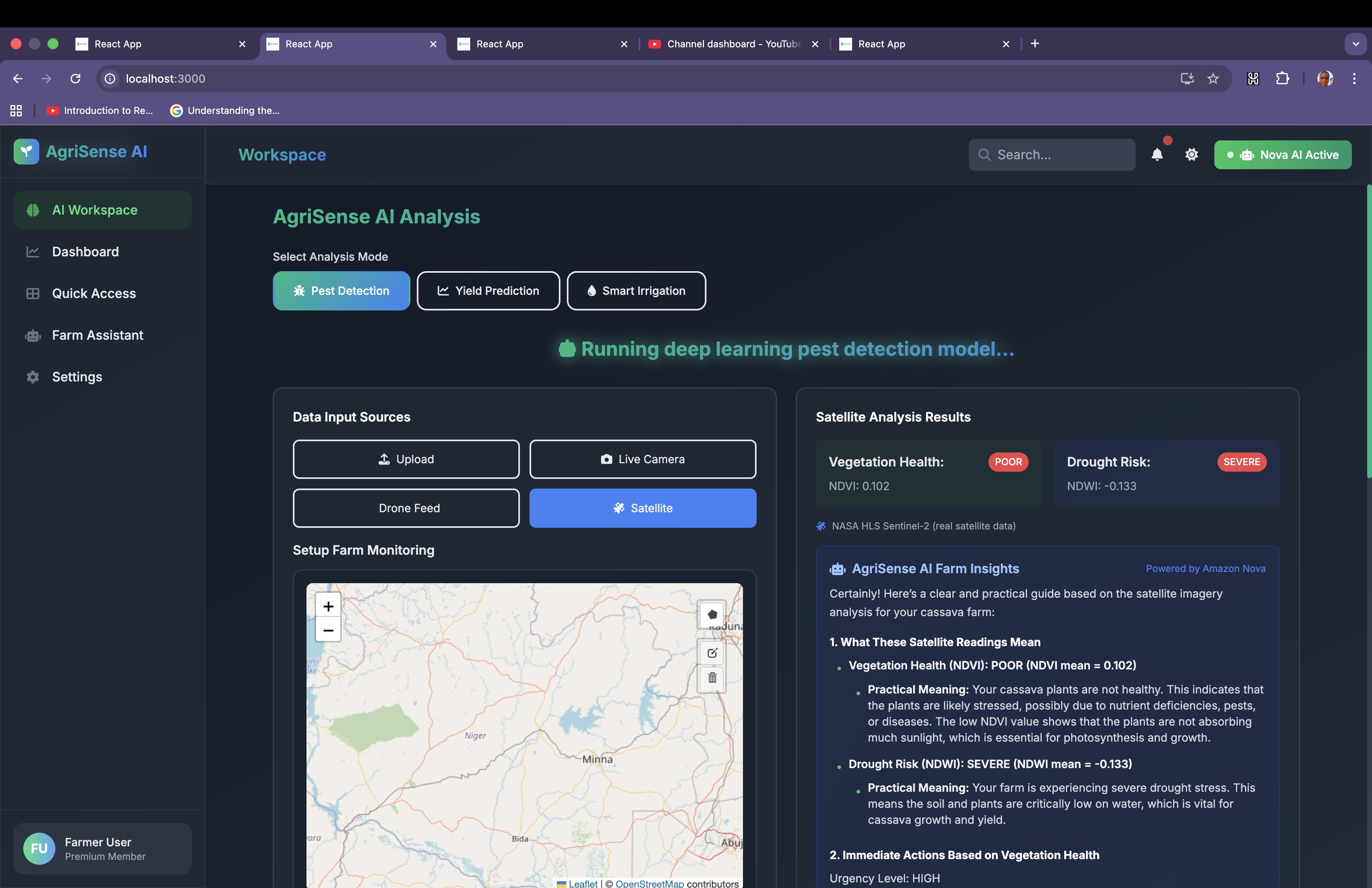
Satellite
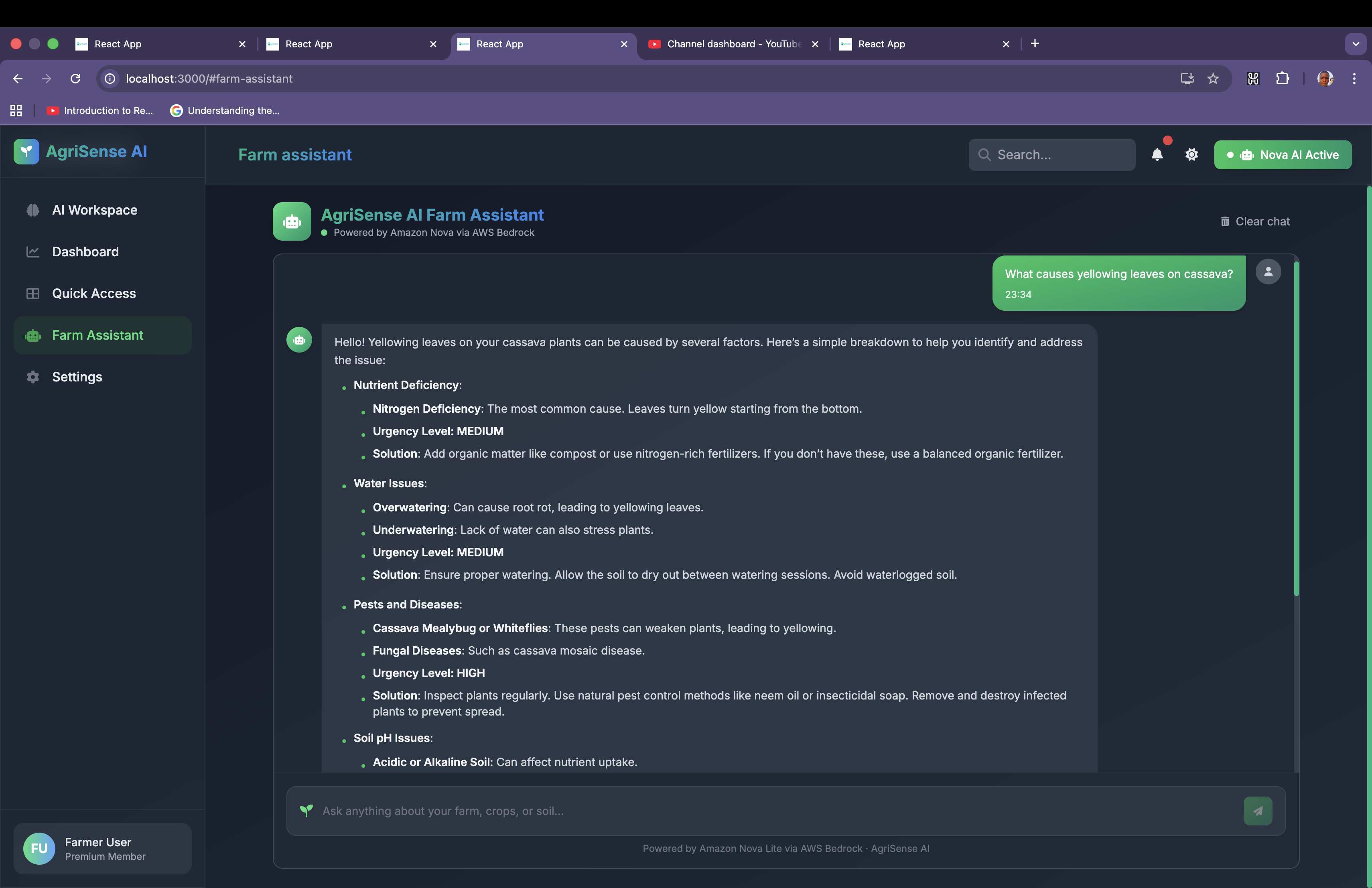
🌍 Inspiration
500 million smallholder farmers in Africa lose up to 40% of their crops every season to diseases they can't see, drought they can't predict, and decisions they have to make without expert advice. Agronomists cost money most small farms don't have. Advice online is generic. And by the time a farmer notices a problem with the naked eye, it has already spread.
We built AgriSense AI because the technology to solve all of this exists. NASA satellites, computer vision, large language models — but none of it had been built specifically for the smallholder farmer in Africa. Until now.
🤖 What It Does
AgriSense AI is a full-stack precision agriculture platform that operates across four layers of intelligence, with Amazon Nova as the reasoning brain across every layer:
🛰️ Satellite (Farm Level) — Draw your farm boundary on the map. AgriSense AI pulls real NASA Sentinel-2 HLS imagery, computes NDVI and NDWI indices, and assesses vegetation health and drought risk across your entire field. Amazon Nova then generates farm-specific advice: whether to irrigate, where to send a drone, and what actions to take before the next satellite pass.
🚁 Drone (Field Level) — Connect any RTSP or RTMP drone stream. AgriSense AI analyzes each frame in real-time via WebSocket, detecting diseases and pests across entire fields automatically.
📷 Disease Detection (Plant Level) — Upload a photo or use a live camera. Our CNN model — trained on 50,000 PlantVillage images at 98.7% accuracy — identifies the exact disease and Amazon Nova generates a personalized treatment plan: organic options first, chemical if needed, urgency level, and whether nearby crops are at risk.
💧 Smart Irrigation & Yield (Soil Level) — Connect IoT sensors via MQTT or enter readings manually. Our ML models predict whether to irrigate and forecast crop yield. Amazon Nova explains the reasoning in plain language the farmer can act on immediately.
After any analysis, farmers can continue a multi-turn agentic conversation with Amazon Nova — asking follow-up questions like "Is this disease spreading to my tomatoes?" — and Nova answers with full awareness of the previous diagnosis. This is the agentic capability at the core of AgriSense AI.
🔨 How We Built It
Backend (Python/FastAPI)
- FastAPI with a clean modular router architecture
- CNN model (TensorFlow/Keras) trained on 50k PlantVillage images
- Random Forest models for irrigation prediction and yield forecasting
- NASA earthaccess library for real Sentinel-2 satellite imagery download
- rasterio for NDVI/NDWI computation from GeoTIFF spectral bands
- Amazon Nova Lite via AWS Bedrock (boto3) for all AI-generated advice
- WebSocket real-time drone frame analysis
- MQTT integration for IoT sensor data
Frontend (React/TypeScript)
- React + TypeScript + Tailwind CSS
- Framer Motion for animations
- Interactive map boundary drawing for satellite analysis
- Real-time WebSocket dashboard for drone streaming
- Agentic chat interface with full prediction context injection
- react-markdown for rendering Nova's formatted responses
AI Pipeline
Image/Sensor/Satellite Input
        ↓
CNN / RF / NASA NDVI Engine
        ↓ (prediction + confidence)
Amazon Nova via AWS Bedrock
        ↓ (expert advice in plain language)
Farmer receives actionable guidance
        ↓
Multi-turn agentic follow-up chat
🚧 Challenges We Faced
NASA satellite latency — Downloading 18 real Sentinel-2 GeoTIFF bands takes ~50 seconds. We built an animated step-by-step progress tracker so the user knows exactly what's happening, and a smart fallback for when NASA data is unavailable so the demo never breaks.
CNN + Nova integration — The hardest part was making the handoff feel seamless. The CNN returns a label and confidence score; Nova needs enough context to generate advice that's actually useful for a farmer with limited resources. Getting the prompt engineering right took many iterations.
Agentic context injection — Ensuring Nova "remembers" the full diagnosis during follow-up questions required careful message history management and context serialization across the
/chatendpoint.
📚 What We Learned
- Amazon Nova via AWS Bedrock is remarkably good at generating practical, culturally-aware advice for African farming contexts — it mentioned Nigeria-specific yield averages and suggested locally accessible treatments without being prompted.
- The NASA earthaccess library makes real satellite data surprisingly accessible for developers.
- The most impactful AI applications are not the most technically complex — they're the ones that translate complex outputs into language that the end user can immediately act on.
🚀 What's Next
- Add authentication so farmers have persistent analysis history
- Expand CNN model to cover more African crop varieties (cassava mosaic, fall armyworm)
- Build a mobile app optimized for low-bandwidth rural connections
- Integrate weather forecast APIs so Nova can give time-sensitive advice
- Partner with agricultural extension services in Nigeria and Ghana for pilot deployment
Built With
- amazon-bedrock
- amazon-nova
- aws-bedrock
- boto3
- fastapi
- framer
- mqtt
- nasa-earthdata
- ndvi
- python
- rasterio
- react
- scikit-learn
- sentinel-2
- tailwind-css
- tensorflow
- typescript
- websocket

Log in or sign up for Devpost to join the conversation.