-
-
App
nspiration
Artificial intelligence is becoming increasingly powerful, but access to AI is still limited by internet connectivity, electricity, cloud costs, and hardware requirements. This is especially important in agriculture, where farmers and agricultural extension officers may work in areas with unreliable or no internet access.
We wanted to answer a simple question:
Can useful agricultural AI work without depending on the cloud?
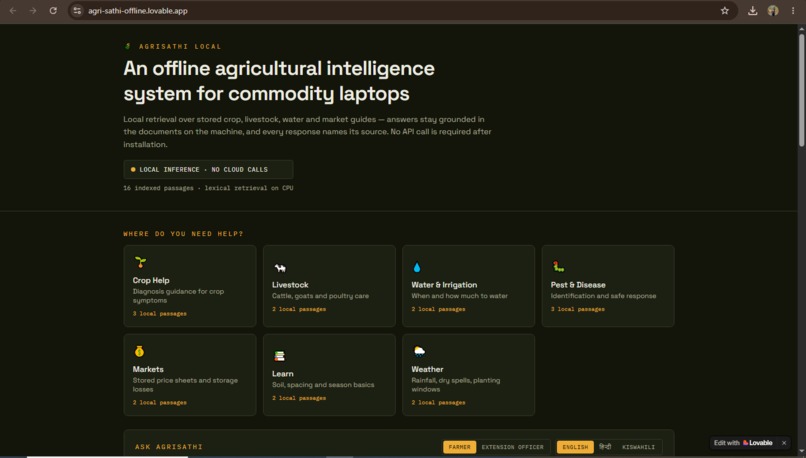
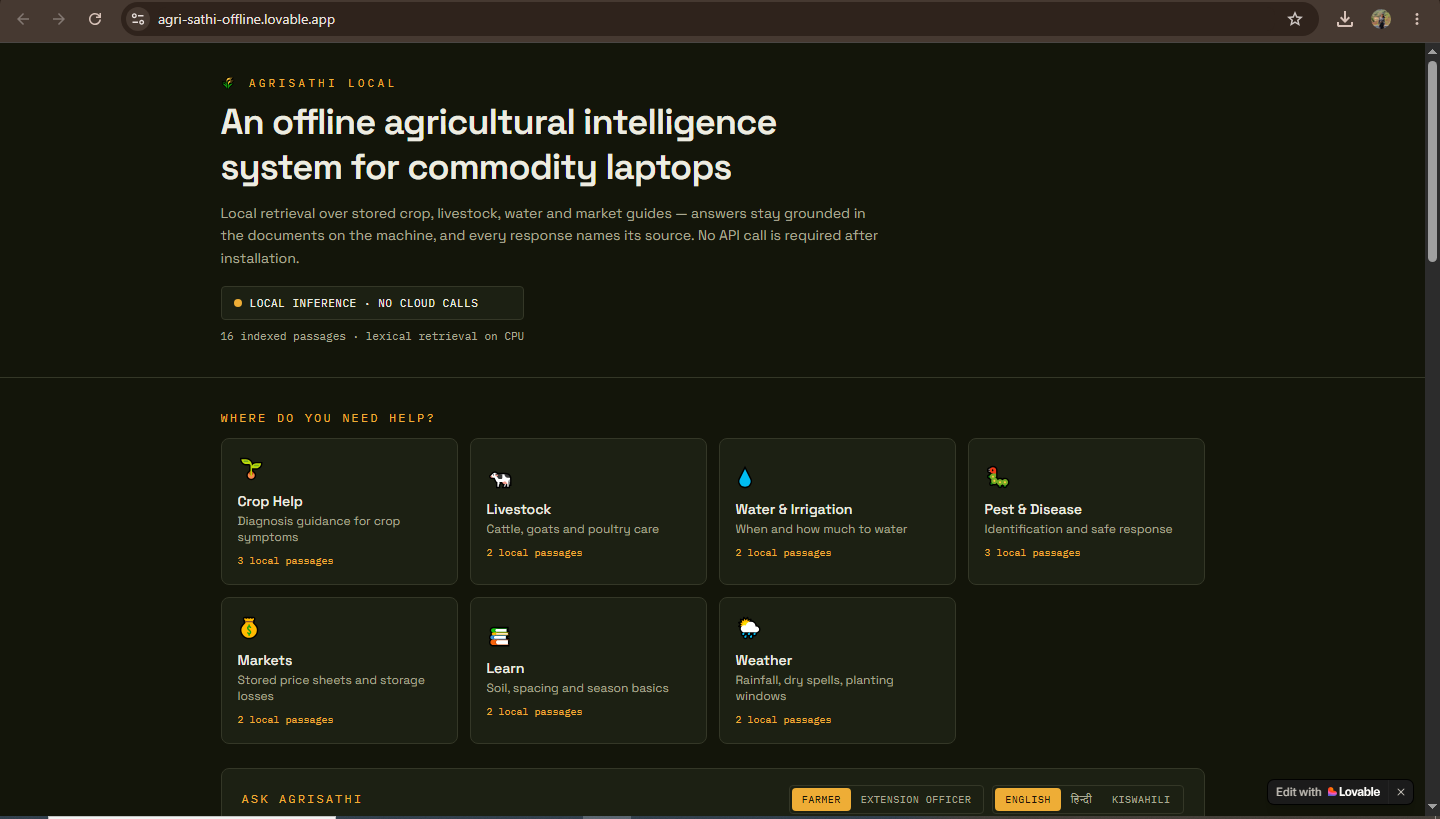
That led us to AgriSathi Local — an offline AI agriculture assistant designed to run on affordable, everyday laptops.
Instead of treating connectivity as a requirement, we designed it as something the system should be able to work without.
What it does
AgriSathi Local allows farmers and agricultural extension officers to ask questions about farming using text or voice.
It can assist with:
🌱 Crop problems and symptom-based diagnosis guidance 🐛 Pest and disease information 💧 Irrigation and water-management guidance 🌦️ Weather-related farming guidance using locally stored data 🐄 Livestock-related questions 💰 Local market and price information when datasets are available 📚 Agricultural education 🗣️ Simple-language explanations 📄 Short, practical action plans
A key feature is our “Explain Like I'm a Farmer” approach. Technical agricultural information can be transformed into simple, actionable language that is easier to understand.
The system can also provide the source information retrieved from its local knowledge base, helping users understand where an answer comes from rather than blindly trusting an AI-generated response.
How we built it
AgriSathi Local is designed around a local-first architecture.
Instead of sending every question to a cloud API, the application processes the request on the user's computer.
Our pipeline is:
User Question ↓ Query Processing ↓ Local Agriculture Knowledge Base ↓ RAG Retrieval ↓ Relevant Agricultural Information ↓ Small Quantized Language Model ↓ Grounded Response ↓ Simple Action Plan
We use Retrieval-Augmented Generation (RAG) so that the language model does not have to memorize the entire agricultural knowledge base.
Relevant information can be stored locally in the form of:
Crop guides Agricultural manuals Disease and pest references Local advisories Market datasets Livestock resources
We then retrieve the most relevant passages for a question and provide them as context to the local model.
To make the system suitable for commodity hardware, we are exploring small instruction-tuned models, 4-bit quantization, and CPU-optimized inference runtimes such as llama.cpp and ONNX Runtime.
Our target is an affordable laptop with approximately 8 GB RAM, rather than expensive cloud infrastructure.
Challenges we ran into
One of our biggest challenges was balancing AI capability with hardware limitations.
A larger model may produce better responses, but it also requires more memory and computing power. A smaller model is easier to run locally but needs better retrieval and prompting to remain useful.
This made optimization a systems problem rather than simply a model-selection problem.
We also had to think carefully about agricultural hallucinations. Giving an incorrect farming recommendation can have real consequences. Instead of allowing the model to freely generate answers, we designed the system around locally stored agricultural sources and retrieval.
Other challenges included:
Keeping inference lightweight enough for affordable hardware Selecting useful agricultural documents Designing effective document retrieval Handling agricultural terminology in simple language Supporting multilingual interactions Working without live internet access Designing a simple interface for users who may not be technically experienced Accomplishments that we're proud of
We are proud that AgriSathi Local is not simply an agricultural chatbot.
Our goal is to demonstrate a complete offline AI system where the application, model, knowledge base, and user information can operate locally.
Our strongest design decisions are:
Offline-first AI Local RAG Small quantized models Low hardware requirements Source-grounded responses Farmer-friendly explanations Local farm memory Support for both farmers and extension officers
We are especially excited about the possibility of demonstrating the system with the internet disconnected:
“The internet is gone. The AI isn't.”
What we learned
Building AgriSathi Local taught us that making AI accessible is not only about choosing a powerful model.
It is about designing the entire system around the user's constraints.
We learned about:
Local LLM inference Model quantization Retrieval-Augmented Generation Knowledge-base design Prompt engineering CPU and memory optimization Offline application architecture Responsible AI in agriculture Human-centered interface design
Most importantly, we learned that a smaller model with the right context can be more useful than a much larger model without reliable, relevant information.
What's next for AgriSathi Local
Our next goal is to make AgriSathi Local more personalized and useful for individual farms.
We want to develop Local Farm Memory, where users can store information such as:
Crop: Maize Location: Arusha Planting date: March 12 Soil: Sandy Irrigation: Rain-fed
Future questions could then use this locally stored context to provide more relevant guidance.
We also want to expand:
🌍 Multilingual and regional-language support 🎙️ Better offline voice interaction 📊 Local market-data integration 🌦️ Offline weather datasets 🧑🌾 Personalized farm profiles 📚 Larger regional agricultural knowledge bases ⚡ Faster inference on low-cost hardware 🔬 More rigorous benchmarking of latency, RAM usage, and answer quality
Our long-term vision is simple:
AgriSathi Local should make useful agricultural intelligence available wherever the internet isn't.
Built With
- ai
- gguf
- language
- llama.cpp
- llm
- offline
- onnx
- python

Log in or sign up for Devpost to join the conversation.