-
-
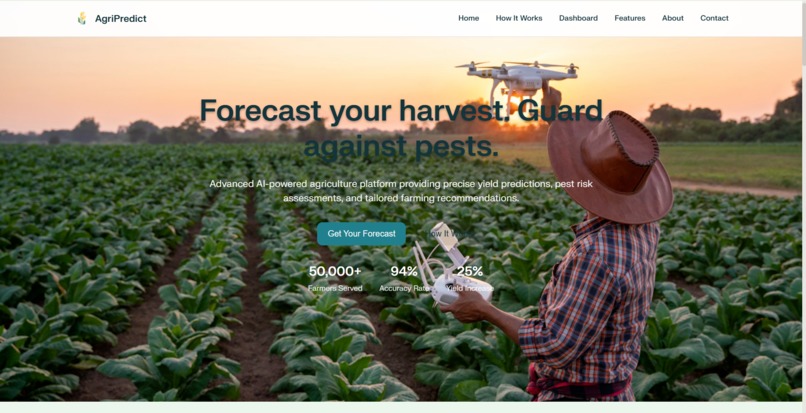
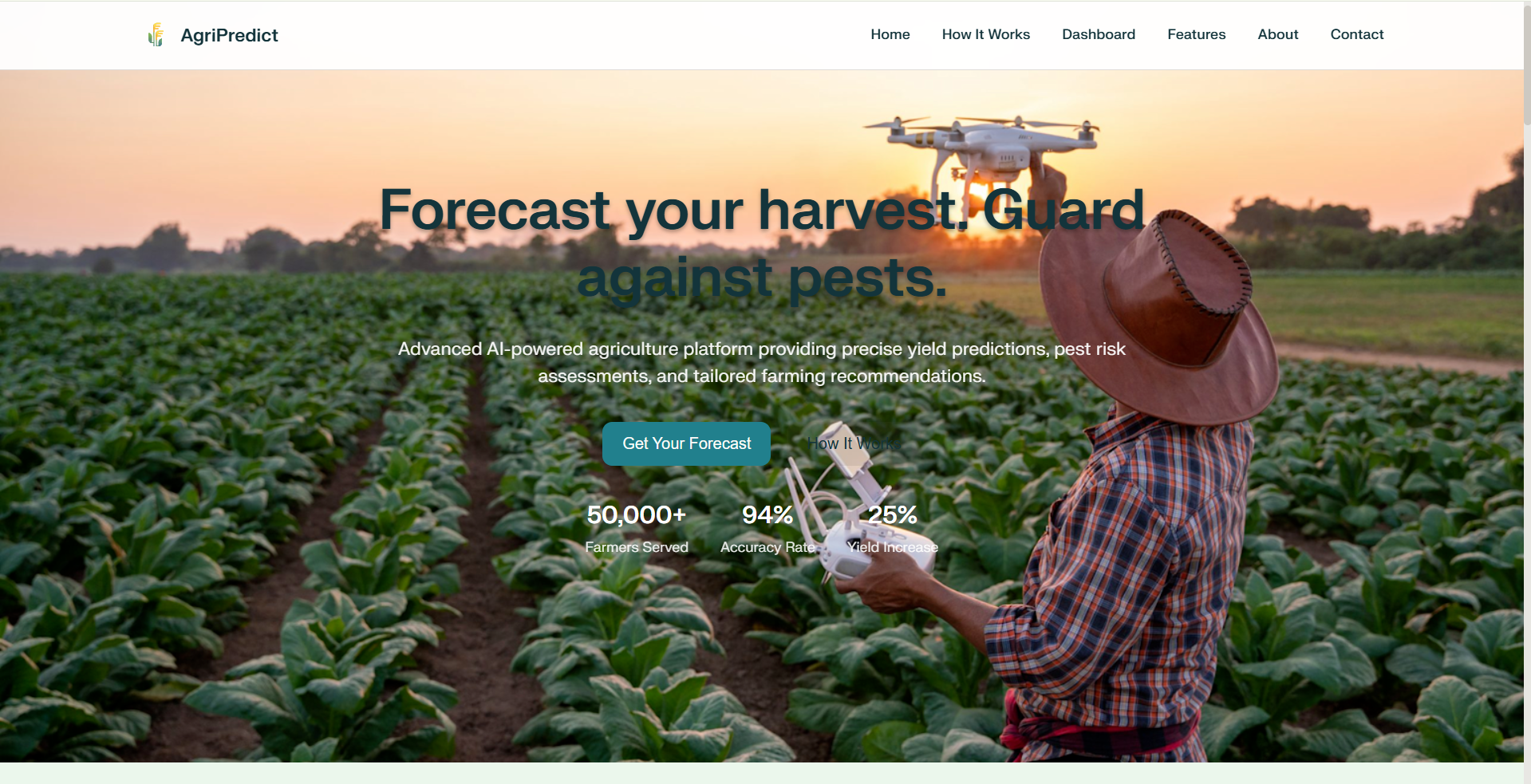
Home Page
-
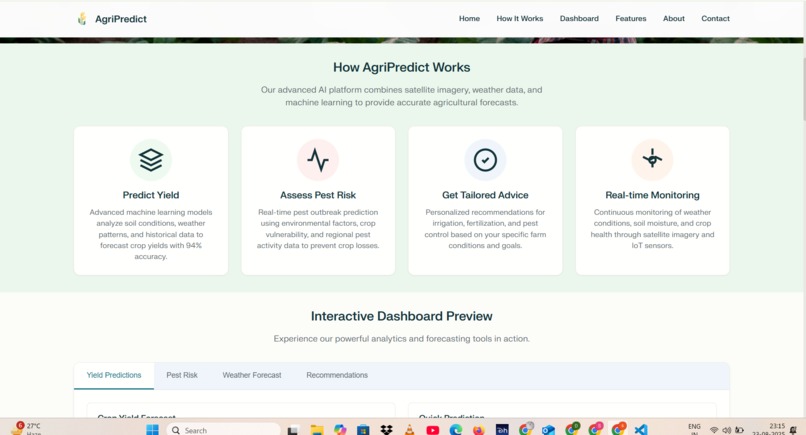
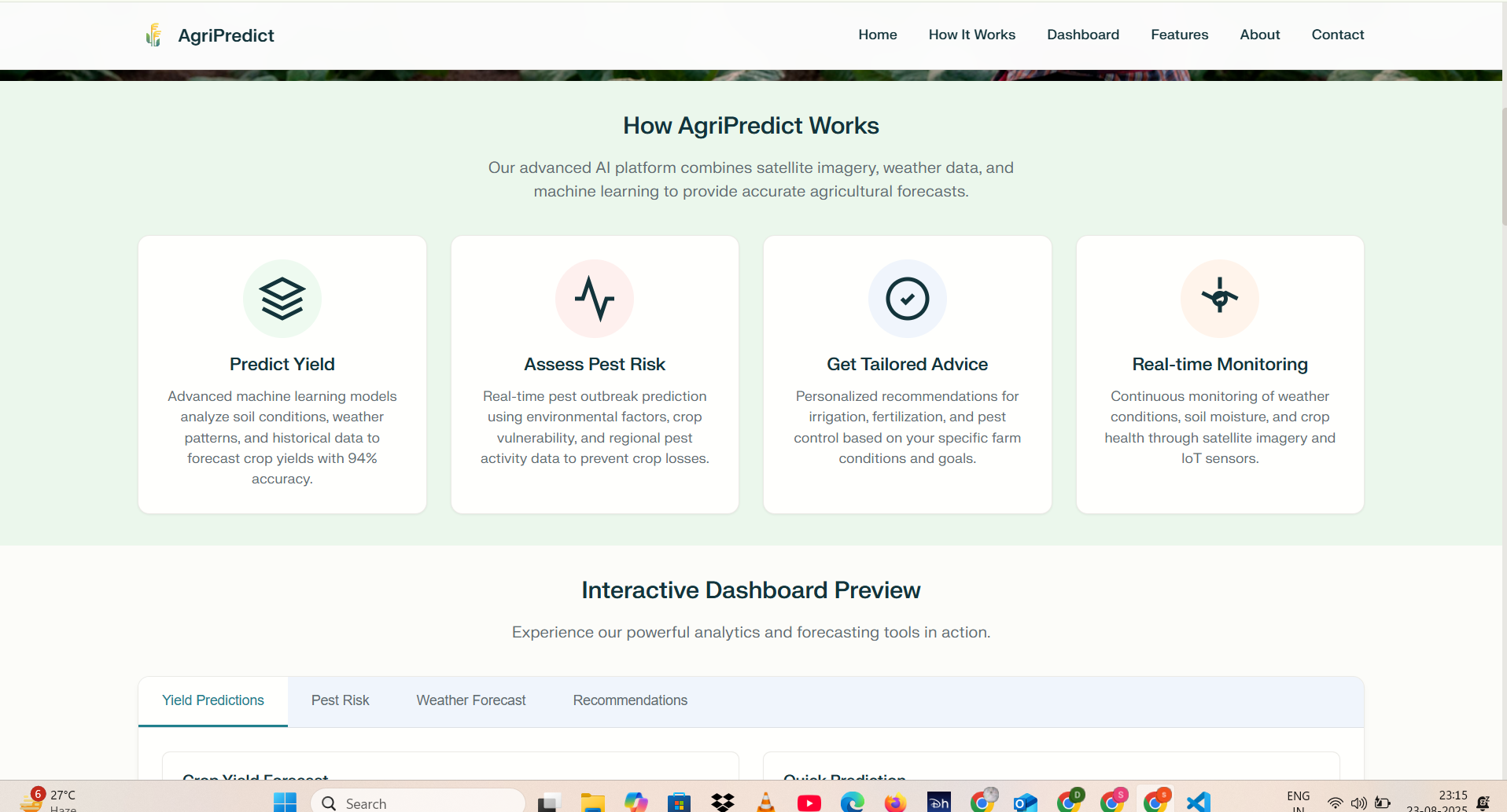
How it work
-
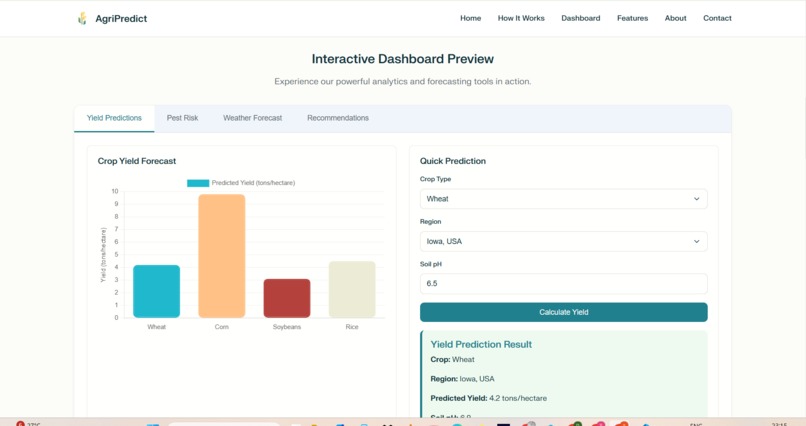
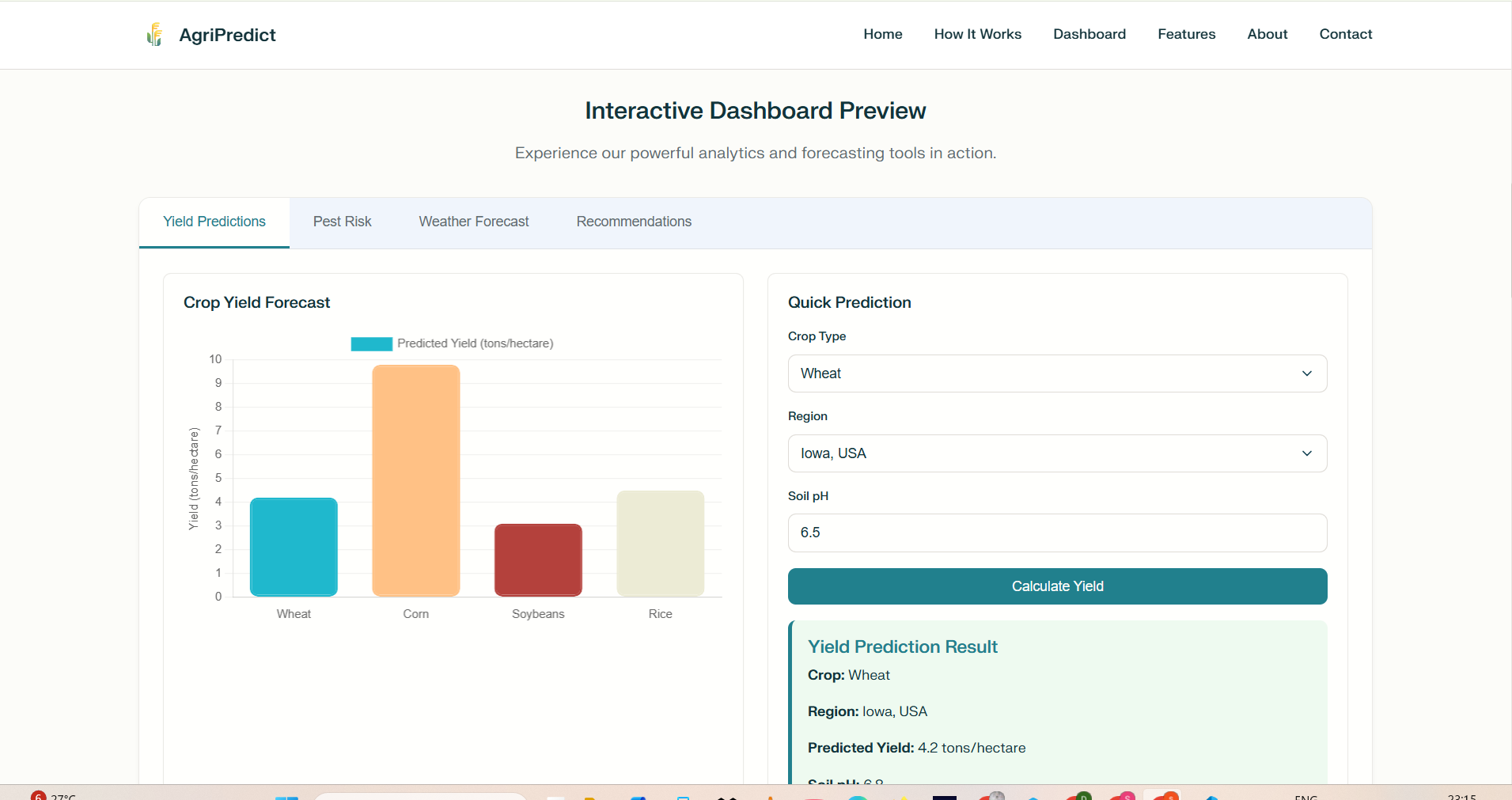
Dashboard
-
Contact
Inspiration
Agriculture remains the backbone of many economies, yet farmers often face unpredictable weather, pest outbreaks, and soil-related challenges that reduce yield and profitability. Inspired by the need to make farming more predictable, data-driven, and resilient, we wanted to create a platform that empowers farmers with actionable insights—bridging the gap between cutting-edge technology and rural accessibility.
What it does
AgriPredict integrates weather forecasts, soil data, and pest risk assessments into a unified platform that:
- Predicts crop yield with high accuracy.
- Identifies pest outbreak risks early.
- Recommends fertilizer, irrigation, and treatment schedules tailored to specific conditions.
- Provides a simple, farmer-friendly interface for decision-making.
How we built it
Data Layer: Collected and structured datasets for weather, soil composition, and crop diseases.
- Prediction Models: Implemented machine learning models to forecast yields and assess pest risk based on environmental conditions.
- Frontend: Built a clean, mobile-first interface with
HTML,CSS, andJavaScriptfor accessibility in rural areas. - Backend & APIs: Designed modular APIs for yield prediction and pest assessments, documented in
API-docs.md. - Deployment: Containerized using Docker for easy scalability, with deployment guidelines in
DEPLOYMENT.md.
Challenges we ran into
Handling incomplete and noisy agricultural datasets required extensive preprocessing.
- Balancing accuracy vs. speed in prediction models to ensure real-time usability.
- Designing a UI simple enough for farmers while still being technically robust.
- Integrating multiple data sources (weather + soil + pest reports) into a unified system.
Accomplishments that we're proud of
Built an end-to-end predictive platform in a short timeframe.
- Achieved reliable yield prediction accuracy with limited data.
- Created an interface that makes complex insights simple and actionable.
- Designed modular APIs that make the system extensible for future datasets (e.g., satellite imagery).
What we learned
Importance of domain-specific feature engineering in agricultural datasets.
- How to optimize ML models for low-resource environments where internet and computing power are limited.
- The value of human-centered design—tech is only impactful if it’s accessible to its end-users.
- Best practices in API documentation and deployment for real-world scalability.
What's next for AgriPredict-Crop Yield & Pest
Integrating satellite imagery and IoT sensors for more granular predictions.
- Expanding to support multiple crops and regional soil variations.
- Adding multilingual voice-based assistance for farmers with limited literacy.
- Partnering with local agricultural agencies to pilot real-world usage.
- Enhancing the AI models with reinforcement learning to continuously improve from user feedback.
AgriPredict isn’t just a project—it’s a step toward smarter, more resilient farming powered by data science and AI.
Built With
- amazon-web-services
- css3
- docker
- fastapi
- github
- html5
- javascript
- json
- json-basedapis
- matplotlib
- node.js
- numpy
- pandas
- plotly
- python
- scikit-learn
- sqlite
- vanillajavascript


Log in or sign up for Devpost to join the conversation.