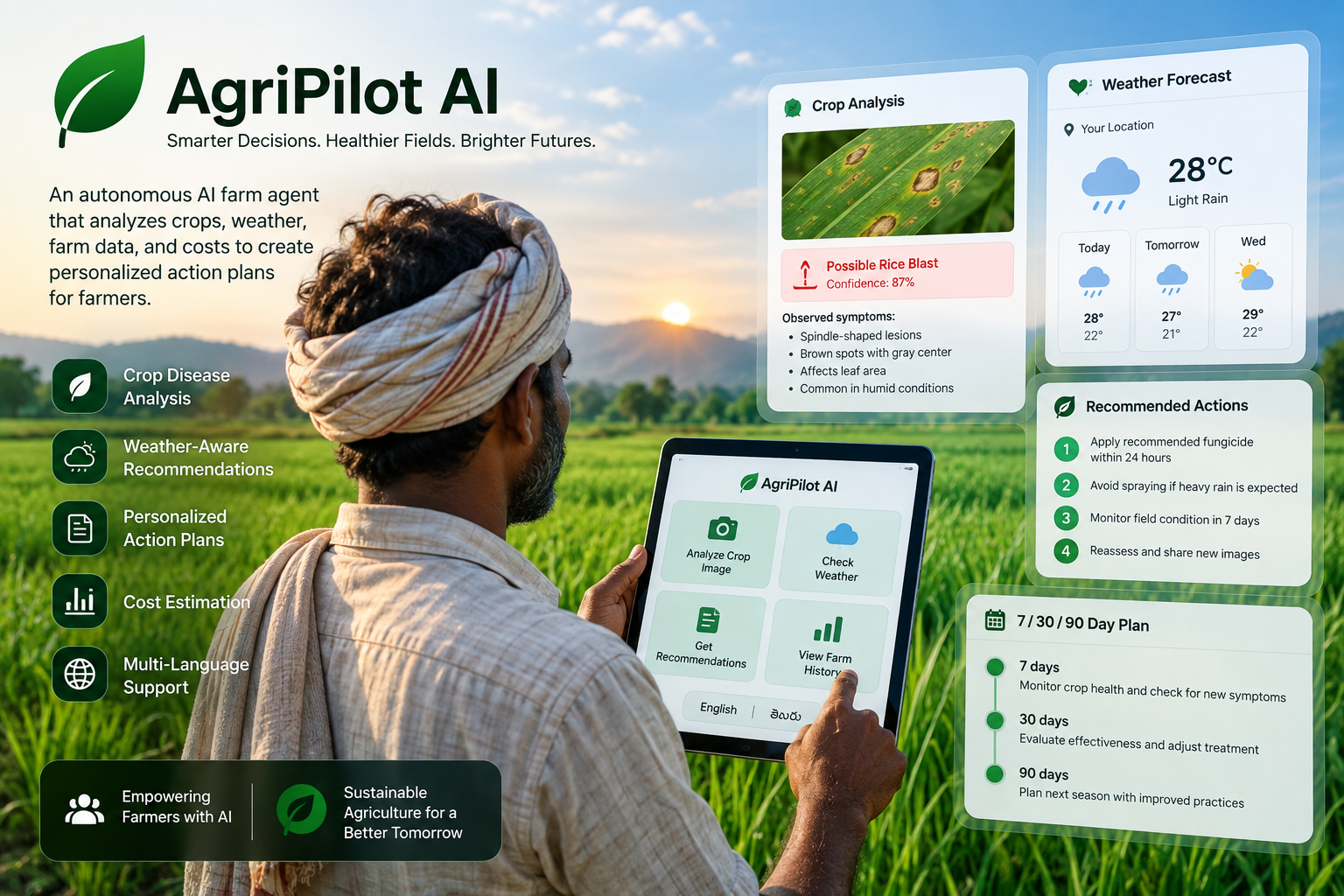
🌾 AgriPilot AI
From "What is wrong with my crop?" to "What should I do next?"
Farmers often have access to enormous amounts of agricultural information, but turning that information into the right action at the right time is difficult.
A crop symptom may have several possible causes. Weather can change whether a treatment is appropriate. Crop stage, soil conditions, previous interventions, cost, and local conditions can all affect the decision.
We built AgriPilot AI to address this gap.
AgriPilot AI is an autonomous AI farm decision agent that combines crop-image understanding, farm information, weather conditions, agricultural knowledge, cost considerations, and temporal planning to help farmers make practical decisions.
Instead of simply answering a question with generated text, AgriPilot AI follows a structured decision workflow:
Observe → Analyze → Verify → Reason → Plan → Act → Reassess
💡 The Problem
A farmer may ask:
"My paddy leaves are turning yellow. It may rain tomorrow. What should I do?"
A conventional chatbot might provide a generic explanation of possible causes.
AgriPilot AI approaches the problem differently.
It considers:
- 📷 What the crop looks like
- 🌱 Crop type and growth stage
- 🌦️ Current and forecast weather
- 🧪 Available soil and farm information
- 📋 Previous farm actions
- 💰 Estimated intervention cost
- ⚠️ Risk and uncertainty
- 📅 Timing of the recommended action
The objective is not simply to generate an answer.
The objective is to generate a defensible action plan.
🤖 How AgriPilot AI Works
AgriPilot AI uses an agentic architecture in which specialized components perform different parts of the reasoning process.
1. Crop Vision Agent
The farmer can upload a photograph of the crop.
The vision pipeline analyzes visible symptoms and produces structured observations such as:
- affected plant parts
- visible discoloration
- lesion or damage patterns
- possible stress indicators
- confidence
- alternative possibilities
The system treats visual analysis as evidence rather than automatically assuming that the first detected condition is correct.
2. Farm Context Agent
The system combines the visual observations with farm context:
- crop
- variety
- growth stage
- soil information
- irrigation conditions
- previous interventions
- farmer observations
This prevents the system from treating every crop problem as an isolated image-classification task.
3. Weather Risk Agent
Weather can change the practicality of an agricultural action.
AgriPilot AI therefore considers forecast conditions before generating a time-sensitive plan.
For example, if heavy rainfall is expected, the system can flag that a planned application may need to be reconsidered rather than blindly recommending immediate action.
4. Agricultural Reasoning Agent
The reasoning layer evaluates the available evidence and generates candidate explanations and actions.
Importantly, the architecture separates:
AI reasoning
from
deterministic calculations and rules.
This allows numerical values, thresholds, dates, costs, and other structured outputs to be calculated by software rather than relying on free-form language generation.
5. Action Planning Agent
The system converts the decision into a timeline.
For example:
TODAY
 └─ Inspect affected plants and record symptoms

NEXT 24 HOURS
 └─ Consider forecast conditions before intervention

NEXT 7 DAYS
 └─ Reassess crop condition and compare observations

NEXT 30 DAYS
 └─ Track recovery and update the farm record
This makes the output actionable instead of producing a long agricultural explanation.
6. Reassessment Loop
Agricultural decisions are not always one-time decisions.
After an action or observation, new information can arrive.
AgriPilot AI can therefore update the farm state and reconsider the next action rather than treating the original recommendation as permanent.
🧠 Why This Is Different From a Chatbot
The central design principle of AgriPilot AI is:
The LLM should reason over evidence, while deterministic software controls important calculations and state.
The system produces structured intermediate outputs before creating the farmer-facing response.
For example:
Vision
   ↓
Structured observations
   ↓
Farm context
   ↓
Weather conditions
   ↓
Candidate explanations
   ↓
Risk evaluation
   ↓
Action candidates
   ↓
Deterministic validation
   ↓
Timeline
   ↓
Farmer response
This architecture makes the system easier to inspect, test, and improve.
⚡ NVIDIA + Nebius
AgriPilot AI is designed to use NVIDIA open AI models for the AI components and Nebius AI infrastructure for scalable execution and deployment.
The architecture separates the application layer from the model-serving layer so that AI inference can be deployed on GPU infrastructure while the rest of the application handles orchestration, storage, validation, and user interaction.
This makes the project suitable for scaling from a prototype to a production-oriented AI service.
🏗️ Technical Architecture
                    FARMER
                       │
          ┌────────────┴────────────┐
          │                         │
       Web App                  Voice Input
          │                         │
          └────────────┬────────────┘
                       │
                  API Gateway
                       │
                Agent Orchestrator
                       │
       ┌───────────────┼────────────────┐
       │               │                │
       ▼               ▼                ▼
  Vision Agent   Context Agent    Weather Agent
       │               │                │
       └───────────────┼────────────────┘
                       ▼
                Reasoning Agent
                       │
                       ▼
              Decision Validator
                       │
                       ▼
               Action Planner
                       │
              ┌────────┴────────┐
              ▼                 ▼
         Farm Database      Notification
              │
              ▼
        Farmer Dashboard
🌍 Real-World Impact
AgriPilot AI is designed for situations where farmers need simple decisions rather than complicated technical information.
Potential applications include:
- crop disease and pest triage
- crop stress identification
- weather-aware farm planning
- intervention scheduling
- farm activity tracking
- cost-aware decision support
- recurring crop monitoring
- personalized agricultural assistance
The interface is designed with simplicity in mind so that the complexity remains inside the system rather than being pushed onto the farmer.
🗣️ Designed for Accessibility
AgriPilot AI is intended to support interaction through:
- simple language
- mobile-friendly interfaces
- image-based input
- voice interaction
- multilingual support
- visual status indicators
- step-by-step recommendations
A farmer should not need to understand the underlying AI architecture to use the system.
🔐 Safety and Reliability
Agricultural recommendations can have real-world consequences, so AgriPilot AI is designed around uncertainty rather than pretending that every AI prediction is certain.
The system can communicate:
- confidence
- uncertainty
- alternative explanations
- supporting evidence
- reasons for delaying an action
- when additional observation is needed
The platform is intended as a decision-support system, not a replacement for qualified agricultural professionals.
🚀 What We Learned
Building AgriPilot AI highlighted an important lesson about agentic AI:
A useful AI agent is not simply an LLM with more tools.
Reliable agents require:
- clear state management
- structured outputs
- tool boundaries
- validation
- deterministic calculations
- uncertainty handling
- feedback loops
- observability
We therefore designed AgriPilot AI as a combination of AI reasoning and conventional software engineering rather than putting the entire decision process inside a single prompt.
🔮 Future Vision
AgriPilot AI can evolve into a continuous farm intelligence platform.
Future versions could incorporate:
- IoT soil sensors
- satellite imagery
- drone imagery
- automated irrigation systems
- localized crop models
- historical yield analysis
- market intelligence
- farm-level predictive analytics
- edge AI through NVIDIA Jetson devices
The long-term goal is an AI system that doesn't merely answer agricultural questions, but continuously helps farmers observe, reason, plan, and respond to changing field conditions.
❤️ Why We Built It
Agriculture is full of decisions that depend on context and timing.
We wanted to explore what happens when modern multimodal and agentic AI is applied not as another chatbot, but as a practical decision-support system for a domain where the difference between a good recommendation and a poorly timed recommendation can matter significantly.
AgriPilot AI is our attempt to turn AI from an answer generator into an actionable farm copilot.
Built With
- agentic
- ai
- cloud
- computer
- docker
- fastapi
- llm
- models
- multimodal
- nebius
- nvidia
- open
- postgresql
- python
- react
- typescript
- vision
- weather


Log in or sign up for Devpost to join the conversation.