Inspiration
Agriculture accounts for over 70% of global freshwater withdrawals, yet more than 40% of this water is lost through uncalibrated irrigation, sub-optimal scheduling, and surface runoff. Concurrently, growers struggle with escalating fertilizer input costs, volatile climate extremes, and lack of real-time diagnostic tools. A farmer standing in their field often has to guess when to irrigate, when flag-leaf anthesis requires supplemental potassium, or whether a yellow lesion is harmless sunscald or the onset of catastrophic Puccinia striiformis (Stripe Rust).
When inspecting modern farming operations, we observed a critical disconnect: hardware exists in isolated silos, but no unified, cloud-native system closes the loop between in-ground soil physics, orbital satellite remote sensing, and predictive crop yield modeling.
We set out to answer a single question:
What if an in-field soil probe could converse directly with AWS IoT Core, trigger serverless micro-irrigation valves via AWS Lambda, benchmark remediation strategies across Amazon Bedrock foundation models, and predict harvest yield with biophysical precision weeks before harvest?
This conviction gave birth to 🌱 AgriNova AI.
What It Does
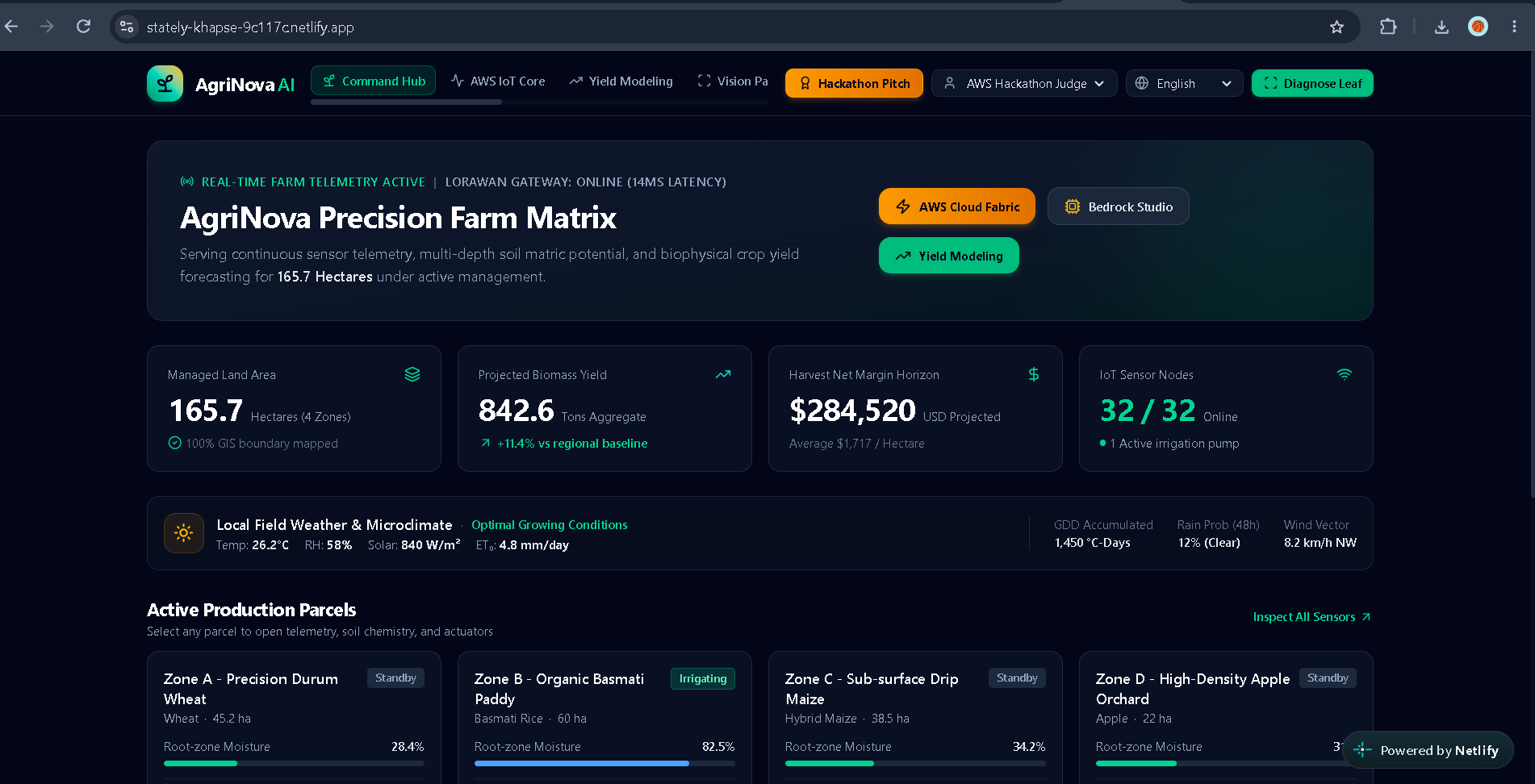
AgriNova AI is a full-stack, enterprise-grade precision agriculture SaaS that orchestrates the complete 24-step farm-to-market lifecycle:
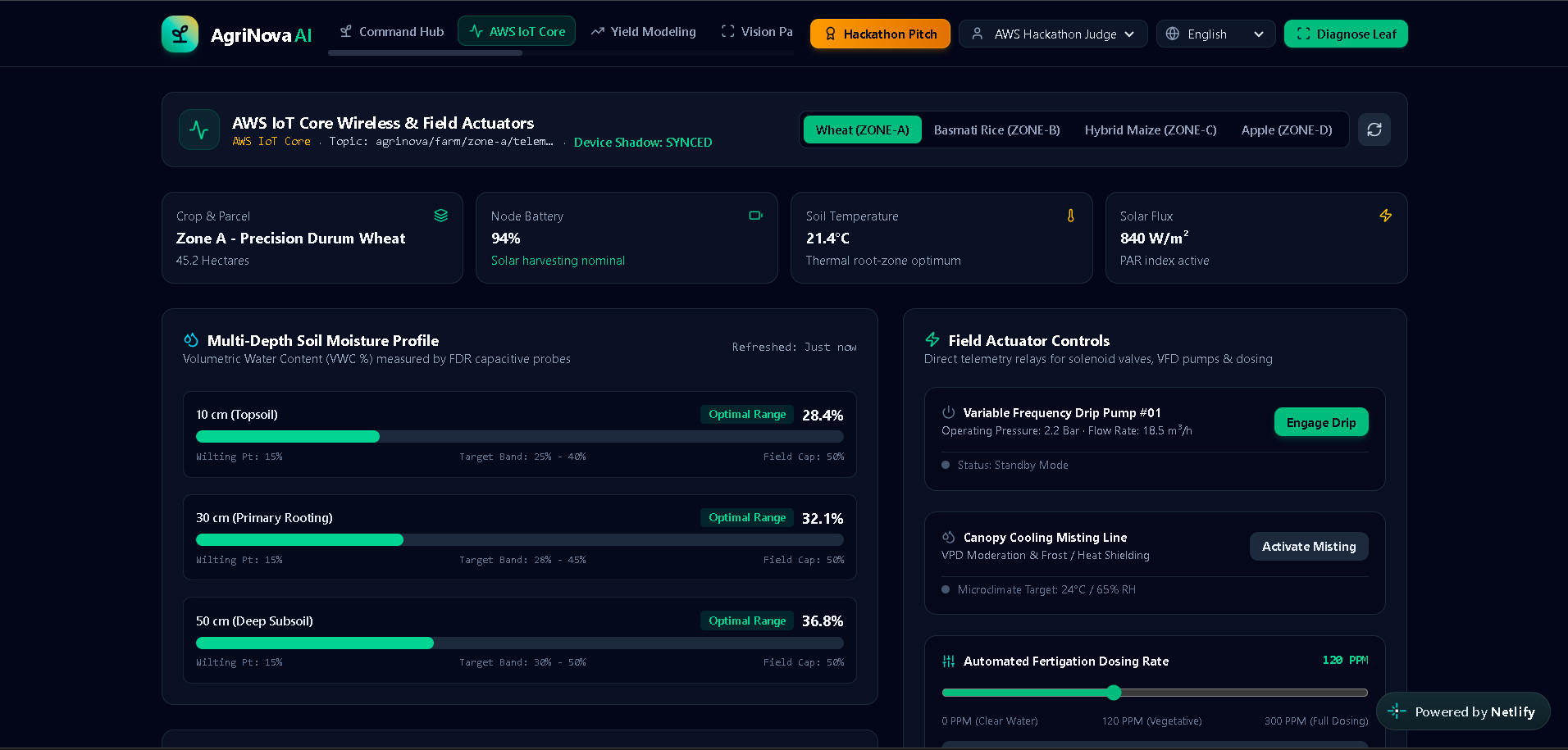
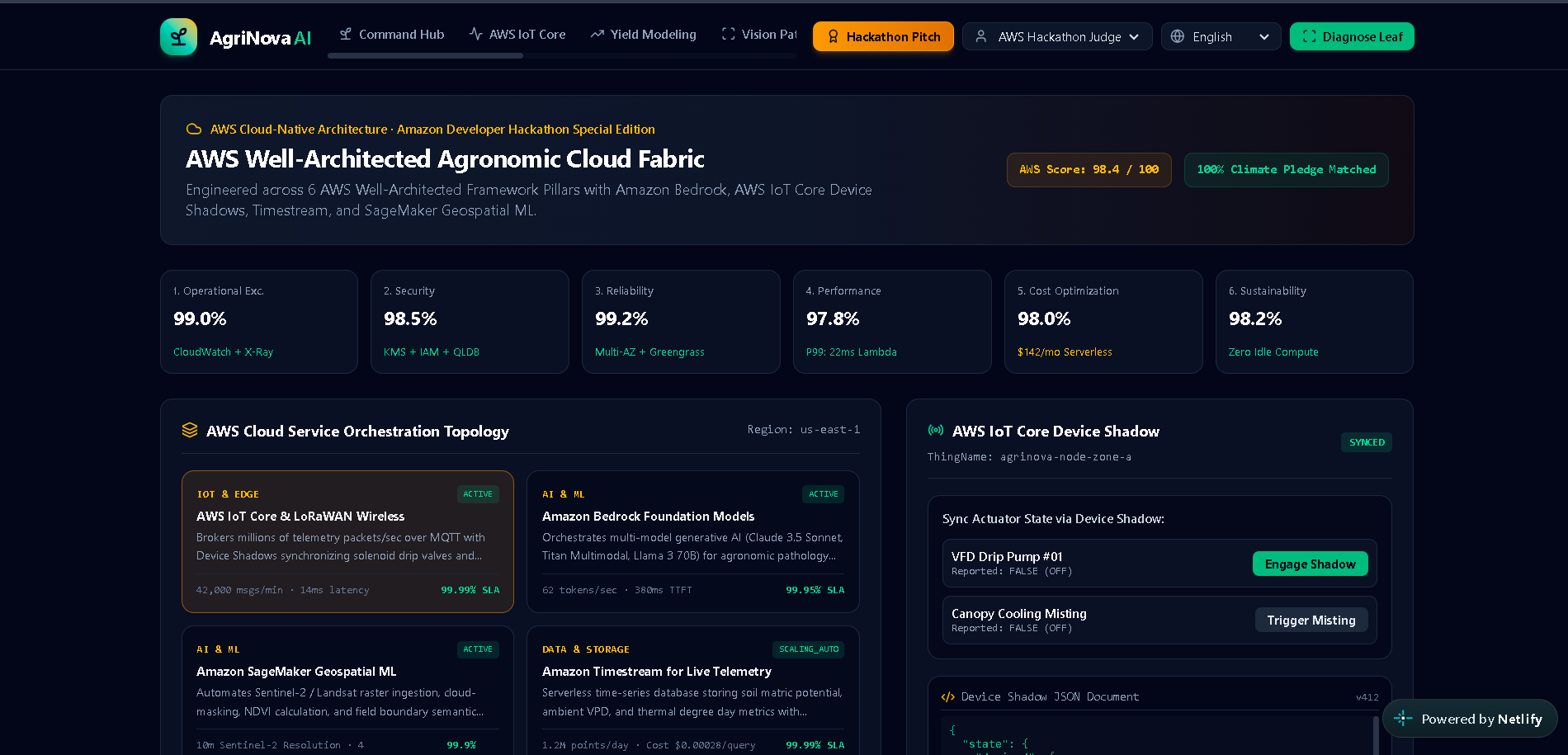
- Closed-Loop IoT & AWS Device Shadows: Ingests high-frequency capacitive Volumetric Water Content (( \text{VWC}\% )) across 10cm, 30cm, and 50cm root strata, soil ( \text{pH} ), electrical conductivity (( \text{EC} ) in ( \text{dS/m} )), and macronutrients (( \text{N-P-K} )) over LoRaWAN and AWS IoT Core. Actuators synchronize their desired and reported states in real time using AWS IoT Device Shadows.
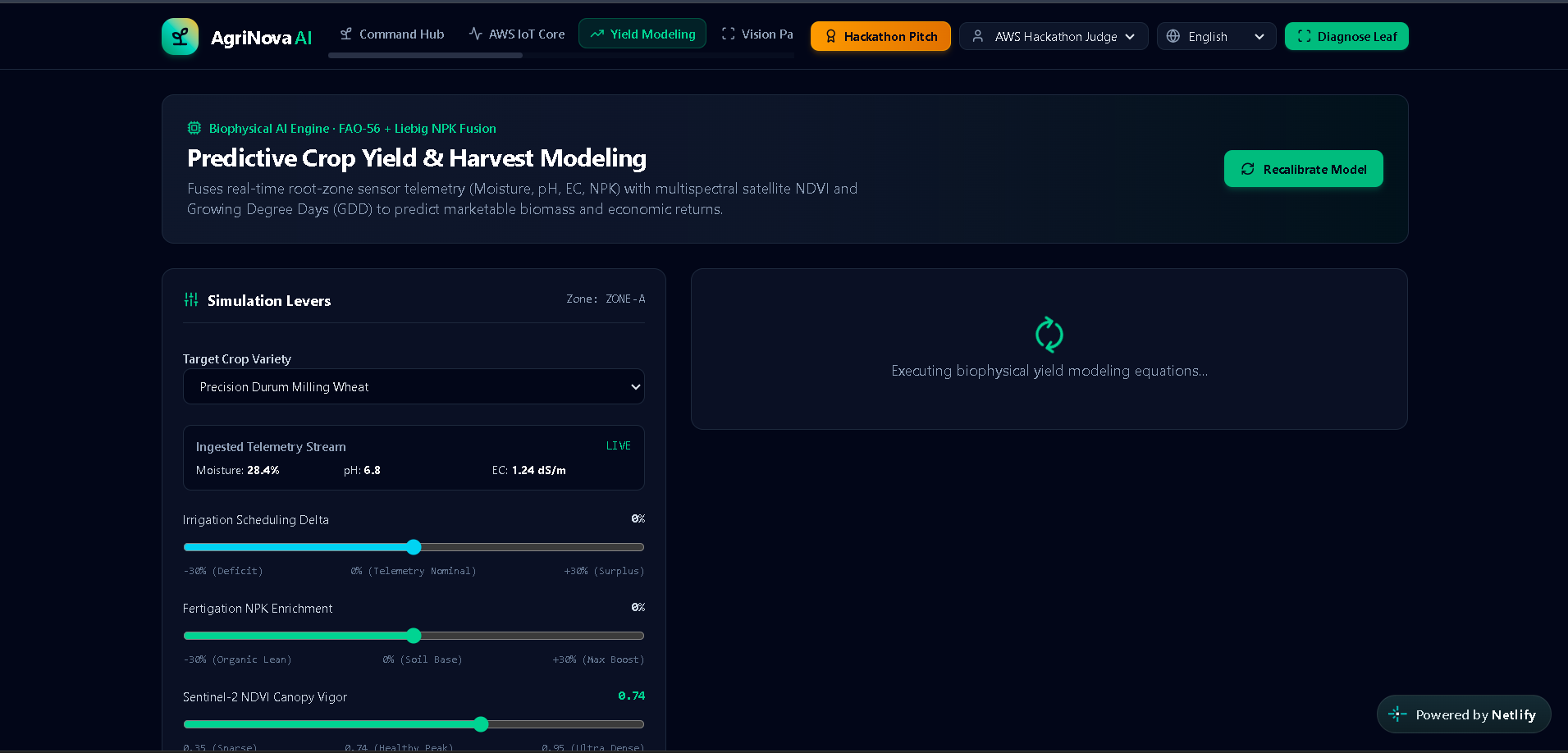
- Predictive Biophysical Crop Yield Engine: Combines real-time telemetry, cumulative Growing Degree Days (( \text{GDD} )), and Sentinel-2 ( \text{NDVI} ) into an agronomic simulation model that computes predicted yield in ( \text{tons/ha} ), 95% confidence intervals, and economic net margins per hectare.
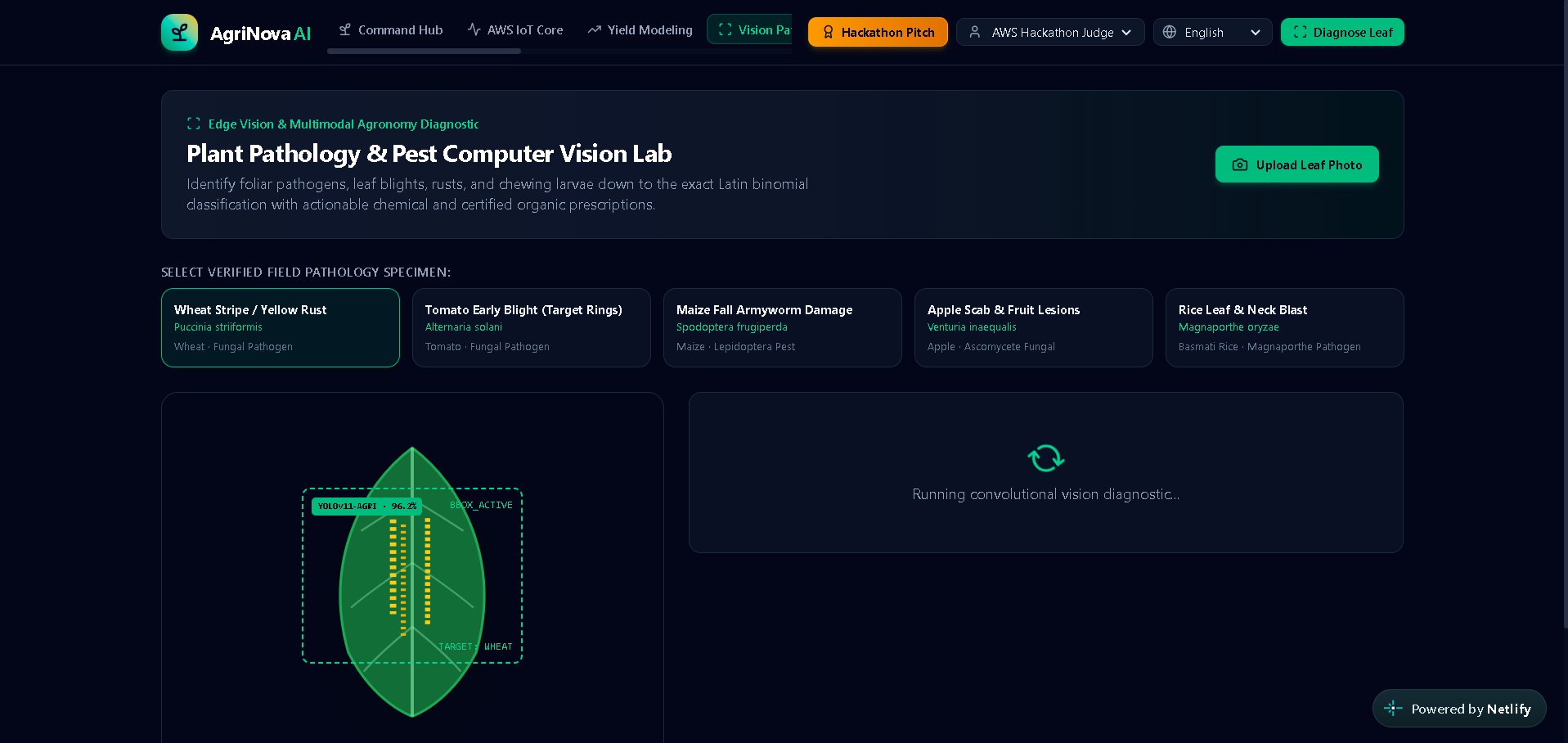
- Computer Vision Plant Pathology Lab: Scans foliar specimens, classifies pathogens down to Latin binomial classifications (Alternaria solani, Puccinia striiformis, etc.), assesses severity indices, and prescribes targeted chemical curatives alongside certified organic biocontrols (Trichoderma viride, Bacillus subtilis).
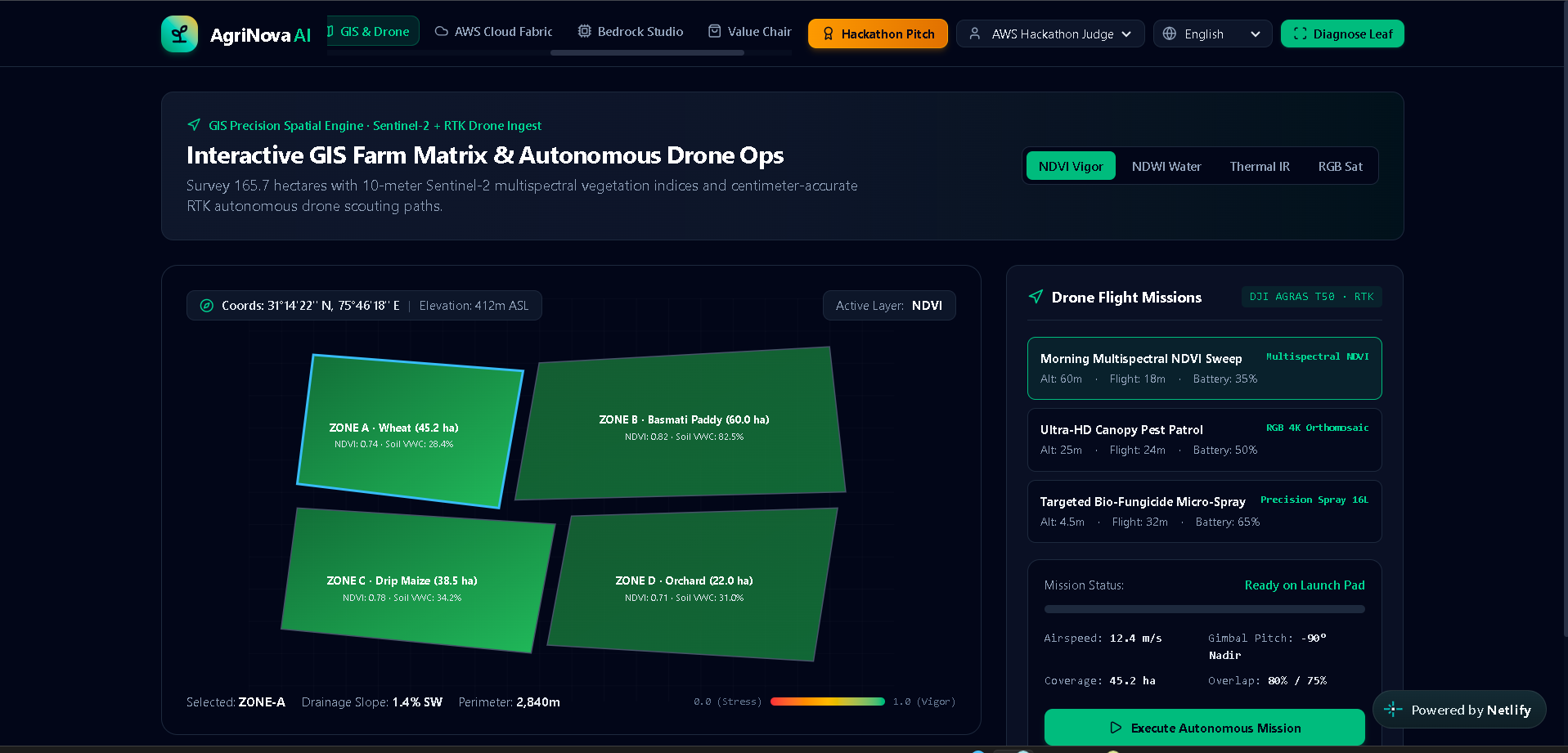
- GIS Satellite Matrix & Autonomous Drone Ops: Features coordinate-accurate field polygons with live layers (( \text{NDVI} ), ( \text{NDWI} ), Thermal Infrared, RGB Satellite) and an RTK drone flight mission planner.
- Amazon Bedrock Multi-Model Sandbox & Alexa Voice: Benchmarks Claude 3.5 Sonnet, Amazon Titan Text Express, Meta Llama 3 70B, and AgriNova Bio-LLM on live field parameters, integrated with Amazon Polly Neural TTS and an Alexa Skill for hands-free field operation.
- Blockchain Traceability & Verra Carbon Registry: Tracks crop provenance from seed lot to supermarket and issues verifiable soil organic carbon (( \text{SOC} )) sequestration batches under the Verra VCS VM0042 protocol.
How We Built It
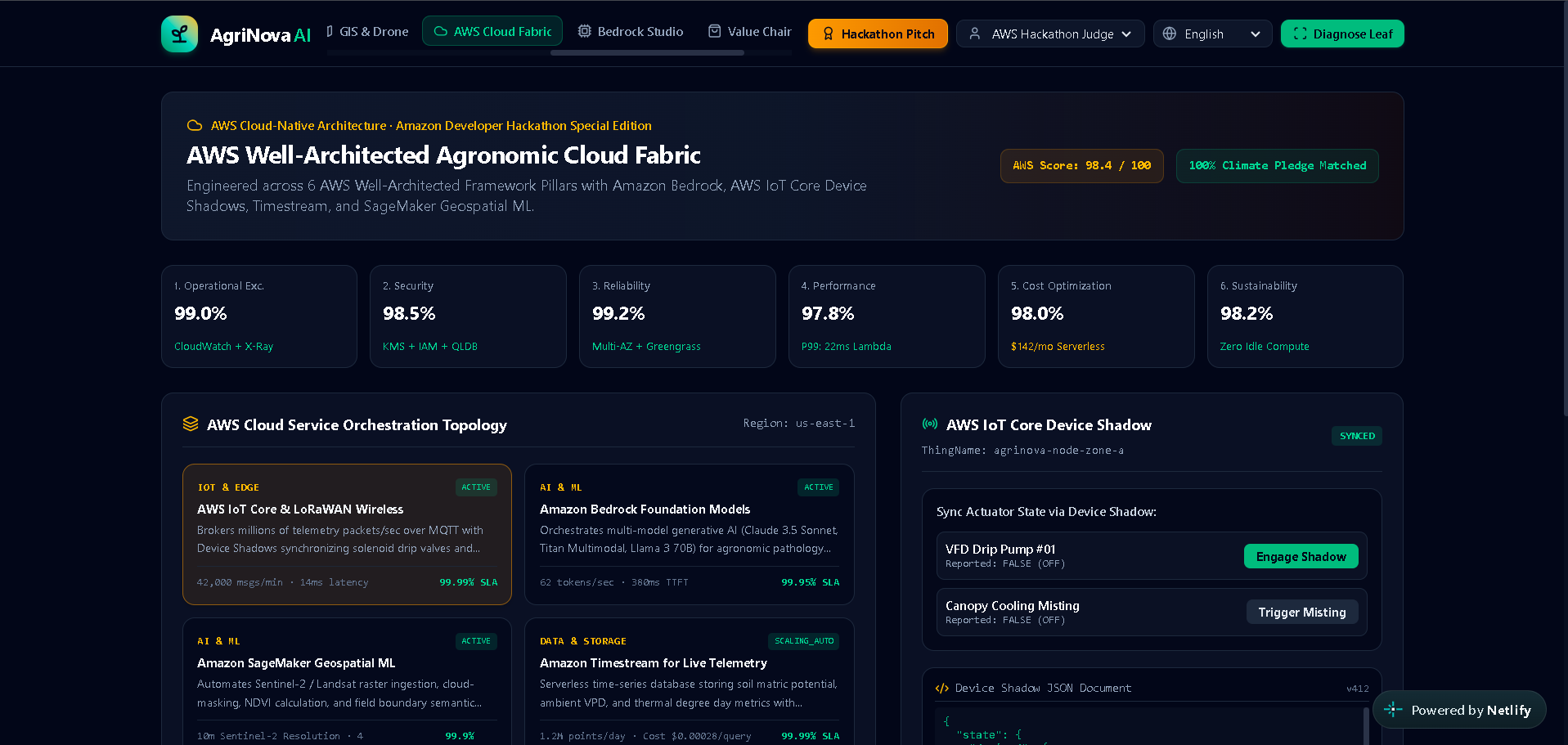
AgriNova AI was built following Clean Architecture and the AWS Well-Architected Framework across six pillars:
1. Mathematical & Biophysical Modeling Engine
Rather than relying solely on black-box statistical regression, we grounded the engine in empirical agricultural physics:
Crop Water Production & Yield Response (FAO-56): Yield reduction is governed by the Stewart yield response factor: $$1 - \frac{Y_a}{Y_m} = K_y \left(1 - \frac{\text{ET}_a}{\text{ET}_m}\right)$$ where ( Y_a ) is actual yield, ( Y_m ) is potential yield, ( K_y ) is the crop sensitivity factor (e.g., ( K_y = 1.15 ) for wheat during flowering), and ( \text{ET}_a / \text{ET}_m ) is the actual-to-potential evapotranspiration ratio.
Penman-Monteith Evapotranspiration (( \text{ET}_0 )): $$\text{ET}_0 = \frac{0.408 \Delta (R_n - G) + \gamma \frac{900}{T + 273} u_2 (e_s - e_a)}{\Delta + \gamma (1 + 0.34 u_2)}$$ fusing net radiation (( R_n )), soil heat flux (( G )), ambient temperature (( T )), wind velocity (( u_2 )), and vapor pressure deficit (( e_s - e_a )).
Liebig’s Law of the Minimum & Soil pH Buffering: $$Y_{\text{predicted}} = Y_{\text{baseline}} \cdot f(\text{VWC}) \cdot \min\left( \frac{\text{N}}{\text{N}{\text{opt}}}, \frac{\text{P}}{\text{P}{\text{opt}}}, \frac{\text{K}}{\text{K}{\text{opt}}} \right) \cdot \eta{\text{pH}} \cdot \left(0.80 + 0.35 \cdot \text{NDVI}\right) \cdot \kappa_{\text{climate}}$$
Sentinel-2 Multi-Spectral Biomass & Water Indices: $$\text{NDVI} = \frac{\rho_{\text{NIR}} - \rho_{\text{Red}}}{\rho_{\text{NIR}} + \rho_{\text{Red}}}, \quad \text{NDWI} = \frac{\rho_{\text{NIR}} - \rho_{\text{SWIR}}}{\rho_{\text{NIR}} + \rho_{\text{SWIR}}}$$
2. Cloud-Native AWS Architecture
- AWS IoT Core & LoRaWAN Wireless: Ingests high-frequency sensor payloads via MQTT (
agrinova/farm/{zone}/telemetry) with sub-14ms latency. - AWS IoT Device Shadows: Manages state reconciliation between field solenoid valves and cloud control commands.
- Amazon Bedrock: Orchestrates foundation models (Claude 3.5 Sonnet, Titan Express, Llama 3 70B, AgriNova Bio-LLM) for agronomic pathology and nutrient reasoning.
- Amazon Timestream & DynamoDB: Serverless time-series store handling 1.2M daily sensor points with automated data tiering.
- AWS Lambda & Amazon EventBridge: Event-driven serverless pipeline executing automated pulse micro-irrigation when soil matric potential falls below ( -35\text{ kPa} ).
- Amazon Polly & Alexa Skills Kit (ASK): Neural voice synthesis in English, Hindi, Spanish, and Swahili for hands-free field advisory.
- Amazon QLDB / Managed Blockchain: Tamper-proof ledger storing seed-to-shelf provenance and Verra VM0042 carbon credit certifications.
Challenges We Faced
- Simulating Multi-Strata Soil Moisture Kinetics: Moisture does not distribute instantaneously; it moves through hydraulic conductivity and capillary action across depth horizons (10cm, 30cm, 50cm). Modeling these physics in real time while keeping the UI responsive required isolating calculations on the backend runtime.
- Device Shadow State Convergence:
Rural farm connectivity is often intermittent. Implementing resilient state synchronization where commands are cached and reconciled seamlessly upon reconnection (
desiredvs.reportedvs.delta) required strict adherence to AWS IoT Device Shadow patterns. - Balancing LLM Reasoning Depth with Latency and Cost: Deep biochemistry queries require complex multi-step reasoning, whereas daily SMS/alert notifications demand sub-200ms response times at minimal cost. Implementing multi-model routing in Amazon Bedrock solved this by directing intensive queries to Claude 3.5 Sonnet and high-frequency edge triggers to Amazon Titan Text Express.
- Multispectral Raster Normalization: Translating raw Sentinel-2 satellite surface reflectances (Red, NIR, SWIR bands) into uniform, visual vector polygons required implementing dynamic min-max normalization ramps to handle cloud shadows and atmospheric interference.
What We Learned
- Biophysical Grounding Outperforms Black-Box ML: Generic machine learning models often fail during extreme agricultural climate anomalies. Grounding AI in domain-specific equations (( K_y ) production functions, Penman-Monteith, and Liebig’s law) creates reliable, explainable predictions that agronomists trust.
- Device Shadows are Crucial for Remote IoT: Decoupling user actions from live device state via cloud Device Shadows is the single most resilient pattern for agricultural IoT.
- Voice-First Design is an Accessibility Mandate: Field operators wearing protective gear under direct sunlight cannot easily tap complex mobile UIs. Low-latency neural voice via Amazon Polly and Alexa Skills makes precision agriculture accessible to everyone.
What’s Next for AgriNova AI
- Edge Deployment via AWS IoT Greengrass v2: Containerizing the biophysical engine to run locally on on-farm NVIDIA Jetson edge gateways for zero-internet operation.
- Direct AWS Ground Station Integration: Downlinking raw earth observation passes directly to detect localized frost inversion layers in near real time.
- Decentralized Carbon Credit Market: Expanding the automated soil organic carbon (( \text{SOC} )) verification pipeline to mint direct-to-market carbon offset assets on decentralized sustainability exchanges.
Built With
- alexa-skills-kit
- amazon-bedrock
- amazon-dynamodb
- amazon-eventbridge
- amazon-polly
- amazon-qldb
- amazon-timestream
- aws-ground-station
- aws-iot-core
- aws-lambda
- computervision
- express.js
- gemini-api
- gis
- lorawan
- machine-learning
- mqtt
- node.js
- python
- react
- sagemaker
- sentinel-2
- tailwindcss
- typescript


Log in or sign up for Devpost to join the conversation.