-
-
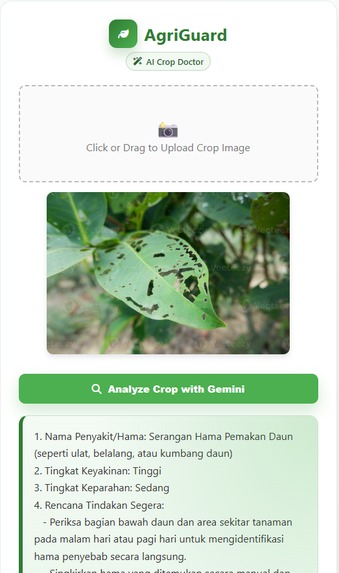
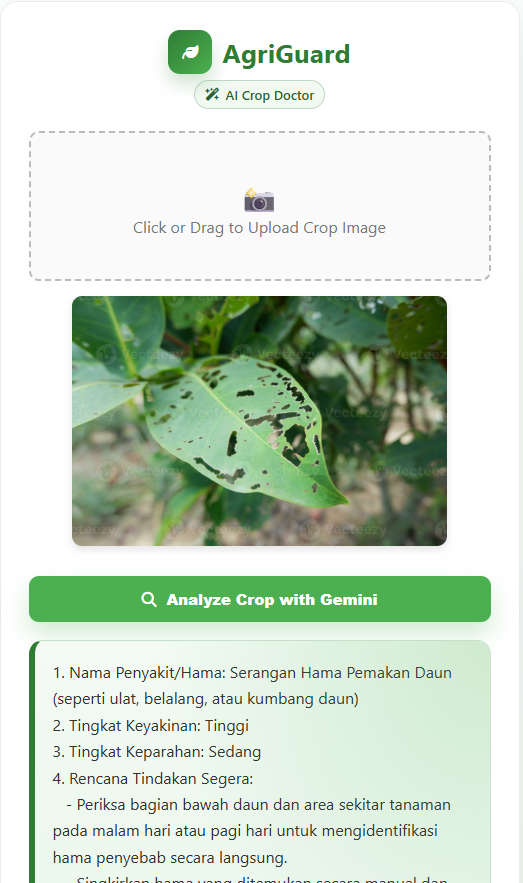
AgriGuard Preview
Inspiration
Millions of smallholder farmers face devastating crop losses every year due to late or inaccurate detection of pests and plant diseases. When a crop gets sick, farmers often lack immediate access to expert agronomists and struggle to organize a structured treatment regimen. We wanted to bridge this gap by bringing an "expert agronomist" directly to the farmer's pocket. Our goal was to go beyond a simple chatbot and build an Agentic AI—a system that doesn't just give advice, but actually takes action to help manage the farm.
What it does
AgriGuard is a smart agricultural assistant built for action. It operates in three core steps:
- Multimodal Diagnosis: Users upload an image of an affected leaf. Using Gemini's Vision capabilities, the app instantly identifies the disease, assesses the severity, and explains the root cause.
- Agentic Workflow (Actionable Scheduling): Instead of just giving a wall of text, AgriGuard translates the diagnosis into a concrete treatment plan. With a single click, the app uses OAuth 2.0 to sync directly with the user's Google Calendar, creating scheduled reminders for tasks like manual pest checking or biopesticide application.
- Interactive Agronomist (Multi-turn Chat): Farming is contextual. Below the diagnosis, a chat interface allows farmers to ask follow-up questions (e.g., "Where can I buy this fertilizer?" or "Is it safe to spray if it rains tomorrow?"), utilizing Gemini's context window for continuous, intelligent conversation.
How we built it
- Backend: Built with Python and Flask.
- AI Engine: We utilized Google Gemini Flash & Lite models via the
google-genaiSDK. We leveraged its Multimodal/Vision capabilities for image analysis and structured prompting to ensure the AI generates clear, safe, and logical agricultural advice. - Integrations: We implemented Google Cloud OAuth 2.0 and the Google Calendar API to allow seamless and secure event creation on the user's personal calendar.
- Frontend: HTML/CSS/JavaScript with a responsive, intuitive interface tailored for easy use in the field.
Challenges we ran into
- Agentic Integration: Connecting the AI's logic to a real-world application like Google Calendar was challenging. We had to navigate Google Cloud Console setups, configure OAuth consent screens for external users, and resolve URI redirect mismatch errors to ensure a secure authentication flow.
- API Rate Limits & Reliability: During testing, we encountered
429 RESOURCE_EXHAUSTEDlimits. We overcame this by engineering a smart Model Fallback System in our backend. If the primary Gemini model hits a rate limit, the application automatically catches the error and seamlessly falls back to high-quota models (like Gemini Flash Lite), ensuring zero downtime for the user.
Accomplishments that we're proud of
We are incredibly proud of making the leap from a "Generative AI" to an "Agentic AI." Successfully authenticating user sessions and seeing Gemini's recommended tasks magically appear in a real Google Calendar proved that AI can be a proactive tool, rather than just a reactive search engine.
What we learned
- Advanced Prompting: How to instruct Gemini to maintain a specific persona (a professional yet accessible agronomist) and structure its output logically.
- Seamless Fallbacks: Implementing
try-exceptloops to manage API quotas gracefully. - Cloud Architecture: A deeper understanding of Google Cloud's security protocols, OAuth flows, and
credentials.jsonmanagement.
What's next for AgriGuard
- Hyper-Local Translation: Implementing localized language support to make the app accessible to older farmers in remote regions.
- Native Video Analysis: Utilizing Gemini's massive context window to process short videos of an entire field, rather than just single images.
- Weather API Integration: Passing real-time location weather data to Gemini via Function Calling to prevent scheduling fertilizer applications right before heavy rainfall.
Built With
- flask
- google-calendar-api
- google-cloud
- google-cloud-run
- google-gemini
- python

Log in or sign up for Devpost to join the conversation.